Sunday, October 17, 2010

can't stop the littles


North American anime fans were excited to see Studio Ghibli’s 2010 picture ARRIETTY THE BORROWERS, based on Mary Norton’s children’s books. But didja know that this isn’t the first time a Japanese animation studio has produced work based on Western stories about a race of tiny people that live in our walls? Huh? Didja?


THE LITTLES was one of the earliest animated series produced by DIC Entertainment – once the entertainment powerhouse responsible for INSPECTOR GADGET, THE REAL GHOSTBUSTERS, part of CAPTAIN PLANET, some of the English dub of SAILOR MOON, and many others – now, after mergers and buyouts, a completely different beast altogether. But in the glory days of the 80s DIC was the kidvid king, responsible for giving many Western cartoons a distinctly international flair. Their Japan connection, producer Tetsuo Katayama, spearheaded Miyazaki’s CASTLE OF CAGLIOSTRO over at TMS. This relationship would pay big dividends as the Japanese studio was tapped to provide animation for a wide variety of DIC projects, including the aforementioned INSPECTOR GADGET, the Homeric SF adaptation ULYSSES 31, the video game tie-in POLE POSITION, Cousin Oliver’s comeback show KIDD VIDEO, and of course, THE LITTLES.


A loose adaptation of the long-running Littles children’s book series by John Peterson, DIC’s THE LITTLES began a three-year run on ABC in 1983. The adventures of Tom and Lucy Little, their parents Frank and Helen, Grandpa and goofy aviation enthusiast Cousin Dinky as they survive inside the walls of the Bigg family house – with the help of normal-sized Henry Bigg – were popular enough to spawn both a feature film and a TV special, as well as resurrection in the syndication television afterlife and on DVD.


Up against Saturday morning cartoon rivals like THE GARY COLEMAN SHOW, RUBIK THE AMAZING CUBE, DUKES OF HAZZARD, MR. T, BENJI, ZAX & THE ALIEN PRINCE, and of course BISKITTS, television viewers couldn’t help but notice THE LITTLES’ clean-line look and solid animation backbone. Unlike THE SMURFS, THE LITTLES had to ground its fantasy elements firmly against the real world of 1980s suburban housing. You can’t cheat your way through animating a series about tiny people that live in crawlspaces and underneath floorboards. The show’s versimilitude proved the fantasy staple of magical beings lurking in the nooks and crannies of the ‘real world’ translates well to television. Personally I was a little older than the target audience, but I enjoyed THE LITTLES regardless; how else was I gonna kill time before the premiere of MIGHTY ORBOTS?

the Littles have better public transit than most of America

 
There’s a strange appeal in tales of hidden creatures living on the margins of the human world – MRS FRISBY & THE RATS OF NIMH is still a juvenile SF favorite (and would get a big-screen animated adaptation around this time, though Disneyfied with enough magical fairy dust to make my teeth itch) and I’m pretty sure I read at least one of the original Littles novels to be at least familiar with the concept.


Henry and the Littles (with pet turtle Slick), the Bigg family, Dr. Hunter and his life partner Jeffrey

Viewed 25 years later THE LITTLES is aggressively 80s, from the lowercase font of its title to the pastel colors of the characters clothes, from the boxy compact cars the Bigg family drives to the dirt bike (and helmet, can’t forget the helmet) Henry uses to get around town from one Littles-infested crisis to another. Chased by Doctor Hunter and his assistant, LITTLES author John Peterson (!!), the Littles civilization is always at risk of being exposed to the outside, giant-sized world. This doesn’t stop them from using the big people as a template for their own lifestyle – there are apparently enough Littles living in our cellars and attics to require Littles-sized highways, filled with Littles traffic, running through our cities.
 
 
Hell's Littles On Wheels

One hopes the Littles are thankful for whatever zoning board decreed all structures needed lots of air vents and steam tunnels. When they aren’t going about their mysterious Littles business, Tom and Lucy always have time to help Henry out of a jam - complicated as usual by the antics of Cousin Dinky- and Grandpa can always deliver a lecture about how drugs are bad or how stealing is wrong, except when the Littles use it as the basis of their civilization. Well, that’s not really stealing. We didn’t need all that stuff anyway, go ahead, take it. THE LITTLES – charming children’s fantasy, or commentary on the wasteful nature of Western civilization? You decide.


Miyazaki's 'Famous Detective Holmes' makes an appearance

Episodes were capped with a “make it yourself” segment usually involving pipe cleaners, balloons, straws, scotch tape, and elementary laws of physics. In the third season of the series Henry’s family travelled the world (with Littles in tow) and the end segments became history or geography lessons. 


I’d quit watching by that time. My Friday nights were lasting a lot longer – movie theater popcorn isn’t going to pop itself, y’know – and my early Saturday mornings were spent sleeping instead of watching cartoons. Did the little people living inside our HVAC system shed a tear as one more viewer succumed to creeping teenageism? Only THE LITTLES know.


  -Dave Merrill
 
Thanks for reading Let's Anime! If you enjoyed it and want to show your appreciation for what we do here as part of the Mister Kitty Dot Org world, please consider joining our Patreon!

Friday, September 24, 2010

FLYING WARPED BOY

“Did I just see that?” It’s a question that used to be heard a lot more among anime fans, before Japan figured out they could sell these things to America and started tailoring their cartoons to the desires of a small but impulse-control poor community. No, used to be you’d throw in a VHS tape of something you vaguely comprehended, like Captain Harlock or Nausicaa, and stuck on the end of it would be an episode of some absolutely insane gag cartoon that you honestly didn’t believe you were seeing. Thank goodness for the pause and rewind buttons.


I’m speaking, of course, of RANPOU, or “Warped Boy Rampoo” as you may have seen it scrawled in marker on the label of your Fuji T-120. This 1984 series, a mere 21 episodes worth, was like all the wacky parts of the wackiest URUSEI YATSURA episodes, only with all the extraneous, non-comedy stuff left on the side of the road.


Ranpou meets Godzilla and Ultraman, rides a hoverbike, cuts one.

Yeah, I know, Japanese animation is serious adult science fiction drama for mature viewers like you. Only it isn’t and never was; “anime” also contains plenty of Warner Brothers style sight gags and inexplicable pop culture references. For every deathly serious blood-splattered action adventure, there’s a gag comedy full of Scooby-Doo style chases, hammers that strike with a fun “BONG!” and mischievous animal sidekicks that are always there to cause more trouble.

That’s the story with RANPOU. Produced by NAS (Nihon Ad Systems), the television anime first aired in April of 1984 and lasted all the way to September of that same year. Abandoned by a fickle public, or victim of the same sponsor-bankruptcy fate that struck many other anime series in the latter half of ’84? Certainly not because of laughs, because that’s all this show is. Our title character used to be a dreamy, handsome, fairly normal junior high kid – and then he got a little close to a flying saucer, which kidnapped him and turned him into a squat, blonde troublemaker. Or is this really some kind of alien plot?


Ranpou before his tragic UFO accident.

Teachers, classmates, monsters, office buildings, other planets – all bow before Ranpou, whose little mouse friend Chutaro invents crazy inventions and whose farts – yes, fart jokes – are classified as weapons of mass destruction. This gleefully anarchic program can’t go thirty seconds without somebody’s skirt getting lifted, somebody shooting a laser pistol at a giant cockroach, or somebody getting hit repeatedly in the nuts to the accompaniment of a cheerfully painful GONG BONG GONG.


Hiroshi-sensei, Mutsumi, Iwasaki-sensei & Ranpou catch a train

Everybody’s favorite is the episode that presages virtual reality by a few years, in which Ranpou becomes Captain Harlock, girlfriend Mutsumi cosplays Nausicaa, and long-suffering schoolteacher Hiroshi is forced to portray FUTURE BOY CONAN’s Lepka in a hodge-podge mish-mash of MACROSS references and Miss Iwasaki bowling alley sight gags involving the theft of a giant gemstone.


Copyright infringement is your best entertainment value.

Masatoshi Uchizaki’s original RANPOU manga ran for nearly ten years in Weekly Boys Champion, racking up an impressive 37 volumes of collected tankubon. However, print success doesn’t always translate to cartoon longevity.

Manga Ranpou from '78

RANPOU the TV anime suffered because of a later time slot that went up against baseball games in some markets, never a good idea. The last episode didn’t even air in some markets. RANPOU has never been released on any kind of home video, another crime left unpunished – so if you wanna see it you better know somebody. And that’s a shame, because RANPOU is exactly the kind of irresponsible fun that people watch cartoons for in the first place.


-Dave Merrill

Thanks for reading Let's Anime! If you enjoyed it and want to show your appreciation for what we do here as part of the Mister Kitty Dot Org world, please consider joining our Patreon!

Monday, August 16, 2010

spreading the japanimation gospel

In the days before "anime cons", we had to express our enthusiasms for Japanese cartoons in different venues. This meant hurling ourselves at the gates of the local comic book, Star Trek, Dr. Who, gaming, fantasy, and sci-fi conventions. But could the world of anime succeed in a head-to-head battle with Mr. Spock and/or Darth Vader? Yes it could and it did, and we have the con publications to prove it.

 
I know nothing about the Kansas convention advertised here, other than that it featured fanart of Grandizer and therefore caught my eye. But soon, the spectre of Japanimation found its way to my home town in the form of the Atlanta Fantasy Fair.

 
At the time Atlanta's largest fandom convention, the AFF started in 1975 and by the mid 1980s had realized these big-eye cartoons from Japan could very well be an attractive inducement to potential Fantasy Fairers, as seen in these clip art images from the Atlanta Fantasy Fair 1986 promotional brochure.


Not to be outdone, other Atlanta SF cons also jumped onto the Japanimation bandwagon with both Starfleet-booted feet. This image is from a Dixie-Trek promotional piece from around the same time. And let's be clear - these local conventions shared a lot of staff and probably the same people were screening the same VHS tapes at different shows across the region.


You'd think a convention called Dixie-Trek would be strictly Trekariffic, but they embraced the philosophy of "IDIC" and expanded their worldview to include Dr. Who, Blake's 7, Superman, Lost In Space, Voyage To The Bottom Of The Sea, comic artists, and eternal con guest Brad Strickland. And of course, Japanese animation.


By 1988 the anime fan community in Atlanta was secure enough in its masculinity to break down the walls of tradition, smash the prejudicial, provincial attitudes of the bourgeouis, and run the darn anime rooms themselves. And when the convention wouldn't give us a room to show anime, we would just rent a guest room and bring a few VCRs and throw a TV Party. See you in room 323!


By the early 1990s the march of technology was unstoppable and new video formats were making the old fashioned VHS tape a thing of the past. The 1990 AFF promised new and improved LASERDISC excitement!


I had been staffing AFF for a few years by 1990, and had chiselled my way into running the anime room, the schedule of which is an informative document showing exactly what people wanted to see in 1990. Or at least what *I* thought people wanted to see. And no, I am not responsible for the typos, as amusing as it might be to contemplate watching something called "Riding Beam."


By 1991's AFF I was running both video rooms, as evidenced by the trend towards Godzilla films, Twin Peaks, SubGenius propaganda, and my very favorite Star Trek episode.


Here's a tip for time-travelling anime room programmers - as much as you like Future Boy Conan, nobody wants to watch thirteen (13!) un-subtitled episodes of it, in a row, starting at 2:30am. Take my word for it.

By a strange coincidence the last year for the AFF was also the first year for our local anime convention AWA and our energies became focused on our own convention world, leaving the comic book and Star Trek conventions to wither away, deprived of the life-giving force of Japanese cartoons. Don't let your convention die - show some anime already! Preferably RIDING BEAM or ORNGE ROAD. 
 
-Dave Merrill

(thanks to Devlin Thompson for much of this archival material)
 
Thanks for reading Let's Anime! If you enjoyed it and want to show your appreciation for what we do here as part of the Mister Kitty Dot Net world, please consider joining our Patreon!

Sunday, July 25, 2010

F IS FOR FAKE

Okay, I guess "fake" is too strong a word. In fact I don't want to even call these "bootlegs" because honestly, they don't represent knockoffs of already established product. But there's a degree of copywrong in the provenance of these pieces that speaks volumes about the desire for Japanese anime characters, as well as the casual disregard for intellectual property that has been the hallmark of Japanese animation's impact outside Japan.


If it's the 1980s, kids are crazy for robots, even in the form of cheap, tiny coloring books meant to be handed out as door prizes or favors at birthday parties, perhaps at Showbiz Pizza. And just think, that cheap coloring book you threw away because you were 8 and had no idea of the dramatic struggle of White Base to survive the Zeon onslaught was actually pirating artwork from a famous Japanese anime series! Let's look inside.


In spite of the Gundam cover, the characters inside are from Star Musketeer Bismark. Because... they couldn't find art to trace of Char or Amuro? Somebody really liked Marianne Louvre? Who knows? All I know is now I need something to put my crayons in.


Luckily this soft vinyl-covered pencil case will do the trick! And hey, it's not going to bother with your typical RX-78 Gundam, but instead chose to decorate itself with a weird approximation of what appears to be a RMS-179/RGM-79R GM II, the Earth Federation's mass production mobile suit from Zeta Gundam. I guess my pencils feel kind of safe, sort of.


The Gundam theme continues on the back with a fairly accurate GunCannon and hey, from a completely different series produced by a completely different studio, it's a Cyclone from Tatsunoko's Genesis Climber Mospeada! Because when you're using unauthorized artwork sometimes you just have to go a little crazy.

So let's take a break from all this pen and paper stuff and play some cheap plastic hand-held pinball. Surely this inexpensive dollar store party favor type game won't feature appopriated character art!


Oh wait. That's a soccer-playing Sailor Mercury going for the gold, isn't it?


Yup, it sure is, her Mercury Healing Tiara contrasting nicely with her striped soccer jersey. I suppose there was a time in the 1990s when it was thought you could sell anything with Sailor Moon characters. On the other hand, I did actually buy this thing, so I guess their plan succeeded.

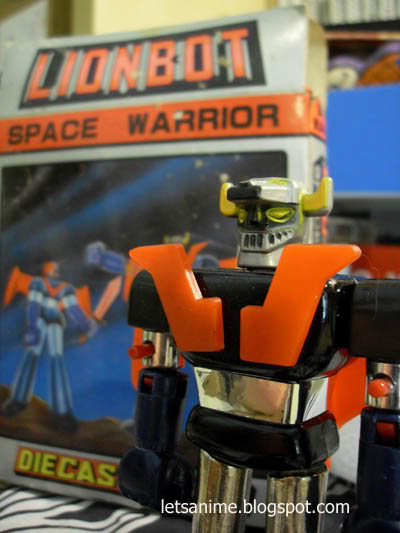
Speaking of satisfying toy play value, it's hard to beat cheap Taiwanese knockoff robots for some good robot toy "fun".


Combining the classical looks of Mazinger Z with the trendy lion motif of Voltron, the "Lionbot" stands ready to defend himself against all the copyright lawyers in the galaxy!


This box art was apparently copied right off the side of THE GREATEST AIRBRUSHED CUSTOM VAN EVER. The other robot isn't a Lionbot, but Tiger Mask captured in a rare moment cosplaying as Great Mazinger.

So just let your feelings about intellectual property and quality childrens toys retreat into the background. Unless you want Lionbot to open you up a clumsily-painted, badly-cast, frosty cold can of BEAT-DOWN!


Sunday, July 11, 2010

the golden age of scanlations


Once upon a time there were people who loved Japanese comics SO MUCH that they would, on their own recognizance, take the original Japanese comics and translate them into English! All by themselves! And then they’d distribute these translations to the world at large, unconcerned with things like “copyright” or “trademark” or “intellectual property”. Of course this whole business has generated a lot of press lately because of the amazing ability of the vast computer networks that surround us all to transmit and distribute information faster than human minds can even conceive. And to think the doomsayers and pessimists always assumed the assault on mankind would begin with killer robots and death rays!

This may astonish today's computer-enabled youth, but scanlations existed long before cheap terabyte drives and broadband connections. In fact these stone-age “scanlations” didn’t need computers at all!


This advertisement appeared in the BOOKS NIPPAN ANIMATION FAN CLUB NEWSLETTER (vol 4) from sometime in 1985. Is this the first attempt at wide distribution of a possibly unauthorized translation of Japanese manga? Could be. Translator and Gunbuster star Toren Smith was always ahead of the curve; he went on to build a career out of authorized, licensed Japanese comics through his Studio Proteus organization.


(alternate Art Frahm cover available upon request)

The prototype scanlation seen here appeared as a companion booklet to the official Shogakukan release of Urusei Yatsura volume 1. You’d simply hold the UY manga – purchased through Books Nippan, of course - in one hand and the translation booklet in the other, and through a complicated mental process not fully understood by our top scientists, the meaning of the Urusei Yatsura story will become clear to you.


One wonders just how popular this particular marketing plan was; Viz would begin publishing officially-licensed Urusei Yatsura in English in a few years. Shogakukan had already released several volumes of Urusei Yatsura in a dual-language format as an English-language teaching aid. Or as a Japanese-language teaching aid, these things swing both ways (these handsome sepia-tone tankubon were also produced for other series, including Sasuga No Sarutobi).


Rather than a strictly commercial product, these 80s UY scanlations were a more upscale form of the ‘translation packets’ being distributed by various fan organizations throughout the 80s. Anything that would fit onto photocopier glass was Xeroxed like crazy – song translations, possibly inaccurate episode guides, character sheets, articles from trade publications – if it was about anime it got distributed, copyright and original intent of the author be damned. It is with this blithe disregard for intellectual property that anime fandom first established itself upon our shores, a mark of Cain that all must bear in shame and/or glory. Of course, the way I figure it, anime fans spent 20 years producing and distributing pro bono advertising for Bandai, so it all evens out in the end.


-Dave Merrill

Thanks for reading Let's Anime! If you enjoyed it and want to show your appreciation for what we do here as part of the Mister Kitty Dot Org world, please consider joining our Patreon!

Sunday, June 20, 2010

NAUGHTY AND ANCIENT

KUM KUM THE PREHISTORIC MENACE


I’d seen stills from this show and some of Yas’ typically excellent artwork here and there for years, but I’d never thought it was anything more than some illustrations, maybe a children’s book or two. I certainly didn’t think it was a Nippon Sunrise series produced in 1975 that ran for 26 episodes, and was not only a success in most of Europe, but was dubbed into English by Paramount and became an integral part of the TV childhoods of kids in Australia and England. America, however, was bereft of KUM KUM. We had to satisfy our prehistoric desires with LAND OF THE LOST and KORG, 70,000 BC and VALLEY OF THE DINOSAURS and CAPTAIN CAVEMAN. Okay, that last one, not so much.


WANPAKU (“naughty”) OMUKASHI (“ancient”) KUM KUM is a fun little series, a prehistoric children’s adventure show that freely mixes comedy, action, myths and facts but remains firmly grounded in the day to day lives of the Mountain Folk, a tribal people just on the cusp of civilization. Kum Kum lives while mankind transitions from being hunter-gathering wanderers to becoming a agricultural, settled, animal-domesticating language-developing society. The Mountain Folk have learned to plow and plant, but still do a lot of gathering.


The Wise One has writing, but only he can read it. Occasional travelers demonstrate things like wheels, wagons, and war; but the Mountain Folk still make do with hunting and fishing. A rudimentary religion is demonstrated by Dark Eyes, the resident fortune-teller and soothsayer, who also demonstrates that this level of civilization possesses sophisticated hairpiece technology.


Our hero Kum Kum isn’t a BAD kid, just curious, mischievous, impulsive, sometimes unthinking, occasionally vindictive. Sure, those ingredients sometimes add up to “bad”, but when he crosses the line, the Wood Cave is always waiting. That’s where we find Kum Kum when the show opens, waiting out yet another stretch of hard time as a result of yet another prehistoric escapade.


Kum Kum’s world is a fun place to be a kid; plenty of forests and mountains to roam through, animals to chase, fish to catch, and friends to tease. Kum Kum’s gang – Butterfly (Chiru Chiru) , Little Rock (Aaron), and Bumbles (Mochi Mochi) run roughshod through the little Mountain Folk tribe, causing no end of headaches to Kum Kum’s dad Strongarm ((Paru-Paru), mom Flora (Malu-Malu), toddler brother Tum Tum and teenage sister Wildflower (Furu). Wildflower is smitten with the Wise One’s son Roman who lives up to his name by roaming far and wide across the unknown prehistoric landscape. Roman roams because his home life is mostly occupied by arguing with his hairy, pipe-smoking father, whose original Japanese name is “Kuropedia.” In spite of courtship attempts made by Little Rock’s enormous, slightly slow brother Jumbo (Goron) and Roman’s temptation to join the Nomad tribe and marry Rose, - not to mention opposition from both Strongarm and the Wise One - true love triumphs and Wildflower and Roman are (SPOILER!) married in the final episode.


Just a few things keep KUM KUM from being an animated, archeologically approved version of one of those natural history museum dioramas; one is the dinosaur that lives in the lake, and the other are the Cheeky-Squeakies.

Saurus is the dinosaur; this old and amiable Apatosaurus is possibly the last surviving dinosaur. He’s happy to chew his cud in the lake and occasionally act as a giant playmate for the children. Sure, we all know that dinosaurs and human beings were separated by a few million years, but here at KUM KUM scientific rigor takes a back seat to cartoon fun.


However, the Cheeky-Squeakies (“Pyonki” in Japanese) have no analog in the fossil record. These bouncy, big-eyed little mascots hop all over the countryside and give the children something to chase in idle moments. Occasionally they catch some, harness them up, and go skiing over the tall grass. We learn in a very special episode that the Cheeky-Squeakies are vastly older than man, have a language and a culture, and occasionally go to war with each other underground in ritualized combat that recalls the classic Uncle Scrooge story “The Land Beneath The Ground”, though unlike the struggle between the Terries and the Fermies, the Cheeky-Squeaky war does not cause earthquakes.

It’s pretty clear that this prehistoric land is supposed to be Japan. We’re treated to establishing shots of blossoming cherry trees, the volcanic nature of the land is remarked upon in several episodes, and we even get to see monkeys enjoying hot springs and an instance of the Japanese folk belief that fish can predict earthquakes. But the question of whether or not Kum Kum's people represent the Jomon culture will have to be answered by more knowledgeable archeologists.


The English language dub firmly presents Bumbles as a male, but I’m not convinced that Mochi Mochi isn’t a girl, a gangly, Big Ethel sort of gal. The female Japanese voice actress and the hair bow may be circumstantial evidence, but it wouldn’t be the first time a character’s gender was switched in the localization. The English voice is a hoarse goofball intonation that could go either way. And let’s face it, these are six and seven year old kids, gender is pretty much academic at this point. (editors note: recent footage screened here at the HQ proves conclusively that Bumbles is a cave-boy)

Kum Kum makes an appearance on an all-Yas character poster


KUM KUM carves its own niche between the One Million BC melodrama of Ishinomori’s ’71 Toei anime RYU THE PRIMITIVE BOY and the 1974 TMS caveman gag comedy GIATRUS THE FIRST MAN- the laughs and life lessons are parceled out in equal doses. Kum Kum’s bad behavior has consequences beyond the Wood Cave and frequently the tribe is forced to struggle for their very survival against the elements, destructive animals, or even other tribes. Parents and children fight and things don’t always wrap up neatly before the end credits. Kum Kum – and by extension the young viewing audience - are forced to come to terms with rather adult concepts like, you know, death. But the Mountain Folk’s life isn’t particulary nasty, brutish, or short – sure, there’s hard work and primitive conditions, but there are also strong family and community bonds, festivals, friends, dinosaurs, and a whole world full of wonders without any schools or homework. It’s no wonder this show was appealing to an entire generation of kids around the world, including the relatives of Argentine footballer Sergio Aguero, who thought the young future soccer star resembled Kum Kum and dubbed him a mispronounced “El Kun.”

(I now pronounce you caveman and cavewife)

KUM KUM was produced by Banjiro Uemera, who would later produce the fine Star Wars ripoff MESSAGE FROM SPACE. In his capacity as head of ITC Japan, he was responsible for 1982’s sf actioner TECHNOVOYAGER, otherwise known as THUNDERBIRDS 2086. He also produced the When Animals Attack film ROAR, starring Tippi Hedren and her animal friends (and daughter Melanie Griffith). Interestingly enough the show is an early directorial attempt by Rin “Shigeyuki Hayashi” Taro, who would go on to work for Toei and direct SPACE PIRATE CAPTAIN HARLOCK, the two GALAXY EXPRESS MOVIES, and from there to direct HARMAGEDDON, DAGGER OF KAMUI, METROPOLIS, X, DOOMED MEGALOPOLIS, PHOENIX, and other anime works. But the primary creator behind KUM KUM is obvious from even the most casual glance; the distinctive art style of Yoshikazu “Yas.” Yasuhiko. Yas.’ CV includes MOBILE SUIT GUNDAM, BRAVE RAIDEEN, DIRTY PAIR, VENUS WARS, ARION, GIANT GORG – Yasuhiko’s classy linework and graceful characters are an unmistakable hallmark of the classic era of Japanese animation. KUM KUM’s Yas. character designs are front and center; Kum Kum and his pals wouldn’t be out of place roaming the corridors of White Base as refugees from Side Whatever, and the flowing robes, bearded giants, and vital natural landscape would return in works as diverse as GORG and ARION.


What makes KUM KUM so fascinating, for me anyway, is that I’m a guy who spends way too much time thinking about Japanese cartoons (obviously). Have been this way for years. And yet here’s a show with a pretty impressive pedigree (Yas, Rin Taro) that not only had I never heard of, but that had been dubbed into English and shown around the world, to boot! It just goes to show, the more you know, the more you realize there’s yet to learn.

(no-pants cave kids)

Why did KUM KUM never make the transition to American television? One reason leaps to mind: prehistoric children don’t wear pants. So the next time you’re thinking darkly of American exceptionalism, remember that sometimes Uncle Sam is, like Kum Kum, still trapped in the dark of the Wood Cave, waiting to be set free.

(bye bye Kum Kum!)

-Dave Merrill

Thanks for reading Let's Anime! If you enjoyed it and want to show your appreciation for what we do here as part of the Mister Kitty Dot Org world, please consider joining our Patreon!

Monday, June 7, 2010

badge of honor

At Anime North a few weeks ago my wife spotted something groovy in the dealers room. No, not glomping crossdressing furry cosplayers – but something that was actually related to Japanese cartoons! Namely, a set of buttons from Albator.


 You know, Albator! The French language version of Toei’s 1978 Captain Harlock series, broadcast to the Francophone world in the late 1970s. Albator, whose name was changed from “Captain Harlock” because, as the story goes, the French localizers were afraid children would confuse the character with “Captain Haddock” from the popular Belgian comic Tintin. Because the characters are so much alike! There isn't a similar story to explain why every other character in Captain Harlock got his or her name changed, nor why all the music was thrown out in favor of vastly inferior replacements.


At any rate the buttons are pretty cool. Not just because Tadashi Daiba – sorry, “Ramis” - is clearly missing an eye, or the general sloppy fan art vibe of the artwork, but mostly for the 70s era CBC logo plastered onto the images. Albator was broadcast on the French-language CBC – sorry, “Radio-Canada Television”- starting in 1979, and along with other French-language anime hits like Goldorak, Candy Candy, and Le Roi Leo, gave the Francophone Canadian anime fan a distinct advantage over the Anglophone Canucks, who were forced to make do with Star Blazers and Force Five on Buffalo UHF stations.


You might notice that one of these characters is not like the others. Sure, Captain Future, the '78 Toei series based on the pulp series by Edmond Hamilton, was popular in Europe, where he was known as "Capitane Flam". However, how a button of Captain Future’s girlfriend “beautiful Joan Randall” wound up with some Albator badges is anybody’s guess. You know those Japanese cartoons, they all look the same. And the character's slight name change only proves the Electric Company's hypothesis that a Joan can become a “Johan” merely by adding our good friend “silent h”.