Saturday, April 26, 2008

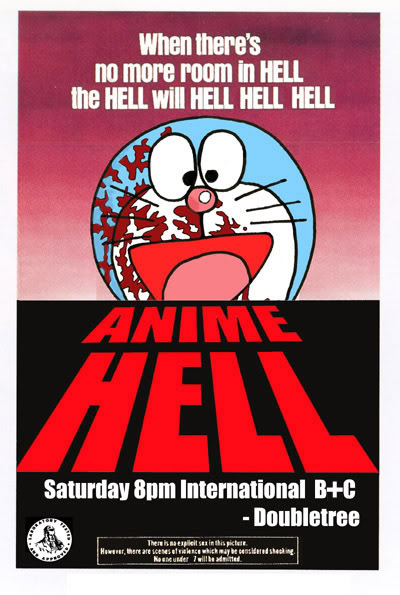
the untold saga of Anime Hell flyers


For years I've been doing a free-form anime-themed clip show called "Anime Hell". It started out as hotel room parties at SF conventions in the late 80s, and as anime cons came into being, the event moved into function rooms and eventually 1000+ seat ballrooms with giant video screens, projectors, PAs, and all the technological accouterments that are really hard to operate when it's 10pm on a Saturday night and you've had a few. Today five or six separate groups of people do "Anime Hell" type events at anime conventions in two different countries.

The show itself has been described as "all about the corniest, strangest and otherwise anime/anime-related things out there," and that's not a bad description. I've shown educational films, anime music videos, fake commercials, clips from 60s 70s and 80s anime, scenes from 8-bit video games, homemade Indiana Jones films, parody subtitles, promotional beer cartoons, anti-drug PSAs, European TV singers, and dogs riding bicycles.

Part of the fun of the show is the promotional flyers; I started making flyers for the Anime Hell parties in the late 80s with clip art and markers. When I started doing all-night Anime Hells at Atlanta's Dragoncon, the flyers got more elaborate.


(flyer from Dragoncon 1996)

Eventually stronger graphic elements started to come to the fore, as I determined scientifically that teeny tiny text might not be the best thing to read when it's taped to the wall of a hotel elevator.


Anime Central's Hell, 1999

The "Hell" logo with the flames was taken from the early 70s Marvel war comic "War Is Hell". The other clip art elements came from damn near everywhere - Chick comics, old UFO magazines, Weekly World News, Archie comics, Dirty Pair "mooks", old encyclopedias, whatever would hold still long enough to photocopy. I stopped doing Anime Hell at Dragoncon in... I wanna say 1999, and concentrated on Anime Weekend Atlanta and Anime Central, but for some reason I didn't do flyers for the AWA shows. Anyways, everybody at the early AWAs knew what Anime Hell was.


(flyer from Anime Central 2001)

In the early '00s the capacity crowds and my laziness meant I wasn't doing any more flyers, which was OK since the months before two conventions were taken up with feverish preparations anyway.

When I moved to Canada in 2004 and started doing Anime Hell at Anime North, I knew I couldn't slack off any more. Canada had no idea what Anime Hell was. I needed to get back on the job!


This flyer is my first color flyer, and features a totally reverse-engineered "Canada" logo. For the next year I went back to black and white, but produced five different flyers, of which this is one:


At this point I was getting more into taking an image that already had ironic or kitsch value, and manipulating it in a very basic way. There are 10,000 people at Anime North and most of them are only going to be able to see this flyer for five seconds, max, so a lot of frippery details and confusing, conflicting images will only deflect my message. So simplification became my watchword. My AWA flyer for that year was even simpler:


For the next Anime North I went back to color, taking a cheesy movie poster and reworking it to my own advantage. It's still a little busy, in my opinion.


For AWA that October, I had been really stuck for ideas and was getting desperate, until I saw a one-sheet for EASY RIDER. What resulted is the simplest and the best Anime Hell flyer I think I've ever done.


Sailor Moon's head is a little off, but other than that, it's perfect; the quintessential mix of weird and powerful and kitsch. Besting that flyer is a tough challenge, and I don't know if I'll ever do it, but this year's Anime North flyer is a strong contender:


Anime Hell, Saturday May the 24th, 8pm, Doubletree International Hotel, International Ballrooms B and C, Toronto Ontario Canada. Brought to you by Anime North. See you there!

-Dave Merrill

Thanks for reading Let's Anime! If you enjoyed it and want to show your appreciation for what we do here as part of the Mister Kitty Dot Net world, please consider joining our Patreon!

Sunday, April 20, 2008

a tragic waste of cel paint and acetate

(this is an exact transcription of a review that appeared in LET'S ANIME #4, fall 1993. While I regret the convoluted sentence structure and general snotty tone of the piece, I think it's useful not only as a snapshot of the popular trends in anime at the time, but as a look at what some of us thought about those popular trends.)

A TRAGIC WASTE OF CEL PAINT AND ACETATE: SILENT MOBIUS

You know, I was willing to give the movie a chance. I'd seen the overpriced, senseless comics in the store, even tried to read a few, but I have this funny habit of preferring comics that actually have a coherent plotline. So anyway, when I heard that Streamline had dubbed the first Silent Mobius movie, I figured that it would be a good way to get a grip on this whole Silent Mobius thing and figure out just what the hell is going on. After all, it's a one-hour movie! Surely they'll make sure the thing is pretty coherent and understandable!

Boy, was I wrong.

Yes, the characters in the film were speaking English, but that's where the last tenuous link with understanding ends. I sat through the entire film and I still don't have the slightest idea what happened! Who are all these women psychic cops? Why are all these demons attacking Neo-Tokyo? Why aren't there ANY male characters in this film? What is the "Advanced Mystification Police"? Does that mean they're better than the "Regular Mystification Police", or what? How did they manage to rebuild Tokyo into a 5000 square mile city in thirty ears? How did they blow up a building that must have been several miles tall, and yet bystanders just say "Oh!" Shouldn't they be fleeing in terror as several tons of debris rain down upon them? How did all these female cops get magic powers anyway? What is the deal with the talking stick that the lead psychic-magic-cop-chick carries? Do they all have talking sticks? Why does the "Advanced Mystification Police" have an entire truck that folds out to be nothing more than an interrogation chair and some lights? Isn't it just easier to shine a flashlight in the sucker's face? Why does the main character refuse to admit that hideous demons are attacking her and her mom, even though it happens four times? And most importantly, why should we care?


Probably the most ostensible howler occurs when the head demon kidnaps the main character's mom and ties her hanging upside down from a crane on a rooftop. So what Mom does is prick her finger and use blood to start drawing a magic diagram on the rooftop, OK? So the scene cuts away from her for a bit, and then goes back to her, and she's traced this huge diagram in what must have been hundreds of gallons of blood, all over the roof! The entire audience of the theater where I had the questionable pleasure of seeing this movie erupted into uncontrollable laughter at this scene. That, and the part where they invoke the name of "Helios, the Sun Goddess". Pardon me, but wasn't Helios a sun GOD? Isn't this taking anime feminism a bit too far?

OK, sure, I know that this film is aimed directly at model-building, dateless 15-year-olds who aren't overly concerned with plot or coherent storyline as long as it involves cool explosions and a few good shower scenes. And sure, the overall quality of the animation was pretty good.

But someone needs to tell these people that when you make a movie, these boring things like character development and plot ensure that the viewing audience gives a shit what happens to all your pretty girl cop characters. And giving a shit is precisely what we don't do.

Apparently the committee that wrote this mess (28 people, we counted) rightfully concluded that the last thing their target audience was interested in was coherence. This film's popularity among so-called anime "fans" in the States only serves to illustrate the true nature of both the film and its fans; i.e., clueless.


(at the time I can recall being frustrated at the current trends of Japanese animation - forgettable OVAs populated with ciphers that invariably ended with two characters shooting magic force beams at each other, papered over with a glossy sheen of high-tech nonsense. Not that anime hasn't always been home to glossy sheens of high-tech nonsense, but it helps to have some characterization and a little heart, maybe some old-fashioned burning with the fires of justice to wash it all down. That's why people still talk about Mazinger Z, Gatchaman and Yamato while most of the OVAs of the 90s are currently residing in the "can't believe we used to watch this" pile. )

-Dave Merrill

Thanks for reading Let's Anime! If you enjoyed it and want to show your appreciation for what we do here as part of the Mister Kitty Dot Net world, please consider joining our Patreon!

Sunday, April 13, 2008

here comes prince planet

My “career” of writing about Japanese cartoons seems like an eternally repeating cycle of recurring motifs. Every ten years somebody pays me to write about Star Blazers, and no matter what medium I write in or what name it goes under, I eventually wind up writing about Prince Planet. The show impacted my brain at an early age, and you might say I’ve been under its influence ever since.


(splash page from a 1965 issue of SHONEN MAGAZINE)


The show’s original title, YUSEI SHONEN PAPI, means "Meteor (or Asteroid or Comet, take your pick) Boy Papi". It was produced by Television Corporation Of Japan (TCJ) who also produced Tetsujin-28-Go/Gigantor, Eight Man/Eighth Man, Yusei Kamen/Asteroid Mask, Kamui The Ninja, Kaitei Shonen Marine/Marine Boy, and Skyers 5. Papi’s original Japanese air dates were June 3, 1965- June 27, 1966, totalling 52 episodes. The show was based on the manga by Hideoki Inoue, which appeared in Shonen Magazine, the '60's weekly comic which also featured Tetsuwan Atomu/Astro Boy, Tetsujin 28-Go/Gigantor, Wonder Three/Amazing Three, Eight Man/Eighth Man, and Ashita No Joe/Joe Of Tomorrow. Papi was sponsored by Japanese candy manufacturer Glico, the name of which makes up a refrain at the end of the Japanese theme song.


Spurred by the success of Astro Boy, Gigantor, and Eighth Man, "Papi" was turned into “Prince Planet” and dubbed by Miami-based Copri International Films, an outfit partially staffed by gun-toting anti-Castro Cubans. The show was distributed to independent TV stations in America and elsewhere by American International Pictures, the same outfit responsible for releasing hundreds of cheap biker movies, most Gamera films, Alakazam The Great, Wild In The Streets, Roger Corman’s Poe epics, and Johnny Sokko And His Flying Robot. AIP was later bought by Filmways, which was bought by Orion Pictures, which in turn was bought by MGM, part of which was aquired by Sony/Comcast. At this point nobody at MGM or Sony or whoever seems to be aware they even own Prince Planet. Two episodes of the series were released on the “Starman” DVDs from Something Weird, and several gray-market outfits are selling DVDs of the show online and through eBay, at conventions, etc.


I first saw Prince Planet at the age of 2, and for years afterwards memories of this show would impinge upon my consciousness, usually spurred by the imagery of Speed Racer or Kimba or whatever Japanese cartoon that happened to cross my vision. 15 years later I’d see the show again thanks to tape trading, and nowadays thanks to the internets and DVDs the show is out there for people who REALLY want to see it; though a legit DVD release would be nice.

So what’s this show about? Prince Planet is a young boy of about 12 from Radion, a far off planet. He was sent to Earth on a mission to study Earthlings and aid them in the fight against all kinds of evil. The organization behind this is called the Universal Peace Corps, a UN-like conclave of alien beings concerned with preserving galactic peace and justice. As the narrator explains frequently, Prince Planet's power comes from his pendant, which is capable of just about anything and must be constantly recharged by a power transmitter on Radion. The plot of any given episode usually calls for the guy operating the power transmitter to be away from his post, or sleeping, or knocked unconscious, or otherwise incapacitated when Prince Planet really needs him. Our hero changes to Prince Planet form by holding the medallion and shouting "Kazow" or sometimes "Kapow" or sometimes "Kazam" or “Wowee”. Sometimes the original Japanese dialog of Papi shouting "Piiiii-Papi!" can be heard in this scene.


When Prince Planet first came to Earth, he landed on the ranch owned by Diana Worthy and her father Mr. Worthy (sometimes called "Pops Worthy"). Prince Planet took the name of “Bobby” and made himself more or less an extended houseguest. This ranch is located somewhere near the city of New Metropol. Sometimes New Metropol is close enough to walk to, and sometimes New Metropol requires a plane trip. It all depends on what the city was in the original Japanese show, and how lazy the American writers were in coming up with names for cities. Diana is approximately Prince Planet's age, dresses like the girl on the Swiss Miss package, and has a knack for getting into all sorts of trouble that only Bobby can extricate her from.


Their big pal Dan Dynamo was an out-of-work studio wrestler who lost his job because he was just too strong. He was almost led into a life of crime, but Prince Planet rescued him and thenceforth Dan Dynamo aided Prince Planet in his mission to fight evil. He also is constantly hungry. He first appeared in episode #2.


Adji Baba is an Arabian wizard from the fake Middle Eastern nation of Abadon. He first appears in episode #4. Prince Planet and the gang frequently travel from place to place with his magic carpet. At one point a hatch is opened on the carpet, revealing machinery inside, so I'm not quite sure what kind of magic carpet this is. Adji has all sorts of wacky magic powers, and they usually backfire amusingly. He and Dynamo don't get along much. The exact spelling of his name is unknown, but he has a son and three grandkids back in Abadon, whom we see in episode #51.

One recurring foe is Warlock, an evil Martian magician with an evil laugh, three feet of spiky black hair, and an incredibly high-pitched voice. His plans may be to conquer the world, steal a secret formula, or destroy something important, but they always include killing Prince Planet and/or Adji Baba. Naturally, these plans always fail. He meets his end in episode #51. The main villain in Prince Planet, however, is Krag. Sometimes known as the Master Of Misery, Krag is the evil warlord of planet Kragmire. He's like the Godfather of outer space, sending legions of enemies, monsters, and heinous devices against Earth and Prince Planet. He has a huge square head and dresses like a deranged undertaker, with a gigantic stove-pipe hat and a black suit with a flower in the buttonhole. His favorite weapon is a pocket watch with hidden sawblades – he throws it - and when he wants to fly, sleek batwings pop out of his back. They just don’t make cartoon bad guys like Krag any more. In contrast to Warlock, Krag has a very deep voice. His end comes when Prince Planet blasts him out of existence in episode #52.

Having first been exposed to Prince Planet when I was all of two years old, I can personally testify to the strange appeal this clunky old show holds. The animation is passable at best, the dubbing is laughable, and the plots are grade-Z comic book science fiction, but Prince Planet has a wacky charm that more than surpasses its weak points. This mixture of SF, fantasy, monsters, aliens, spies, and gangsters, combined with bizarre, dada-esque scripts, villains reminiscent of the Batman TV show, and heroes that weren't afraid to blast, zap, or crush their way to justice, wound up congealing into a show that left an indelible mark on many young, impressionable minds.


A Japanese friend of mine reports that not only did she watch and enjoy Prince Planet during its original run in Japan, but she also had an entire Prince Planet costume, complete with medallion, that was obtained by collecting wrappers from Prince Planet chewing gum. The mind boggles. The Japanese DVD set of “Papi” episodes features two discs of extras that include TV ads for Glico “Usei Shonen Papi” candy, complete with all sorts of “Papi” themed prizes and giveaways. The show was a particular hit in Australia, where several other anime shows like Ken The Wolf Boy got English dubs and broadcast releases denied us here in the States, and where the later adoption of color TV meant B&W programming enjoyed a longer lifespan.

The show was one of the first animated series to have a definite beginning and a definite end; in the last episode Prince Planet hops into a spaceship and returns to Radion to make his report. Characters like Krag make their appearance halfway through the series. Other characters like Dan Dynamo and Adji Baba enter and exit the series. Since most syndicated TV shows at the time shunned continuity, Prince Planet’s continuing storyline is surprisingly progressive, in a “stuff that happened in earlier episodes is referenced in later episodes” kind of way, not in a “depicting minorities in non-stereotypical fashion” kind of way, there’s plenty of that.

Being black and white hurt Prince Planet’s chances at syndication in the 70s; stations wanted color shows. Programs like 8th Man, Amazing Three, and Gigantor joined Prince Planet on the monochromatic rubbish heap, to be revived only through video trading and the tables of bootleg VHS dealers at SF conventions.

Back in the late 1980s I started an organization devoted to 60s Japanese cartoons and deliberately set out to get in touch with fans of Prince Planet and other shows. Since then I’ve heard from hundreds and hundreds of fans who remember the show and have a real desire to see it again. Nostalgic tail-end boomers want to relive their youth, parents want to share the show with their children, and students of goofy kids cartoons always have room on their shelves for one more DVD box set of obscure 60s goodness. Other black and white cartoons like Astro Boy and Gigantor have enjoyed success in re-release; why not Prince Planet?

90s print version of Let's Anime, cover by Paul Young


For your future reference and general edification, allow me to present a Prince Planet episode guide, obtained from that invaluable research resource, the Internets. The titles are from the original Japanese series; the American version would mention episode titles in the “coming next episode” trailer at the end of each show, but there was never an official title card. I’ve added commentary where appropriate.

1. A Boy From Outer Space
2. Giant on the Matters (enter Dan Dynamo)
3. The Formidable Rival
4. The Arabian Magician (first Adji Baba)
5. The Flying Jelly Fish
6. Dinosaur Men
7. A Big Showdown
8. Robot Island (features a cameo by Gigantor!)
9. The Overgrown Lizard
10. Shaberia (aka “Shabiria The Vicious Vegetable”)
11. Fancy Machine
12. S.O.S. Global
13. Gold Picker
14. Attack of the Radioactive Ants (aka “Atomic Termites”)
15. The Great Space War
16. The Star in Memory
17. The Space Zoo
18. The Stolen Mount Fuji
19. Pirate Satan
20. Planet Of Terror
21. Robot
22. Good-Bye Saturnian
23. The Earth Zero Hour
24. The Ghost Space Ship
25. Battle on a Desert Island
26. Secret Under the Sea
27. The Rocket Pilot
28. Gaist the Devilfish
29. The Gift From Prince Planet
30. Gollen, the Formidable Foe
31. The Pollen Bomb
32. Operation Rico
33. Rico, the Great Detective
34. A Spy From the Necro
35. The Demon Scientist
36. The Young Spies
37. Pollo The Secret Agent
38. The Magic Glove (aka “Diana Will Believe Pretty Much Whatever Anybody Tells Her”)
39. The Robot Prince
40. Rico's Adventure
41. The Lion in the Desert
42. Crisis on the Earth
43. The Horror of a Snowman
44. Revenge in the Valley
45. The Comet Missile
46. The Mystery of a Mummy
47. The Mystery of Organ
48. Horror at 10:10 PM
49. The Birdman Racket (aka “The Birdman Bandits”)
50. Secret Path into the Earth (aka “Invaders From Alkali”)
51. Ajababa's Grandchildren
52. The Star at Home

I hope this list helps those of you out there with Prince Planet episodes to catalog your findings and expand your Prince Planety knowledge. Together we can keep the memories of Prince Planet alive until somebody somewhere down deep in somebody’s film archives gets the moxie together to throw this stuff on a DVD for us. With extras.

-Dave Merrill

(thanks to Meg Evans, Shaun Camp, and Tim Grumbly)

Thanks for reading Let's Anime! If you enjoyed it and want to show your appreciation for what we do here as part of the Mister Kitty Dot Net world, please consider joining our Patreon!

Saturday, March 29, 2008

anime-style astroglide(ers)

Firstly, allow me to thank those who have nominated me for "most thought-provoking blog" over at The Anime Blog Awards, which is no longer a thing, apparently. No, I didn't know there were awards for anime blogs. Apparently there are, or were. Anyway, on with the blog.

For the past forty-odd years, the unstoppable juggernaut of Japanese cartoon merchandise has impacted every corner of the globe. This colorful path of destruction has left many an inexplicable piece of merchandise bobbing in its wake. Which brings us to today's topic of discussion - little toy gliders.


This brightly-colored styrofoam glider was found in a dollar store somewhere, and immediately caught the eye of any anime fan in the vicinity. Obviously this is a flying model of the New God Phoenix from Gatchaman II, which is the 1978 sequel to the popular 1972 Tatsunoko anime series The Brave Frog. No, wait, I mean Gatchaman.

Anyway, these dinky little stunt glider toys are merely one example of the crazy world of unlicensed toys based on Japanese anime that seeped through the semi-permeable membrane of the Pacific and found their way to toy stores, flea markets, dollar stores, hobby shops, and souvenir stands across America. In future Let's Anime posts we'll be taking a look at all sorts of similar items, but right now it's all about the gliders.


As we can see from the handy guide on the back of the package, this series of gliders wasn't limited to Gatchaman sequels, no sir. #1 is of course our Phoenix. #2, however, is from a completely different show from a completely different studio - it's the Comet, from the 1978 Toei series Captain Future , based on the 40s pulp hero created by Edmond Hamilton. #3 is of course the Cosmos Queen, the super starship from Leiji Matsumoto's matriarchi-riffic retelling of the Monkey King legend, 1978's Starzinger. This was shown in the US, retitled "Spaceketeers" as part of Jim Terry's "Force Five" package and features the only space suit designed with a miniskirt. Thank you Leiji.


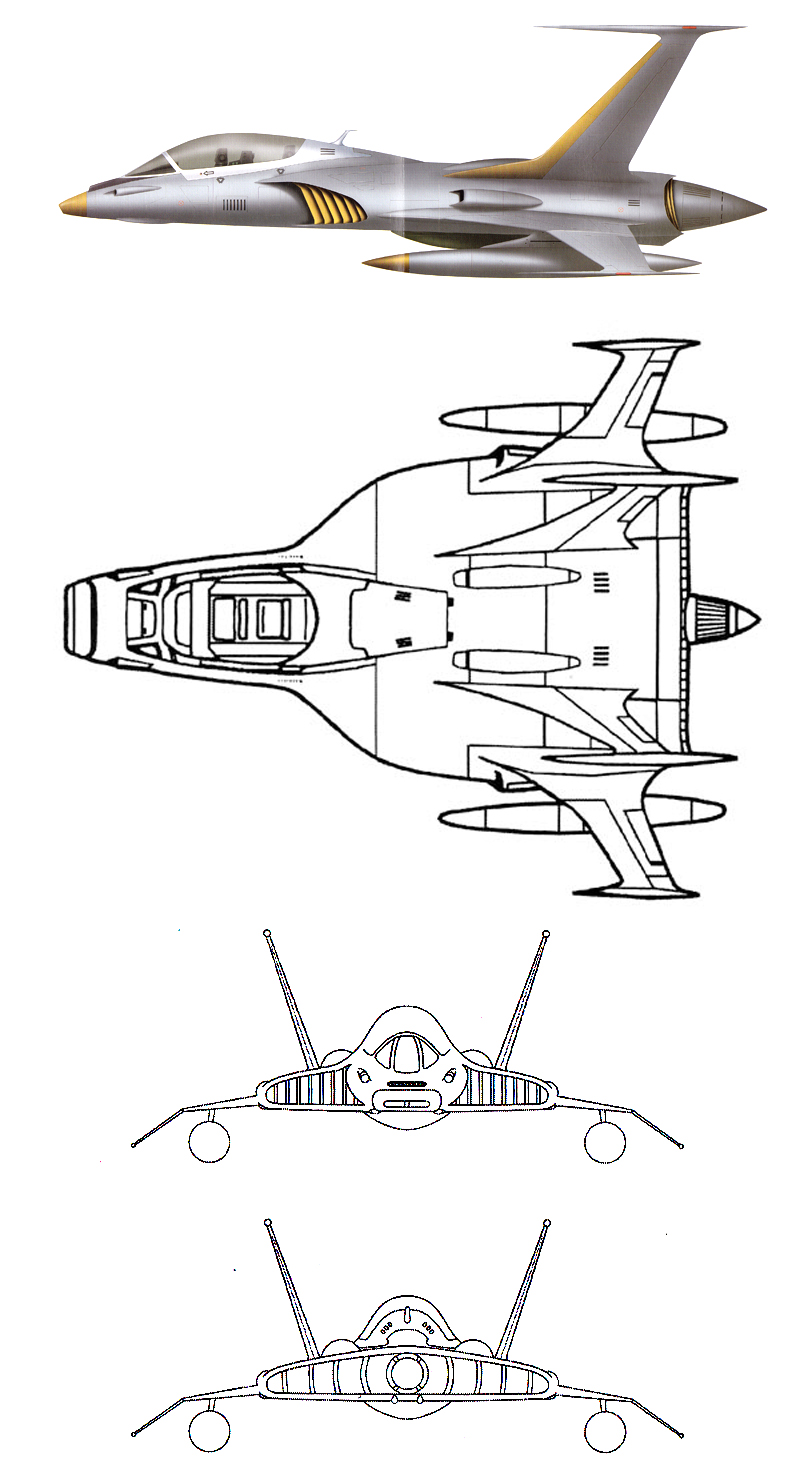
#4 and #5 are reimaginations of the Cosmo Zero and the Cosmo Falcon, both from Space Battleship Yamato. Did they ever make an official model kit of the Cosmo Falcon? This cheap unlicensed glider toy might be your only chance to hold one in your hand! #6 is the G-4 from, again, Gatchaman II, piloted by Jinpei the Swallow.


But cheap Taiwanese knockoffs aren't the only flying anime-themed objects hurtling briefly through our skies! Check out this prototype unmanned aerial vehicle:


Apologies for the poor image. It's a photocopy from a page of the original print version Let's Anime #3, which in turn was a photocopy of a photocopy from a picture that appeared in an aviation hobbyist magazine of unknown provenance. Anyway, it's a model plane version of Nausicaa's "mehve" or "mowe" or however it's spelled, her powered glider/airplane thing as seen in the film Nausicaa Of The Valley Of Wind. 
Who made it and why is anybody's guess. Here's a closeup of Nausicaa and her little pet fox-squirrel Teto, apparently painted on plywood.


Who knows what quasi-legal anime merchandise is hurtling through the heavens above? Keep watching the skies, junior birdmen!


-Dave Merrill

Thanks for reading Let's Anime! If you enjoyed it and want to show your appreciation for what we do here as part of the Mister Kitty Dot Net world, please consider joining our Patreon!

Saturday, March 22, 2008

SPACE FANZINE YAMATO: THE UNTOLD STORY

(On the birth of Space Fanzine Yamato)

guest columnist Steve Harrison tells us how he published the first American fanzine dedicated to a single Japanese animated series! Take it away Steve!

Star Blazers in the June '80 Starlog
The genesis of Space Fanzine Yamato has its roots in STAR BLAZERS. STAR BLAZERS took over my mind, in a way. Its early 1980s broadcast was the “catalyst anime” that got me hooked, and thru different means and avenues I started to pick up items from the Japanese “parent” show, SPACE BATTLESHIP YAMATO.

 My main focus (mostly due to this being all I could find) was the vast catalog of YAMATO record albums, so those beautiful full color liner notes, those few pictures were my main, my ONLY knowledge of YAMATO. The Drama Albums (LP recordings of actual dialog and music from films and TV) helped, because even without understanding Japanese, one fairly quickly picked out character names. Not that I had any real clue about the correct spelling or anything, and yes, I was aware enough to know that “Jason Kodai” and “Shane O’Toole” (character names used in the international version of the SPACE CRUISER YAMATO movie) had nothing to do with the actual Kodai and Shima. Oh, some of the wacky, utterly mistaken ideas I had looking at those pictures!

amusingly inaccurate poster for British theatrical release of "Space Cruiser"

So I was at a convention (an SF/media con, there were no such things as “anime cons” back then) near Detroit, ConFusion I believe, in Jan. ‘82... I had lugged my trusty Sylvania VCR with me in hopes of maybe nabbing some new DR. WHO episodes, maybe show off some STAR BLAZERS to some friends (trying to get more people hooked on the show), and who knows... my Detroit friends implied that at this con there were sometimes some folk who were into that “Japanimation” stuff. So, I also lugged along most of my YAMATO LPs, because I didn’t have any books on the show. I didn’t know there WERE books on the show.

1980s anime video entertainment center
So, yeah, in freezing cold Michigan winter weather I’m lugging a 42 pound VCR, a box of tapes and cables and such, and 10 or so pounds of LP records. I was younger, stronger and clearly insane.

Well, after a day of doing con stuff, I finally get word that yes, those "Japanimation” folks made it to the con, they were from Canada, and I was introduced to Marg Baskin and her crew. They were polite enough but a tad standoffish, I assume because of my “newbie” status. Seemed STAR BLAZERS and YAMATO wasn’t too interesting to them, except for this one girl whose name I just couldn’t catch (it’s an odd problem. Some people I meet and *snap* I lock the name and the face and no problem. For other people the name just vanishes instantly, even though I WANT to remember. It’s embarrassing).

So this young woman was keenly interested in my YAMATO LPs. She was pointing to pictures, saying names, describing history and story points… holy crap, she knew stuff!

We spent most of the convention just talking to each other, to the point where we talked for just about 24 hours straight! It started mainly because it was late at night and she was locked out of the room, I had offered her some space to crash in my room (OK, not my room, the room I shared with 6 other fans... man, we were all crazy then) but she was uncomfortable with that and I couldn’t blame her… so we spent all night long wandering the hotel and talking about YAMATO and anime and stuff.
English language Space Cruiser Yamato
promotional material circa 1978

I finally locked in her name was Ardith, we had a good laugh over my wonky brain. She mentioned that she did some writing for the Star Blazers Fan Club newsletter (wait...there's a Star Blazers Fan Club?!) and so on. The end of the convention was near and I was feeling really depressed. I figured off she goes to Canada and I’d never see her again and how do I keep in contact and...

Oh what a doofus I was! She wasn’t a Canadian, she was from Michigan! Home in Battle Creek and going to school in Ann Arbor! Boggle and joy!

(Then a blizzard and ice storm hit and the convention became “Continuation” and I lost my job at the time because the State Police wouldn’t let anyone onto the highways.)

Found out that she was hoping to attend a con in Chicago in Feb. 82 called “Capricon”, she knew that the Chicago C/FO was going to be showing anime, she hoped I could go too....

So naturally, broke, jobless, I still cadged a way to get to Chicago, register for the con, pay for my share of the room, and convince my best friend (and only other person in the Star Trek Club of Grand Rapids who was hep to STAR BLAZERS) Jerry Fellows to come with me to meet Ardith and see what Chicago had to offer.

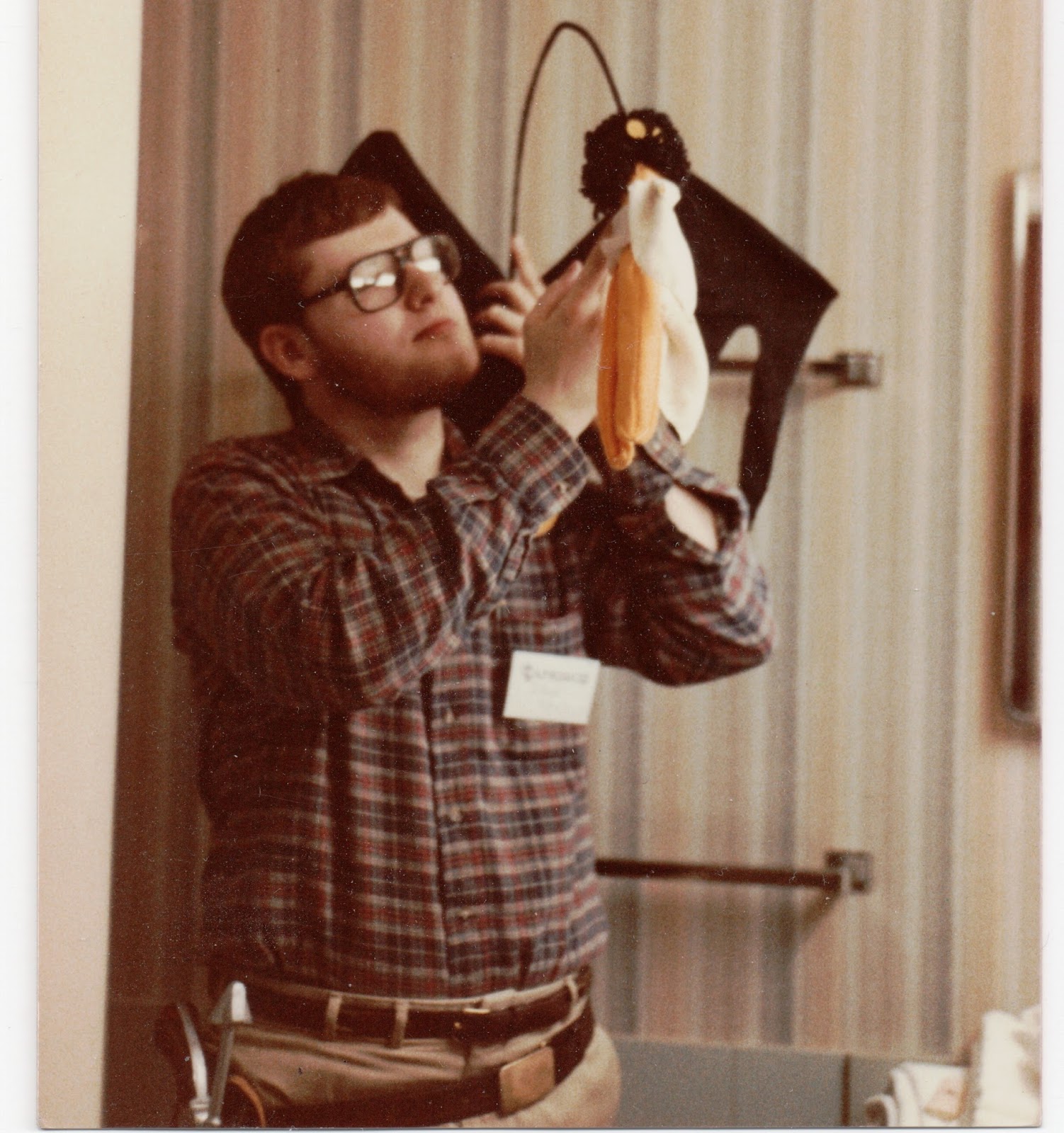
author and friend circa 1982
During our time together, Ardith made mention of how she was getting upset with the producer of the Star Blazers Fan Club newsletter. It seemed that the editorial habit was to take Ardith’s carefully constructed reports from Japan (she WAS going to school in Ann Arbor for Journalism, after all) and rewrite them, taking credit for her work, her knowledge. There were articles and reviews that she DID get a byline on, but all the news that the newsletter reported came from her, uncredited, and it bothered her.

Me being me, and maybe trying to show that I was “somebody” (likely because of some buried feeling of inferiority due to her knowledge of Japanese and all that), I blithely suggested “Well, why don’t you do a newsletter or fanzine of your own?” I was met with a confused expression... you couldn’t just produce such a thing! It took...

It takes a typewriter and a photocopy machine, or taking it to a printer if you want it to look really good. There was no magic, no mystery to producing a newsletter or a fanzine, I had done it (well, newsletter, but I knew people who did ‘zines), and I had done similar things in putting on Babelcon, the Grand Rapids media con. It was work, but it was easy work. She was unsure, but grew more interested as I talked. Even there I had coined the name “Space Fanzine Yamato” out of a general giddy session of “naming” stuff (Space Lunchbox Yamato, Space Ice Cream Cone Yamato, etc.). So plans were laid. Ardith would translate whatever she wanted to translate, I would write about things, Jerry would write about things, we’d package it and sell it.

Thanks to Ardith I learned about (L.A. anime retailer) Books Nippan, and started to buy Roman Albums and anime magazines. My knowledge slowly grew, the outline of what I wanted to see in Space Fanzine Yamato firmed up, and the format started to gel in my head.

I was applying the “George Lucas” philosophy. Back in 79 when I got hooked on Star Blazers, what would I have wanted to know? What would I have wanted to buy? I decided to produce the fanzine that I would have wanted then.
Space Fanzine Yamato front cover

One of the magical moments was when Ardith told me her friend James was making a trip to Los Angeles and could pick up “Japanimation” items while he was there. From his trip I got the BE FOREVER YAMATO blueprint book- and the final concept locked into place. I would include a translated copy of that Yamato cutaway blueprint as a “bonus item”, ala what the Japanese magazines Animage and My Anime were doing.

So the slow, grinding agony began. Ardith first produced a flood of work...then as time went on it slowed. I, being a slug, painfully ground out my text. Jerry had finished all his pieces like a week after we discussed it. Time burned on, relationships developed, blossomed, fell apart- oh, there was a hella lot of drama as time went on, much of it totally surprising to me, and I was... not the best person I try to be at times. Finally all the articles and translations were in hand. Lots of money had been spent taking Roman Albums to the copy shop for chara model sheets and other pictures. We had a long session with the 35 mm camera, photographing LP jackets. We took all our text to the typesetter and underwent the painful process of choosing fonts and size and all that stuff (Oh GOD as my WITNESS to have had a Mac and laser printer in 1982! File under “if I knew then what I know now”).


Star Blazers character guide from SFY
I had done paste-up work for my high school newspaper back in ‘76 and spent years producing newsletters, flyers, and program books for the Star Trek club and (Star Trek convention) Babelcon, so I understood the mechanics, but I clearly didn’t have professional tools. No predesigned layout sheets, so I used graph paper. No hot wax machine so I used spray fixative. No Khyron machine for headlines, so anything not done at the typesetter ended up with Letraset and typewriter. The front cover illo came from a “This is Animation” book (and the black border was HELL to dry), the picture on the back was one of Ardith’s black and white photos taken off TV. I was up 'til 1 AM doing the paste-up.

I haven’t mentioned advertising yet, or what the deadline was. I wanted SFY to come out at the next Capricon, Feb. 1983. I thought it made sense, an anniversary as it were. It was suggested I do the “reservation” thing, take money from people and use that to fund production, then ship when the book came off the presses. I didn’t want to do that. I didn’t want to have to refund money if the project fell apart and I didn’t want to have the debt hanging over my head (moral as well as fiscal). I wanted to have a finished product ready to ship, costs finalized and known. Good thing I did that, because there were a few times it looked like the book wasn’t going to make it.

SFY's translated Yamato cutaway diagram, later used to produce unauthorized T-shirts
Flyers were created and put out at various conventions, the idea being that if you were interested in SFY you would send me your name and address on a SASE, and when the book was ready I would mail out notices, you’d send money and you’d get your copy. I was quickly buried under replies, over the course of a few months I had like 60 SASEs. My, there’s some interest out there.


What were the mechanics of printing Space Fanzine Yamato? I took the paste-ups to the printer. 11 sheets of 8 1/2 x 11, folded to make 44 pages, plus card stock cover. 100 copies, cost (from memory) $130. The Yamato blueprint was 8 1/2 x 14, took that to a different shop with a photocopier that could shoot that size, got a deal of 8 cents per for 100. Typesetting was $80. I didn’t factor in the costs of the film and developing for the LP pictures, the cost of photocopying from the Roman Albums, the cost of any of the books and stuff I had bought or the materials cost for graph paper and fixative.

So, production costs: approximately $218 for 100 copies. MSRP of the ‘zine was $3.00. First printing was sold out by March 1983. Not too shabby. Did a second printing due to demand, sold THAT out just as quickly.

So, why no SFY issue 2?

The team had all fallen apart by Feb. 1983. Conflicts, personal issues, confusion, hurt, words said, words unsaid, mistakes, misunderstandings... quite a soap opera had developed and to all of us it was all so serious. Many of the events caught me totally by surprise, other issues...well, again, if I knew then what I know now…

SFY: Yamato LP checklist, episode guide
Ultimately, without Ardith, I couldn’t do it. Not JUST because of her knowledge and translation skills (a significant factor, nonetheless), but because without her I just lost the fire, the “heart” to do it. Over the years many have tried to boot me into rebooting the concept, because clearly the idea of a Space Fanzine Yamato is still valid. Jerry even started a website, Space Webzine Yamato, to try and get me going (and he’s done such an excellent job I feel I’d just be a drag on his work at this point.) but that fire is... well… not GONE, but it’s banked, the coals glowing in the back of the bin.

Still, for all the pain at the end, I¹m really quite proud of the finished product. Oh, I¹d do some things different now, or course. Just the advent of desktop publishing alone would have totally revamped the production process. The ability to scan in a drawing from a book, be able to scale it, clean it up, flow text around it...*sigh*.

Oh yeah, the Offical Bootleg. After the initial two press runs, I was contacted by Derek Wakefield of the Texas Earth Defense Command STAR BLAZERS fan organization. He wanted to know if they could do a print run of SFY for their members. Seems there was a great deal of upset that copies were not available. So I figured as long as it was marked as a reprint, go ahead, it was for a good cause. One of the reasons I agreed was I had heard that someone out there was actually duplicating a copy and selling them for something like $6 each! Good lord, what a bizarre mixed feeling THAT caused!

Then there was seeing a copy sitting in a showcase at a comic shop in Battle Creek, in mylar, with a $20 sticker on it. I nearly busted my sides laughing.

The face of anime and its fans has changed quite a bit since the '80s. The idea of a dedicated booklet explaining basic things about a series such as character names, episode titles, listings of products released all seems quite quaint, even primitive in today’s world of one click data mining. Yet nobody had really done what we did with Space Fanzine Yamato, and that's quite an accomplishment. Now in some ways the spirit of the 'zine lives on at Jerry's Space Webzine Yamato and in the growing data tapestry at the official Star Blazers website as overseen by Tim Eldred, and that's a pretty proud legacy.


I haven't seen Ardith since...oh, lordy, 1984? She finally managed to achieve her dream of living and working in Japan, and I do hear from her indirectly via a mailing list once in a blue moon. Jerry is still in town and we get together when we can. And every once in a while I do have that voice in the back of my head, saying "hey, let's get the band back together!"


color illustrations from SPACE CRUISER YAMATO/ARRIVEDERCI YAMATO promotional booklet, the June 1980 issue of STARLOG, author's photographs, theMarch 1978 issue of STARBURST, black and white illustrations from SPACE FANZINE YAMATO vol. 1


Thanks for reading Let's Anime! If you enjoyed it and want to show your appreciation for what we do here as part of the Mister Kitty Dot Net world, please consider joining our Patreon!

Friday, March 14, 2008

dawn of the dorks

Twenty-one years ago in the March issue of ANIMAGE (the number-one Japanese animation magazine) they ran one of their occasional features detailing how sometimes those crazy roundeyes get obsessed with cartoons from Japan and form their own anime clubs and dress up in costume and stuff like that. Apart from the two page spread of 80s Americans dressed like Lum, Jigen, Prince Zordar, and a foam-rubber Raideen (helpfully headlined "That's American Costume Play!") there was this photo:


It's some of the members of C/FO Atlanta, posing stiffly in a comic book shop, reaching out to their Japanese proto-otaku brethren! Back then we had more hair and were about 20 pounds lighter on average, and we thought nothing of taking a rainy Saturday to drive to the south side and get our picture taken wearing our Lum t-shirts holding MEGAZONE 23 LPs. How did this happen? Well, we had an anime club.


In the mid 1980s several things happened at once; I got a driver's licence and a part-time job, by virtue of tagging along with my brother to conventions and SF club meetings I had fandom contacts, and home video equipment was getting cheaper and cheaper. At an Atlanta Fantasy Fair in, let's say 1985, some Florida fans came to town and showed anime movies in their hotel room in the evenings. This set the stage for the next fifteen years of my life, more or less. At an SCA meeting I met up with Scott W. and Albert R., both of whom had an interest in anime. The head of the Dr. Who club had anime tapes along with his British SF shows, and he encouraged our talk of an anime-themed splinter group. We found out a guy named Bill S. had moved to town and was going to start his OWN anime club. We got together with THAT guy and joined forces and started the Atlanta branch of the Cartoon/Fantasy Organization.


By 1986 we were meeting in library community rooms, basements, wherever we could set up a TV and a VCR, showing whatever 10th-generation VHS copies of whatever we could get our hands on - ORGUSS television episodes, YAMATO films, DIRTY PAIR, LAPUTA, LUPIN III, L. GAIM, PROJECT A-KO, VAMPIRE HUNTER D, GALAXY EXPRESS, SAINT SEIYA, URUSEI YATSURA, FIST OF THE NORTH STAR, PRINCE PLANET, ICZER ONE, MOBILE SUIT GUNDAM, CRUSHER JOE, DANCOUGAR, CITY HUNTER, ETERNAL ORBIT SSX, DEVILMAN, AREA 88, ODIN, DAGGER OF KAMUI, LENSMAN, you name it. There would be two or three sets of VCRs in the back of the room copying whatever was available. Dues were ten bucks a year, which sounds like a lot, but we did print and mail a newsletter every month. EVERY MONTH! No wonder I did so poorly in college.


Most weekends we'd gather at somebody's apartment and daisy-chain more VCRs and copy anime all night long, marvelling at the artform that was so incredibly awesome and yet so unknown in the United States. Every few months there would be a convention and if the convention didn't give us a room to show anime in, we'd just get a hotel room and show it ourselves. We quickly learned which brands of videotape were the best, which VCRs to choose, how to wire it all up to your stereo to get stereo sound, and how loud you could get before the people next door complained.

C/FO Atlanta was a chapter of a national C/FO organization that grew out of Los Angeles and at its peak had chapters throughout the United States, Canada, and even in Japan. By the time we came on the scene the C/FO was beginning to feel the heat from swelling, itching ranks of new anime fans who had seen ROBOTECH on television and wanted more of this "japanimation" thing. The veteran C/FO members were old-school SF fans who were into old-school media fandom - giant fanzines full of fan fiction and pointillist fan artwork, typeset with an IBM Selectric and sold for thirty bucks each. While the new kids had a respect for the fanfic, they wanted tapes, and plenty of 'em. Meetings in Atlanta became daisy-chains of AV cable stringing decks together, fifteen TVs blaring at once, rowdy teenagers grabassing in the back, annoyed librarians kicking us out, and me going home with a stack of 30 blank tapes to copy PROJECT A-KO for everybody.


And let me point out that at this point - 1987 - you could not buy Japanese animation on videotape legitimately in the United States. Nobody was releasing subtitled anime. Nobody was putting the things in theaters. You could watch ROBOTECH on television, which was dubbed (horrors!) and edited (double horrors!) and you could rent dubbed and edited kids' movies in the kids' section of the local video store, and that was it. So if you wanted to watch Japanese animation, you HAD to come to the anime club and bug somebody. (Yes, there were video pirates selling bootlegs of anime in the dealers rooms of conventions, even back then, but we made a point of decrying their conduct in as offensive a fashion as possible). How were WE getting anime? By shelling out for the actual Japanese commercial tapes, by swapping with people through the mail, and by trading tapes with pen pals in Japan. There was a whole network of people mailing each other T-120 videotapes, keeping the Post Office busy.


By the time AKIRA came out - I mean, made it to us in America - things had come to a head. The national C/FO Organization was going through a painful and spite-ridden reorganization that would smash its national power forever, and the local club was basically me loading all my tapes and my parents old television into a car and driving across town to show cartoons I didn't care that much about to strangers. I came to the realization that I wasn't getting paid enough for this crap. In fact I wasn't getting paid at all! So I quit.


C/FO Atlanta failed to meet the requirements to remain an offical chapter of the actual offical C/FO (not enough members of the national organization) and so, realizing that affiliation with the national org at that point was not worth the proverbial bucket of warm spit, the club changed its name to "Animated Film Association". Most of the other C/FO chapters across the country did the same thing, and the late 1980s were littered with three-initial anime clubs of guys meeting in library basements showing cartoons to each other, like Britons continuing to use Roman law after the Romans went home.

By that time I had quit the local club and had started a mail-based organization called the "Prince Planet Foundation" reflecting my personal obsession with Japanese anime and manga of the 60s. I mailed out newsletters when I felt like it and corresponded with people who shared my interests and I amassed a prodigious collection of Prince Planet episodes which I then copied for everybody in the flipping world. Holy cow, did I get sick of Prince Planet.


After six or eight months I got together with former C/FO member Lloyd C. and we started a brand new anime club with no newsletters, one-time-only dues, a tape library to prevent me from copying PROJECT A-KO all the time, and a total lack of rules, constitutions, officials, or any of the red-tape BS that so annoyed us with the C/FO. Also I was not going to haul my television any more. This new club - Anime-X - lasted for about ten years and formed the nucleus around which grew Anime Weekend Atlanta, which has lasted for 14 years as of this writing. I still see C/FO Atlanta members at AWA every year and it always astounds us how a club that started out with 5 people in somebody's basement watching a really terrible copy of GUNDAM III somehow became a convention of 10,000 people in a giant convention center. Well, as long as I don't have to haul my TV or copy PROJECT A-KO for anybody, it's all good.

-Dave Merrill

Thanks for reading Let's Anime! If you enjoyed it and want to show your appreciation for what we do here as part of the Mister Kitty Dot Net world, please consider joining our Patreon!