Showing posts with label matsumoto. Show all posts

Wednesday, November 29, 2023

When The Rings Of Time Come Together, We Will Meet Again


In the fall of 1979 I was a cartoon-addicted elementary school student, spending my Saturdays with Scooby-Doo and old Warner Brothers shorts on network TV. Weekdays the UHF stations gave us Tom & Jerry, the Super Friends, Speed Racer and Battle Of The Planets. That autumn the elementary school playground gossip was all about a new cartoon that had just started airing on channel 46. This new show was kind of like our favorite film Star Wars, in that it involved outer space battles between zooming fighter-plane starships; but this had something different. Apparently it involved a submarine or a battleship that for some reason was now in outer space. I scoffed. Certainly this was going to be terrible. But the next afternoon I found myself over at a friend’s house and the TV was on and there it was, Star Blazers.


I'd seen other Japanese cartoons before; this one was different. This was a heartfelt, melodramatic space opera whose characters struggled through tears and anger as they travelled one hundred and forty eight thousand light years and back to save everything they cared about, a cartoon that didn't hide its Asian origins as Space Battleship Yamato, but put them right there in the credits. I don't want to underplay the work of Yamato's producer Yoshinobu Nishizaki, but without Leiji Matsumoto we wouldn't have Star Blazers. We wouldn't have those hazy, dark-blue starscapes or the ethereal cosmic goddesses bringing a spark of mystery to the warplanes and battleships of this outer-space World War Two. Without Matsumoto we wouldn't have Yamato, but without Yamato Leiji Matsumoto would still be a titan of the manga world, if just for his melancholy space-train fantasies or  his instantly iconic space pirates or his cynical, tragic war comics or his comedies set in hardscrabble down-and-out-in-Tokyo, all drawn with that lush, descriptive brush line,  equally at home depicting dinosaurs, cavemen, Type-30 Arisaka rifles, or cosmic super-constructions. Leiji Matsumoto created futures filled with relics and ruins, where myth and legend coexist with science and technology, and where the only constant anyone could rely on was the strength of the human spirit. Sometimes we try to bury history, sometimes we try repeat it, but his world, our world, is everywhere an uncanny, turbulent mix of the past and present, and like Matsumoto's heroes, we can only try to hold fast to our ideals.


Early this year the world lost Leiji Matsumoto. As part of the North American anime fandom that grew around his work, I joined with other fans in presenting various memorial panels at this year's anime festivals. For me it was an opportunity not only to honor his memory and to show off some of my favorite Matsumoto works, but to dig around a little in his back catalog and uncover some things I'd never seen and some facts I might not have known.

I learned he'd been born Akira Matsumoto in Kurume, which is in Fukuoka, down on the island of Kyushu in southern Japan. Even today it's a six hour bullet-train ride from Tokyo. In elementary school his class library had copies of Tezuka's New Treasure Island and Dr. Mars, turning a young Akira into a manga fanatic. He'd be a published manga author while still in school, and when Tezuka was in Kyushu with one of his perpetual looming deadlines, Matsumoto was recruited to be a local assistant.


The late 1950s and early 1960s saw Matsumoto begin a career in shoujo manga, marry fellow manga-ka and sometime collaborator Miyako "Licca-chan" Maki, adopt his pen name Leiji, and move into both science fiction and WWII manga with strips like Burning Southern Cross, Black Zero, Submarine Super 99 and Lightning Ozma, which coincidentally features a space battleship named Yamato.


In mid-1960s issues of Shonen Book, Matsumoto would draw Light Speed Esper, a story about young Hikaru who battles the alien Giron with the super suit created by Professor Asakawa and the help of his adoptive alien parents. Esper is perhaps the most involved SF manga series based on an electronics company mascot, and would also become a pioneering live-action tokusatsu TV show.


Matsumoto's art followed the culture into a more adult-oriented late 1960s as his Sexaroid and Mystery Eve pushed the mature-audiences envelope along with a wider cultural shift towards nudity and adult situations, and his Wheel of Time aesthetic first saw light in Tezuka's COM magazine as the "Fourth Dimensional World" series.


But it was the down-and-out-in-Tokyo loser of Otoko Oidon that gave Matsumoto his first iconic anti-hero, surviving in a four and a half tatami mat room on cheap ramen and home grown mushrooms. The antihero themes would continue in his war comics, beginning with "The Cockpit" and continuing under various names for the rest of his career.


When Nishizaki's Office Academy began preproduction of Space Battleship Yamato, there were several directions open to them. The idea of reviving the Yamato as an outer space warship wasn't a new one, having shown up in pulp fiction, model kits, and even Matsumoto's own Lightning Ozma. But honestly, if you're going to merge WWII and SF then you need to get the guy who's good at both, and that guy is Leiji Matsumoto. Bringing his signature aesthetic to a project that desperately needed a strong visual style, Matsumoto found himself knee-deep in the production of the TV series and its sequels, working on the show and a manga adaptation for Akita Shoten.


His attempt to insert a space pirate into Yamato understandably denied, Matsumoto would make Captain Harlock an important part of 1975's Diver Zero, a story about abandoned Moon androids rebelling against the people of Earth. His mid-70s manga would wander between the high school comedy of Oyashirazu Sanka, the SF of Time Travel Boy Millizer Ban, and in Princess, the feline adventures of Torajima no Mime.


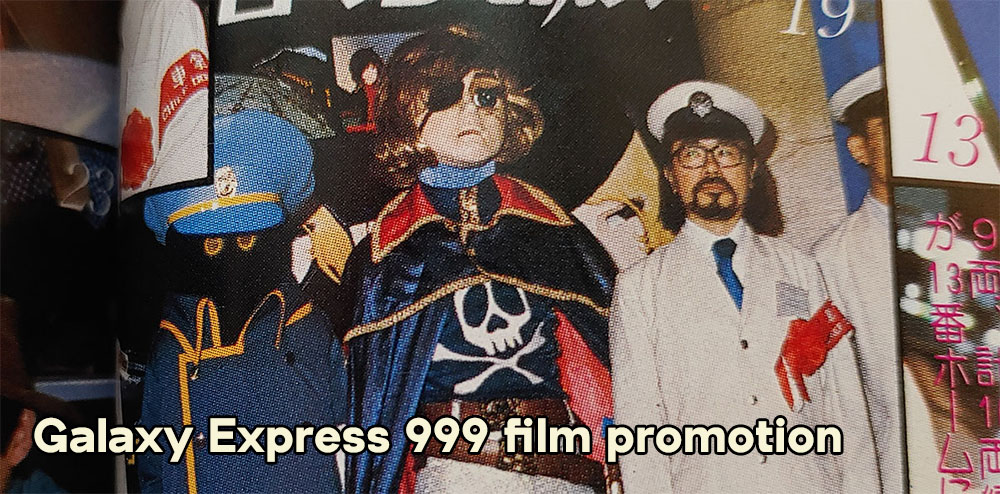
Captain Harlock would get his own manga adventures in Play Comic in 1977. The same year he'd begin Galaxy Express 999 in Shonen King and Wakusei Robo Danguard Ace in Adventure King. This is what the rest of the 1970s would look like, a parade of Leiji-themed TV anime, feature films, radio plays, novelizations, toys, games, and merchandising, seemingly stretching to the Andromeda Galaxy and back. Leiji Matsumoto was busier than ever, yet still found time to take a safari trip to Kenya.


Part of this Matsumotoverse explosion was the premiere of the Westchester Films version of the 1974 and 1978 Space Battleship Yamato TV series. Retitled Star Blazers, this series would air in syndication across America where it would convince not only myself but an entire generation that Japanese animation was an exciting and innovative medium, and we needed to fill our lives with as much of it as humanly possible.


The "Yamato boom", fed by Matsumoto's visual style, would fade away as the 1980s anime world switched gears towards idol singers, transforming robots, and obnoxious aliens. SSX and the Queen Millennia anime series would both have truncated seasons, the Yamato herself would have its final voyage in 1983, but Matsumoto's manga kept right on, continuing his Battlefield series with Hard Metal in Big Comic and giving Japan a third Black Ship Crisis in Fuji Evening Paper. 


Never one to abandon icons, Matsumoto would throw Harlock and his crew into Wagner's Ring Of The Nibelungen in, of all places, the pages of "Used Car Fanatic," while his Battlefield series continued with "Case Hard" and the mysteries of Leonardo Da Vinci's genius were explored in "The Angel's Space-Time Ship."


The mid 1990s meant Yamato-boom kids were now adults, inspired by Matsumoto to work in his style and produce new animated versions of his works. One of the best of these later-period adaptations is the three-part OVA series The Cockpit, delivering three punchy antiwar stories from his Battlefield series.


A new Galaxy Express film and a home video adaptation of his Queen Emeraldas manga arrived in 1998, while Matsumoto produced the historical epic manga Shadow Warrior. Captain Harlock's Wagner cycle would make the anime transition in 1999, Cosmo Warrior Zero would fly through the same universe in 2001, and Harlock would revert to the "Herlock" spelling for a Rin Taro-directed video series in 2002.


An entire new generation of eyeballs would see Leiji Matsumoto's style as French electronic music robots Daft Punk built an entire album around a Matsumotoverse theme with their 2003 album/film Interstella 5555. At both Anime North and AWA I met audience members for whom 5555 was their first exposure to Leiji Matsumoto's work.

The oughts would see a parade of new Matsumoto anime that included versions of Gun Frontier and Submarine Super 99, the lengthy Galaxy Express side series Galaxy Railways, and an abortive attempt to rework Space Battleship Yamato into Dai Yamato Zero-go, which found its greatest success in the medium of Pachislot. In 2006 Matsumoto would bring his manga career full circle with Firefly Yokai, a new take on his first published manga, 1954's Honey-Bee Adventures.


Prepping for these panels, I conferred with several friends in Japan who'd met Matsumoto and were familiar with his studio, and I gathered some interesting facts from their experiences. For instance, Patrick Ijima-Washburn told me that he'd asked Matsumoto about his favorite comic from the West. Matsumoto thought he was talking about Westerns, meaning cowboy movies, and replied that his favorite Western was the 1954 Joan Crawford film "Johnny Guitar." 


Dan Kanemitsu, The Man from I.O.E.A. (the International Otaku Expo Association) related to me how former Matsumoto assistant, Yattaran inspiration and Area 88 artist Kaoru Shintani was working with fellow Studio Leiji-sha employees one day when a taxi pulled up and Matsumoto hustled in with a big mysterious bundle he'd just spent all his cash on, a bundle that turned out to be an actual Revi C 12/D gunsight from a Messerschmitt, you know, the star of several Matsumoto Battlefield manga stories, a key element in the film Arcadia Of My Youth, and an object Leiji had just spent every bit of ready cash on, could someone please pay the taxi? 


Speaking of youths and Arcadias, anime journalist Darius Washington made sure I knew that Matsumoto's model for his mysterious, aristocratic blonde characters was the German Heimatfilm actress Marianne Hold, the star of dozens of films including 1955's "Marianne Of My Youth." 

I also spent a little time assembling an online mixtape of music from various Leiji Matsumoto projects, which you can listen to over at Mister Kitty dot Net.

As for myself, my interest in Star Blazers led me to join one of the American anime clubs that grew out of the show's success on American TV, and soon I found myself running an anime club in my home town, writing fanfic, drawing fan art, publishing anime zines, attending one of the first anime conventions, and writing professionally about Japanese animation for a variety of print and online media. Eventually I'd help start our own anime convention, still going strong 28 years later, and along the way I'd make thousands of friends. Without that anime fandom, without Leiji Matsumoto,  I and many like me would have had a very different path.


“(Leiji) Matsumoto used to say, ‘At the faraway point where the rings of time come together, we shall meet again,’” Studio Leiji-sha director Makiko Matsumoto said in their statement. Leiji Matsumoto was the author of thousands of pages of manga, countless adaptations, characters, and adventures, recognized with the Japanese Medal of Honor With Purple Ribbon and the Order Of The Rising Sun as well as the Knight Of The Order Of Arts And Letters from France, and on February 13, 2023, he succumbed to acute heart failure in a Tokyo hospital.

Eulogizing Tochiro Oyama's passing in the film Galaxy Express 999, Tetsuro Hoshino says "being human means you also have to face death... whether you've fulfilled your dreams or not." Leiji Matsumoto's dreams were right there in the pages of his manga, dreams of romance, struggle, honor, violence, eroticism, humor, and the human spirit's ability to transcend time and space itself. He may be gone, but those dreams will remain with us, always.

-Dave Merrill

thanks to Patrick Ijima-Washburn, Dan Kanemitsu, Darius Washington, and L. Matsumoto.


Thanks for reading Let's Anime! If you enjoyed it and want to show your appreciation for what we do here as part of the Mister Kitty Dot Net world, please consider joining our Patreon!

Tuesday, January 31, 2023

Vengeance Of My Youth's Arcadia


Sure. Have a pummeled kid look up mid-thrashing, exclaim “Captain Harlock!” and let the audience figure out that guy from the wanted poster earlier, with the eyepatch and the skull-and-crossbones suit, that guy is probably a space pirate. That’s how Captain Harlock debuts in 1979’s Galaxy Express 999 film, a walking bit of iconography at home among the movie’s space trains and cosmic frontier towns.

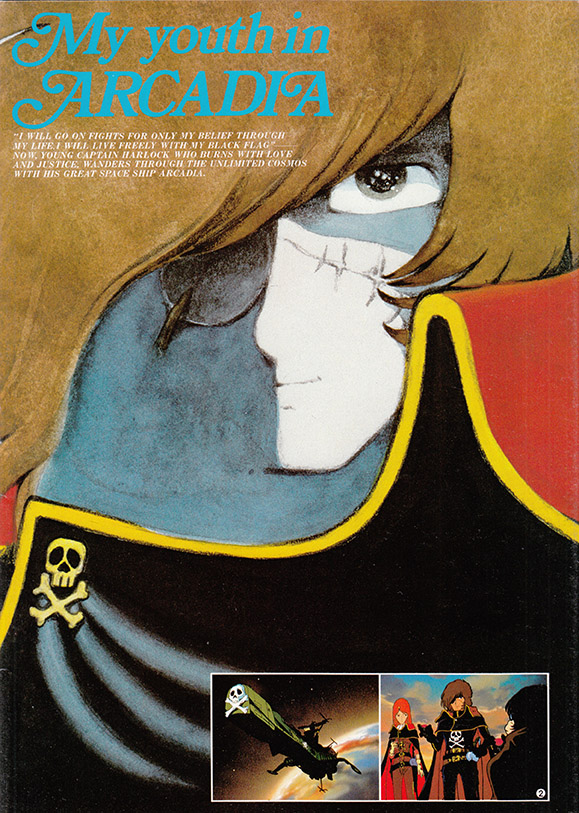
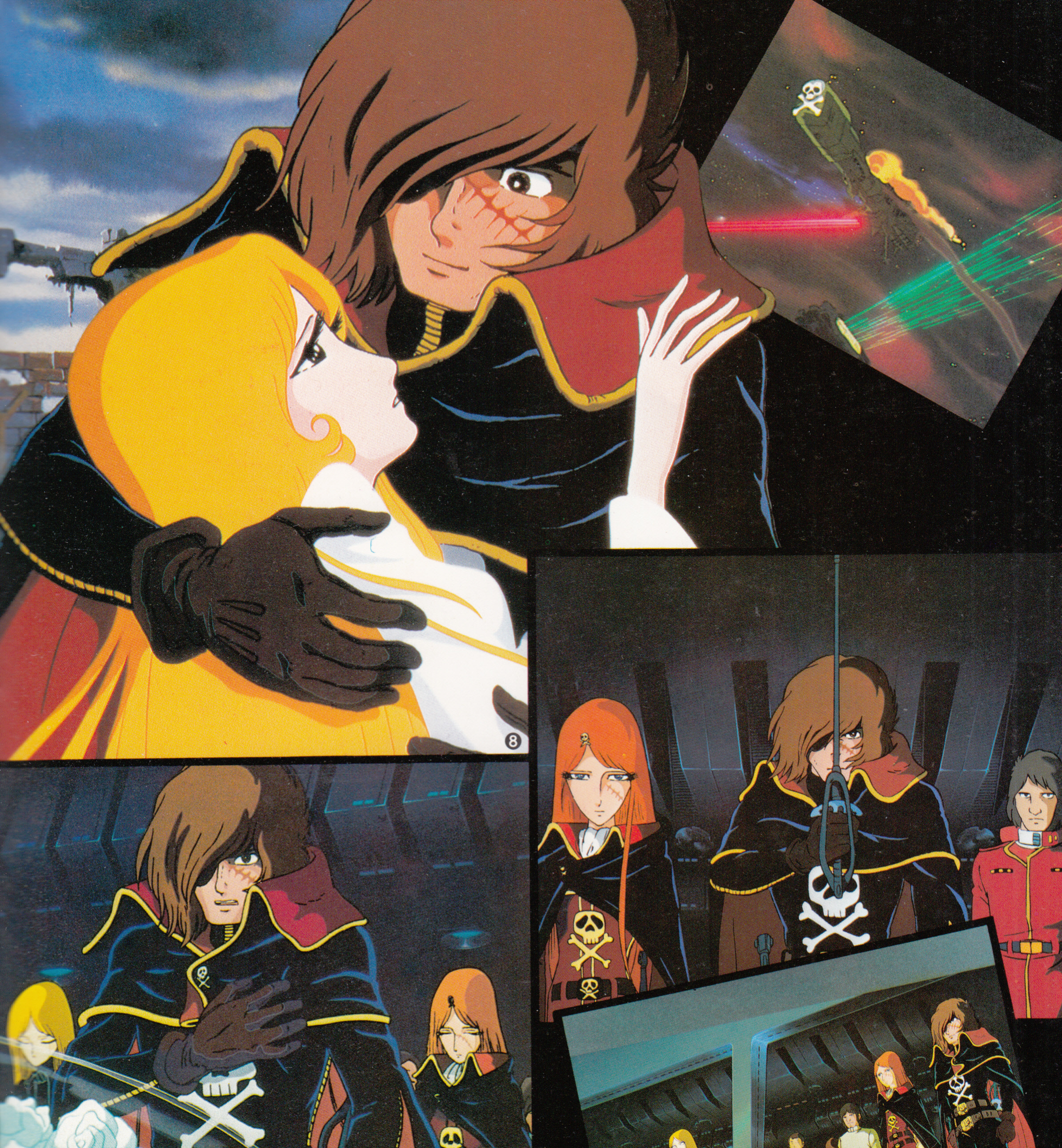
Three years later, Captain Harlock would get his own feature film in Toei’s Arcadia Of My Youth. Appearing at the tail end of a space-opera fad, Arcadia puts Leiji Matsumoto’s most iconic character front and center, gambling his charisma is enough to carry a picture without advance public-relations buildup from any juvenile galaxy-train passengers. Here’s everything in one package, how Harlock became a cosmic corsair and where his space battleship Arcadia came from, in a film filled with romance, tragedy and conflict, and yet ultimately, weirdly, confusedly unsatisfying on first watch. At least, that’s how it was for me. 


 Sure, no movie’s gonna live up to the anticipation we had for Arcadia. “We,” of course, being the anime nerd crew I hung with in the early days of Reagan’s second administration. Warped by afternoon syndication of Star Blazers, we sniffed out Roman Albums and “Special Mooks” at local comic shops and comic cons. “Animation Comics” taught us about someone named Captain Harlock, his name regularly spelled out in English. Was he a space pirate? Looking like that, he’d better be.


We had definite Harlock expectations, mussed slightly by the whimsy of the nascent home video industry, which would bring us New World’s Galaxy Express dub with a renamed, celebrity-soundalike Harlock and the two ZIV International VHS releases of selected episodes of the 78 Harlock series. ZIV’s localizations, stonily accurate or wildly nonsensical, were bookended with a theme song that exhorted us to “Take to the sky!” And when Harmony Gold stitched that entire ‘78 series together with 1981’s Queen Millennia to create the “Captain Harlock And The Queen Of 1000 Years” teleseries, the retooling was an entirely different, comically inferior experience. Our gang wanted to see the REAL Captain Harlock, and to us that meant Arcadia Of My Youth, the film that shows us how Captain Harlock met spaceship engineer Tochiro Oyama and enigmatic female space-freebooter Emeraldas, and how they all became outlaws flying freely through the immensity of space.

By the time Celebrity Home Video released a package of edited, dubbed Japanese anime features that included Cyborg 009 Legend Of The Super Galaxy, Locke The Superman, and Arcadia Of My Youth as “Vengeance Of The Space Pirate,” our local crew had a few years of tape swapping and video-room programming under its belt. We’d seen the Macross movie and Project A-Ko and the rest of that period’s shiny, high-tech productions, filled with cute girls and expanding transformable robots. Might we have grown past Arcadia without even realizing it? But there Arcadia was, at a MRSP eight times the minimum hourly wage. Our dream movie was finally in our hands, sadly complete with lackluster dubbing and clumsy edits, one more piece of Bad American Dubbing, another obstacle on our path to True Arcadia Satisfaction.

Arcadia's previous American VHS releases


The 1990s rolled around and anime found itself embraced by a home video market hungry to fill Suncoast and Mediaplay shelves. That’s when pioneering American localizer AnimEigo released Arcadia Of My Youth, uncut and subtitled in English. Here it was, the full film without edits or bad dubbing, available at Blockbuster or at your local anime con. Here’s that Captain Harlock movie in the form you’ve been demanding, surely this satisfy your Harlock needs, right? This SHOULD be your favorite movie ever. And it... still wasn’t. Kind of a letdown. Was it too slow? Too long? Dependent upon a vast scope and a widescreen spectacle that 1990s VHS and tube televisions simply could not deliver? Maybe… maybe that last part.

Let’s skip a few decades, to when Discotek Media delivers a beautiful Blu-Ray of the film, matched with their release of Arcadia’s TV sequel Endless Orbit SSX. North American viewers- that’s me- could maybe, finally, mercifully get past that Celebrity hack’n’slash job and AnimEigo’s well-intended but slightly hazy release. This high-def version of Arcadia appeared on various streaming platforms, potentially into every internet-enabled home, at a point where North American anime culture has been prepped by English-language releases of the 1978 Harlock series, the Galaxy Express 999 films, and Leiji Matsumoto’s ‘70s Harlock manga. In other words, American audiences- again, that’s me- could watch Arcadia and be closer than ever to the film’s original context, freed from the murky expectations built up by fanzine synopses, Roman Albums, and fuzzy, badly dubbed VHS. How does this Arcadia feel now? Short answer: this movie finally works.


Let’s start with the film’s title itself. The legitimacy of a claimed a Goethe quote is largely dependent upon there being very little crossover between Goethe fans and anime nerds. More prosaically, Arcadia Of My Youth recalls “Marianne Of My Youth,” a 1955 French/German film starring Horst “the German James Dean” Buchholz as a Bavarian boarding school student who falls in love with a mysterious girl played by Heimatfilm star Marianne Hold. Hold would inspire Leiji Matsumoto’s Maetel, as well as songs by Japanese avant-garde rockers Jacks and power balladeers THE ALFEE.

Arcadia the film avoids Harlock’s previous anime iterations, instead building out from two of Leiji Matsumoto’s mid-1970s “Battlefield Manga” stories. The job of bringing all this into the thirtieth century fell to Arcadia screenplay author Yooichi Onaka, who seems to have done a little TV writing and two Arcadia novelizations. Battlefield’s “Stanley’s Witch” becomes the basis for Arcadia’s pre-credits scene starring our hero’s early 20th century ancestor Phantom F. Harlock, voiced here in his final role by actor Yujiro Ishihara, brother of ultranationalist Tokyo governor Shintaro Ishihara. Flying his “Arcadia” tagged biplane, Phantom F. pits his life against the challenge of crossing the Owen Stanley mountains in New Guinea, unwilling to give up his dream even if it costs him everything.


As Arcadia Of My Youth’s credits roll we find ourselves back to the future, where Pacific War comparisons move from subtext to text as our home planet surrenders to hegemonic galaxy invaders the Illumidas, whose greenish skintone splits the difference between that of Yamato enemies Gamilas and the Comet Empire. Any comparisons between the Illumidas occupation of Earth and the American occupation of Japan are purely coincidental on purpose, you understand.

Amidst Earth’s collapse, Solar Federation captain Harlock tries and fails to run the alien-invasion blockade and is forced back to Earth with a cargo of refugee passengers. His command and career are kaput, and he can’t even hang out with his willowy blonde girlfriend Maya because she’s deep undercover DJ’ing clandestine Earth resistance radio. There’s nothing for Harlock but to join the rest of the hungry Earthman masses struggling to find a meal in the ruins. This is where he meets fellow former Federation officer, genius engineer and future best friend Tochiro Oyama, during a silly bar fight that supplies most of the film’s comic relief.


The Illumidas policy is to recruit conquered citizens and exploit them for police-state grunt work. This means there aren’t any hard feelings when officer Zoll of defeated planet Tokarga arrests our heroes and Illumidas brain-machines investigate both their genetic structures; Zoll is just following orders. This brings us to our second “Battlefield” excerpt, a lengthy memory-flashback starring Harlock and Tochiro’s ancestors, who met each other during WWII in an attempt to flee to an episode of Heidi, Girl Of The Alps (Zuiyo Eizo, 1974). Back in the 30th century, we find the conquered Earth military is managed by sneering traitor Triter. Earth’s forces are offered a devil’s bargain of preferential treatment if they will prove their loyalty to Illumidas by crushing previous Illumidas subjects the Tokargans. Will Harlock captain that mission? He will not. He’s got his pride, and anyway, he’s got to stick around Earth for the sake of Maya’s radio career.


Maya’s morale-lifting broadcasts are ostensibly for all Earth, but get real; she’s passively-aggressively speaking just to Harlock. Before the two wise up and start talking privately, the Illumidas Communications Commission raids her broadcast studio. Harlock gets caught in the crossfire and well, let’s just say the film has leveled-up in its quest to show us Harlock’s origin.


Confiding in his newly one-eyed bestie, Tochiro reveals he’s secretly built a giant space battleship. Would Harlock like to be its captain so they can ditch this square world and blast off for kicksville? Boy, would he. But first Tochiro finds himself entranced by recent arrival Emeraldas, the free space trader whose giant spaceship has been damaged trying to make it through the Flame Stream Prominence, a dangerous stellar phenomenon dubbed the “Owen Stanley Witch Of Space.” I wonder if our heroes will challenge it later?


This assemblage of main characters is interrupted by La Miimay- not the blue-haired Miimay from the ‘78 show, but an incredible blonde simulation- who’s overheard big news during her secretarial job in Illumidas HQ. The command’s going out to demolish Tokarga. The entire planet is condemned.


Zoll and the Tokargans want to commandeer Tochiro’s spaceship and return to protect their home, but Tochiro knows you shouldn’t loan money, books, VHS tapes, or starships. Instead, Tochiro and Harlock will fly to Tokarga while Zoll and Earth resistance fighters do what they can to protect the Earth. That means we’re about an hour into the film before we finally meet our real star, the Arcadia. Erupting from its underground cavern helpfully built beneath what used to be the Solar Federation’s headquarters, we’re both amazed at the impressive scenario and curious as to how Tochiro intended to launch this thing if the bad guys hadn’t conquered the Earth.


Rescued from an Illumidas firing squad, Emeraldas receives her iconic scar (check another box, film) and Maya is also wounded, earning the full-on “Love Story” treatment, becoming more beautifully radiant the sicker she gets.

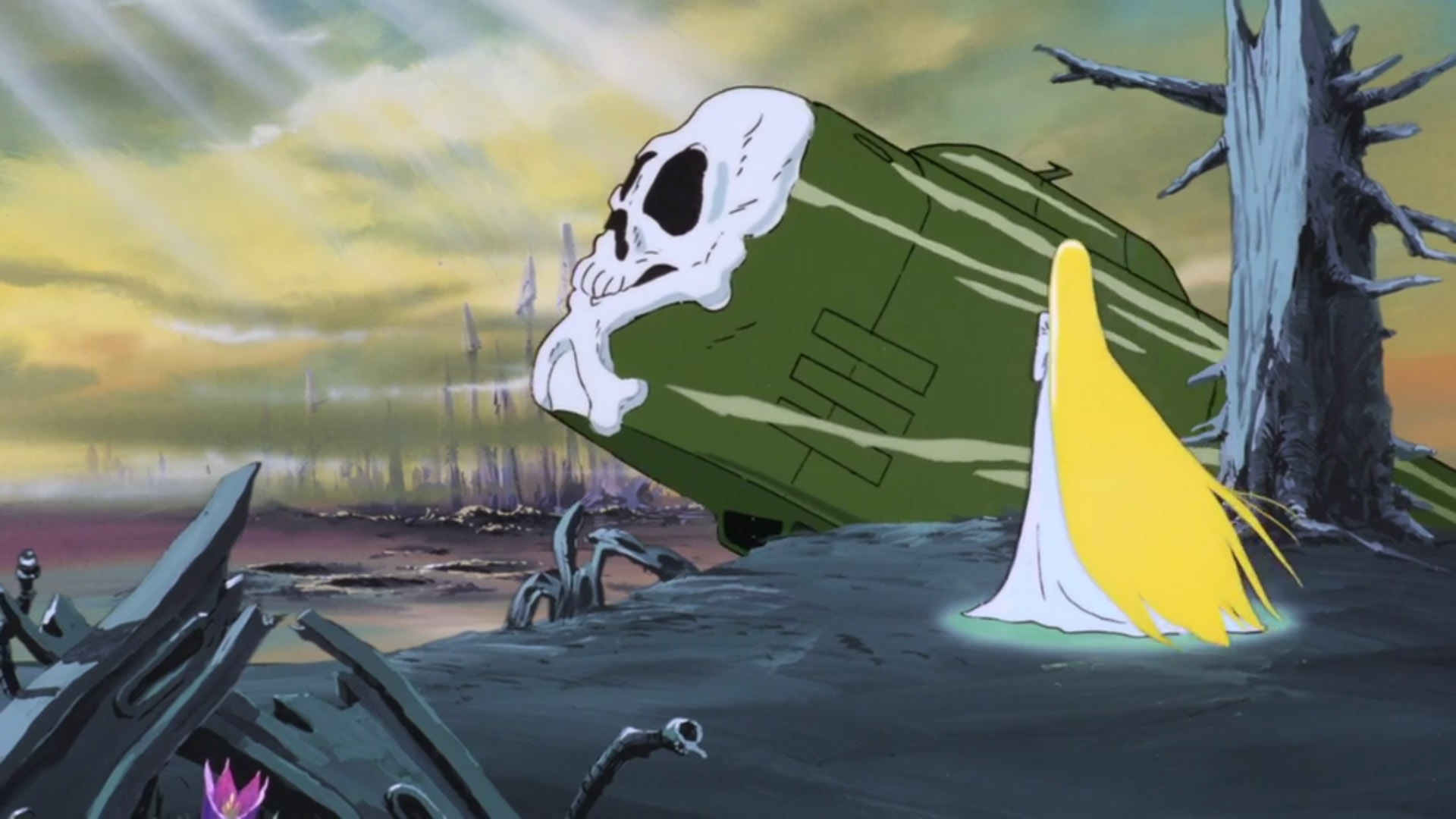
Arcadia the film sends Arcadia the ship through outer space and to a ruined Tokarga, now inhabited by corpses and Illumidas death-robots, overdue for annihilation. Rescuing a few stricken survivors and Harlock standby Mr. Bird, the Arcadia must challenge the Flame Stream Prominence to return to Earth, defying the peculiar life-energy attraction force these stars generate. Sure, that’s a strange quality to develop in a celestial object that by its very nature is inimical to all forms of life in the first place, but before we can question yet another illogical thing in this space pirate origin movie, a heroic sacrifice gets our heroes through this crisis. 


Harlock and the Arcadia return to Earth to mourn their dead, and right away blast off again for the film’s climactic final battle, where Arcadia comes closest to its thematic template– not the WWII-In-Outer-Space of Yamato, but the Hollywood pirate flicks of the 1930s and 1940s, in which enormous Age Of Sail ships of the line would blast broadsides at each other, until eventually our hero, a once-respected noble forced into piracy by cruel happenstance, would swing over the rigging and duel the enemy hand to hand. That’s how Arcadia Of My Youth ends, half an hour of whooshing space noises and staccato commands, laser blasts, gravity-warping explosions and swashbuckling extravehicular boarding, culminating in a cosmic burial-at-sea and a Captain Harlock finally fully equipped with goth fashion, iconic spaceship, and a helpful supporting cast, prepared at last to roam freely through the expanses of space, fine, nobody’s stopping you, go do it already.

Fandom writing about Harlock and AOMY from the 80s


Rising above Arcadia’s 130 minute haze is the character design and animation direction by the great Kazuo Komatsubara, the man behind the ‘78 Harlock series and a ton of other successes from super robots to magical girls. However, here K. Kazuo’s work isn’t lively enough to offset the film’s overwhelming lassitude. The direction by Tomoharu Katsumata is competent enough, with rare moments of quiet beauty, but he’s content to film great chunks of action in long shots, to frame gigantic space battleships in the middle distance without giving us a sense of size or mass, to pan across still shots of characters standing still. Compared to the nervous, organic motion of Rintaro’s Galaxy Express or to his reality-warping, electronic-music-soundtracked sequel Adieu, Arcadia’s risk-averse cinematography seems even tamer. The same year as Arcadia Katsumata also lensed the less-than-sizzling feature Future War 198X, and in 1985 he’d helm the legendarily tiresome Odin: Photon Sailer Starlight, another outer space non-actioner. Like an expensive sports car minus an engine, Arcadia Of My Youth doesn’t really go anywhere fast, but looks great doing it. 

My Ruler In Arcadia


It’s certainly not the film we were promised in the trailer, which in the best Hollywood tradition is made up largely of footage not seen in the actual film. The preview delivers spectacular spine-jarring footage of the Arcadia blasting its main cannons, shock obliterating the frame for seconds, smoke and dust and cosmic detritus swirling in the vacuum of space, whoops, this is footage lifted clean from 1979’s Galaxy Express. We see Harlock’s pal Zoll of Tokarga put a burst of unfriendly cosmo-gun energy right into Harlock’s eye, absolutely not how the film goes. The trailer’s soundtrack leans heavily on Dvorak’s New World Symphony, which can’t help but make the actual Arcadia’s Toshiyuki “Golgo 13: The Professional” Kimori soundtrack seem less than memorable and kind of a bait and switch on both the audience and Kimori.


As Arcadia Of My Youth ends with a purported Goethe quote, we’re left with more questions than are answered. Who are the Illumidas? Should their name actually be spelled “Ilumidus”? Why did they conquer Earth in the first place? Why bother conquering Tokarga years before, only to blow it up? If a film deliberately evokes the American occupation of Japan, can we speculate here that maybe the Earth deserved it? Did the Solar Federation’s astro-political mouth write some checks the Solar Federation’s astro-political ass couldn’t cash? How did Tochiro excavate a giant cavern, equip it with machinery, and construct a giant space battleship all by himself? What, exactly, is the relationship between Harlock and Maya? Are they brother and sister, are they dating, are they both, like in that Folger’s ad? Maybe he’s just an obsessed stalker, which would explain why she runs from him at one point. If they are actually a romantic couple, Arcadia needed to show us the pair walking in a meadow, laughing in slow motion, or shopping at Ikea. Any relationship signifier would do. A 130 minute film can give us Date Night Harlock along with Air Pioneer Harlock and Luftwaffe Ace Harlock. Except it can’t, because outside of the cockpit of an airplane or the bridge of a warship, Harlock doesn’t really exist. He doesn’t grow or change, there’s no Harlock character arc, he wasn’t turned into a grim specter of vengeance by outlaw bikers or sneering thugs or The System, Man, he was broody and stoic before this movie and he’ll be broody and stoic after it’s over, because being an eternal archetype means never having to evolve as a character.


That being said, I’ll admit I’m not being fair to Arcadia. This movie was released in 1982 to a Japanese audience that had already absorbed 42 episodes of a Captain Harlock TV series, two Galaxy Express films and a TV series featuring Harlock as a supporting character. The Japanese crowds watching AOMY didn’t NEED to know who Harlock was, or why, where and when, or convincing rationales for invading aliens and their whimsical planet-exploding foreign policies. They accept the film and its heroes for what they are; archetypes moving on a fixed course, past the background scenery of galactic empires, through narratives as unchangeable as any samurai epic, rubber-suit kaiju eiga, or gangster thriller. This is a film about a space pirate with a skull-festooned space battleship, created by Leiji Matsumoto, who’s made a career out of nostalgia-infused, iconic-character science fiction. Adjust expectations accordingly.

My dissatisfaction with the “Vengeance” release is not as qualified. The dub is mediocre; villains attempt bluster or smarm, heroes are quietly heroic, and some voice work, especially that of Maya, is awkward and stilted, hardly the diction of a supposed radio pro. Objectionable material is cut without regard to continuity or soundtrack. Entire scenes are missing, including the flashback opening sequence, leading to a print thirty minutes short. While I do think that Arcadia could do with a bit of trimming, this is clearly too much, and the Just For Kids box art depicting a not-appearing-in-this-film scene from the trailer merely confuses. AnimEigo’s release is of course superior. However, here in the 21st century the Discotek version is the one to watch and perhaps radically change opinions about Arcadia, featuring a big-screen hi-def image and an uncut “Vengeance” dub along with the original Japanese audio.

Arcadia humor comics in Animec Rapport Deluxe 6


I’ve spent a few decades trying to honestly assess Arcadia, trying to force my one-track brain away from teenage nerd expectations. Years of speculation, countless screenings of a trailer and two contemporaneous, arguably superior films starring essentially the same characters all have their thumb on the scales. However, regardless of presentation or context, Arcadia defies casual dismissal; if the test of a truly superior fictional character is his ability to transcend merely average material, Harlock passes with flying skull-and-crossbones colors. It’s obvious there’s a big difference between fuzzy VHS and the high-def home video of today, and in the case of Arcadia the differences are bold. Quieter scenes are filled with detail lost in tape-to-tape-to-tape transfers, and more subtly animated shots work as they were intended, rather than blurred out of existence. Viewers such as myself who might have last watched the movie on somebody’s living room tube TV back in the ‘90s might need their opinions recalibrated upwards, especially considering how Arcadia’s themes of holding on to principles in the face of sacrifice and failure seem to hold a lot more power after life has knocked you around for a few decades.

"Arcadia" comic by Dave Mitchell


Sadly, we can’t go back in time and tell ourselves to wait for the maturity that only years can bring, or even for the invention of better home video. What remains is the realization that perhaps Arcadia Of My Youth’s tagline needs updating – to paraphrase a paraphrased Goethe quote, at the end, men realize what their youth’s Arcadia needed was simply some solid Matsumoverse context and a Blu-Ray upgrade.

-Dave Merrill

Thanks for reading Let's Anime! If you enjoyed it and want to show your appreciation for what we do here as part of the Mister Kitty Dot Net world, please consider joining our Patreon!

Tuesday, March 29, 2022

The Queen Of One Thousand And Forty Years


On September 9, 1999, at 9:09am (Japan Standard Time), disaster will strike the Earth! Speeding by on its thousand-year orbit, the giant planet Lar Metal will miss us by inches, but in its wake comes destruction on a vast scale. Professor Amamori of the Tsukuba Observatory struggles with the biggest astronomical news of the century, along with his orphaned nephew Hajime and Amamori’s assistant Yukino Yayoi, a mysterious beauty burdened with an awesome secret and a terrible decision that will affect the destiny of both planets.

This is the story of Queen Millennia (Japanese title 新竹取物語 1000年女王 or Shin Taketori Monogatari: Sennen Joō, or "The New Tale of the Bamboo Cutter: Millennium Queen,") Leiji Matsumoto’s followup to his popular Galaxy Express 999. Queen Millennia would appear as a manga series, a TV show, a radio drama, and a 1982 feature film, released just as the TV anime was reaching its climax. A blizzard of Queen Millennia ballyhoo buried print and broadcast media in a blanket of thousand-year hype, leading some wags to describe the property as "The Queen Of Promotions."


Ultimately this millennial juggernaut would have less horsepower than the 999; merch plans and a 52-episode run were both cut short, and decades later Queen Millennia is perhaps known more in the West as part of a confusing Harmony Gold adaptation, or as an LP in the New Age section of your local record store, a little-seen footnote alongside more popular Leiji Matsumoto properties like Space Pirate Captain Harlock and Galaxy Express. Forty years on, what’s the deal with this 1000-Year Queen’s film? It’s been decades since Yukino Yayoi & co. first appeared on movie screens, but even though Japanese animation has enjoyed unprecedented worldwide prominence, the Queen Millennia movie remains firmly absent from the North American anime market.

The North American anime fandom of the Club Era (1977-1995) knew of Queen Millennia thanks to Roman Albums, anime magazines, and the occasional 5th generation VHS copy. Unlike some other anime of the period, the Millennia film was mercifully spared an edited, weirdly-dubbed American release, and even the fan subtitle crowd hadn’t caught up with it. So it was up to our Atlanta-based Corn Pone Flicks fansub group to get the job done. We had our pal Sue's script and our pal Shaun's LaserDisc, and soon it was one more star in the CPF fan subtitle galaxy. 

script and final product


Expecting rock-em sock-em SF adventure from that Queen Millennia fansub? This film delivers its struggles on a more spiritual scale, opening with a closeup of Yayoi’s long-lashed brown eyes slowly receding into space, advising everyone to get comfortable and settle in. Queen Millennia spends a lot of its run time showing us slow-moving planets, leisurely floating continents, and Lar Metal’s space invasion armada gently manoeuvring into formation, all set to a Kitarō soundtrack that inspires restful contemplation rather than cinematic excitement. 


The movie covers the major plot points of the Queen Millennia mythos; Junior high schooler Hajime suffers the sudden loss of his parents and an uncomfortable new life with astronomer Uncle Amamori, while crushing hard on his math teacher Yayoi and worrying about, you know, that whole impending When Worlds Collide thing. Hajime escapes a meteor-smashed Tokyo to a hollow-Earth survival shelter and learns not only was his engineer father somehow involved with the Lar Metal, but that his dream gal is actually cosmic royalty in the final days of her thousand year term secretly ruling mankind. Yayoi, a space-age Princess Kaguya (there’s that “Tale Of The Bamboo Cutter” tagline) now doing business as Queen Millennia, finds herself forced to reconcile sister Selene’s rebellion with the Earth emigration plan of her Lar Metalian fiancée Dr. Fara, while at the same time dealing with the anti-Earthling prejudice and unwanted affections of her Captain Harlock lookalike subordinate Daisuke Yamori. Ultimately, Yayoi must choose between her home planet and the Earth she’s purportedly been in charge of. And I say “purportedly” because judging by the last thousand years it doesn’t look like anybody’s been in charge.

Yayoi in regulation astronomy leotard

It’s an occupational hazard of adapted media, but sometimes watching the cinematic Queen Millennia is an exercise in spotting things the TV show and the manga did better. Yayoi spends much of her TV time dressed down in denim, chilling with her adopted parents and her all-purpose Leiji Matsumoto cat in their mom & pop ramen shop, letting us know she honestly enjoys the low-fi Earthling lifestyle. TV’s Amamori gets to spend more time hectoring the military-industrial complex and their takeover of his observatory (Macek’s script for the Harmony Gold version literally names it “The Military Industrial Complex” in his version, a Boomer child’s callback to Eisenhower if ever there was one). Hajime is allowed time to grieve lost parents and mix with schoolyard friends and rivals to mix. Selene leans into her resistance fighter persona and gives the viewer a fun masked mystery character. 


The movie version abandons all this in favor of long, lingering shots of planets, spaceships, floating chunks of Japan, and Lar Metal’s airbrushed Roger Dean album cover landscape. On the other hand, the film ditches the manga scene where Yayoi goes to Venus in an Lar Metal insectoid spaceship controlled by her entire, jaybird-naked body, Iczer One style, and that’s probably OK. 

Leiji Matsumoto self-insert fanfic

That’s not to say the Queen Millennia film doesn’t have its own unique anime charms. There’s a sequence towards the climax where Prof. Amamori, Hajime, and a parade of creative staff caricatures loot the No More War Museum and use the suspiciously well preserved tanks, warplanes, and automatic weapons to counterattack the Lar Metal assault force in a well animated clash of cultures. The film regains some momentum again when Yayoi confronts the ultimate ruler of Lar Metal, Laarela the Holy Queen, who manifests as a blank-eyed moppet radiating murder power, the creepiest levitating girl seen in film since Linda Blair defied gravity in The Exorcist.


The film’s distinct visual style is almost a character in its own right. We think of the 80s as being neon grids, primary colors, and high-tech hairstyles, but every decade has echoes of its past and countercultures always flourish in the margins. The occult had spent the 1940s and 50s strictly for cult religions and professional Nightmare Alley spook-show grifters, but these and other alternative worldviews gained new energy from the upheaval of the 1960s, as disaffected youth sought meaning and purpose away from stupid, vulgar, greedy ugly American death-suckers. This hunger for alternative spiritual meaning became known as the New Age Movement in the 1970s, embracing everything from Tibetan shamanism, Ayahuasca-fueled mystery ceremonies, the Rev. Moon, the Hare Krishna, spirit channeling, UFO contactees from countless planets, and the untapped powers of an entire flea market full of crystals, rainbows, dream catchers, pewter angels, gazing balls, and incense. The entire patchouli-scented parade was still marching sandal-clad strong into and throughout the 1980s.


Queen Millennia is wall to wall carpeted with these baroque, rainbow-crystal-healing-vibration hallmarks of the New Age, where there's a seeker born every minute. We’d see this junk science permeate pulp fiction of the time and Leiji’s was no exception; for instance, the Erich von Däniken ancient astronaut underpinnings of his Space Pirate Captain Harlock. Interviewed before Queen Millennia’s release, Matsumoto went so far as to describe the film as “occult-like.”

Earth ruled by powerful hidden adepts? This is old-school Hollow Earth Shaver Mystery stuff crossed with Madame Blavatsky’s Ascended Masters trip. Unseen Tenth Planets causing Earthly cataclysm and disaster is the backbone of numerous mid-century kook-science theories, the granddaddy of which is Worlds In Collision by Immanuel Velikovsky, a NYT best seller (!!) that suggests the planet Venus erupted from Jupiter four thousand years ago, and whose wild orbital journey caused most of the miracles of the Old Testament before it settled down in its current position. The scene in Queen Millennia where Lar Metal approaches Earth and we see a giant spark as the electric potential of the two planets equalizes? Straight outta Velikovsky. As a wild wild planet bonus, the film even gives us its version of Von Daniken wannabe Zecharia Sitchin’s "dark star" Nibiru, the rogue planet that killed the dinosaurs and has us next on its hit list. Don’t trust those Zeta Reticuli brain implants, kids.

Queen Millennia Book Club reading list
 

Queen Millennia's aesthetic of misty, transparent palaces, hazy skies, and vast prehistoric underground worlds would make a great book cover for any number of paperbacks in the new age section of any Waldenbooks or B.Dalton at any local mall circa 1985, which, by the way, also had the Record Bar or Sound Warehouse where you could find Kitarō’s Queen Millennia soundtrack album, released in America as "Millennia" on Geffen Records (Geffen- GHS 24084).

Kitarō or Masanori Takahashi is, of course, the renowned Japanese electronic-instrumental composer, blending folk, classical, and electronic music into what millions of late-night public radio listeners know as New Age music. Coming into prominence with his score for the 1980 NHK documentary "The Silk Road," his albums first saw wide American release when he signed with Geffen, who packaged six earlier and one new LP for the US market. American anime nerds, their pop culture radar antennae already alert for any Asian content, were quick to spot Kitarō's records. As with Harmagedon, this gave us the opportunity to purchase the soundtrack for a film we couldn't yet see. 

Queen Millennia Record Club selections
 

Putting Kitarō on the Millennia soundtrack assignment is a strong signal that this movie isn't going to be a typical Matsumotoverse space-warship pass in review; the composer's new-age reputation amplifies the film's new age themes. Of course, even harmonic convergences aren’t immune to the power of pop music, and as a counterpoint to Kitaro's spacey harmonics, American singer Dara Sedaka, daughter of Neil "Believe In The Sign Of Zeta" Sedaka, delivers Queen Millennia’s end-title tune "Angel Queen" (Canyon – 7A0149c).

All these new-agey cultural highlights might make for fascinating cultural analysis, maybe, but they aren’t enough to elevate Queen Millennia, a film that dazedly unspools its slow-paced story with animation that plods and rarely soars. The big secret of who Yayoi is and what she’s up to is unwrapped in the first ten minutes, leaving the viewer to glean what excitement they can from duelling space fleets and potato-head Matsumoto characters firing giant prop crossbows at alien fighters, only to be confused and bemused when the retired Millennial Queens rise from their Millennial Tombs and transform themselves into space ships, Turbo Teen style. By the film’s end we’re watching an entire rogue galaxy rushing towards us at Einstein-defying speeds, a deus ex machina climax that feels less like universal destiny and more like last-minute writer’s room panic. 


On a more concrete level, there are lots of beauty shots of 1999 Tokyo being smashed to bits and raised up in the air like in the end of five or six Marvel movies. The film definitely delivers disaster footage worthy of any number of mid-70s earthquake, tidal wave, volcano, Japan Submersion flicks. And if you're into the whole connected-Matsumoto-universe Time Is A Flat Circle thing, Queen Millennia shows us where Queen Promethium and the machine empire come from. This leads us backwards to Rintaro’s 1979 Galaxy Express 999 movie, a film with a similar assignment (boil down a TV series) but a more successful final product.

Voice talent, creatives, and Kitaro at Queen Millennia event


Queen Millennia shares a lot of staff with a different Toei SF epic, 1980’s Cyborg 009 Legend Of The Super Galaxy. Character designer/animation director Yasuhiro Yamaguchi, literal cult director Masayuki Akehi, mechanical designer Koichi Tsunoda, and DP Tamio Hosoda worked on both films, each featuring impractical yet stylish spacecraft, scripts and running times that freely bend the laws of time and space, and blatant references to the debunked theories of human history being influenced by ancient astronautics. Queen Millennia screenwriter Keisuke Fujiwara has written for literally hundreds of films and TV episodes, including 55 episodes of GE 999 and 53 episodes of Mazinger Z, making him perhaps the hardest working writer in anime-show business.


The film has seen French, Spanish, Chinese and Italian releases, but so far North American licensors have yet to give Queen Millennia any sort of home video outing. I’ve no doubt the questionable performance of the mid 80s Harmony Gold series influenced decisions at some point, and the film’s then-groundbreaking production committee financing might make for complicated licensing rights. Acquiring rights to the Kitarō soundtrack can’t help but add an extra layer of licensing-lawyer billable hours to the whole mess. Even today in North America’s anime-saturated market here aren’t a lot of companies willing to go that extra Millennia mile, and this is a shame. Queen Millennia is like no other film inspired by Leiji Matsumoto works; it is first and foremost a tragedy, the desires and wishes and struggles of ordinary and even supernaturally advanced peoples meaningless against the immense, unstoppable power of the cosmos itself. Will fans of early 80s SF anime and fans of new age synthesizer soundscapes ever be able to come together in front of the TV and enjoy a film made just for them? Or will one of those rogue planets or out of control galaxies stumble out of outer space and smash us to bits first? I’d say odds are about even. See you in the underground caverns!

-Dave Merrill


Thanks for reading Let's Anime! If you enjoyed it and want to show your appreciation for what we do here as part of the Mister Kitty Dot Net world, please consider joining our Patreon!!