Showing posts with label c/fo. Show all posts

Friday, September 2, 2022

Annoying Adventures With The Tape Trading Taskforce

this column originally ran in 2003 at Mike Toole’s “Anime Jump” website, and has been amended with minor corrections, slight alterations, and additional annoyances. Names have been changed to protect the innocent and guilty.

Back in the pre-DVD. pre-streaming era, when you had to swap stuff with strangers through the mail to get any kind of decent Japanese cartoons, brave nerd pioneers would find ourselves having to get too close for comfort to certain specimens of the genus “anime-fannus North Americanus.” These are but a few of the many tales that make up the warp and woof of the rich tapestry that is your anime nerd heritage, and they should serve both as amusing anecdotes and cautionary examples. 

actual anime VHS tapes received via the US Mail
 

Oh so many. The person who created his own home-made flyers for our anime convention and posted them around town. The guy who spent weeks arguing on BBS message boards about how Masamune Shirow invented manga as we know it and then tried to track us down at Project A-Kon to argue about it with us some more but got thrown out of the con due to the weed and bong he brought to the staff room he was crashing in. The letters about 60s cartoons that segued quickly into being letters about sex acts. But let’s focus on a few.

1.

Back when I was copying tapes for people through the Anime Hasshin tape traders list, a California fan got in touch with me with an aim to getting copies. He sent his list, I sent my list back, he replied with a large letter back commenting (negatively) on the contents of my tape list and asking why I didn’t make copies in 6-hour EP mode. I replied that (1) EP sucks in terms of video quality, and anyway, (2) they’re my VCRs and I’ll do with ‘em what I want.
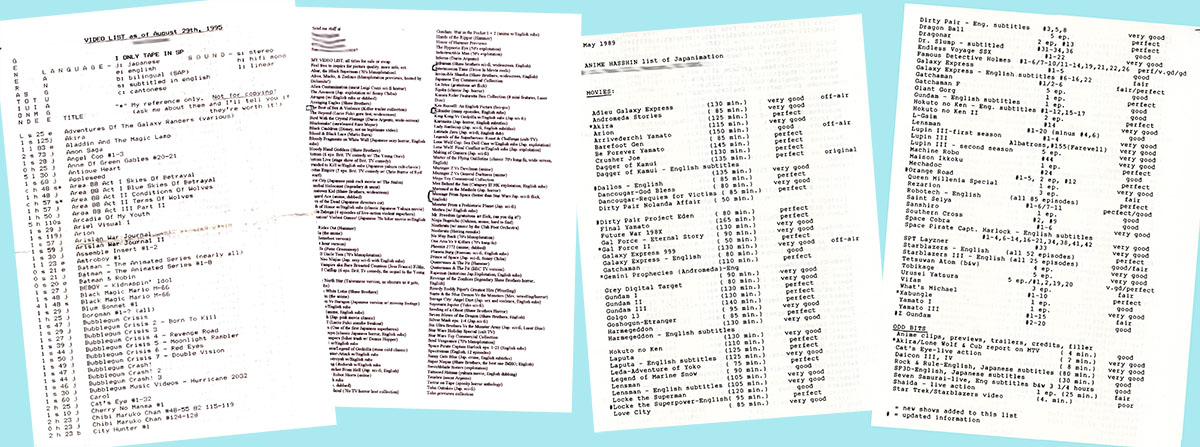
lists of anime tapes in the collections of anime fans circa 1990


His reply letter more or less agreed with me, or at least admitted that we all have our own preferences. I figured I’d never hear from him again, Well, a week later a tape arrived in the mail from him, along with return postage and a request list that was almost exactly six hours long. A movie, two OVAs, some TV episodes, just cram it all on there, please.

I’m like, whatever. The tape goes on the pile of tapes to be copied. You see, at the time I was copying a lot of tapes from people both through the mail and right at home. I’d come home from the local anime club with a stack of blanks and a list of requests, and I spent a lot of time violating copyright law so Bob McBobbob and his pals could watch Project A-Ko or “Dirty Pair Does Dishes” at their leisure.

One week later, I get a long, pissed-off letter from the guy, asking where the hell his tape is, how dare I treat anime fans in this way, where do I get off behaving in such an obnoxious fashion, HE always makes sure HE gets HIS tapes done quickly, etc etc.
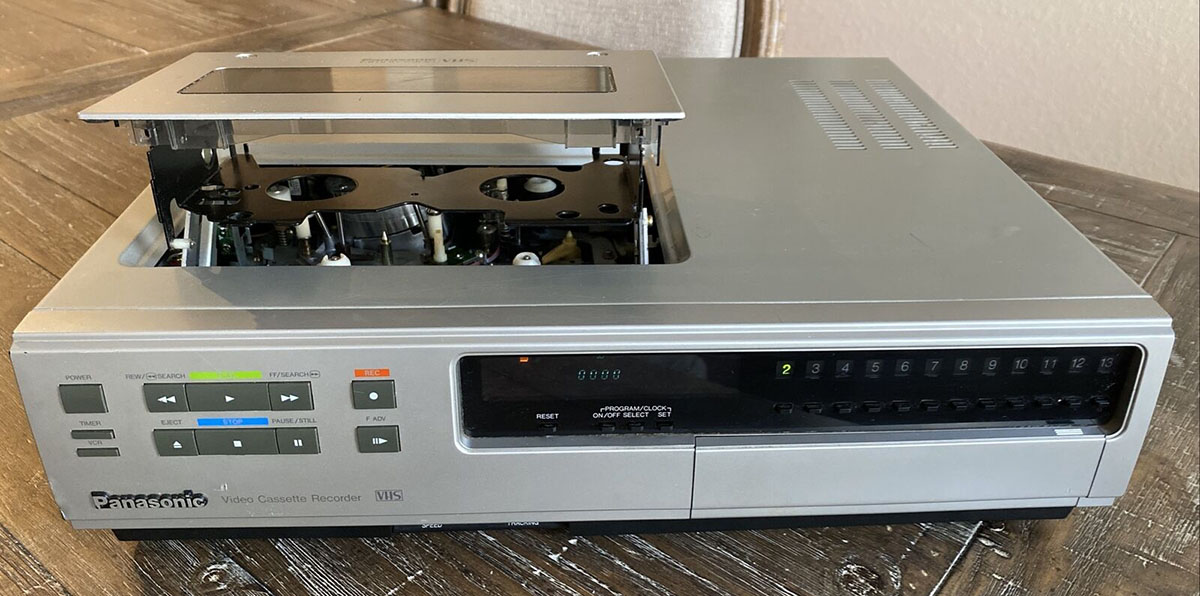

So this gets my full attention. What I do is I dig out my oldest, funkiest, top-loading 2-head VCR that only records in black and white. It was a Panasonic that suffered a drop onto a concrete landing after I tripped on some stairs while carrying it to a Saturday night let’s-copy-anime-and-eat-pizza gathering at a now demolished apartment complex at Lindbergh and Piedmont in Atlanta. I used this Panasonic as the recording deck. Every so often as I passed the machine I gave it a mighty smash with my hand or other suitable blunt instrument. Talk about hashtag VHS Artifacts! They got all six hours of anime, though. Was it watchable? I don’t know. I never heard from them again. 
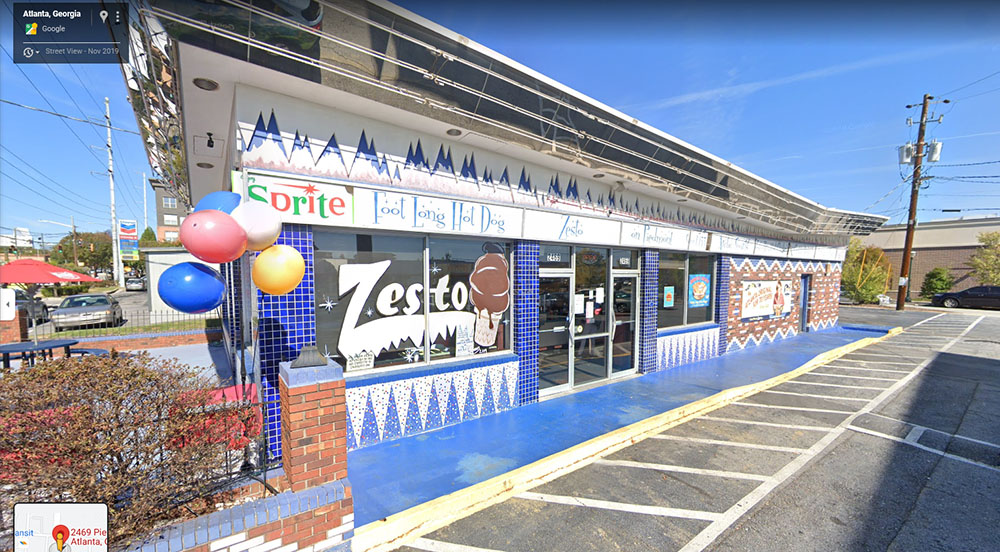
 

meet you at Zesto's on Piedmont


2.

A few years later we were fan-subtitling Captain Harlock though the auspices of Corn Pone Flicks. A VHS, a SASE, and a request for episodes arrived, as per our guidelines. We put the Harlock episodes on the tape, which was placed into its already-stamped return envelope, and mailed back.


A month later the emails started – that tape never arrived. Which is a thing that happens sometimes. Mail gets lost. It’s a thing. What made this email special was the demand we replace and mail this person their replacement tape on our own dime. Because, as the email stated, we were running a business and as such had a responsibility to our customers. Since we were most definitely NOT running a business, we actually had NO such responsibility. By that time we’d learned just ignoring the kooks was the best plan of action, which is what we did to the increasingly angry emails that continued to arrive, eventually accusing Corn Pone Flicks of running an elaborate swindle, stealing blank VHS tapes from an unsuspecting public. The perfect crime!

3.

Speaking of copying tapes, it was the custom of the time for anime nerds such as myself to have lists of their available anime titles photocopied and available to send out, because it’s difficult to ask for tapes you don’t know exist. If you were a member of an anime club or two, you might have access to the anime lists of five, ten, twenty anime tape traders. You might not consider these lists themselves a valuable commodity, but a Pacific Northwest outfit known as Kinosei Anime thought otherwise! For a small fee of six dollars, they would send you the tape lists of fans and clubs who were willing to copy anime for strangers! I found out about Kinosei when I started getting letters from people who had acquired my name and address from them. And no, Kinosei Anime never asked permission to send anyone’s name, address, and list of tapes out to the world as part of their low-stakes unethical behavior game. I mean, it’s not a big deal – I’m sure this scheme netted them, what, thirty, forty bucks, max – but ask first, people.

"Dear Dave, I have sold your name and address to strangers. Do you have any Kimba The White Lion. Thanks, Jeff"


4.

So back in, like, 1989-1990, our phone rang. It was the operator, asking if I would accept the charges on a collect call from a person whom I didn’t know. I figured it had to be an emergency, or at least really important, so I said “yes”. BIG MISTAKE. The mystery caller is a guy who fished my name out of the C/FO Directory. He figured he’d call me collect and ask lots of questions about Japanese TV shows in general and the live-action superhero show Spectreman in particular. No emergency, no crisis, not even a very interesting conversation. Definitely not worth my dime or my time. 
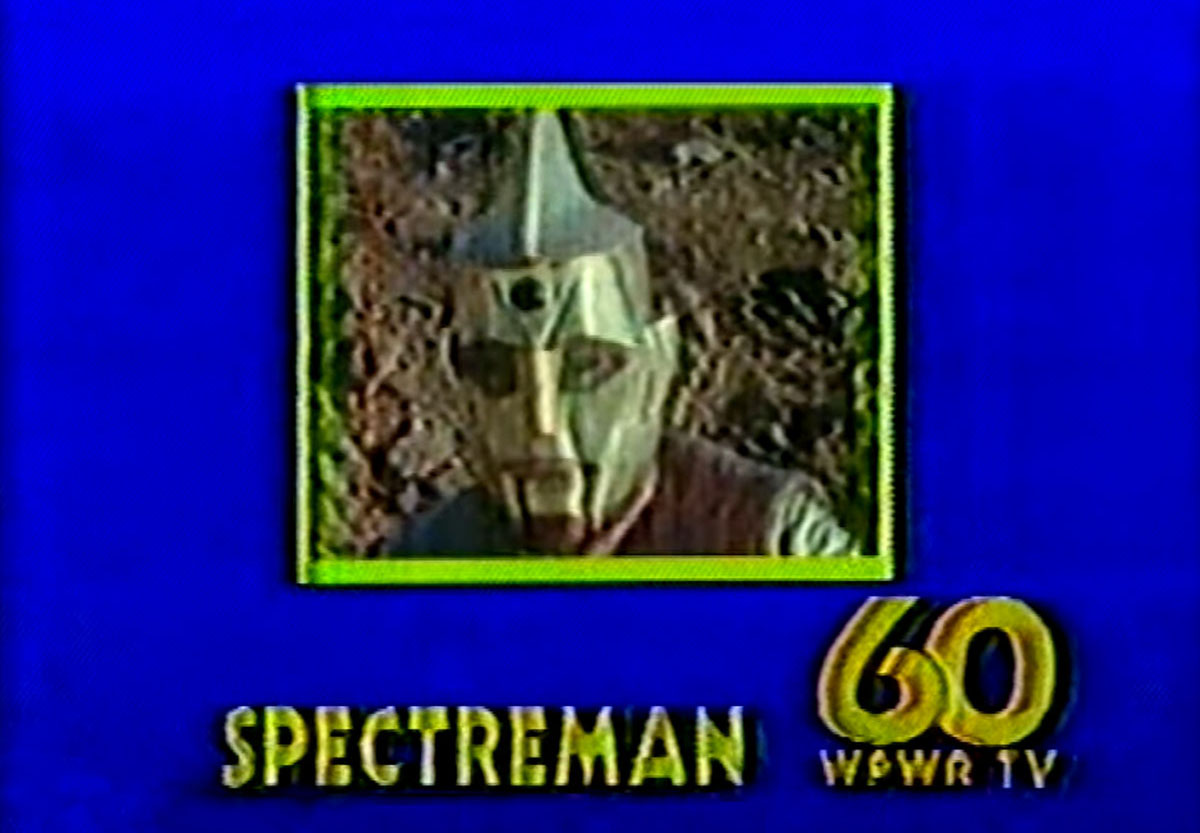
a mystery with a name

He wanted to know this. He wanted to know that. He wanted me to mail him tapes. He wanted me to mail him fanzines. He wanted everything as free gifts from the goodness of my heart and the bottomlessness of my bank account, the extent of both having been greatly exaggerated somewhere down the line. I gathered from his rambling conversation that his caregivers wouldn’t let him call people unless it was collect, and they also wouldn’t give him any money for fanzines or tapes. So obviously, collect-calling to panhandle from strangers was his only option. I finally got off the phone without agreeing to send him anything. Sure, I should have just hung up on the guy, but I was raised to be polite.

the 1988 C/FO Membership Directory - personal information redacted
 

He called right back the next day. I refused the charges. He called back several times over the weekend. We refused the charges. About a year later he called AGAIN. I heard the operator ask if I’d accept the charges from this guy’s name, and I threw the phone across the room while hollering “NOOOOOO!!” in slow motion, just like the movies.

Found out later I wasn’t the only person to get the collect treatment. A pal of mine in South Carolina also got nailed, and at least one former C/FO generalissimo was on the receiving end of who became known as “The Collect Call Bandit.” My guess is that the guy was in some sort of managed care or group home situation and whenever he got a chance, he leaped to the nearest telephone and started collect-calling people like a maniac until the white coats could pry him loose and get that straitjacket back on him.

Anyway the moral of the story is never, ever accept collect calls from strangers. Those 1-800-Collect people are LYING TO YOU. Oh, and also, never let anyone print your home phone number anywhere.


don't do it

Of course, these days we’re deluged by scam calls and robocalls from duct cleaning services and extended warranty salesmen and important messages threatening imminent arrest from the IRS, Immigration or the Social Security Administration. Compared to all this, simply being desperate for Spectreman sounds downright wholesome.

5.

The hands down most annoying guy I ever swapped tapes with was a person I’m going to call named “Bert Ernieson.” He’s another someone I got in touch with via anime club trader lists. Where do I begin? His video lists were handwritten in barely legible pencil on three-hole lined notebook paper. These letters were typically five or six double sided pages filled with scores of trivial questions. Tape requests from Bert would be for odd, hard-to-dig-out titles – in the VHS days this meant fast forwarding to the middle of a tape to find the exact requested episode of Urusei Yatsura or whatever. Let me tell you after four or five tapes, all this cueing time adds up. His mail would include various right-wing pamphlets, for instance the famed, completely bogus urban legend alert about how a cabal of atheists, led by Madalyn Murray O'Hair herself, were going to get all religious programming banned from TV. This right-wing Christian material seemed at odds with some of the selections on Bert’s own tape list, which, to be fair, featured a lot of obscure anime titles, but also included hard-core triple-X American adult films.


But all that was just mildly annoying. Bert, however, took it to the next level. For one thing, he shipped EVERYTHING Media Mail® (Book Rate), the cheapest, slowest, most error-prone way to mail anything. Nothing could induce him to ship things first class, not even sending him the extra postage. Invariably he would use and re-use and re-re-re-use cheap, fiber-particle filled padded mailing envelopes. Items shipped thusly would wind up covered with tiny bits of paper and fiber. This might be OK for books. However, trying to play VHS tapes covered with tiny bits of paper and fiber will result in a VCR mechanism coated with tiny bits of paper and fiber. This is, shall we say, contraindicated by the operating manual.


And then we have the VHS tapes themselves. The tape trading custom of the time was that you’d buy brand new tapes and copy trade requests onto the brand new tapes. But Bert had another plan. He’d copy YOUR requests onto whatever tapes he happened to have lying around. Brand new from the store, or used over and over again, didn’t matter to Bert. Quality brands like Sony, TDK, Fuji or Maxell? Awful house-brand K-mart tapes or clearance bin rejects? It’s all videotape to Bert. He explained his method was to re-copy every incoming video onto 6-hour tapes, apparently to save space in his closet or dungeon or whereever. In practical terms, this meant every single movie or TV show you requested from him had already been transferred to one of his grab-bag mystery-brand video tapes, at a recording speed ensuring the worst possible audio and video quality.

Avoid these brands
 

This tape-recycling meant leftovers at the end of tapes, just in case you enjoy being surprised by, say,13th-generation English dubs of partial Cream Lemon episodes at the end of the super robot cartoon you were showing friends while parents were in the room. Try it, it’s embarrassing and fun! Or when you agree to swap three tapes, and he sends you four, the extra one full of unasked-for junk, just so he can say “hey, I sent you four tapes, now you owe me four tapes instead of the three we agreed on.”

And yet, I continued to swap tapes with him (there were a LOT of obscure titles in his Crawlspace Of Questions), until one day he tried to pull a fast one on a friend, let’s call this friend Lisa Black. He couldn’t or wouldn’t follow Lisa’s simple requests for “new tapes” and “no fiber mailers,” so she refused to copy any more tapes for him. In order to get around her embargo, he started to send her blanks under a different name, utilizing the concept of “sock puppets” before the internet was really even a thing.

I dunno. Maybe it WAS his cousin, like he said. I don’t care. Anyway, she saw through the ruse, because Bert wasn’t smart enough to change his distinctive ordering habits, or his distinctive handwriting. Around this time I happened to mention Lisa in a letter to Bert and his reply was that he was disappointed “I was still dealing with that Nazi, Lisa Black.” Well, I replied that I’d been trading with Lisa for 10 years, that she was, to the best of my knowledge, not an adherent of National Socialism, that she was one of the few truly decent people in a hobby full of obnoxious jerks, and that Bert and I were done swapping tapes. Goodbye to shitty copies of obscure robot anime, to ripped fiberpack mailers, to 4th class book rate, to letters full of questions and demands. Somehow, the anime fan world survived without these things.


Life moves on. A fandom of tape-swapping nerds evolves into a fandom of convention-going nerds. Anime became something we watched in theaters, bought at Best Buy, and eventually streamed on computers. Of course, annoying fans still exist, but their annoyances are new and exciting, in ways we could only have dreamed of back in the day. And let’s be honest, the truth is that for every jerk there were and are ten or twenty non-jerks; reasonable, friendly, generous anime fans ready to show up, help out, and bring snacks, fans who send surprises in the mail and bring gifts back from their Japan trips, fans who build friendships that survive decades. Without fandom, my life would have be considerably lonelier, be much less exciting, and would certainly be bereft of many Japanese cartoons and their related paraphernalia and accoutrements.

Yes, there are a few times when I’m exceptionally maudlin or temporarily addled, when I reminisce about the “good old days” of swapping tapes through the mail. Who doesn’t love to get packages in the mail? Those were exciting times, learning about a whole new art form and sharing that knowledge with anyone who’d sit still long enough. Certainly those tape-trading networks proved their worth, educating a continent and forging powerful bonds And yet, if the harsh modern world of the 21st century means I’ll never again get bitched out by total strangers over copies of Japanese cartoons, then I’m all for progress.

-Dave Merrill

Thanks for reading Let's Anime! If you enjoyed it and want to show your appreciation for what we do here as part of the Mister Kitty Dot Net world, please consider joining our Patreon!

Saturday, June 26, 2021

I Was A Teenage Anime Club President

As a former teenage anime club president, I spend a lot of time these days sitting on my porch in my rocking chair with my elderly cronies, sneering at the kids today with their hair and their clothes and their streaming video and their instagram influencers. Actually, I don't do any of that. Instead, occasionally I pull some stuff from my files and use that junk to write about our anime club experience. Like now!


The 1980s were tough for anime fans. Streaming video on the internet didn't exist. The internet pretty much didn’t exist. Funimation, Sentai, Nozomi, and Discotek weren’t around to sell us DVDs or Blu-Rays, which also didn't exist. Sure, there were video rentals on every corner, but their anime selections were limited to Ninja The Wonder Boy or Chatterer The Squirrel or Jim Terry compilations of super robot cartoons shoved into the kiddy section. If you wanted anime, you had to know somebody who had it and was willing to copy it for you. In practical terms, you either cultivated a network of Japanese pen pals with whom you'd trade off-air American TV for Japanese anime, or you bought bootleg anime videos from a dealer at your local comic-con, or you joined one of several anime clubs, hoping they’d put you in touch with somebody who'd copy tapes for you. It was a complicated process.

In Atlanta I'd been attending comic conventions and Dr Who club meetings since I was 14, trying to get a line on somebody who knew how I could get my hands on anything with those big-eyed Japanese cartoon characters. The people I met at those conventions and clubs were grownups from places like Florida and Michigan with tapes of Lupin III and Space Cobra, and most were members of something called the Cartoon/Fantasy Organization.


C/FO New York meeting flyer from 1980

There were two other guys in Atlanta also trying to find anime and find others who liked anime. Eventually we put our heads together and decided to start our own local branch of this Cartoon Fantasy Organization. We'd meet once a month in whatever community room we could reserve, we'd screen whatever anime we could find, and we'd generally nerd out. That was our plan and we're still kind of following that plan, some of us.


C/FO Atlanta newsletter 1,3,4,5 (#2 is lost)


For us in Atlanta, those two or three years of C/FO activity were busy times. We had a meeting once a month, we went to every comic con, Trek Fest, and fantasy fair that would let us in the door, and we were constantly meeting at somebody's house to daisy-chain VHS decks and copy Vampire Hunter D or Project A-Ko or some other future Blu-Ray release over and over again into the wee hours, at which point we'd adjourn to Denny's for bad coffee and heartburn.


April 1987, for instance: we watched Time Stranger in somebody’s apartment, we’re going to defy the Omni Hotel’s ban on in-room VCRs, here's some fan art, who wants a button.


Screening anime at meetings meant borrowing the library's Media Cart - a big metal wheeled cart containing a 27" CRT TV and, if we were lucky, a top-loading VHS deck. Eventually we began bringing in our own TVs and VHS decks, and we began splitting the TV signal to secondary monitors and running the audio out to a boom box or somebody's stereo. It got kind of complicated up in there.


C/FO Atlanta newsletter #6-8


March 1987's news featuring Harlock, Gundam, Urusei Yatsura, Dirty Pair. Sounds like my Twitter feed. It only took us eight years to get that proposed anime con off the ground!


C/FO Atlanta newsletter 9-12

Our club screened pretty much whatever turned up that month; a lot of members were swapping VHS with people all over the country and the world, and usually there would be two or three decks in the back of the room copying something for somebody. I'd come home from anime club meetings with a stack of blank tapes that needed Dancougar or Dirty Pair or Yamato copied onto them. The soft whir of the Toshiba M-7850 was always in the background of my life at that time.


tips for home tapers from July 1988


The monthly newsletter we published was a lot of work, but it had benefits. Most importantly, the newsletter told the members where and when our next meeting was. C/FO Atlanta met in a wide variety of locations, including private homes from Smyrna to Stone Mountain, libraries in Little Five Points and Virginia-Highlands, and even a few community rooms located, for some reason, in banks along the Buford Highway corridor, one of which is now a restaurant called “Shaking Crawfish.”


C/FO newsletter volume 2 #1-3


Assembled at first using a law firm’s then state of the art word processing software and laser printers, we later downgraded to a dot-matrix printer, markers, glue stick, and scissors. Producing the C/FO Atlanta newsletter was a crash course in graphic design and guerrilla publishing. Print runs happened wherever and whenever we could get access to somebody’s copier, and this usually meant abusing the hospitality of whoever in the club worked somewhere with a photocopier. But the newsletter was all for a good cause, documenting what the club had been up to for posterity (that’s us now) and cluing members into what was happening in the world of anime. Sometimes the news was even accurate!


your "trusted" source for anime "news"


You might even have been lucky enough to live in a town with enough of a Japanese community to support retailers that sold imported Japanese home goods, Japanese groceries, and Japanese media like magazines, books, comics, and videos. Atlanta was one of those towns, and in our part of town Satsumaya Oriental Grocery was our headquarters for Pocky, Zeta Gundam coffee candy, and rental tapes featuring Dragonball, whatever Sentai show was on the air that season (Choushinsei Flashman), Dragonar-1, Maison Ikkoku, Saint Seiya, Metaldar, City Hunter, and Red Photon Zillion, which seemed to resemble a game some members were playing on their new Sega Master Systems.


Satsumaya rental VHS


Occasionally we'd pack up our VCRs and get a hotel room at one of Atlanta’s fantasy or SF conventions like Dixie-Trek or the Atlanta Fantasy Fair, and we'd screen anime on the TV in our hotel room for our friends and whoever happened to wander in for free snacks.


Thanks to our tapes and the hunger of convention organizers for programming, by 1988 we were running the anime room at Atlanta's largest fantasy convention, the Atlanta Fantasy Fair. Most of what we screened was in Japanese without benefit of subtitles, with a smattering of off-air English dubs and a little fan subbing taking up the slack.


How many people were awake on Sunday for Cyborg 009 Legend Of The Super Galaxy? I don’t know. I can confirm that we had a full house for the Fist Of The North Star movie and Project A-Ko. That’s a room full of non-Japanese speakers watching entire films entirely in Japanese, a testament to the storytelling power of the medium.


C/FO Atlanta newsletter vol. 2 #4-7


C/FO Atlanta newsletter vol. 2 #8-11 (end)


big news for Dec. 1988

Eventually the C/FO would skid to a halt. Leadership devolved to the San Antonio club, which basically decided to game the system, set the national org up to fail, and then act surprised when it failed. Our Atlanta club let inertia decide for us; the national C/FO left us behind in its headlong rush towards oblivion and we decided our new name was going to be the "Animated Film Association" and our newsletter was going to be called “Anime-X”.


the three issues of "Anime X". Look at that great Josh Timbrook Akira cover!


The club kept going under this name for a few months, but after a few years the never-ending cycle of monthly meetings and monthly newsletters and manhandling televisions across town so a room full of slack-jawed strangers can stare at Akira proved too much for me and in early 1989 the club petered out. Was this the end of Atlanta’s anime club scene?


meet the new club, different from the old club

Absolutely not. After an eight months cooling-off period, Lloyd Carter and myself started a new anime club. This new club didn't have a newsletter, wasn't part of a larger club, and wasted no time on bylaws or elections. “Why waste a great name?” we figured, and so we dubbed the new club "Anime-X." This group lasted all the way until the early 2000s, leading to both the print "Let's Anime" and Anime Weekend Atlanta. So we must have been doing something right. More about Anime X later. In the meantime, why not haul a CRT television, a top-loading VCR, and some VHS fansubs to your local community center and start your own anime club? Tell ‘em Dave sent you!


-Dave Merrill, with special thanks to Scott Weikert, Jim Reddy, Shaun Camp, Newton Ewell, Ted Delorme, and a host of C/FO Atlanta members. You know who you are.


we'll let this pencilled-in editorial comment have the last word


Thanks for reading Let's Anime! If you enjoyed it and want to show your appreciation for what we do here as part of the Mister Kitty Dot Net world, please consider joining our Patreon!


Saturday, January 25, 2020

the persistence of the vision of anime info packets

BROTHERS and SISTERS, FRIENDS of the REVOLUTION, I come before you today to TESTIFY! We have COME THROUGH THE VALLEY of the INFORMATION SUPERHIGHWAY, my friends! We have SCREEN-CAPPED and we have PHOTOSHOPPED and we have even MEMED, my friends, we've been adopted into today's digital world where our LIVES are turned into JPEGs and PDFs and GIFs and put onto CD-ROMs and emailed as ATTACHMENTS, my brethren, we've been TWEETED AT and FACEBOOKED and INSTAGRAMMED until Impact Fonts and Hazy Sunset Filters are part of our DAILY LIVES! They're INESCAPABLE, my friends, we carry 'em in our POCKETS and on our TVs and in our CARS and we act like it's always been this way and it's gonna be this way FOREVER, AMEN. Well I am here to TESTIFY that all our DIGITAL EVERYTHING is just DIGITS IN THE WIND, dear friends. They're PHANTOMS that COME AND GO with the breeze! Dearly beloved, that server gonna CRASH! That streaming service gonna go BANKRUPT! That hard drive gonna give you the CLICK O' DEATH, can I get an AMEN? Photobucket and Flickr and Imgur will one day go the way of the DINOSAURS and you'll NEVER get those photos back! Twitter will FAILWHALE and Facebook gonna get DDOS'd and Tumblr gonna STUMBLE, brothers and sisters. And I ask you WHERE WILL YOU BE? WHERE WILL YOU BE ON THAT DAY?


My friends I'll TELL you where you gonna be on that day. You gonna be looking at something PRINTED on PAPER because, my friends, PRINT IS KING. That's right! No power outage gonna erase that paperback book! Ain't no batteries in your daily newspaper! Nobody gonna be DRM'ing your Rand McNally Atlas you keep in the trunk of your car just in case! Do this for me, friends, get a SHOVEL and go on down to the TOWN DUMP and start DIGGIN' brothers and sisters, and what are you gonna find? You're gonna find PRINT, is what you're gonna find. Newspapers, magazines, TPS reports, grocery lists, Sears catalogs, junk mail, and books, books, books, because when you LAY something down on PAPER that SOMETHING is gonna STAY THERE until somebody SETS FIRE TO IT or puts it through an INDUSTRIAL SHREDDER, and ain't many of those around, and nobody got time for that anyways. 

Let me assure you, dear friends, I'm DEADLY SERIOUS about this, print is gonna last. Don't take MY word for it! Oh no. I have proof and everything, and that proof is the sheer weight of paper that the North American anime nerds of the 1980s had to generate just to keep themselves informed on what the hell it was they were watching! Sure, everybody knows there was a big secret network of hidden "tape traders" copying Japanese cartoons onto glitchy 1980s VHS tape and swapping them with friends and strangers across the land. And everybody knows that most of those cartoons were in regular old Japanese without so much as a subtitle or a bad American dub. But what might not be apparent to the interested parties thirty and forty years later is that alongside those Scotch and TDK brand VHS and Beta cassettes, alongside that magnetic tape was good old fashioned print on paper explaining these TV cartoons and movies for viewers who might not speak Japanese. Yes, these copy paper Rosetta Stones were circulated amongst the faithful, copied, re-copied, and re-re-re-copied just like the VHS tapes themselves, sourced from fanzines and APAs and round-robin letters and the occasional industry publication or newspaper, collated and packaged and mailed out to keep America's anime nerds reasonably informed about who was killing whom in the giant robot epic they were currently confusing anime-club audiences with. 


Many of these synopses were reprinted right out of the anime club newsletters, that tiny dot-matrix print blurring into something resembling readability. One of the most common handouts would be overviews of entire anime TV series covering broad plot points, characters, key pieces of machinery, air dates, and if you were lucky, some vintage fan artwork, as in this Pat Munson-Siter Science Ninja Team Gatchaman piece hijacked from the C/FO San Antonio newsletter.


Here Brother Steve Harrison walks us through the characters of the Captain Harlock TV series Eternal Orbit (or, as we were calling it, "Endless Road") SSX, complete with illustrations of the characters cut and pasted from the gospel of My Anime Endless Road SSX Preview Dec.'82. With data like this, an anime fan could (and would!) watch an entire TV series and be kinda sorta able to follow the story reasonably well, even without Japanese language skills.

A simple list of film release dates, as seen here, proved invaluable when writing about anime theatrical releases. The run times were absolutely vital when trying to figure out if Mobile Suit Gundam II was going to fit on a T-120 VHS tape (not at SP speed, it won't). Thirty four years later we in the West are able to watch a surprising chunk of this list, with the glaring exception of Arion, Future War 198X, and of course Gu Gu Chicken. Get with it, licensors! 


Here's a piece about Metal Armor Dragonar, the only Mobile Suit Gundam series that was NEVER a Mobile Suit Gundam series. It's notable for the green paper, for being about all the attention this show would ever get in the West, and again for being a prime example of that fuzzy dot-matrix printing combined with the smallest possible font size. Yeah I wear glasses now, THANK YOU


Many of these anime synopses were reprinted from anime fandom Amateur Press Associations (or A.P.A.s), the self-published collective magazines that were the primary source of fan drama in those more innocent pre-internet days. This guide to Dream Hunter Rem first saw light in C/FO Santa Monica's program book and then was appropriated for use in "Out Of Chaos," which was the title for someone's personal section of whatever A.P.A. they were a part of - maybe Sasha, or Final Stop Andromeda, or APA Hasshin, or another of the myriad of anime-focused A.P.A.s that clogged mailboxes and inspired flame wars. 


This synopsis of the Galaxy Express TV special "Eternal Wanderer Emeraldas" was reprinted exclusively for the Books Nippan Animation Fan Club, courtesy the Japanese Animation Archives, open to the public by appointment only. "Petuniacon" was, interestingly enough, a Bay Area indy comics convention built around an appearance by Cerebus creator Dave Sim. Note the spelling of "Emeraldus," and keep in mind this is how we spelled it back then and that's why occasionally we still spell it like that. Come at us, bro!


Sometimes they'd just cram four or five short synopses onto one page, giving readers a cheat sheet of 80s Japanese animated film, typed on what appears to be the same equipment used to produce much of the early C/FO's printed output, an IBM Selectric with a nice clean typeface, thank goodness.


Popular series like Urusei Yatsura would receive comprehensive coverage in these packets, like this extensive piece from the "Final Stop Andromeda" APA.


This particular UY guide had been copied, stapled, copied again, stapled again, copied and stapled a third time. People really needed to know about Urusei Yatsura!


And once you managed to actually get a few Urusei Yatsura episodes on videotape, well, you needed to know which episodes they were, so that you could label your random assortment of Urusei Yatsura episodes correctly. 

desperately random selection of Urusei Yatsura episodes

You may ask, how did these information packets reach the fans? What were their distribution channels? Well, one way you'd get them is by joining an anime club - Anime Hasshin made them available to members. Other fans took it upon themselves to compile all the information they could possibly grab and assemble them into sets, which would be copied and sent out to fans everywhere! 


Yes, years before Helen McCarthy and Jonathan Clements would edit their Anime Encyclopedia, Houston's Lynn Johnson (not the cartoonist Lynn Johnston, mind you) was doing the Lord's work packaging vital anime information one packet at a time, sending 'em out to anyone with a few bucks to spare and a three ring binder to keep 'em in. Meanwhile, a growing contingent of amateur linguists were ferreting out the hidden meanings of all that katakana and kanji keeping us from knowing what was really going on in our favorite anime titles. 


An entire galaxy of teasingly unavailable anime titles were detailed in various magazines and books, and while today fans may recognize Area 88 and Laputa (starring "Pazoo" and "Cedar"), and hope one day Kenritsu Chikyu Boeigun (Prefectural Earth Defense Force) returns to home video availability, we might still wonder about "Love 30S Chuhai Lemon." Wonder no more, dear friends! Love 30S Chuhai Lemon was produced by Wonder Kids in 1985, it's based on a manga about a hard boiled detective and his clumsy romance, it featured the song "Raindrops Keep Falling On My Head," and Wonder Kids went bankrupt immediately after releasing it.


Meanwhile Hiro Media Associates was planning to dominate the nascent Original Video Animation market, both with animation from Kaname Productions and with their anime magazine "Globian," which would cover the whole world of direct-to-video animation. And, when Bruce Eimon finished translating their video guide, we'd all get a taste of what we'd be watching 4th generation VHS copies of at our next club meeting. Thank you Bruce!


Occasionally a little bit of editorial bias would wriggle its way into their reviews. 


"...a big spoof with nonsense animation..." - there's your pull quote right there!

Occasionally the American mass media would take notice of Japanese animation. America's "Japanimation" fans would dutifully clip those press clippings and distribute them widely as proof to the world that Japanese animation was a legitimate art form and not just a bunch of weirdos sitting in a dark room waiting for some cartoon character to flash her panties. Even though I'm not gonna lie, that's pretty much what it was most of the time.


And occasionally anime-adjacent properties would make their way into the info packets- like Kow Yokoyama's post-apocalypse model kit diorama-saga Maschinen Krieger ZbV 3000 aka "SF 3D," and the subsequent role playing game based on the series, and its English translation courtesy Space Battleship Yamato model kit importers TCI. 


But for the most part, the contents of these anime info packets were as advertised, information about Japanese animation titles, some of which wouldn't get licensed releases for decades. 


And some of which STILL haven't received licensed releases. 


Seriously, I can see Touch not making it over here, sports anime is a hard sell, but Cosmo Police Justy had its own American comic book! And SPT Layzner, well, that one actually made it to the "licensed" stage, but never actually came out. Sure, the masters Bandai provided were flawed, but so what? Nothing's perfect!


At this point you're probably thinking, "Sure, this is interesting. But how exactly were groups of anime fans reproducing these info packets? What were the technological and economic circumstances that came together in the 80s to make photocopying cheap and easy? Well, I can tell you in one word, and that word is KINKO'S.

vintage 80s Kinko's ads

The first Kinko's opened in 1970 near UC Santa Barbara and grew to 1200 24-hour copy centers across ten different countries, a place where every struggling rock band, glue-stick fevered zinester, ink-stained cartoonist, aspiring entrepreneur, and Japanese cartoon synopsis distributor could roll up to at 1am and start making copies. Kinko's facilitiated the distribution of raw, genuine information on a scale never before seen, putting the power of print in the hands of anyone with four cents and something that would lie flat on the platen glass. Enabling collage artists, early desktop publishers, and an entire world of Factsheet Five-reading small press publishing mail art aficionados, Kinko's was instrumental in driving the visual culture of the last quarter of the 20th century. 

These are a few of my favorite zines

And sure, here in the 21st century, the zine culture that once crowded racks at Tower Records is gone. And Tower Records is also gone. Both were replaced with the internet, from which we download our music and with which we share information about Japanese cartoons. It's convenient and fast, and nobody's asking four cents a copy or what's the difference between 20# and 60# paper. But there are downsides to this convenience. Digital media, well, it's ones and zeros stored on somebody's hard drive or optical disc or server somewhere, and that's not nearly as permanent as paper. The zines we made in the 1980s and 1990s? Well, unless you took steps to get rid of 'em, they're still around somewhere in a box in your closet. But websites? If you stop paying for that hosting that website is going bye-bye. If your web host goes out of business and you didn't keep a backup, well, so long to all your work. YouTube can delete all your content, Facebook can delete all your content, hell, even Google here can delete all MY content. Let's Anime could vanish forever in an instant! Except, of course, for the print version from the 90s, which is, of course, safe in a box in my closet!


pasteups from Let's Anime #4

My friends, that's why we're still looking at these info packets twenty and thirty and thirty five years later. They're a snapshot of the anime we were watching, the anime we wished we could watch, and in some cases the anime we had no idea even existed. These things are desire itself, manifested upon paper, a magical spell hoping to bring forth Amon Saga and Roots Search and Votoms. These info packets are physical evidence of the work of a generation of fans that didn't know someday we'd be watching this stuff in English on our phones that we keep in our pockets everywhere. They only knew that they had to secure that information, they had to reproduce that information, and they had to keep it moving to the next group of fans, because information is always essential... except for whatever was going on with this Five Star Stories synopsis.


Remember dear friends, print is FOREVER! Can I get an amen? 

--Dave Merrill

Thanks for reading Let's Anime! If you enjoyed it and want to show your appreciation for what we do here as part of the Mister Kitty Dot Net world, please consider joining our Patreon!