Showing posts with label urusei yatsura. Show all posts

Friday, March 31, 2023

A Time Slip Of Forty Years: 1983 In Anime Film


Let's look at the numbers. In 1982 there were 21 animated movies released in Japanese cinemas with a total running time of 1881 minutes. The next year saw slightly fewer films-  only 19 - and a concomitant shrinkage of total length down to a mere sixteen hundred sixty-five minutes. You could marathon that in less than a day! But when you look at the actual films themselves forty years ago, a different story emerges, a story of Crushers, Fantastic Trips, long-distance murder professionals, magic islands, time slips, Final Yamatos, and horrific disasters both real and imaginary. 1983 was a year of Japanese animation pulling away from its terebi manga roots and finally becoming real, slightly overstuffed roadshow capital-c Cinema in brand new ways. Let's take a look at the anime films in the order in which they were released forty years back!


Urusei Yatsura: Only You planted its tiger-striped-booted feet firmly into February 1983 and said, this is what it's gonna look like for the next few years, anime is going to be an outer space carnival of pop music, cute girls, interstellar hijinks, and frustrated romance. Based on the popular Shonen Sunday manga by Rumiko Takahashi, Urusei Yatsura, or "Those Obnoxious Aliens" as we used to call it, ostensibly is the story of Lum the invader gal and her hapless boyfriend, the dopey, skirt-chasing Ataru. Quickly overwhelmed by its equally obnoxious cast and a creative team that included Mamoru Oshii and Akemi Takada, the series became an ensemble comedy that bent the laws of time, space, propriety and gender. Only You is the first of six feature films that together with with 194 episodes of the Urusei Yatsura TV series would go a long way towards defining the 80s anime style.


One month later would be the premiere of Crusher Joe, a film directed by Yoshikazu "Yas" Yasuhiko, produced by Studio Nue and Nippon Sunrise, their first non-TV compilation film. Crusher Joe is based on the SF novels by Haruka Takachiho, who would go on to create the similarly-motifed and possibly canonically connected Dirty Pair. The far-future galactic troubleshooters known as Crushers operate throughout the galaxy, and the number one team is known as Crusher Joe after its leader Joe. His teammates the pretty princess Alfin, the cyborg Talos, engineering genius Ricky, and the 'droid Drongo uncover a conspiracy that threatens the galaxy while dodging both the murder plots of the space-pirate guild and the red tape of the United Planets. Pulpy science-fiction adventure in the classic style, Crusher Joe would get two more OVA sequels and this film would be gifted a terrible English dub that features new songs from "Bullets." Fret not, the Blu-Ray is subtitled.


The short feature Dr Slump HoYoyo! The Race Around The World premiered March 13, 1983 and the movie is just what it says on the tin. Indeed, this film is a wacky race as Akira Toriyama's zany Arale and the rest of the goofy Penguin Village gang pop the clutch and tell the world to eat their respective dusts. It's part of Dr. Slump's only American video release!
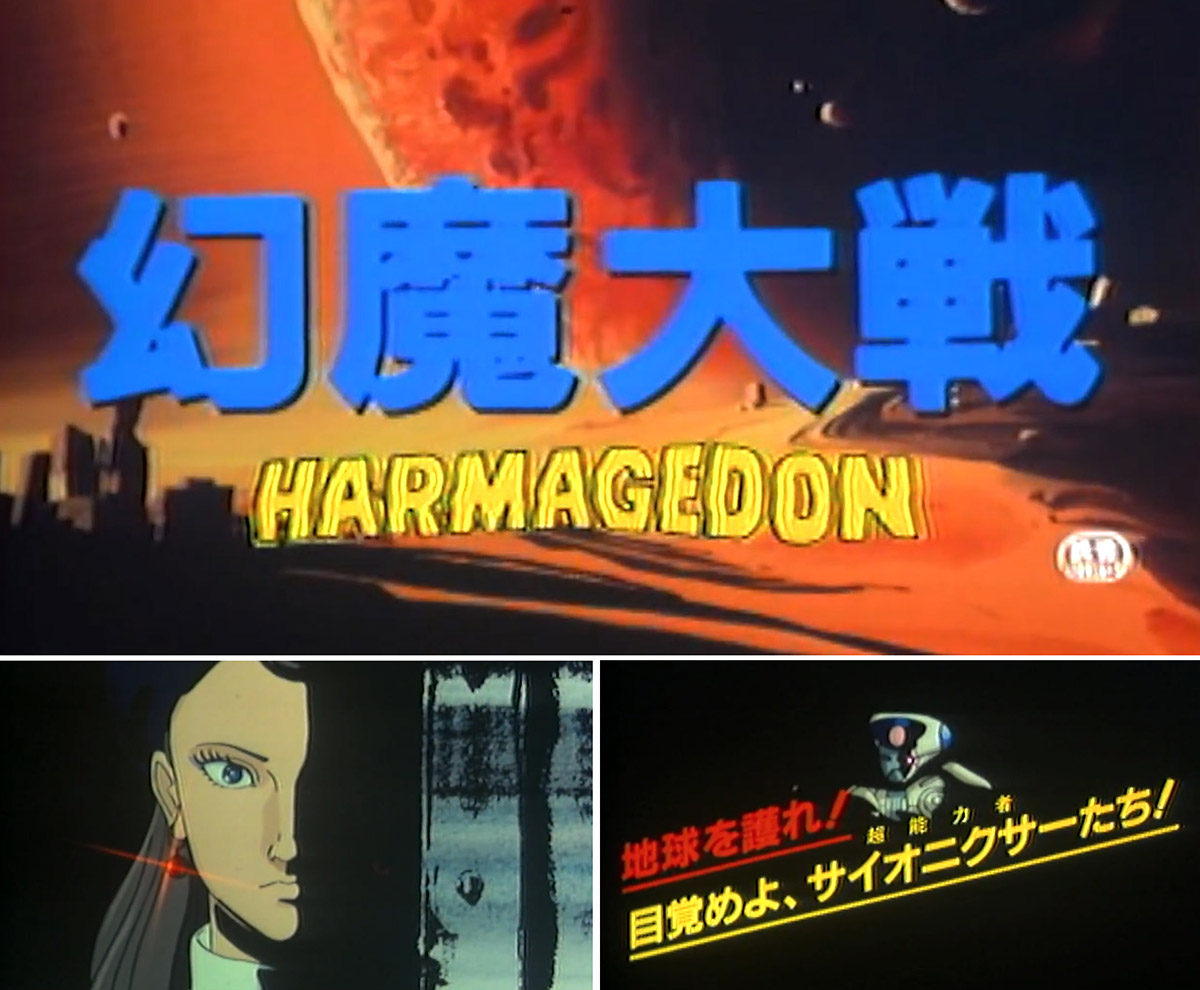

 
March 12 saw the release of Harmagedon, the first anime feature by publisher-turned-film-producer Haruki Kadokawa. This expensive, overstuffed epic features music from prog rock legend Keith Emerson and character designs by future prog manga legend Katsuhiro Otomo. Harmagedon, or Genma Taisen if we're going by the kanji, is based on the 1960s manga drawn by Shotaro Ishinomori and written by Kasumasu Hirai, who wrote manga classic 8-Man, pulp novel/Sonny Chiba vehicle Wolf Guy and a lengthy series of Harmagedon sequel novels. Hirai's interest in syncretic New Age religions is no surprise considering Harmagedon's script, filled with the vast darkness of Entropy fought across time and space by psychic warriors empowered by universal love consciousnesses. Harmagedon was released on VHS in the US in the 1990s, but earlier in the 80s you may have seen the laserdisk videogame it inspired, Bega's Battle.


The Space Battleship Yamato faces its ultimate challenge in Uchuu Senkan Yamato Kanketsu-hen, Space Battleship Yamato the Final Chapter (or as the English language text in the promotional material likes to call it, simply Final Yamato) as the evil Denguils, outer space legions descended from Mesopotamians rescued from the Biblical flood of Noah by the actual Satan, send the water planet Aquarius to literally drown the planet Earth again. Only the Yamato - captained by a surprisingly alive Captain Okita - can save us all. This epic spectacle's extended version clocks in at 163 minutes, which includes scenes producer Yoshinobu Nishizaki added into a 70mm re-release nine months after its initial March 19 premiere. Perhaps this film's butt-demolishing length helped Yamato fans weather the full decade before they'd see another Yamato project (the ill-fated Yamato 2520).


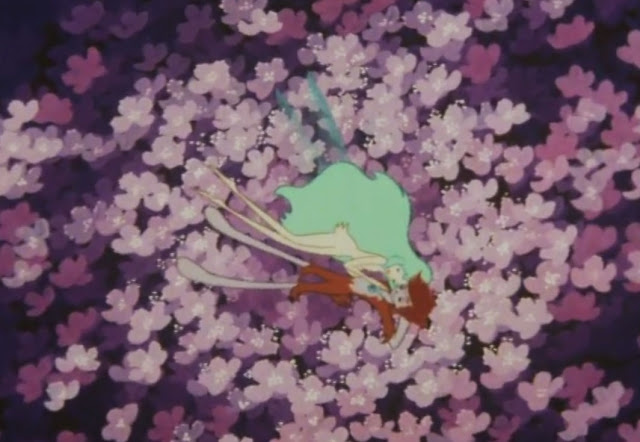
Noel embarked on her Fantastic Trip on April 29 1983. This movie feels like a vanity project for producer and Noel's voice actor Iruka, a Japanese folk singer who since 1970 has released 26 LPs, three books, four childrens' books, 8 radio shows, and acted in a medical TV drama. Iruka is really Toshie Hosaka, and she got the Iruka nickname in high school when she saw a crowd of music students carrying their guitar cases and said "it looks like a school of dolphins (iruka in Japanese)." So this particular Fantastic Trip of Noel's is a loosely plotted string of vignettes that allow the film to express simple concepts about pollution or friendship while delivering various Iruka songs. Noel lives on an island in space with her friend Pup and a bunch of animal friends. One day after singing a song about wanting to be a country girl, she decides the sun's too hot and would like some ice cream. So Noel and Pup take off in her airplane to give the Sun some ice cream. They stop at Planet Gaudy where she convinces everyone to become nudists. 

Meet The Beatles (And Noel)

After giving the Sun ice cream, they sing a few songs with the Yellow Submarine-era Beatles on the bottom of the ocean. Then smog attacks, but they are rescued by the super whale Super Zoomer. The source of the smog is an urbanized industrial planet, and the immediate threat is stopped by Super Zoomer and then there's an extended sequence involving babies on tricycles and a song about pollution controls. The end. Noel is voiced by Iruka in the original and by Corinne Orr in the American version, which aired on cable TV and was released on home video to a confused and bewildered nation.


First he was portrayed by Ken Takakura. Then Sonny Chiba took on the role. But the definitive Golgo 13 may be the 1983 anime film directed by certified genius Osamu Dezaki. The first animation production starring Takao Saito's legendary assassin Golgo 13 was this eponymous TMS film, released May 28. Known in the West as "The Professional," Golgo 13 is jam packed with slow-motion murder, mayhem, early computer animation, and the "postcard memories" Dezaki became famous for, as Duke Togo weathers a series of increasingly bizarre attempts on his life, which, let's be honest, is itself a series of increasingly bizarre attempts to take the lives of others.


Jiron Amos saddles up his Walker Machine and rides out on the vengance trail in the July 9 release Xabungle Graffiti, a theatrical compilation of the Xabungle TV series from Nippon Sunrise that was released in a double bill with Sunrise's Dougram film. Will Jiron and the crew of the gigantic transforming land-battleship mecha Irongear defy both the traditions of their violent land and its mysterious ruling class? You'll say "yes" by the time the new MIO song starts. Available as part of Sentai's Xabungle Blu-Ray set, this Tomino series lacks the seriousness and the death toll of his other works.


On July 9, the compilation film of the Nippon Sunrise Fang Of The Sun Dougram TV series was distributed by Shochiku with the title "Document Dougram". Created by Votoms helmer Ryousuke Takahashi, the film is a condensed retelling of the struggle of guerrilla fighters battling to free the planet Deloyer from the oppressive Earth occupation forces, and is one of the few series we're discussing today that has yet to get any sort of English language release. Come on fellas, let's get it together here. Document Dougram was released along with the super deformed comedy short "Choro Q Dougram," a combination of Dougram sponsor Takara's popular deformed minature spring-powered car toy Choro Q with characters from Dougram.


Another not-available-in-America title, Maya Mineo's serio-comic gagfest manga Patalliro first appeared in Hana to Yume in 1978, switched to Bessatsu Hana to Yume in 1991 and is still going strong. Bratty boy-genius Patalliro is both king of Malynera and heir to a diamond fortune and lives to confuse and irritate everyone around him, including his dreamy bodyguard Bancoran, who attracts a variety of beautiful boy admirers. The Patalliro Toei anime series ran for 49 episodes while this film, Stardust Keikaku (Keikaku means "plan") was released on July 10 and clocks in a mere 48 minutes.


Unico In the Island Of Magic was a July 16 release. Osamu Tezuka's Unico was created for the Sanrio magazine Lyrica, a lost little unicorn propelled through worlds of magic and legend on the whims of the Wind Goddess. Here in Unico's second movie he finds himself on the Island of Magic as a succession of increasingly disturbing Madhouse-animated creations threaten him and his friends, and the enigmatic wizard Torby must decide whether to defy his master, or turn us all into lifeless dolls. Both Unico films received English dubs and home video releases, frightening entire generations of 80s kids on both sides of the Pacific.


Based on the semiautobiographical manga by Hiroshima survivor Keiji Nakazawa, Barefoot Gen / Hadashi no Gen, a July release, was directed by Mori Masaki and produced by animation powerhouse Madhouse. This film, the first of two Barefoot Gen movies, details the life of an ordinary Japanese family struggling to survive in a militarized total-war Japan and the aftermath of that war's cataclysmic conclusion. Barefoot Gen's manga was one of the first Japanese comics to be translated and published in America (by Leonard Rifas' Educomics) and the film received a 1992 American release with a subsequent dub and release by Streamline Pictures in 1995.


Prime Rose: A Time Slip Of 10000 Years was broadcast August 21 as part of Nippon TV's 24 hour "Love Saves The Earth" telethon. The demon Bazusu sends both Kujukuri City in Chiba and Dallas in Texas ten thousand years in the future and makes them battle for his amusement. Tanbara Gai of the Time Patrol fights to stop this fighting along with the barely-dressed Emiya Tachi/Prime Rose in this Tezuka Pro/Magic Bus production.


Wrapping up the year, September and December would see two Nine movies from Gisaburo Sugii and Group TAC, based on Mitsuru Adachi's popular baseball manga about Aohide High School's center fielder Katsuya and the team manager, the mysterious beauty Yuri Nakao.  Adachi would keep working that baseball angle in his next 80s series Touch, perhaps his biggest manga hit in a career that is woefully underrepresented in the West.


And that's what 1983 looked like if you spent your year in Japanese theaters watching cartoons. If you ask me to pick a favorite, well, that's a tough question. Urusei Yatsura Only You might not be as critically acclaimed as the next UY film Beautiful Dreamer, but I think Only You is a rock-solid 90 minutes that takes the Urusei Yatsura cast out of Tomobiki and into the kind of big-screen science-fiction nonsense that movies were made for.


I'm always going to have a soft spot for Harmagedon, as maligned as the film may sometimes be. It's a movie made up of some terrific, fantastically realized pieces of animated cinema, separated by long stretches of not much at all. Not to generalize, but Japanese film is, well, we might say sometimes it's deliberately paced. Discursive. Meandering. Tends to wander. That's Harmagedon in a nutshell, it's all over the map.
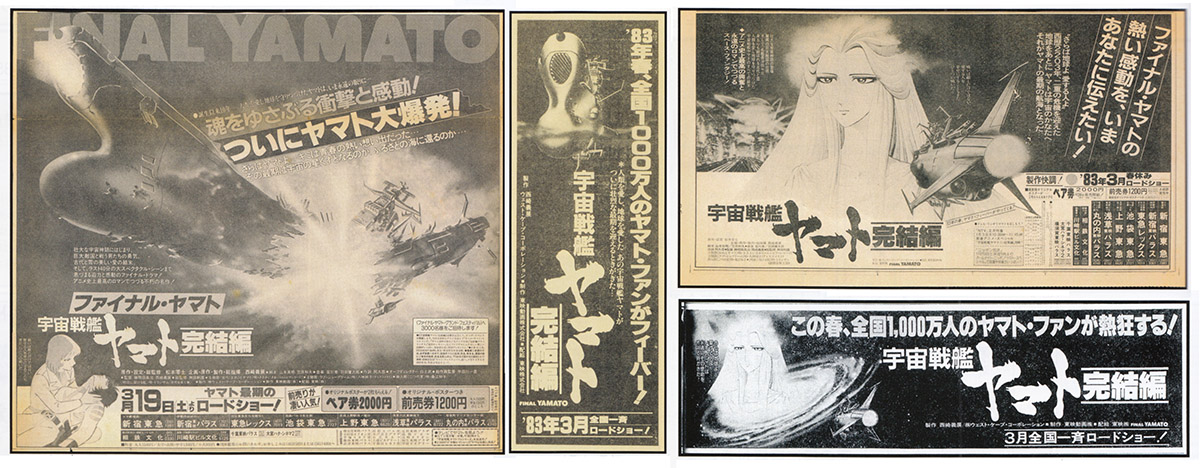
 

And as meandering as Harmagedon might be, at least it's forty minutes shorter than the long version of Final Yamato, a film that hopes you're as excited as Nishizaki is about This Being The Last Yamato Film Ever Swear To God. If you're on board with this, fine, and if you aren't, if everything isn't as epic and as majestic and as awe-inspiring as it possibly can be, well then you might think this movie's too long. And it probably is. But as the Japanese iteration of those bloated Cinemascope studio-destroying historical epics midcentury Hollywood was throwing its cash at - your Liz Taylor Cleopatras, your How The West Was Wons, your Fall Of The Roman Empires, your Lawrence Of Arabias, your Spartacuses - as one of those overbudgeted overture-preceded pray-for-intermission endurance contests, Final Yamato fits right in.


As a big fan of Saito's Golgo 13 manga it's interesting to see various G13 stories turn up in the script of the TMS Golgo 13 film, but at times the connecting threads of plot stitching them all together are overwhelmed by the sheer hallucinogenic power of Dezaki's visuals. Not that this is a bad thing, you understand. Similarly, Crusher Joe from Yas and Sunrise looks great and is filled with terrific science fiction action sequences, and those sequences pile on top of each other until the film's had what feels like one or two climaxes too many.


Pound for pound, frame for frame, perhaps 1983's most enduring animated film is Madhouse's Unico In The Island Of Magic, a movie that throws goggle-eyed witches in our faces, fills the screen with nothing but the blue of Torby's cloak, and forces Unico to flee, scared to death through an island made entirely of the petrified remains of Torby's victims. A film that feels as fresh today as it did on that hand-me-down in the kids' mid-1980s playroom, Island Of Magic holds up today against everything forty years has thrown at it, and that's not something a lot of movies - let alone people, even - can say.

-Dave Merrill


March 1983 issue of OUT

Thanks for reading Let's Anime! If you enjoyed it and want to show your appreciation for what we do here as part of the Mister Kitty Dot Net world, please consider joining our Patreon!

Sunday, December 12, 2021

ninteen anime eighty-one part two


Last time here at Let's Anime, we looked at the Japanese anime television of 1981. And let's make no mistake; that was so much TV, you’d think people didn’t have any time to get out to theaters to see anime films. Remember movie theaters? I miss seeing movies in theaters. Anyway, now we're going to take a look at what those people were looking at when they quit looking at their TVs and instead hit their local cinemas to look at anime films, those anime films of 1981. I'm gonna throw some TV movies and specials in here too, just to confuse everybody. 

 
cosplay at the Gundam I premiere

Mobile Suit Gundam might have not been a big success in 1979, but the show refused to vanish, and two compilation films were released in 1981 to great fanfare with a third, final film screening in 1982. Much like the success of the earlier Space Battleship Yamato film, this new theatrical re-imagining of a television series put Mobile Suit Gundam on the pop culture map, and soon Gundam model kits would be standard issue in every otaku's survival kit. The movies received both dubs and subs here in North America through a variety of formats and localizers, and you can watch all three right now on Netflix.
 
 
The twelfth-century fairy tale of the runaway four musical animals is known in German as "Die Bremer Stadtmusikanten" and was made famous by the Brothers Grimm. Here the story become the basis for Bremen 4 - Angels In Hell, Osamu Tezuka’s fourth TV movie produced for NTV's annual 24-hour charity program Ai wa Chikyū o Sukū ("Love Saves the Earth"), as a space alien sent to save the Earth from war transforms woodland animals into people that just happen to form a rockin' band. Sure, this brings to mind Tezuka’s 1960s series Wonder Three, and why not?


The Hello Kitty company Sanrio front-loaded the rollout of their late 70s magazine Lyrica with a lineup of manga all-stars. Osamu Tezuka’s contribution was Unico, the story of a little unicorn wandering lost through lands of myth and legend. This became a 1981 feature film from Sanrio with animation by Madhouse, and it is an absolute gem, at turns beautiful, haunting, psychedelic, and Margaret Keane-level sugary. Columbia released an English version in the 1980s to home video and cable TV markets, and you can relive your 80s youth today with Unico on DVD and blu-ray from Discotek, and streaming on various platforms.  


Sanrio continued its theatrical anime assault with Sea Prince & Fire Child aka the Legend Of Sirius, a Disneyesque re-telling of Romeo and Juliet recast as a romance between children of the gods of the ocean and of fire. Darker and less cutesy than Unico, Sea Prince & Fire Child also received an English-language Columbia release & subsequent Discotek disc.


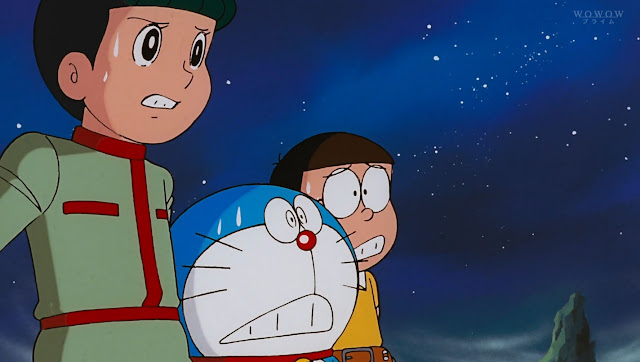
Slightly less mythological is Doraemon: The Legend of Spaceblazer Nobita, an extra-dimensional adventure where amazing robot cat Doraemon and doofusy human kid Nobita must save the planet Koya Koya from total destruction! Popular throughout the world, Doraemon has yet to make it in the American market, and it's a shame because American kids would really enjoy the knock-offy Star Wars vibe of this feature.


Speaking of total destruction, that’s what Tatsunoko did to the original source material when they adapted Jules Verne’s 20,000 Leagues Under The Sea into Kaitei Daisensou Ai no 20,000 Miles aka Undersea Encounter, sometimes called The Great Navy Battle: 20,000 Miles of Love. In the future, the Emperor Darius seeks to rule the entire world, but is opposed by the Nautilus, captained by Captain Nemo with the help of two castaways Ricky and Ben. Harmony Gold had the license to this TV movie, but their English dub is hard to come by.


Mary Shelley’s Frankenstein got slightly better treatment when Toei adapted her groundbreaking, genre-inventing novel for a TV special. Toei's Kyōfu Densetsu Kaiki! Frankenstein was directed by Toei's all-star tag-team of Yugo Serikawa and Toyoo Ashida, and in true Dr. Frankenstein style, great liberties are taken with the original source material. Part of the Toei/Marvel Comics deal that gave us Hamburger Dracula and Spiderman's giant robot, it's unclear how much this feature draws from the Gary Friedrich/Mike Ploog Marvel comic series.  Dubbed by Intersound, this was released on VHS in the United States.


The original master thief battles the original master detective in the Toei TV special Lupin Vs Holmes. The two Victorian-era rivals are pitted against each other in this adventure, based on a 1906 novel that featured Arsene Lupin and a Holmes pastiche that was written by Lupin creator Maurice LeBlanc. This anime has had home video releases in a few countries, but not Japan.


The inspiring true story of Helen Keller became a quadruple-Tony winning stage play, an Academy Award winning film, and also a Japanese anime TV special from TV Asahi. The only version I've ever seen has Finnish narration on top of the Japanese dialogue, making audiences perhaps appreciative of a little silence.


Tchaikovsky's Swan Lake comes to the anime screen in this theatrical version produced by Toei that manages to capture the majesty of the original ballet while also delivering anime-style entertainment. Was the Swan Lake character of "Odille" the inspiration for Vampire Hunter D's Lamika? Hmm.  Swan Lake got an English dub from Turner Program Services for the cable TV market and is currently streaming and on DVD from Discotek.


Jack London’s gritty tale of up-North survival and the journey of Buck from former pet into pack leader alpha dog becomes a telefilm from an obviously overworked Toei. Their Call Of The Wild stays reasonably close to the source material and was dubbed by Intersound, achieving immortality through VHS and bargain-bin DVD releases and screenings of "Totally Lame Anime."


In Enchanted Journey, Gliko the chipmunk punk leaves his comfortable tame life and battles his way to freedom in the great north woods. Known in Japan as The Adventure Of Glicko, this animals-in-peril feature is from Studio Korumi and is based on the children's book by Atsuo Saito. The English dub, featuring voice work from Orson Welles and Jim Backus, aired on HBO and got several home video releases.


Last time Let's Anime discussed the TV anime Jarinko Chie aka Downtown Story aka Chie The Brat, the TMS series based on the Etsumi Haruki manga. That TV show was a followup to this Jarinko Chie film, a Toho/TMS/Telecom feature directed by future Ghibli star Isao Takahata. This cinematic adventure of Osaka's scrappy street kid played in theaters in a double bill with our next feature.


Based on the 4-koma gag manga by Masashi Ueda, Furiten-kun is a goofball salaryman appearing here in his only feature film. Furiten's cinema debut consists of 7 short segments and is a production from Oh! Production and the studio that brought you Chargeman Ken, Knack.


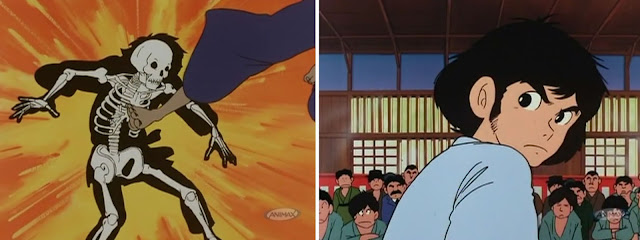
Sanshiro comes to Tokyo to become a martial arts champion, becomes the disciple of judo master Yano, and falls in love with Sayo Murai whose father teaches martial arts to police. Along the way Sanshiro battles his rival, the jujitsu fighter Higaki Gennosuke. It's all happening in the Sugata Sanshiro anime TV special (aired June 8) from TMS/Telecom, based on the novel by Tsuneo Tomita and with character designs by Kazuhiko Kato / Monkey Punch!


Joe Yabuki meets his destiny in the boxing ring in Tomorrow’s Joe 2, a feature based on the immensely popular Tetsuya Chiba manga, as directed by Osamu Dezaki with character designs by Akio Sugino. Is this the first time the Dezaki/Sugino team would revisit a property they'd brought to animated life on television? 


Space Warrior Baldios, the Ashi Pro/MIC environmental disaster super robot series, wrapped up its 1980 TV series with a 1981 feature that recapped the story and added a downer ending. This got a dub courtesy Peregrine Film which made it to VHS and some UHF TV markets in the States in the late 80s before being license-rescued on disc from Discotek and streaming via Crunchyroll/Retrocrush.


Tetsuro Hoshino re-embarks on the 999 for one last trip through and beyond the galaxy to defeat a revived Mechanized Empire and discover the truth about himself in Adieu Galaxy Express 999: Final Stop Andromeda, in theaters August 1, 1981. This is the second 999 film from Rintaro (Shigeyuki Hayashi) and some might say the movie is a redundant retread of the first 999 picture. However, this gorgeously animated story claims its own visual territory while forcing Tetsuro - and the viewer - to re-evaluate everything they thought they knew about eternal machine life. It’s on several streaming services and you can buy the DVD and Blu-Ray from Discotek.

First TV, then movies; that's our roundup of 1981 in Japanese animation. Of course there are series and films that didn't make the cut due to time and space constraints, the limits of research, and me wanting to get this thing done with before 2021 ends. I didn't even mention the shows that carried over from 1980, like Fishing Sanpei, Tetsuwan Atom, Tetsujin-28, Doraemon, Sazae-san, etc. So if I missed something, and I definitely did, don't blow a gasket. But what are the winners? What are the standout anime titles from forty years back that still have an impact today? What are the anime series that keep kicking around inside my skull after decades, and what therapy exists to make them stop?
 

Well, Superbook might have had some extra name recognition on account of it being attached to a two thousand year old religion. There's that. However, this simplistic, clunky show achieved syndicated Japanese cartoon eternal life thanks to cable and broadcast runs that lasted decades, scores of different home video releases distributed via the American Christian media ecosystem, and the show's remarkable popularity in former Soviet bloc nations.


Queen Millennia was the last Leiji Matsumoto property to come out of that 'anime boom' era, the last time his mashup of SF, vintage tech, kids and dream girls would manifest itself in Japan's popular culture. The subsequent succession of Matsumoto remakes, reboots, and reimaginings have had varying degrees of artistic and commercial success, but none have become as popular as his late 70s - early 80s adaptations. The 1981 Queen Millennia show would find itself on American TV screens a few years later, uncomfortably Frankensteined together with 1978's Captain Harlock to make Harmony Gold's "Captain Harlock And The Queen Of 1000 Years," the first many of us would see of either series.


1981 was the year Nippon Sunrise's Mobile Suit Gundam came roaring back out of obscurity to remind us all this series was still in the fight for, and would eventually assume, the throne of Robot King. Sunrise and Gundam's success story has helped move Japanese animation out of our small anime-nerd world and into universal popular culture, and the word "Gundam" itself has come to stand for "SF robots" the world over.


Urusei Yatsura showed up to electrify the anime world in October of 1981. This boy-meets-space-alien series inverted shojo manga tropes and built a subversive, stylish, surrealist romantic-SF-comedy anime empire that would influence the entire field for the next decade and beyond. 


Some of my own personal 1981 favorites might not have been as earth-shakingly impactful. Adieu Galaxy Express perhaps let the visuals get way ahead of the script, but those visuals make a film that sheds its 70s skin and reveals shining neon colors bursting out of the absolute blackness of space, enormous extra-galactic mechanical contrivances contorting in miles-wide convulsions, and a surprise 2001-style Stargate sequence, all to get Tetsuro to yet another showdown with the Mechanized Empire.


And of course, one of my faves from 1981 is the MIC comedy-adventure Honey Honey, based on the 60s Hideko Mizuno shojo manga. If you blinked in either Japan or the US you might have missed this show, but it still made a few fans.

1981 still echoes in today's animation landscape. Urusei Yatsura's manga is being reprinted in English and the films are getting Blu-Ray releases, while Superbook is still on the air in some markets. Grown up kids still talk about Unico and forming Voltron's Blazing Sword. And while Furiten-kun and Bremen 4 remain obscure, while the anime Frankenstein and the Call Of The Wild have passed into kitsch, and nobody anywhere gets to watch Arsene Lupin Vs Sherlock Holmes, the mobile suit aesthetic of Mobile Suit Gundam has conquered the Earth Sphere along with the real world, one plamodel at a time. So long 1981! 
 
-Dave Merrill

Ninja Dog says "see you next time!"

Thanks for reading Let's Anime! If you enjoyed it and want to show your appreciation for what we do here as part of the Mister Kitty Dot Net world, please consider joining our Patreon!

Monday, August 31, 2020

1987 catalog of dreams and VHS tapes


When we talk about 1980s North American anime fandom we tend to emphasize the fan art, newsletters, costumes, tape trading, and other home-grown elements of the fandom. And sure, that's because the DIY stuff is interesting and clumsy and charming. Just as interesting might be the contemporaneous Japanese anime merchandise that American fans were, even then, shelling out their hard earned cash for. How buried in anime merchandise could an 80s anime fan get without having to fly to Japan and fill up some suitcases? Surprisingly buried, actually! 


Before specialized websites and email, we relied on business cards, xeroxed catalogs, and addresses we’d find in classified ads and on convention flyer tables. Nascent "otaku" and the Japanese-American community would shop together at Mitsuwa Plazas from New Jersey to Texas to Chicago. We’d haunt Japanese groceries, comic shops, and toy & hobby retailers, and if we had a stamp to gamble we might shop via mail order with companies like Books Nippan, Nikaku Animart, Kimono My House, and something called Wyvern Web Graphics. 


The mid 80s creation of three Florida anime fans, Wyvern Web Graphics (a wyvern is a legendary bipedal winged dragon) combined anime knowledge, language skills and relationships in Japan to start an anime-merchandise import company at a time when options were few for desperate American anime nerds with a few bucks burning holes in their pockets. Wyvern Web would sell via mail order and would table at a small circuit of SF and comic conventions in the Southeast for a few years.

So what were those 1987 American anime nerds able to purchase? An embarrassing amount of stuff, to be honest. Posters, movie booklets, Roman Albums, postcards, buttons, binders, pencil boxes, stickers, sweatshirts, scores of anime soundtracks on LP and CD, and literally hundreds of official release laser discs and tapes of both VHS and Beta variety. But don’t take my word for it, let’s look at the April 1987 Wyvern Web catalog. 


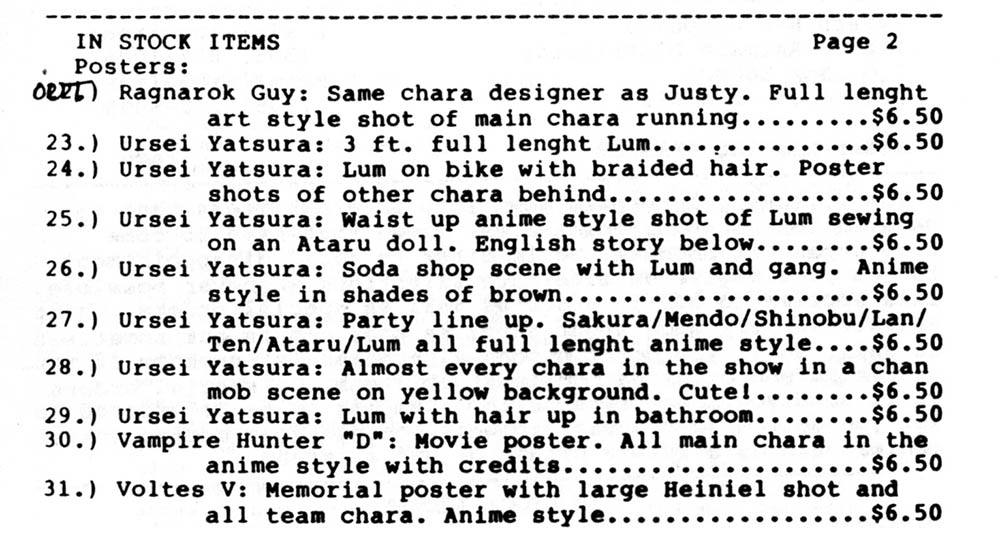
Posters were a big item, reasonably priced from $4.50-$6.50. I can recall paying $8 for the full size Harlock and Galaxy Express 999 posters at Atlanta Fantasy Fairs. Of course $6.50 in 1987 dollars would be $26 today. 


I bought the Locke The Superman and the 3-foot Lum posters from Wyvern. That Lum hung in my room for years, garnering sarcastic comments from every female visitor (don’t mind them, Lum, they’re just jealous). 


I'm fairly certain I purchased this Lum wallet from WWG but I'm pretty sure I didn't spend $16 on it. It's more of a coin purse than anything else. It's not listed in their catalog but I bought this Urusei Yatsura pencil case from them; it's one of my favorite pieces of UY merch, demonstrating exactly how well the series fit into the colorful, New Wave design aesthetic of the late 1980s. 


It's honestly kind of humbling when you see exactly what the anime home video market looked like in the 1980s - I recall actual anime on video being hard to come by, but here we see a comprehensive selection of the Japanese anime field. Of course, we have to remember that these hundreds of titles were all in Japanese with none of English subtitles or dubs we take for granted today.

Let's also take a look at these prices and remember it's 1987, the minimum wage is $3.35 an hour, and a Beta copy of the Daicon openings is going to cost you a cool hundred dollars ($236 today). Captain Harlock Arcadia Of My Youth was $146 on VHS – today you could purchase five Blu-Rays of the film for that much money. Bubblegum Crisis part 1 was only $80 ($190 today) and the Fandora OVA was only $64 for the tape, $57 for the laserdisc. Or you could wait a couple of decades and pick up an ex-rental Fandora VHS for 100 yen. 


I’ve never played Persona, but I’ve seen the Digital Devil Story: Megami Tensei OVA on sale here from WWG on VHS for a mere $78. Is it essential? Jury’s still out! 


The selection of anime really is impressive, including Harmagedon. Giant Gorg, God Mazinger, three volumes of Galient, and all three Gundam movies. You could drop $120 on Lensman, or $80 on Karuizawa Syndrome - you know, the OVA by Yoshihisa Tagami about the romantic adventures of a freelance cameraman. You could make it a Tagami double feature with his Digital Target Grey for only $113. Or you could take the safe route and buy the crowd-pleasing Macross movie on laser disc for only $64. 


There isn't a price for this Queen Emeraldas Galaxy Express 999 TV special, but I believe I paid $70 for it. At the time I was making minimum wage at the local K-Mart, which meant I worked twenty hours for 45 minutes of video. I think it's worth it - the thing still hasn't received an official English release. Ditto for the other Leiji Matsumoto Queen here, Queen Millennia, a film that really deserves to be seen in the West. Why no Millennia, people? Get with it, and while you’re at it, sell it for less than $150! 


I did not buy this Urusei Yatsura laser disc from WWG - it's a loaner, and has laser rot to boot. But in 1987 it would set you back $64 ($150 today), and I sure hope you copied it to VHS before the laser rot set in. Price-wise, the most expensive item in the catalog is the extended version of the Final Yamato film, which will run you a cool $160 in 1987 dollars, or three hundred sixty four dollars and ninety-three cents here in 2020. That’s more than two dollars a minute to watch the Earth get drowned and Kodai and Yuki finally get it on. 


Music is a big part of anime, and anime music on LP and CD was a big part of things. The CD was still a relatively new format in ‘87 but a surprising amount of titles were available. I didn't pick up this Captain Harlock Symphonic Suite LP until years later. The Macross Song Collection album was a staple in anime fan record collections for years. 


If you bought this Prefectural Earth Defense Force CD back in 1987 it would set you back sixty dollars in today's money, and I think it's worth it just for the title track alone (I didn't get this from WWG, it was a gift). Similarly priced is the Urusei Yatsura Juke Box 2 CD, not to be confused with Urusei Yasura Music File or Urusei Yatsura Music Capsule or Urusei Yatsura Jam Trip. You'll go broke trying to keep up with Urusei Yatsura album releases. 


Rounding out our music selection is one of the most striking anime covers ever, the Zeta Gundam Symphonic Suite with the amazing Masao Yamazaki artwork that takes the anime right out of those anime characters. A bargain at twice the price! 


Wyvern Web’s operation lasted only a few years. Getting this treasure trove of anime merchandise in front of interested and educated buyers ready to shell out seventy or eighty or ninety dollars for VHS tapes in foreign languages was itself a tremendous challenge. The principal business owners relocated to Japan and the stateside end of the Wyvern Web business collapsed fairly quickly, leaving our part of America sadly bereft of high-quality anime merchandise; for a little while, anyway. But their catalog remains, a testament to the wide gulf between the strong desire of anime fans and the not-so-strong purchasing power of anime fan bank accounts. I guess some things never change.

All merchandise from the personal collection of D. Merrill


Thanks for reading Let's Anime! If you enjoyed it and want to show your appreciation for what we do here as part of the Mister Kitty Dot Net world, please consider joining our Patreon!