Showing posts with label Lupin III. Show all posts

Monday, February 17, 2020

Anime Hell Presents: That 70s Show


Gang, I am super excited about next week's Anime Hell screening at Eyesore Cinema! It's an all 1970s presentation of Manga Matsuri films and TV episodes and commercials and OPs and some special surprises, too. Most everything is in Japanese with English subtitles! 


It's an evening of super robots, tragic orphans, and international thievery as the Japanese animation of the 1970 explodes across the Eyesore Cinema screen at 8pm on February 22! Doors open at 7:30, admission is only $5.00! 


Eyesore Cinema, of course, is one of the last remaining video rental shops in North America, with thousands of films for rent, movies for sale on DVD and VHS, and some records and zines for good measure. Their screening room has quickly become Toronto's home for offbeat screenings, art sales, swap meets, and badfilm uprisings. If you're ever in town you should wander in and spend some money! 


And of course, if you're in town next Saturday you should wander into Eyesore around 8pm, for ANIME HELL PRESENTS: THAT 70s SHOW! See you there!


Friday, November 30, 2018

1978: Anime's Greatest Year?


(portions of this column were originally presented early Sunday morning at AWA 2018. Thanks to all who battled through their hangovers to attend.)


So, 1978. Let me tell you about 1978. First off, it was still the 1950s sometimes, thanks to Sha Na Na, Grease and Happy Days. On the other hand, we had three Popes that year! Jimmy Carter brokered Mideast peace and signed the Panama Canal treaty. The Cowboys won the Super Bowl, the Yankees took the World Series, and M.A.S.H. and Little House On The Prairie weren't even half over. Me, I was eight years old, and if there was one thing I loved more than pestering anyone with a car to take me to see Star Wars again, it was watching cartoons on TV. Sadly, apart from Bugs Bunny re-runs, that Fantastic Four show starring Herbie the Robot, and of course, Super Friends, our network cartoons were all dreck like Fangface, Web Woman, and Galaxy Goof-Ups.

Meanwhile in Japan, lucky shoujos and shonens were literally wallowing in an ocean of colorful, wild, and occasionally ridiculous pop culture, as Japan's entertainment machine kicked into overdrive spewing out Pink Ladys and Ultramen, Chogokin super robots and Micromen and Space Invaders, all part of a nation's creative output... including an anime industry that just might have hit its peak in 1978. 

Seriously? 1978? Japanese animation as we know it has been a thing for more than fifty years. Why would I do something so silly as to pick a year and claim it's the greatest? Well, okay. I freely admit this is a foolish, subjective endeavor designed primarily to let me cheerlead for some of my favorites, using forty years of hindsight as leverage. But even skeptics have to admit 1978 brought new works by some of Japanese animation's greatest talents and sequels to some of anime's greatest properties. Japan's class of '78 cartoons proved popular around the world and many of these shows are still watched today. We're still feeling their impact forty years after the fact.

1977 hadn't quite stopped yet

The year started out with an advantage thanks to all the terrific anime that carried over from '77. The Leiji Matsumoto-created super robot series Danguard Ace continued to show Ichimonji Takuma and Captain Mask battle Leader Doppler and his army of monster robots. Candace White Adley struggled from heartbreak to heartbreak in the landmark shoujo anime Candy Candy. The "Robot Romance" series of Tadao Nagahama began with Voltes V, which we'll be seeing released here on DVD soon from Discotek Media.


In Japan's movie theaters, Space Battleship Yamato came cruising back with the July release of the film Farewell To Space Battleship Yamato: Soldiers Of Love, or, as the English-language text on the promotional material dubbed it, Arrivederci Yamato. After 1974's tepidly-received Yamato TV series and a vastly more successful 1977 release of a compiled Yamato movie, the question was, could producer Nishizaki turn Yamato into what today we call a "franchise?" He could, and did. Farewell To Space Battleship Yamato: Soldiers Of Love was a hugely successful epic gotterdammerung of a film in which the revived planet Earth is menaced by the Comet Empire and the crew of the Yamato must defy orders, save Teresa of Telezart, and make the ultimate sacrifice. Produced at breakneck speed by top tier Japanese animation talent like designer and collaborator Leiji Matsumoto, director Noboru Ishiguro, and character designer Yoshikazu Yasuhiko, Farewell is a terrific film that delivers an entire new civilization's worth of space vehicles to threaten our heroes, gives the Comet Empire that monumental, shuddering Hiroshi Miyagawa pipe organ theme, and still delivers Yamato style outer space romantic mysticism in a 151-minute epic that makes every minute count. North America received Voyager Entertainment VHS and DVD releases of this film, but as of now it's out of print.


Sure, we all wept at the (spoiler!) climactic sacrifice of the Yamato and her crew at the end of Arrivederci Yamato. However the Yamato would return in October's TV version of the Comet Empire story, Space Battleship Yamato 2. In this series the Yamato's tragic end isn't quite so tragic or final, as we see an expanded version of the film that gives more screentime to our crew, allows space dictator Desslar a chance at redemption, and finally standardizes the Yamato's formerly lackadaisical mechanical design. This show and the first Yamato TV series would be packaged in foreign markets as "Star Blazers" and air in US markets in 1979, a crucial series for many a North American anime fan (like me). Available on DVD as part of Star Blazers and currently out of print.

Harlock, Herlock, whichever

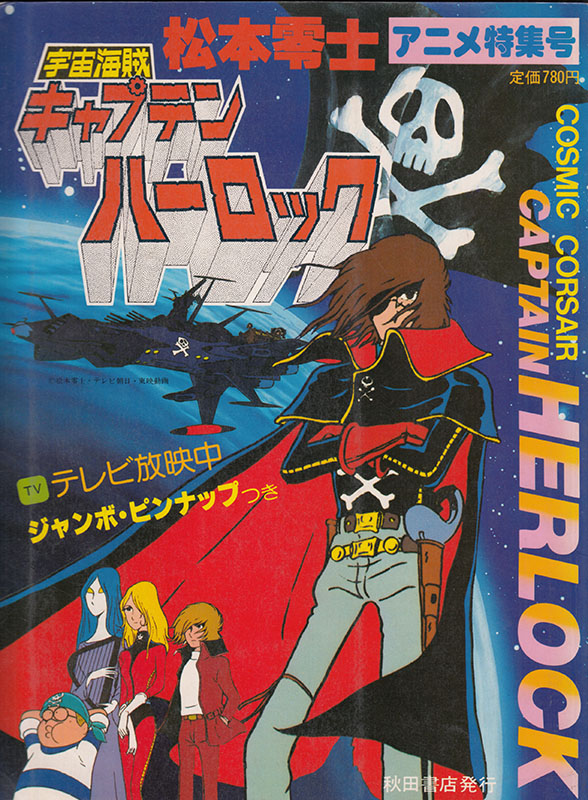
Japanese audiences were experiencing Leiji Matsumoto overload in 1978. Danguard Ace was still on the air, the Yamato was battling the Comet Empire in theaters and on TV, and March would see the first episode of one of Matsumoto's most iconic series, Space Pirate Captain Harlock. Harlock and his forty fellow space pirates defy the evil plant women of the Mazone, who return to Earth after millions of years to lay claim to their ancient-astronaut home. As we mentioned before, this terrific TV series is currently available on streaming video and in a Discotek DVD release, and Harlock would go on to star and co-star in feature films and TV series for decades to come. 


Not enough Leiji? Enjoy his April '78 science-fiction Journey To The West pastiche SF Saiyuki Starzinger – localized here as Jim Terry's Spaceketeers - or settle in for a ride on the Galaxy Express 999. Leiji Matsumoto's wistful meditation on life, death, and everything in between as seen through the eyes of a young boy travelling to Andromeda to get an immortal machine body, Toei's Galaxy Express 999 TV series first aired in September of 1978 and ran for 113 episodes. As we discussed earlier, this series is currently streaming and soon to be available on DVD from Discotek.


Harlock wasn't the only space captain zipping around '78; Golden Age SF writer Edmond Hamilton's 1940s hero Captain Future launched in November for 52 episodes of Toei-produced interplanetary adventure. These reasonably faithful pulp adaptations were thankfully updated with 70s era mechanical design and starred the titular Captain Future, Curtis Newton, and his shipmates the android Otho, the robot Grag, Simon "The Brain" Wright, and Space Girlfriend Joan Randall as they battle the evil forces that threaten to wreck the solar system. A big hit in Japan and Europe, the series has seen home video releases in almost every format and almost every region, with the exception of (sigh) North America.

Gatchaman II

Tatsunoko's Science Ninja Team Gatchaman series first aired in '72 – the cast's giant flared jeans are a dead giveaway - for 105 episodes of science ninja vs international criminal action. One of creator Ippei Kuri's most iconic creations, Gatchaman would get a theatrical compilation film in July, just in time to get audiences ready for the October start of the sequel to Gatchaman, Gatchaman II. The missing Condor Joe (spoilers!) returns early on, and the new show wastes no time getting back to battling robot monsters and evil Galactors. 1978 would also be the year that the '72 Gatchaman series would be edited, rewritten, dubbed by an all-star cast of American voice talent including Alan "Wilbur" Young and Casey "American Top 40" Kasem, and reach syndication in America as Battle of The Planets. Packed with action, great characters, and stunning mechanical mayhem, BOTP grabbed Americans by the eyeballs and turned them into what we now call 'anime fans.' Both BOTP and Gatchaman have had several iterations of home video release in North America, and the entire mythic Gatchaman cycle of Gatchaman, Gatchaman II, and Gatchaman F is available on DVD from Sentai, right now for the bargain price of eighty dollars.

it's kid-tested


Lupin III, hands down the world's greatest second-story man, safecracker, confidence trickster, and all around thief, made the jump from Monkey Punch's manga and a few hundred TMS produced TV episodes to the big movie screen in his 1978 feature film debut, directed by Mushi Pro vet Soji Yoshikawa and released by Tokyo Movie Shinsha. Known in some circles as "Mystery Of Mamo," this very 70s film is a wild roller coaster ride around the world as Lupin battles the possibly immortal Mamo past sight gags, 2001 references, spaghetti western homages, Clark Bar comic book ads, and the kinds of sleazy, lustful TV Lupin behavior that Hayao Miyazaki would totally abandon when directing the next Lupin III film. Mamo's long-lost English dub is now available on the Discotek DVD along with four (!) other English dubs.


The title can be literally translated into English as "Here Comes Miss Modern", "Here Comes Miss High-Collar" ("haikara" a Japanese portmanteau of "high collar"), or "Fashionable Girl Passing By," but in Japan they call this series Haikara-san ga Toru. In 1977, Waki Yamato's original Shoujo Friend manga series won the first Kodansha Manga Award. The Nippon Animation adaptation of Haikara-san ga Toru began airing in March of 1978, taking us all the way back to Tokyo in 1920, where teenager tomboy Benio Hanamura is always getting in trouble and advocating for new-fangled modern ways. 

here comes miss modern tree-climber
Though opposed to arranged marriages, she's engaged to the dreamy young Army captain Shinobu. Benio tries to sabotage the engagement but finds herself falling in love in spite of herself. Can their romance survive war in Manchuria, amnesia, and the Great Kanto Earthquake? A new anime film of Haikara-san was released earlier this year and Eleven Arts licenced it for North America, so look out, here she comes!

Hiromi Oka leaps from the pages of the sports shoujo manga classic Aim For The Ace by Suzumu Yamamoto, joins her high school tennis club and finds the tennis superstar inside that only the challenge of Ochofujin and the Demon Coach can bring out. This October '78 remake of the amazing 1972 Aim For The Ace series didn't feature 1972's Osamu Dezaki direction or Akio Sugino's character designs, but that's OK, they were working on the terrific 1979 Aim For The Ace movie. None of Aim For The Ace is commercially available in English in any form. Why is this? Somebody make it happen.

New Aim For The Ace


April 1978: Tadao Nagahama and an all-star cast of anime geniuses (Masaki Tsuji, Yoshikazu Yasuhiko, Yuki Hijiri, etc.) continues his "Robot Romance" series with Fighting General Daimos. Kazuya Ryuuzaki, a young karate champ/astronaut, returns from deep space along with his sword-slinging Afro-sporting copilot Kyoushirou to find Earth under attack from space aliens fleeing the destroyed planet Baam. As befits the star of an anime show, only Kazuya can pilot the transforming truck-robot Daimos to battle the invaders. His thirst for vengeance is derailed slightly when he falls in love with the Baam princess Erika. Can their romance survive the struggle between two worlds? Animated by Sunrise under contract to Toei, this show packs a one-two punch of super robot destruction and soapy love story melodrama that totally satisfies. Daimos eventually aired in the Philippines, Italy, Poland, and even in an edited compilation video titled "Star Birds" that was released on home video and a few airings on Pat Robertson's CBN cable network.

from a Fighting General Daimos children's storybook

Robert Louis Stevenson's Treasure Island has enjoyed many cinematic adaptations, and the world of anime is no exception. There have been one, two, at least three separate Japanese cartoon versions of this seminal pirate adventure story. Unquestionably the best Japanese anime iteration – the one without talking animals, anyway - is the October '78 TMS Treasure Island series, directed by genius Osamu Dezaki. This is what he was doing instead of remaking Aim For The Ace, I guess. Treasure Island aired in France, Germany, Italy, Spain, Mexico, Columbia, Taiwan, the Arabic world, and after circumnavigating the globe, finally reached the English language audience via YouTube with TMS subtitles.

Treasure Island never looked so great

1978 started its journey with the New Years Day premiere of Perrine Story, the 1978 Nippon Animation series based on the Hector Malot novel Sans Familie. Young Perrine struggles to make her way from one end of Europe to another to find her estranged grandfather and experience the clash of class and race at the tail end of the 19th century. Nothing explains the power of Japanese animation quite like its ability to entertain regardless of viewer demographics, and it's when you are on the edge of your seat hoping Perrine and her weakening mother and their long-suffering donkey Polikare can muscle their wagon up the muddy 19th century roads through the Alps, well, that's when you realize the true power of anime. I defy anyone to fail to be moved when that donkey makes a reappearance later in the show, which sadly is unavailable commercially in English.

Perrine, Baron, and Polikare, the donkey who drank too much

Sanrio, the Hello Kitty people, spent the 1970s branching out into other media, including the shoujo manga magazine Lyrica and a series of animated films, including 1978's Ringing Bell, a 47 minute film based on a children's book about a cute little lamb named Chirin. Devastated when his mother is killed by a wolf, Chirin swears eternal vengeance, and ironically is taught to be a violent survivor by the very same momicide-committing wolf. Chirin grows to learn the world is a terrifying nightmare of unending conflict. You know, for kids! Released on American VHS by Columbia in the 1980s and recently revived on DVD by Discotek, Ringing Bell is a beautifully animated film that illustrates perfectly how even the most talented of artists can completely misjudge their audience.

don't be fooled by that Ringing Bell box art


Between April and October of 1978, viewers were treated to what many believe is the best Japanese anime series ever made, Future Boy Conan. Based on Alexander Key's 1970 dystopian YA SF novel "The Incredible Tide" – yes, he's the guy that wrote "Escape To Witch Mountain" - this Nippon Animation series was produced by the anime dream team of Yasuo Otsuka, Isao Takahata, and Hayao Miyazaki. Remember that world war we had back in July 2008, the one that saw the use of super powerful magnetic weapons more powerful than atom bombs? After the world is thrown off its axis, the survivors of a flooded Earth struggle to rebuild civilization, represented by the polar opposites of the techno-fascist Industria and the peaceful, agricultural High Harbor. We first meet our hero, the titular Conan, living a bucolic, shark-fighting life with his grandfather alone on Lonely Island. The world, or what's left of it, intrudes when the girl Lana washes up on shore, with soldiers from Industria in hot pursuit. To protect Lana, Conan leaves Lonely Island and finds both friends and enemies in a world still reeling from the great disaster. Future Boy Conan is filled with adventure, action, humor, intrigue, disaster, and redemption; it's the kind of broad-appeal anime property that's made its creators famous the world over, and of course is commercially unavailable in English.

my Conan frame-tray puzzle

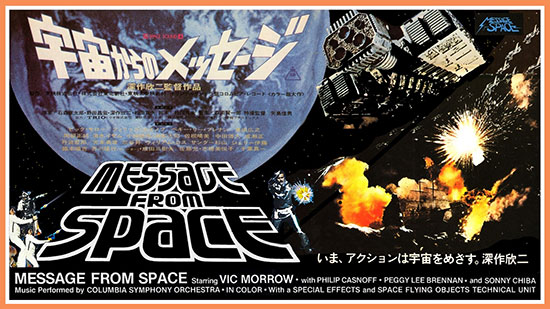
Naturally, being on the other side of the world, I had no idea these cartoons even existed. But it wasn't so terrible, back in 1978. For instance, one summer night our whole neighborhood kid gang were dropped off at Cobb Center Mall to see a movie. This was back in the day when parents felt perfectly confident in leaving their 8 and 9 and 10 year olds unsupervised at movie theaters. We all got out alive, so I guess it was OK. Anyway the movie was a rollicking sci-fi actioner titled Message From Space, and we all agreed it was pretty awesome, almost as good as, if not as good as, that other space movie with the Death Stars and the light sabers. I spent years looking for Message From Space, back when my only hope was to catch a late-night UHF TV broadcast. I'd find out it was directed by the guy who made Battle Royale, and that it starred faded Hollywood royalty and top-of-the-line Japanese movie stars, that Shotaro Ishinomori was one of the writers, that it was a sci-fi updating of the Hakkenden legend, and that there was a followup TV show starring a space ape. You can judge for yourself with the DVD from Shout Factory


So was 1978 anime's greatest year? I think I've presented a pretty solid case, and I didn't even mention Invincible Superman Daitarn 3 or that Pink Lady anime series. But to be honest, who's to say 1977 or 1979 or any other year might not be just as great? In a field that continues to produce amazing work year after year, who knows what classics lie ahead? All I know is, I'll probably be watching.

-Dave Merrill

1978 says "So long!"


Thanks for reading Let's Anime! If you enjoyed it and want to show your appreciation for what we do here as part of the Mister Kitty Dot Net world, please consider joining our Patreon!


Wednesday, February 26, 2014

world's most wanted

(this review of Pioneer's 2003 DVD release "Lupin The 3rd: The World's Most Wanted" originally appeared in 2003.  Pioneer's no longer in business and this DVD is out of print, but I had a lot of fun writing this review and am glad to present it again.)

FROM:  INSPECTOR ZENIGATA
TO: ICPO (Interpol)  HEADQUARTERS, GENEVA
SUBJECT: LUPIN THE 3RD -THE WORLD’S MOST WANTED

Gentlemen:
I am saddened to report that once again the entertainment industry has demonstrated its contempt for the rule of law with the release of yet another in a long line of animated serials dealing with the notorious criminal, Lupin the 3rd.

This latest DVD release even has the audacity to poke fun at Lupin’s criminal status with its title “The World’s Most Wanted”.   I am shocked at the lack of respect for law that Pioneer, once a highly-regarded entertainment conglomerate, has demonstrated with this video.  It was bad enough that these supposedly comical cartoon “adventures” of that reprobate Lupin had been transmitted across the public airwaves during the mid 1970s, but to dredge these accounts of larcenous and immoral behavior from whatever pit of depravity they had been confined to is almost a crime in itself.


All of Lupin’s accomplices are fully implicated in the crimes this video depicts.  The gangster Jigen, the mercenary swordsman Goemon, and that curvaceous grifter Fujiko are all explicitly shown engaged in violations of the criminal codes of dozens of nations.  I am, as always, deeply embarrassed that the corrupt and malicious producers of these animated films have seen fit to include a painfully inept caricature of myself as a character in these shameful episodes.  It is a known fact that Lupin III has eluded capture so far - but not for lack of effort on my part, I am proud to say.  I only wish the same was true for some of our “brethren in blue”, who seem to regard this brigand as a harmless and entertaining thief rather than a menace to public safety and morals.


The six “escapades” contained in this DVD are fanciful recreations of some of Lupin’s most heinous offenses, as produced for Japanese television by the Tokyo Movie Shinsha animation studio.  “The Revenge Of Lupin The 3rd” features the destruction of an entire luxury liner, prompted by a madman driven to revenge after becoming the victim of one of Lupin’s previous schemes.  In the luridly titled “Buns, Guns, And Fun In The Sun”,  Lupin and his gang demonstrate what may be new heights of contempt for civilized society, as they not only rob the box office of Rio’s soccer stadium and make a mockery of the Brazilian penal system (here my opinion of the Rio police matches Lupin’s - I fear the tropical climate and moral lassitude of the inhabitants has contributed to the decline of this law enforcement unit) - but a priceless national landmark is perhaps irreparably damaged by Lupin’s unthinking greed.  “50 Ways To Leave Your 50-Foot Lover” is a fanciful tale of the supposed Loch Ness Monster, reportedly tamed by Fujiko’s singing voice.  “Gold Smuggling 101” is a primer in perfidy for anyone who wishes to embark on a life of crime.  I must say it was ingenious of Lupin to utilize a scheme straight out of the film Goldfinger, but then again, he IS a thief.  What disturbs me the most about this episode may be the depiction of the corruption of what was once a respected bank manager;  or perhaps it may be the depiction of myself, which literally portrays the author as a myopic crank from whom Lupin is able to escape without effort.  I assure you, my failure to permanently apprehend Lupin is a result of the criminal’s inhuman cunning and dexterity, not a lapse of attention from this detective.“Shaky Pisa” is remarkable not only for the earthquake-device that nearly destroys Pisa, but also for expecting the viewer to believe that Lupin the 3rd will retire from the scene while leaving millions of lire un-stolen.  In the “Cursed Case Scenario”, the ancient sands of Egypt are befouled by Lupin’s perfidious footsteps.  Not even national treasures are safe from his larcenous grasp!  Luckily his ill-gotten swag seems to be more trouble than it is worth.  
The animation of these criminal adventures is of the standard seen on broadcast television in Japan in the mid 1970s; adequate without devolving into primitivism, though bereft of the occasional flashes of artistry seen in other “cartoons” of the period.  The depiction of Lupin and his accomplices are realistic enough, though exaggerated for supposedly comic purposes.  Other than a garish series title in English, the opening credits are as originally presented, and the end credits are similar to the Japanese, with a rather weak instrumental replacing the original Japanese vocals.   Rendering these photoplays into English was obviously an attempt on Pioneer’s part to corrupt the morals of the children of the Western world, already known to be in a precarious state. 

Lupin’s English voice is remarkably similar to his Japanese.  This new Anglophone version, however, is closest of all to the rendition heard in the long-suppressed “Mystery of Mamo” film (though Lupin’s voice was the only point of accuracy in that otherwise scandalously erroneous production. “Ed Scott”, indeed).  Both Lupin and his crew of malcontents spout dialog that positively reeks of the disrespectful, flippant attitude that would lead one to a life of crime;  puns, insults, and innuendos of a leering nature abound in their speech.   I am positive that the intended audience for this low-class banter will find it quite amusing, however disturbing it may be to those of more refined tastes.

Seemingly tireless in its mania to promote lawlessness and crime, Pioneer has released this DVD with options of both English and Japanese language tracks.  A detailed section of line drawings of characters, devices, and locales acts as a veritable university education in wrongdoing for the interested viewer.  Previews for other of Pioneer’s perhaps more law-abiding productions fill the remainder of this digital video disc.
   

In conclusion, let me exhort Interpol to use every means at its disposal to prevent this latest affront to the public dignity.  How much longer will law-abiding citizens be forced to endure the glorification of criminality?  Is Lupin the 3rd the kind of figure we want held up to our children as a figure to be emulated?  Already reports are coming in about a new Lupin comic book in America, and the new year will see Lupin’s duplicitous face plastered across the television screens of that already criminal-infested country.  I urge you, sirs, to wait no longer.  For my part, I have just received information about Lupin’s latest target, and I must end this communication posthaste.  Rest assured, gentlemen, that this time I will DEFINITELY bring Lupin the 3rd to long-delayed justice.

Inspector Zenigata, ICPO

(transcription by correspondent Dave Merrill)

Thanks for reading Let's Anime! If you enjoyed it and want to show your appreciation for what we do here as part of the Mister Kitty Dot Net world, please consider joining our Patreon!

Sunday, October 24, 2010

Lupin III The Mystery Of The Secret Of Mamo

(this review of Pioneer's LUPIN III: SECRET OF MAMO originally appeared at the ANIME JUMP website in 2004. The film has recently been released on DVD by Discotek Media.)


Funny how perspective changes things. When I first saw SECRET OF MAMO, back before you were born, I had already seen Miyazaki’s Lupin film CASTLE OF CAGLIOSTRO. Little did I know that the clean-cut, dapper, chivalrous Lupin of CAGLIOSTRO was not in fact the norm – was actually a total departure from Lupin’s true nature. When that faded-out thirteenth generation color bar faded from view and MAMO started, I was appalled. Not just at the incredibly lousy copy, but because MAMO’s Lupin wasn’t the charming rogue of CAGLIOSTRO. No, this Lupin was the perfect freewheeling bastard, a larcenous, horny, hairy-chested swaggering chainsmoking sonovabitch who fought dirty and attempted to molest Fujiko at every opportunity. In other words, what we’re seeing is the real Lupin III.


Of course this film's actual title is simply "LUPIN III". The original, unreleased English dub was designated “Mystery Of Mamo”, an appellation that stuck thanks to the thousands of home copies that were distributed through the American anime fan world of the ‘80s. An apt title; who dubbed this film? What was the purpose? Where was it shown? It’s a mystery, a mystery of Mamo, one might say. Theories range from the film being screened for the Armed Forces Network in America’s Japanese military bases, to a version produced for the inflight movies of JAL. This dub has surfaced attached to Lupin releases in Italian and Dutch. And maybe someday some intrepid reporter will track down who dubbed this film and why they changed Fujiko’s name to Margo. But I digress.


SECRET OF MAMO has been rendered into English four times – five if you count the scenes included in the CLIFF HANGER Laserdisc videogame. Curiously, even this latest Pioneer version – lovely DVD transfer, swell extras and all, does not measure up to the original “Mystery” dub. But that’s OK. You can’t beat perfection.


This film wastes no time; it opens with Lupin III being executed. Naturally, Lupin’s Interpol nemesis Inspector Zenigata is skeptical. His suspicion pays off in Transylvania, where a living, breathing Lupin escapes his clutches. Zenigata’s next ambush at the Great Pyramid in Egypt also fails to catch Lupin, who escapes along with fellow rogue Jigen with the Philosopher’s Stone in tow. Why is Lupin risking life and limb to swipe a mythical piece of rock? And why is he in Paris, handing it over to Fujiko, his double-crossing sometimes girlfriend?

The mystery is revealed along with Mamo, a blue-skinned dwarf resembling an underfed Paul Williams who is quite possibly the most powerful man in the world. To capture the Stone, his agents turn Paris into a battleground complete with attack helicopters and monster trucks. I don’t mean balloon-wheeled pickups, I mean monster 18-wheelers that roar like prehistoric beasts.


The rest of SECRET OF MAMO is a whirlwind of philosophical speculation and wild globe-trotting action. A crucified, brain-tapped Lupin betrays his overwhelming subconscious desires for women and Pop Rocks, a thinly disguised Henry Kissinger threatens Goemon and Jigen with America’s military might, and Zenigata wanders around Mamo’s secret Caribbean island, interrogating famous historical figures in an attempt to finally capture Lupin. The ten-thousand-year-old genius Mamo has cloned himself countless times; human history is a result of his constant interference. Is humanity powerless to stop this diminutive psuedo-deity? Will he succeed in destroying the world and replacing the teeming masses with his private collection of immortals? Will Fujiko choose eternal life - or Lupin?


Our heroes escape the Air Force bombardment of Mamo’s island and regroup in Colombia, where who should appear floating in the window? Mamo still lives, and with Fujiko mesmerized, departs to begin his campaign of world destruction. Alone, Lupin stakes his life on one gamble – that Mamo isn’t the god he appears to be, and that he himself is the one and only original Lupin III.


It’s at this point that MAMO really distinguishes itself. Lupin has been deserted by his most faithful companions, and even his hideouts, weapons, and wealth are gone – and yet he’s clawing his way up the Andes, facing down what may be an immortal super-genius with nothing more than a tacky blazer and a few homemade gadgets. Meanwhile, Inspector Zenigata defies direct Interpol orders and resigns – to continue chasing Lupin. Here’s where Zenigata and Lupin become brothers, both fighting for what makes life worth living.


SECRET OF MAMO seethes with this kind of philosophical subtext, but never forgets to entertain. The movie is a big, brawling, colorful set-piece adventure filmed in one hundred percent Tohoscope, full of nods to spaghetti westerns, James Bond, Hitchcock and even 2001. Lupin breezes through Paris, Egypt, Colombia, and the works of De Chirico and Dali without a backward glance. It’s the kind of film where Henry Kissinger lights his cigar with a lighter set in the torch of the Statue Of Liberty, where earthquakes are faked by detonating underground nuclear power plants, and Hitler and Napoleon brood on a Caribbean island – and when Our Heroes learn the Terrible Truth behind What Is Really Going On, they’re more interested in finding a place to neck. After all, they already know everything they know is wrong.


Yet where another, lesser film would get bogged down in boring What Does It All Mean mumbo-jumbo, MAMO never forgets its roots as an animated cartoon, heir to the tradition of Wacky Gags handed down from Tom & Jerry and the ouvre of the Warner Brothers. Throwaway jokes and visual puns abound; for instance, when a low-flying plane barely misses Lupin on a strafing run, its landing gear skids across Lupin’s head and leaves tire tracks, and what would be a fairly gory finish to one of Goemon’s sword fights has the shock value removed by what can only be described as a “sight” gag.


The Lupin franchise really put the animation studio TMS on the map, and it’s easy to see how MAMO turned them from a reasonably successful TV cartoon studio into one capable of holding its own in the cinema. MAMO’s widescreen is used to good advantage, with panoramic views of the film’s many locations giving the more fanciful aspects of the plot some solid ground to rest upon. The crew from the original 1972 Lupin TV series was reassembled for this film, and it’s evident from the painstakingly accurate vehicles, weapons, and gadgetry that the designers take great love in bringing realism to the cartoon world. I think the Lupin franchise –heck, culture as a whole - lost something when consumer electronics quit being hulking great boxes of leather and chrome with giant dials and knobs- it hearkens back to the golden age of home stereo when receivers and amplifiers were complicated, woodgrain combinations of function and form that looked impressive as hell on your bookshelf, instead of the insubstantial products of today. When you find out that history is worse than bunk, nothing more than the bored pastime of a crazed, ancient dwarf – what’s left but total, Playboy Philosophy, leather-interior, Hai-Karate soaked, quadrophonically amplified 70s style hedonism? This was a movie for grownups in 1978, and it’s even more so now; do kids today even know who Henry Kissinger is, let alone recognize the Clark Bar superhero contest ad when they see it?


It may just be the countless screenings of crappy bootleg copies talking, but this DVD looks FANTASTIC. There’s not a scene where my jaw wasn’t scraping the floor, agape in awe at how stupidly CLEAR everything is. I’ll come right out and say that Pioneer’s new dub isn’t bad. In fact, if I hadn’t had the soundtrack of the original “Mystery” dub burned permanently into my brain, gain hiss and all, I’d think it was fine. However, I have, and I don’t. Pioneer’s dub is not only not as funny as the original dub, it takes liberties with the original script that not only aren’t as funny or as dramatic, but in a few cases are just plain wrong, and once or twice they simply take this film places the film doesn’t want to go and in fact has made it pretty clear that it never wants to be anywhere near.


Henry Kissinger reads an issue of Lupin Comics featuring the famous Clark Bar Superhero Contest ad, now starring Lupin - edited from the American DVD release for obvious reasons.

The original “Mystery” dub is actually the closest yet to the original Japanese dialog. I don’t see why these outfits knock themselves out writing new lines when perfectly good dialog already exists. Sure, the Pioneer voice actors do a great job. Tony Oliver does a tremendous job with Lupin, and while Zenigata’s Jake Martin gets a bit too cowboy at times, he approaches the role with the right amount of bluster.


Luckily this new DVD comes with subtitles, so you can get the full effect of Jigen preparing to abandon Marilyn Monroe and Humphrey Bogart, albeit in Japanese. The disk also includes a digitized version of the original movie program book – the DVD booklet is a translation of same –and an art gallery full of conceptual sketches of all the characters in the film, and a few that aren’t. It ALSO comes with a Lupin keychain, which is kinda cool.

Not that I’ve seen all eleventy-hundred Lupin films, but of the ones I’ve seen, MAMO stands out as my favorite. There are plenty of Lupin adventures with gags, exotic locales, outrageous escapades, and other trademarks of the series, but MAMO combines the typical Lupin ingredients with a Cinemascope sense of spectacle and a good chunk of post-Watergate 70s cynicism (Can a Japanese film be “post-Watergate”?). Paradoxically, the outrageousness of Lupin works best when firmly rooted in the real world, and there’s not a Lupin film more outrageous yet more authentic than THE SECRET OF MAMO.

-Dave Merrill


Editor's note: the recent Discotek Media release of Lupin III: Mystery Of Mamo is an even better transfer than the Pioneer release, and contains all four English dubs, including the original "Margo" dub that has been scientifically proven to be the best. You need it in your life. 

Thanks for reading Let's Anime! If you enjoyed it and want to show your appreciation for what we do here as part of the Mister Kitty Dot Net world, please consider joining our Patreon!