Wednesday, June 24, 2009

JUST DOING THIS TO MESS WITH OUR HEADS

Wouldn't it be great if Kodansha's "Osamu Tezuka Manga Complete Works" editions were in English? Well, they kinda are.


Yes! A charmingly typewritten synopsis of his classic shojo manga PRINCESS KNIGHT! True, the rest of the comic is in Japanese, but it's a start. Is there more? Yes there is - a lot more! This Kodansha set was a 400 volume set published over a twenty year period, and as near as I can figure, they all have English-language forewords. Everything from his breakout classic New Treasure Island to, say, Ambassador Magma! 


AMBASSADOR MAGMA aka SPACE GIANTS! All right! So, how different is this from the Space Giants show we enjoyed as children?


Yeah, that's pretty different. For one thing, token Caucasian reporter "Liz" isn't even mentioned! Hey, what about KIMBA THE WHITE LION, you know, JUNGLE EMPEROR?


No, that's not Santa Claus there, it's Hige Oyaji and a grown-up Kimba - now named Leo - bravely facing the elements atop Mount Moon! A grown up Kimba?? What the heck?


Yes, the original manga goes places NBC would not dare... at least not in cartoon form. They took a big old pass on Tezuka's continuation of the Kimba storyline, and we'd have to wait until CBN Cable aired "Leo The Lion" to find out how Kimba grew up.   But enough of these popular Tezuka works - did Kodansha release Complete Works editions of his more, shall we say, obscure manga?


Yes! Yes they did. JET KING, the story of an alien boy who can change his shape at will to better defeat evil, has a spoiler right in the English synopsis, so don't read it! Also in this volume, HIKARI is the story of a boy with crazy hair and two handguns who fights gangsters. Based on a true story.

But what about ASTRO BOY? I can hear you now, where's TETSUWAN ATOMU? Okay, here's your MIGHTY ATOM already.


This volume contains the story "The Three Magicians", which was one of the first Astro Boy stories I was ever exposed to, as it is also the subject of this LP:


Those three magicians get around.

Somebody should take the hint and get to work giving this classic Tezuka manga some actual North American releases; PRINCESS KNIGHT would sell like cotton candy at the fair and who would pass up a chance to own the original stories behind SPACE GIANTS and KIMBA THE WHITE LION? Not me! In the meantime, I suppose we'll have to be content with 30 year old typewritten summaries.

(editor's note - as it turned out our pleas were heard and Princess Knight did get a manga release in English courtesy Vertical. Ambassador Magma and Jungle Emperor remain unlicensed.)

-Dave Merrill

Tuesday, June 9, 2009

ROKUSHIN GATTAI GOD MARS!!


Six enormous colorful super robots erupt from hiding to protect Takeru Myojin, a 17-year old member of the Crasher Squad who, in reality, is actually a space alien named Mars from the planet Gishin with super ESP powers sent here to destroy the Earth! Will his fellow Crasher Squad members let their suspicion and mistrust of Takeru ruin their friendship? Will Emperor Zule succeed in killing Takeru and detonating the Earth-destroying bomb hidden inside the super robot "Gaia"? Will Takeru's twin brother Marg resist Zule's mind control before he's forced to battle Mars to the death? And will Takeru/Mars realize his six super robots will combine to form the Six God Combination God Mars, the most powerful robot in the universe? The answers to all these questions may be found in ROKUSHIN GATTAI GOD MARS, the 64-episode 1981 series from Tokyo Movie Shinsha that raised the bar for colorful, well-designed super robot animation as well as heart-rending cosmic sibling melodrama.


One of TMS's few robot anime titles (the others include their 1980 remake of TETSUJIIN-28 and 1983's SUPER DIMENSION CENTURY ORGUSS), it quickly downplays the "enemy robot of the week" formula in favor of cosmic soap opera, and the melodrama and tears continue right until the end of the series. MARS, a 1976 Shonen Champion manga series by pioneer Mitsuteru Yokoyama, drew on the science fictional ESPer hero themes explored in his earlier works such as BABEL II and THE NAME IS 101, spiced with flavors of the giant robot guardian motif originated in his TETSUJIIN-28 and GIANT ROBO series.

TMS continued the evolution in GOD MARS. Where there was once one super robot guardian, GOD MARS now gives us six separate super powerful giant robots that combine into one ultra-unstoppable mechanical deity, the centerpiece of a shiny, colorful space opera that captivated audiences around the world.


The story? 17 year old Takeru Myojin is a member of the Crasher Squad, the rapid-reaction space unit of the Earth Defense Forces in the future year 1999. Troubled by strange dreams, confronted by mysterious assassins from outer space, Takeru learns his real name is Mars. As an infant, he was sent to Earth from planet Gishin as part of a secret plan by its evil Emperor Zule. Possessed of super ESP powers, Mars can summon the gigantic robot Gaia, which in addition to being your typical super strong robot, also contains a super bomb capable of destroying the entire planet Earth! The emperor's plan is thwarted, however, because Takeru rejects Zule and Gishin, instead choosing to defend his adoptive home planet alongside the Crasher Squad - Mika Hinata (girl), Akira Kiso (chubby guy), Asuka Kenji (captain), Naoto Izyuujin (the cool guy), and Namida (audience-identification kid), all led by Commander Ohtsuka (exactly the same character from TETSUJIIN-28, right down to the pot belly and moustache).


Luckily for Takeru and the Earth, his real father on Gishin secretly sent five other robots to Earth. Awaiting Takeru's summons, these five robots - Sphinx, Uranus, Titan, Shin, and Ra - slumber in locations across the globe but when Takeru commands "ROKUSHIN GATTAI!", they burst forth from their hiding places and combine into GOD MARS.


With a reputation built on anime adaptations of high-profile manga including shojo titles (ROSE OF VERSAILLES), sports drama like AIM FOR THE ACE, and the long-running adult comedy LUPIN III, TMS was known for bright, stylish animation with an international flair. ROKUSHIN GATTAI GOD MARS would be no exception. The show practically vibrates right out of the TV with the brightest, cleanest, cheeriest color palate since that time the NBC Peacock dropped acid at a wild Technicolor corporate party. The skies are impossibly blue, the trees are vibrantly green, rockets blast with clouds of flame, ray-guns scintillate and sparkle. The Six God robots aren't wasted in some tedious rainbow motif but each have their own color schemes and visual identities, and the God Mars combination is distinctive and friendly, a big clunky multicolored skyscraper of a robot that must have been a bitch for the animators. It's a series that caught American anime fans' eyes when it was nothing more than opening credits on a compilation tape; even jammed together with hundreds of other OP titles from hundreds of other similar super robot cartoons, GOD MARS stands out.

Thematically GOD MARS also excels. Abandoning the traditional 8 year old boy audience entirely, GOD MARS adopts melodramatic space opera storyline full of tragedy, loss, and heartbreak, embodied in its fan-favorite character, Takeru's shy, retiring, dreamy twin brother Marg. Held in the palace of Zule on Gishin, Marg telepathically warns his brother of impending danger until Zule brainwashes him for use as a living weapon against Takeru in a tragic battle of brothers. The first third of the series is filled with angst and more than a bit of sloppy emo brotherly emotion as both Mars and Marg agonize over the fates that have kept them from a normal sibling relationship. Meanwhile, Takeru's pals in the Crasher Squad and the EDF begin to realize that Mars is a space alien related to the other space aliens who are destroying Earth, and also, if he dies, the whole world goes boom. So there's a lot of suspicion, soul-searching, moody moping, and protective custody. Meanwhile the girl Gishin super-ESPer ace Rose swears to defeat Takeru, but eventually realizes that not only is Gishin wrong to attack Earth, but as one of the few speaking female roles in the show, it's up to her to provide some hetero non-incest romantic interest; so we're treated to a half-hearted romance between Rose and Mars. This in no way dimmed the Mars/Marg relationship, which would inspire reams of disturbing twincest fan fiction and set the template for a generation of dreamy boy-love dreams.


The show makes a brave attempt at romance between Mars and Rose, but you can tell their hearts really aren't in it, especially as a late-series plot point involves Rose being possessed by the spirit of Marg! It's a shame because Rose is one of those starts-off-evil but later-becomes-good characters with one of the few real character arcs in the show, and deserves to be more than a beard. Nobody takes the Rose/Mars hookup seriously, the nonexistent romance between Mrs Myojin and Commander Ohtsuka is more believable.

Mika is shocked, shocked I say
The 64 episodes of GOD MARS are divided up into three distinct sequences; the Gishin Chapter, the Marume chapter, and the Earth chapter. As the fight with Zule wraps, Earth finds itself smack dab in the middle of one of those fugitive space-princess sagas as Flore arrives, a refugee from a war on planet Marume, where the evil emperor Giren has conquered the planet next door. Sought by both Giren and the mysterious space pirate ship "Frontier", Flore is given asylum on Earth, and just like what happened when the United States gave asylum to the Shah of Iran, Earth is attacked by both Giren's space fleet and by the Frontier, captained by the mysterious Gasch. Luckily for all concerned Flore has super ESP powers. Takeru and the Crasher Squad travel to Marume and involve themselves in the civil war between two peoples defined by their magnetic orientations. No, seriously.


Emperor Giren and Flore battle psychically

This 'Marume Chapter' is really curious; we're treated to Gasch's space pirate ship which is equipped with sails and masts and bowsprits, one of the lead figures in the Marume war is a religious leader we can only refer to as the "Space Pope", there is an extended combat sequence where guys on skis battle tanks and airplanes, and the power level of God Mars is amplified to such an extent that Takeru can stand on the surface of a planet hundreds of light years away and call his robot protectors from Earth, who arrive within minutes to fill up air time with yet another repeat of the Six God Combination Robot Combination Sequence, two solid minutes of animation that can be used and re-used and re-re-used every episode.


Gasch and Flore battle psychically

The Marume saga wraps with peace breaking out among the twin planets and with Takeru and the Crasher Squad learning that Emperor Zule is once again threatening Earth from beyond the death dimension, or some such Kirbyesque nonsense. And thus begins the Earth Chapter. The writers realized they'd written themselves into a corner with the awesome, unbeatable power of God Mars, and so Takeru/Mars is hobbled by psychic handcuffs that drain his life force every time he yells "ROKUSHIN GATTAI!".


The ZULECUFFS!

Only the mysterious space-surfing Rose Knight can show up in the nick of time every episode to distract the villian of the week long enough for Mars to save the day! Yes, years before Tuxedo Mask was rescuing Sailor Moon, the Rose Knight was pulling the same kind of lazy-writers duty in GOD MARS. Who is the mysterious Rose Knight? I wonder if it's actually the character named Rose in disguise?


There, just spoiled the show for you.


A GOD MARS compilation film was released in 1982 and it's that movie which familiarized most American audiences with the show. And "familiarized" is probably too strong a word, as judging from the reviews the movie left most viewers confused and slightly irritated, a natural reaction to any film that shoehorns 25 episodes of action into 95 minutes and hands it to a continent of people who aren't already familiar with the concepts. GOD MARS remains a footnote of the 1980s anime boom, albeit one with staying power; GOD MARS got its own OVA remake in 1988 (featuring a girlfriend for Marg!) and a back-to-basics OVA adaptation of MARS was released by KSS in 1994. Among North American anime fans GOD MARS is mostly known these days for being the subject of some really well designed toys and dreamy boy ESPer fanfic.


Which is a pity; because GOD MARS is an entertaining show. Even if you just want to sit back in the couch and let the Crasher Squad's space attack plane zip through the impossibly blue skies to the tune of the "God Mars" theme song, the show is so colorful, so visually appealing, and so well animated (in parts) that anybody who enjoys animation will find something to like about at least part of it. Had GOD MARS been on American televison in the 1980s I predict it would have been a hit or at least a fondly remembered cult classic; Europe got a good chunk of the show and it's still fondly remembered over there. The closest North America ever got was the TMS/NBC coproduction MIGHTY ORBOTS, a five-god combination robot controlled by clean-cut non-twin Rob Simmons and his robot little sister Ohno. ORBOTS was directed by Osamu Dezaki, creating hands down the best looking American network Saturday morning cartoon ever, though hobbled by typical focus-group approved American cartoon scripting.


know the difference.

It may very well be true that there are vast chunks of GOD MARS that are tangential to the main storyline, if not outright nonsensical digressions. I mean, seriously, space popes?! But all the recycled robot combination sequences and tacked-on plot extenders can't hide the power of GOD MARS - the struggle of Takeru Myojin to move beyond his tragic past and find his place in the world. And if that place is to be the super-ESPer master of an immensely powerful six-god combination robot, then so much the better for us all.

-Dave Merrill


Farewell, Rose! Farewell, Crasher Squad! Farewell, Mars!

Thanks for reading Let's Anime! If you enjoyed it and want to show your appreciation for what we do here as part of the Mister Kitty Dot Org world, please consider joining our Patreon!

Tuesday, May 26, 2009

i am terribly sorry.

Still in crazy busy mode. Anime North went well and there was much classic anime discussioning, but I still have obligations to fulfill and miles to go before I sleep, or at least before I get a free couple of hours to write something on this blog. In the meantime you should go out and purchase the latest issue of Otaku USA magazine, featuring a big article by yours truly all about Captain Harlock and Galaxy Express 999, with extra sidebar material by Tim "Star Blazers" Eldred! Additionally there's work by the always great Darius Washington, Mike Toole, Daryl "Destroy" Surat, and others much more talented than myself. So don't let my lazy behavior keep you from wallowing in 1970s Japanese cartoons, go buy magazine! Talk at you soon!!

-Dave

Friday, May 8, 2009

the quiet time is not so quiet

Apologies for my lack of blog here for the past few weeks. I've been busy as heck on a few real-life projects that have taken my time and energy that otherwise would have been spent talking about thirty-year old Japanese cartoons, and for that I am deeply sorry. At any rate here's what's been going on instead:

This weekend is the Toronto Comics Arts Festival which I am a volunteer at. It's two days of indy cartoonist stars and legends of comic art meeting the public at the Toronto Public Library Main Branch - and it's free! So if you have a free couple of days it's well worth your time.

Two weekends later - that's right, it's Anime North, Canada's number-one Japanese animation festival! I'm on staff at that show as well. Additionally, I will be on a "Classic Anime" panel Saturday at noon, and Sunday at 1pm I will be delivering an illustrated lecture on the influence of Western literature upon Japanese animation (meaning: Captain Future, among other things). And Saturday night... well, Saturday night is special.


Anime Hell returns to Canada for one night only of cerebral-cortex-crushing video madness. Followed by TOTALLY LAME ANIME: AFTER DARK!! Don't miss it.

And then I go to a wedding and then May is over and I spend June goofing off. Er, I mean, writing for Let's Anime!! Of course. See you then!

Saturday, April 18, 2009

What Would Jesus Watch - (cartoon edition)


SUPERBOOK EASTER!!


FLYING HOUSE SALOME DANCE!!


TILTON!!1!!


Whew... glad that's settled.

SPECIAL BONUS: WHAT BIBLE EDITION STARRING ANIME CHARACTERS WOULD JESUS READ?
The Flying House Bible, of course. Starring Corky!


And this makes Tilton happy.


Remember kids - Superbook and Flying House say JESUS IS JUST ALL RIGHT WITH THEM!


(actual dialog in this scene: "Hey it's Jesus!!"

This is of course not to be confused with the religious animation of Hikyou-Kisei Studios, including their famous show Genki no Bakagai no Eluron.

-Dave Merrill

Thanks for reading Let's Anime! If you enjoyed it and want to show your appreciation for what we do here as part of the Mister Kitty Dot Org world, please consider joining our Patreon!

Tuesday, April 7, 2009

INTO THE MACHINE!!!

Lodging deep within the brains of millions of prepubescent youths, JACK AND THE WITCH is one of those movies you see on some UHF station's afternoon movie timeslot when you're home from school with a fever or it's a rainy summer day or you're stuck at the relatives and are aimlessly turning the knobs on that giant woodgrained RCA monster - the knobs make that satisfying "klunk" as you switch from channel 2 to channel 3, and you have to fiddle with the tint once you get up into those rabbit-ear channels, and you sit there by the set inhaling ozone and faint scorched plastic until things look just right.


Twenty years later you thumb through some incomprehensible Japanese book listing every animated film ever released in Japan from 1941 until 1990 or so, and you see a picture that jogs your memory hard, like a fist, and you stand there shocked as you realize that no, you didn't DREAM that movie or IMAGINE it or HALLUCINATE it after one too many shots of Dimetapp Children's Cough Syrup - it actually exists, for once your memory isn't cheating. There actually is a Japanese animated film about little witches who fly broom-helicopters on fire missions against a spectacularly homely boy named Jack and his carload of animal friends, there really is a movie filled with spooky castles and crumbling balustrades and legions of devilish imps, featuring a giant machine that exists only to turn friendly woodland creatures into evil witches.


That's JACK AND THE WITCH, a movie seemingly produced to give children nightmares and confuse the hell out of adults. Released in 1967 by Toei Animation Company in between two rock 'em sock 'em CYBORG 009 films, JACK isn't based on a fairy tale or a popular manga or an ancient legend. It's its own thing, a bastard cross Between some whimsical Hanna Barbera TV cartoon and all the scary parts of the best Disney movies.


Directed by Japanese animation pioneer Taji Yabushita, JACK is not nearly as linear as some of his more familiar works like ALAKAZAM THE GREAT (1960) and ADVENTURES OF SINBAD (1962). However, JACK's flat character designs combined with lush, expressionistic backgrounds are proof positive of Toei's mid 60s schizoid split between wannabe Disney and wannabe UPA. Released over here by American International, this film was dubbed by Titan Productions, the outfit that handled Astro Boy, Gigantor, and many other imports. Close listeners can hear Corinne "Trixie" Orr and Billie Lou "Astro Boy" Watt voicing several different characters. Other than impacting the subconciousness of impressionable youths, this film made almost no impact on American anime fandom at large - American anime fans would obsess over early Miyazaki films and the voice talent of EIGHTH MAN, but lacking star animators or super robots, JACK AND THE WITCH spent years in obscurity, or at least a slightly higher level of obscurity than it now currently enjoys.


Our titular hero Jack is a cleft-palated young hellraiser with his own car full of animal chums. Yeah, that's it, that's all the introduction you get. As the film opens he's bombing through the house - yes, driving IN THE HOUSE - in his Model T, blissfully ignorant of things like legal driving age or roads or seat belts. Well, wouldn't you know it, after a song about how the world is a lovely place, he gets into a race with a little girl witch named Allegra who rides a chopped and channelled broomstick/helicopter. Happens all the time. Allegra offers Jack a ride on her broomstick and takes him straight to an evil castle. Don't accept rides from strangers, kids!

Turns out Allegra and her more adult witch commander-in-chief Auriana all live in the terrifying castle and their hobby is turning innocent children and woodland creatures into hideous imps of Satan. This is accomplished by means of a giant machine made up of mostly of bones. "INTO THE MACHINE!!" the imps chant as our heroes are vaccummed into its depths. "INTO THE MACHINE! INTO THE MACHINE!!" It's a rhythmic cry that scarred the memories of many a TV-watching kid. Jack escapes the harpy machine- but mouse pal Squeaker doesn't!

INTO THE MACHINE! INTO THE MACHINE!
Jack's animal posse escapes the creepy, gargoyle-carved-pillared castle with their own harpy prisoner, an amiable sort who's not averse to fun. Their impromptu dance party back at the house is interrupted by Jack's return; not to mention a fierce claw-chain attack by Allegra, which is halted by the simple expedient of whacking her on the skull with crockery until she's unconscious. Stricken by sympathy, Jack stops the animals from exacting any more violence on Allegra, but he's repaid by her knocking him down as she wakes up and escapes. Cheer up Jack, it won't be the first time a girl makes a sucker out of you. Every hesitant schoolyard crush is writ large on the animated stage here as Jack comes to grips with his strange new feelings towards this weird female creature.


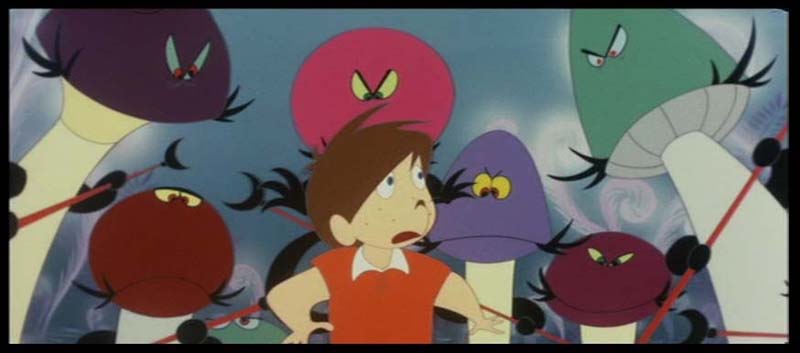
Attack Of The Mushroom People
Anyway, Jack and the animals realize they've got to rescue Squeaker. Their castle home invasion is sidetracked by Allegra, who's their friend again! Sure she is! She tricks our heroes and they fall into a pit populated by giant bugs and talking Sid & Marty Krofft mushrooms. But all psychedelic experiences must eventually come to an end and soon it's time for Jack to face the harpy-transforming machine. INTO THE MACHINE JACK! Saved at the last minute by desperate anti-wind power sabotage by Barnaby the Bear, Jack must now travel to the ice caves to rescue Allegra, who was banished there for her failure! Jack has a thing for the bad girls. He frees the witch-sicle with a smash from a huge crescent wrench - but then must face the angry vengeance of Auriana, whose swinging pendant chain sends Jack and Allegra into a crazy underwater volcano dimension of swirling psychedelic colors! When Jack's captured animal pals trick Harpy Squeaker into breaking the witch-queen's crystal ball, Auriana's power takes a serious hit - Jack and Allegra pop back into the regular non-psychedelic world (or at least as regular as this film gets) and Auriana changes into a weird Oni-type goblin, inflates a giant dinosaur skeleton balloon, and sets a time bomb before she escapes!


However, as it always happens in these movies, the witch is hoist by her own petard and both the castle and the witch are destroyed in a giant explosion. All the harpies are changed back into the little boys and girls and animals they once were, and the ruined castle changes into a beautiful forest. Allegra changes from her creepy witch look into a blonde. As the film wraps, children and animal friends ride off into the sunset in Jack's car, the end credits roll over dramatically-lit shots of actual models built of the film's characters, and early 70s children all over the world have nightmares.

actual footage of children's nightmare
Did I mention that JACK AND THE WITCH is a strange film? Too bizarre for younger children, not nearly comprehensible enough for older children, and possessed of none of the pretentious artistry that allows adults to admit they enjoy cartoons, it's an odd beast that refuses to be neatly categorized. Perhaps the last gasp of Toei's struggle to produce fairy-tale Disney style animated features, its European facade is permeated throughout by hints of Asian folkways; the Oni-demon Auriana transforms into, the sasumata-carrying harpy guards, and the swirling bands of fire lifted straight from Yabushita's work on SARUTOBI SASUKE. Maybe the legacy of JACK AND THE WITCH goes beyond entertaining kids in 1967; perhaps its destiny is to put us all back in touch with that confused pre-teen trying to make sense of the mysterious ways of a world that gives us girls who are sweet one minute and scary the next; a world that gives us movies like, say, JACK AND THE WITCH.


-Dave Merrill

Thanks for reading Let's Anime! If you enjoyed it and want to show your appreciation for what we do here as part of the Mister Kitty Dot Org world, please consider joining our Patreon!

Tuesday, March 17, 2009

the aptly named noel's fantastic trip


No, I did not pay $39.95 for this.
Most of us get obsessed with Japanese cartoons as children, and it's only later that we start to realize part of what attracted us to the things is that they are, at least to Western eyes, really strange. I mean, seriously; when you're a kid you just accept the fact that people might dress up in bird costumes and fight giant mummy robots, or that a World War Two battleship would naturally make a great intergalactic weapons platform. As adults, however, you take a step back and say, "wait a minute..."


I encountered Noel's Fantastic Trip, (or Noel no Fushigi na Bouken if you prefer) as an adult, so I have no childhood confusion about its narrative coherence-- there is none. This film makes absolutely no freaking sense what-so-ever. Equal parts fairy tale, antipollution message, and multicolored hallucinogenic experience, it's a movie that defies rationality, copyright, and traditional notions of "entertainment" and "common sense".

It's about a little girl named Noel. Sure, the VHS box copy describes Noel as a boy, but Noel is addressed as "miss" in the film, and the character is introduced singing a daydream song about living life as a country girl, making it clear that whoever greenlit this video release at Columbia hadn't bothered to sit through five minutes.

Noel's Holly Hobby obsession brought to life
Anyway, Noel lives on a floating island along with a zoo's worth of friendly animals. One day while relaxing in the sun after singing a song about wanting to be a country girl, Noel decides the Sun might like some ice cream. So, Noel and her little dog pal Pup take off in their airplane to deliver ice cream to the Sun. Now you might think,a movie about a girl living on an island floating in the sky piloting an airplane to the Sun while playing Good Humor Man, that's kind of out there. Well, just wait, this is the NORMAL part.


Once out of Earth's atmosphere, Noel encounters the Space Shuttle, a 2001 style ring space station, and in some sort of fanfic writer dream scenario, is passed by the Space Cruiser Yamato, or at least a reasonable facsimile thereof.

We're off to outer space all right.
There's an extended musical number involving stars and asteroids and comets and outer space in general. Next stop is the Planet Gaudy, a glammed out place where everybody dresses as outlandishly as possible, until Noel convinces the citizens to take all their clothes off. Leaving a planet of nudists in their wake, Noel and pal reach the Sun, whose enjoyment of ice cream is only slightly marred by a bit of smog drifing in from some unknown planet.

set the controls to the heart of the sun's love of ice cream
Can Noel find the source of pollution and convince them to enact pollution controls? Diving underwater to escape the billowing clouds and belt out yet another song, Noel's subsea spotlit rock guitar solo is interrupted by the Beatles, complete with Yellow Submarine.

No, we're not kidding, that's the Beatles

After a couple of songs the journey continues, interrupted only by another song, and a smog attack. I guess the smog is tired of the incessant singing too. Who can save Noel now? Super Zoomer, of course! Super Zoomer, a whale in a Superman suit who's a student at the Superman school and can change the course of mighty rivers and bend steel in his bare hands! He answers Noel's SOS and soon his mighty super whale powers have saved the day.

the super school for super students
On the horizon they spot the smog's source, a giant city full of factories spewing out pollution. And songs, also about pollution. Apparently this city, populated by foxes and bunnies and bears, was once nice and sunny, but when the factories came and people started driving smelly cars the air got bad and people got sick all the time. Explained through song, the conflicts of the industrialized world - things we like produced in factories that destroy the land and air - seem very simple, especially when set to music and illustrated with scenes of anthropomorphic animal children playing in aqueducts and junkyards.

Super Zoomer vs Super Smog
Luckily for the cartoon world, the problems of industrial pollution can be solved by hollering for Super Zoomer to come and battle a giant talking pollution cloud. Blue skies return to the animal city after Super Zoomer uses his super lung power to blow the pollution far away, where it becomes somebody else's problem. This allegorical battle between a talking super whale and a talking smog cloud seems downright normal compared to the next sequence, which is a musical production involving legions of tricycle riding babies pedaling in aerial formation from the time of the dinosaurs to the present. 

I repeat, tricycle riding flying babies.

Nothing a choreographed platoon of babies can't solve.
This confusing sequence is in aid of a son all about how the world is better now that cars are running on "good gasoline" and how we've saved the world through "clean energy". Is there a better way to promote catalytic converters and antipollution regulation in general? And... that's the movie. Feeding the sun ice cream, meeting the Beatles, calling a giant whale to fight pollution.


At a mere 70 minutes you'd think the film would zip past, but you'd be wrong. Most of the movie is songs, tedious songs. And while the musical numbers are full of colorful, psychedelic quasi-mod graphics, only children small enough to be transfixed by any colored moving shapes will find it entertaining. Those of us older than 4 will be scratching their heads in confusion at this, seemingly a film intended for babies, immigrants, and guys on mushrooms.

Noel's Fantastic Trip was based on a children's book by Japanese folk singer Iruka, who also voiced Noel and wrote and performed all the music (her son was cast as Noel's animal friend Kisonosuke, or "Pup" in the English version). Iruka has been performing since 1970 entertaining audiences throughout Japan and the world, and in 2004 was made a Goodwill Ambassador for the International Conservation Union for Nature Conservation. 

Iruka on stage
She would combine her storytelling ability with her passion for nature in her first children's picture book, 1977's  "Noel's Blue Umbrella", starring the first appearance of her alter ego Noel. 


In America Turner Production Services got the job of localization, which means more work for Peter Fernandez and Corinne Orr, and the Grimes, Curtis, Hammond gang. As part of Columbia's mid 1980s catalog of Japanese animated films, it shares the mysterious "can't believe this is for kids" vibe of their Sanrio films Unico In The Island Of Magic and Ringing Bell, but rather than super wizardry or bleak Darwinism Noel's Fantastic Trip gives us the Beatles, super whales versus super smog, and tricycle babies in formation.

The film's not without appeal; the character designs and animation reflect the charm of its children's book origins, and there's an aggressive whimsy in Noel's transforming house/airstrip, the super-school perched on a peak on a lonely asteroid, and the Dick Bruna/Richard Scarry animaltown residents. But when half the movie is taken up with mid-tempo musical numbers about stars or country girls or clean energy, you wind up boring older children, confusing adults, and making Apple's lawyers sit up and take notice.


Perhaps the film is, after all, more mysterious than fantastic, more of a pop-culture curiosity than a must-see cinematic gem. And yet, in spite of the movie's pacing flaws and general lack of focus, we can't help but admit that when Noel's Fantastic Trip decides to give us unforgettable moments, it doesn't let copyright or coherence stand in its way, and that's an attitude you don't see from most films. Maybe Noel and Iruka are right, maybe we do all need a mysterious journey every once in a while. 

-Dave Merrill

edited and revised 2017

Thanks for reading Let's Anime! If you enjoyed it and want to show your appreciation for what we do here as part of the Mister Kitty Dot Net world, please consider joining our Patreon!