Monday, February 14, 2011

Magnos The Robot, I Suppose

This review originally appeared at the Anime Jump website in 2004.

Many people think of Japanese animation as high-tech, sophisticated entertainment for adults; animation that breaks the boundaries of animated entertainment and stuns audiences with originality and innovation.

These people are of course completely wrong.

As evidence to the contrary, I present the only possible argument; a rebuttal that is smashing in its impact and draws one to an inexorable conclusion that brutally shatters paradigms, even as it opens up new worlds of possibility.

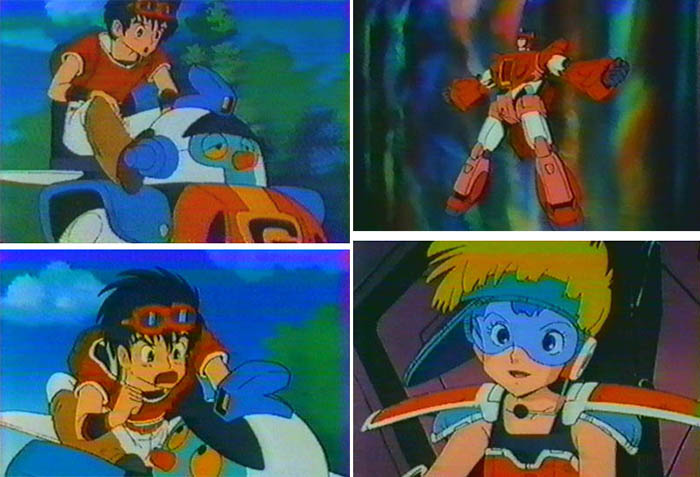
The argument? MAGNOS THE ROBOT aka MAGNETIC ROBO GAKEEN, a mid-1970s Toei giant robot show that combines all the classic elements of Japanese anime: hackneyed plot, clichéd characters, outlandish and impractical mechanical design, and bizarre, incomprehensible villains and monsters. Combined with deadpan American dubbing, the end product can only be described as kitsch. Released on DVD in the US by "Liberty International Publishing", MAGNOS is a simple, tape-glitches-and-all transfer of an earlier VHS release that once graced the kiddie section of America's video rental stores and thrift shops.


No grand vision went into making MAGNOS. Driven by market forces, the creators simply threw together whatever elements they could rip off from other, more successful anime shows. Giant super robots, fantastic ultra-scientific secret bases, grotesque evil creatures – they’ve all been done before, and done better. However, the producers of MAGNOS took the bizarre visuals and childish storylines of your typical robot drama and cranked everything up to eleven – and as with all kitsch, their efforts had the opposite effect. Instead of appearing fantastical and awesome, MAGNOS THE ROBOT simply looks outlandish, impractical, and faintly ridiculous.


Earth is in big trouble; horrific creatures from the depths of the earth, actually ancient astronauts from outer space, have declared war on the surface world. Even though national monuments are being blasted into pieces, the United Nations refuses to listen to Sir Miles Nevers, the only one with any sort of idea who’s attacking us. Apparently the UN believes that sometimes things just explode for no reason. Is Sir Nevers a scientist, a naval officer, a industrialist? MAGNOS never tells us. Nevers has a gigantic nuclear powered flying battleship, a combat unit of helicopters and antiaircraft cannon, and a complicated combining-robot fighting system. However, all this equipment is completely useless, because what Nevers DOESN’T have is a hairy, disgruntled, denim-clad, kung-fu-fighting 70s style antihero to pilot his robot and save the world.

Enter Janus, who is a disgruntled karate champion with bad hair and a wardrobe straight out of the Levis department of your local Sears. Anybody who’s ever seen any 70s giant robot show can tick off the subsequent plot elements: Janus is asked to pilot the robot. Janus refuses because he’s the 70s style antihero and they never volunteer for nothin'. The horrific monsters attack! Janus, shocked at the fighting ineptitude of Nevers’ gang, is compelled to show these amateurs exactly how he did it in the karate ring. He changes into a tacky jumpsuit and is tossed into the robot cockpit, where his fighting spirit and cocky, never-say-die attitude succeed where skill and training fail.


But wait! What about the girl? There’s ALWAYS a girl in these shows, and it’s ALWAYS the professor’s daughter, and her and the hero NEVER get along, for at least three episodes. Well, MAGNOS is no exception. In fact, Nevers’ daughter Ester is absolutely vital to the plot. You see, Nevers built his Magnos robot in two parts, and one part is piloted by his daughter, and another part has to be piloted by a tough karate champion guy. I know some parents go to extreme lengths to hook their children up, but this is ridiculous. Actually the male-female thing fits in with the whole “magnetic” theme of the show – with a positive and a negative, MAGNOS evokes both your Electrical Engineering 101 syllabus AND your Tantric Sex manuals.

You see children when a man robot pilot and a woman robot pilot love each other very much...

The 1970s were known as the decade of the ridiculously elaborate pilot-entering-his-giant-robot scene, and MAGNOS upholds the tradition magnificently. First our heroes don stupid-looking jumpsuits. They get into rocket-propelled elevators and make special arm movements, which magnetically change their jumpsuits into even stupider-looking jumpsuits. Once inside little flying cars, they’re shot out of the nuclear battleship, along with the parts of their robots. The flying cars dock with the robots, and Janus and Ester wind up fighting evil inside some of the most inept looking machinery ever designed for a Japanese cartoon. Seriously, these two robots – “Magnon” and “Magnetta”- resemble gingerbread men more than they do combat equipment. Naturally they’re useless against the monsters of Xerxes Tire-Iron Dada, so they must combine into Magnos. This requires the following sequence: Janus and Ester leap out of their robots in mid-air and whirl around each other face to face, while the pieces of Magnos are shot out of the nuclear battleship. All this whirling somehow turns both Janus and Ester into some sort of rectangular yellow box, and as the pieces of Magnos come together in the sky, this rectangular yellow box becomes Magnos’ belt buckle. Magnos itself is another terrible robot design – think of Go Nagai’s STEEL JEEG and then exaggerate the less plausible, more outlandish features. Magnos has pumped-up steel muscles, a head that doesn’t turn, blades that pop out of the hands, and tiny wrists and ankles (this becomes a plot point later, believe it or not).


Meanwhile, of course, the enemies of mankind have been chilling out and watching this entire transformation take place. Xerxes Tire-Iron Dada is far away in another galaxy, so he’s forced to rely upon his minions to conquer Earth. Led by Brain, a grotesquely ugly green fellow with a giant brain that resembles an afro, they include a robot guy, a woman made out of fish parts, and some kind of lion person. They’re all full of great plans for defeating Magnos and conquering the Earth. Most of these plans involve gigantic monsters made from combining Earth animals – resulting in LSD-inspired combinations like Batroacher and Octo-Crabus X-3. Yes, it’s monster design via Conan O’Brien’s “If They Mated”.


The Brain, Xerxes Tire-Iron Dada, and the majestic Octocrabus X-3

The dubbing is terrible. The mix is awful, resulting in incidental music drowning out nearly every important line of dialog. The actors read their lines competently enough, but the script can’t decide if it wants to be silly and self-referential or deadly serious. Of course, when the bad guy is named Xerxes Tire-Iron Dada and most of Brain’s lines consist of “What treachery is THIS?” it’s hard to maintain a serious tone. At least SOMEBODY was having fun with MAGNOS.

It’s hard to say how seriously this was taken in Japan, anyway. After all, this IS a show where a giant bat-cockroach attacks an oil refinery, where our karate hero Janus is shown karate-chopping a BULL in a flashback. The show is just wild enough, just kitschsy enough to make me think that everybody was in on the joke. At least I HOPE nobody was taking this seriously. The animation isn’t as lame as the storyline; perfectly competent Toei TV show animation, much as you’d see in any TV anime of the day. Some of the fighting scenes are actually fairly well done. “Well done” – never thought I’d use that phrase in connection with MAGNOS.


KARATE BULLFIGHTER!!

Curiously, the Spanish track on the DVD has a better audio mix than the English track. MAGNOS was a big hit in Italy under its original GAKEEN title, and it would have been nice to see the Italian opening credits, maybe some Italian dialog. But this is a bargain basement DVD release, and anyway, special features would destroy the low-rent atmosphere MAGNOS works so hard to maintain.


Grace Jones - actress, model, musician, Bond Girl, otaku?? This is a REAL Grace Jones LP.

Yes, I said DVD – MAGNOS THE ROBOT makes a fine addition to anybody’s DVD collection, as a counterpoint to all those expensive box sets full of anime designed for the hip, artsy, with-it, modern aficionado of the animated art. MAGNOS takes us directly back to the time when the term “Japanese cartoon” meant cheap, lurid, violent children’s entertainment. If you’re concerned about the image of Japanese animation as a mature art form for intelligent adults, avoid MAGNOS, because it will make you cry. However, if you’re in the mood for outlandish junk-food cartoons about clumsy-looking giant robots battling the monsters of Xerxes Tire-Iron Dada, then MAGNOS is the one to watch.

-Dave Merrill

Friday, January 21, 2011

tezuka parade of values

Our unplanned Osamu Tezuka January jag continues! Let's take a look at some offbeat merchandise from Tezuka-inspired anime series; particularly JUNGLE EMPEROR, which you know as KIMBA THE WHITE LION unless you know it as LEO THE LION. Which isn't actually the same show, but a sequel. The 1965 KIMBA series was the first color cartoon made expressly for Japanese television, and served as the inspiration for many tributes, imitations, and products, including this lovely Leo light.


No, seriously, that's what it was marketed as, the "Lovely Leo Light".


At some point in the mid 1980s my brother went out to L.A. He picked this lamp up at the fabled "Pony Toy-Go-Round". And yes, it still works!


And if reading by the light of the Lovely Leo Light makes you hungry for candy, you can always have some Jungle Emperor Ju-C-Double candy, delivered right from Leo's neck.


I picked this up at a now-defunct Japanese grocery store in Doraville GA and yes, I ate all the candy. As an imitation Pez, the Ju-C delivery system sports softer plastic construction and a less robust candy-feed mechanism than its European counterpart. However, it features the angry head of Leo, in the face of which all objections vanish.


When you're done with the candy, Leo's head can be mounted trophy-style atop your favorite pencil at school.


Remember moms, this candy is approved by Osamu Tezuka himself - and he's a doctor!


Once your Tezuka themed shopping expedition is complete, your purchases will fit neatly inside your Astro Boy plastic bag.


This one was picked up in the mid 80s at the Philadelphia retailer "Heaven", which featured a full line of Astro Boy T-shirts and Space Giants and Godzilla monster toys, alongside thousands of magnets, toy robots, and other wonderful kitschy goodness. A more aptly-named retail establishment would be hard to find.

-Dave Merrill

Thanks for reading Let's Anime! If you enjoyed it and want to show your appreciation for what we do here as part of the Mister Kitty Dot Net world, please consider joining our Patreon!

Thursday, January 6, 2011

Rintaro + Otomo + Tezuka = Metropolis

Note: a version of this review originally appeared in 2002 on the website Anime Jump.

METROPOLIS is an animated version of a manga by Osamu Tezuka, with a script by Katsuhiro Otomo, directed by Rintaro. If those names don’t mean much to you, then this review won’t either. Oh, sure, you’ll enjoy this movie- which is a visually stunning, brilliantly directed animation spectacular with an engaging storyline, strong characterization, and refreshingly retro character design - you just won’t enjoy it as much as I did.

Back in the 1930s, Japanese manga pioneer Osamu Tezuka saw some stills from the 1926 Fritz Lang film METROPOLIS. Inspired (as so many were) by the haunting images of the gigantic city and the struggle of its inhabitants, Tezuka wrote his own story around Lang’s film and in the first flush of his success as a manga author, published his own METROPOLIS, which, along with LOST WORLD and NEXT WORLD, made up his original science fiction trilogy.

Set against the background of the fantastic techno-wonderland Metropolis, this film portrays the power struggles between the city-state’s various factions. Not only is the city’s disgruntled underclass about to revolt - obviously they’ve seen the silent film - but the city’s mysterious millionaire Duke Red is plotting against the government. Duke Red’s own Marduk political faction is constantly at war with the intelligent but subservient robots. Marduk’s commander, Duke’s adopted son Rock, struggles for his father’s attention, but is ignored in favor of Duke’s scientific fantasy, the center of which is the immensely powerful, lifelike girl-robot Tima.

Kenichi, Shunsaku Ban, and robot detective Pero
In the midst of this three-and-four way struggle, Shunsaku Ban and his nephew Kenichi arrive. Ban is a detective on the trail of the missing scientist Dr. Lawton. Is Lawton involved in Duke Red’s mysterious plan? Can they get to the bottom of the mystery, even as Metropolis crumbles around them?

I know this is a cliché bored reviewers trot out for every new anime film, but I’ll say it again. METROPOLIS is visually stunning. Rintaro’s direction has never been stronger, and I say that as someone who owns four different versions of his GALAXY EXPRESS film and who watched all of DAGGER OF KAMUI without subtitles, twice. All his hallmarks are there- dramatic rays of light penetrating the darkness, gigantic buildings delicately shaded and colored, choreographed slo-mo scenes of vast destruction. At times he’s even taking cues from himself - the whimsical robots he pioneered in ROBOT CARNIVAL are back, and there is one scene lifted wholesale from BATTLE ANGEL ALITA. Rintaro’s well-animated (by ace studio MADHOUSE) characters inhabit a fully-realized world that we see from every angle, from the top of Duke Red’s menacing Ziggurat to the lowest of Metropolis’ deepest levels. Sometimes all in the same shot.

Tima and Kenichi
Since this is a Katsuhiro Otomo version of an Osamu Tezuka story based on the Fritz Lang movie, one has to look for Otomo’s hand in the script, and it’s definitely there - political corruption, personal betrayal, technology that goes too far and assumes a life of its own. The struggle between the natural and the artificial is not a new theme for Japanese animation, but I know of no other film that lays the battle lines out so clearly, and demolishes them so utterly. I was particularly impressed to learn that many story elements were added to the original by Otomo - his storylines are seamlessly integrated and really have that Tezuka atmosphere.


The score is an unexpected pleasure. METROPOLIS has a wonderful jazz soundtrack that contrasts brilliantly with all the high-tech scenery. Instead of the typical bombastic orchestra, or heaven forbid, the dreaded all-electronic soundtrack, the lively, fun METROPOLIS score ranges from bebop to Dixieland and keeps the film’s humanity in the foreground. These aren’t old classics dug out of the public domain vault, either; apart from one very prominent Ray Charles tune, this is original work by Toshiyuki Honda, and that’s Rintaro on sax, can you dig it?

Rock menaces Professor Lawton
To be certain, the long-time anime fan will get a kick out of this film However, that’s not to say METROPOLIS won’t be entertaining for the general public, especially now that the general public has been acclimated to the idea of Japanese animation being potential art-house material. This film has all the techno-spectacle of AKIRA, but instead of that movie’s bleak tone and no-future worldview, METROPOLIS has old-fashioned scientific romance appeal. I don’t think it’s too far off to characterize this film as a big, sloppy love letter from Rintaro to the memory of Osamu Tezuka. All of Tezuka’s classic stock characters make an appearance and the homages and references are constant. Much is made of the computer animation in this film, and while there’s a real attempt to keep it in line with the traditional animation, it is still too smooth, too shiny, and too controlled. The gulf between paint and pixel is still too wide, and the film’s attempt to bridge the gap is earnest but unsuccessful. Still, as Rintaro points out, Tezuka himself was always trying new things and new techniques. Both his commercial productions and his experimental works were rife with well-meant attempts at expanding the medium. If anything, a pure Tezuka version of METROPOLIS might have had even more CG, perhaps less of the juxtaposition of old and new, less of the struggle between gleaming future machine and old school cartoon that gives this METROPOLIS its power.


The readily available, early 2000’s edition DVD is just as classy as the film. Columbia-TriStar produced a comprehensive gatefold package, with the film in English, Japanese, and French, subtitled in two different English versions as well as French, Spanish, Portugese, Chinese, Korean, and Thai, and of course it’s widescreen. The extra materials? You get character sketches and a step-by-step visual guide to the special effects and CG animation. A 20 minute special details the original comic and features interviews with Rintaro, Otomo, the major voice talent, the animation studio Madhouse, and the composer Toshiyuki Honda. There are additional interviews with Rintaro and Otomo, there’s a Rintaro filmography and a short bio of Tezuka’s career. Seeing Otomo and Rintaro both agree that Tezuka wouldn’t have let them make this film while he was alive, or watching Taro explain his efforts to drag digital animation into the analog world; it’s gold. Lacking is a primer on the Tezuka references - there can’t be too many Americans versed in Tezuka’s visual motifs. Perfect for the Blu-Ray, fellas!

The inevitable conclusion
Not to diminish Tezuka’s legacy, but he was known as kind of a control freak. I have doubts he would have let Otomo and Rintaro have their way with METROPOLIS if he’d been alive, and that would have definitely resulted in a stodgier, less interesting film. What counts is the end result, and the end result of METROPOLIS is a fantastic, engaging film that shows the best of Tezuka’s story, Otomo’s screenwriting, and Rintaro’s direction. It’s rare for a film project to live up to its hype. It’s rarer still for a film to exceed all expectations. METROPOLIS, for me at least, is that film.

METROPOLIS screens Thursday January 6 and Sunday January 9 at the Toronto Underground Cinema.
See you there!


-Dave Merrill

Thanks for reading Let's Anime! If you enjoyed it and want to show your appreciation for what we do here as part of the Mister Kitty Dot Net world, please consider joining our Patreon!

Sunday, January 2, 2011

coolest thing ever, Tezuka edition

Custom hand-painted Russian nesting dolls sporting your favorite Osamu Tezuka characters? Yeah, that's pretty cool.


Painted by "hooverdam", whose handmade MLS banners have been seen in major league soccer events around the world.


Happy 2011!

Thanks for reading Let's Anime! If you enjoyed it and want to show your appreciation for what we do here as part of the Mister Kitty Dot Net world, please consider joining our Patreon!

Wednesday, December 22, 2010

merry xmas and a happy 2011

My apologies to all; I fully intended to have another post up here before the Christmas holidays rolled around, and that just isn't gonna happen. In the meantime, however, I want to wish everybody a happy holiday season full of joy and good cheer.


See you in 2011!

-Dave

Friday, November 26, 2010

Welcome To The GALATT

In a defenseless world where war has been outlawed, only one brave scientist stands between the alien hordes and our precious Earth. Can his super robot creations protect us all from destruction?


Sure, this is the basis for hundreds of Japanese cartoons. But CHORIKI ROBO GALATT (aka “Galatt The Great”) dares to take this concept and “transform” (haw haw) it into a gag comedy! Premiering on October 6 1984 and lasting until April of next year, GALATT’s 25 episodes were a humorous digression among Nippon Sunrise’s more serious mid-80s series like VIFAM, the sadly neglected PANZER WORLD GALIENT, and HEAVY METAL L.GAIM. Yet GALATT’s squat comedy robot action idiom would live on in later Sunrise series like GRANZORT and WATARU, as well as the Ashi Productions hit NG LAMUNE & 40, and something called S.D. GUNDAM, whatever the heck that could be.
our heroes Michael and Patty and their robot pals
Two things distinguish GALATT. One is the Yumi Murata theme song, which is fun and funky with great 80’s style techno hooks. I mean, come on, hear the song and you’ll be mumbling “G-A-L-A...T-T” to yourself for weeks. The other thing is the running gag about how our genius inventor, Dr. Kiwi, is a total child molester. Seriously, he spends the show trying to grope the female lead, 13-year old Patty Pumpkin. Hell, he spends the OPENING CREDITS of the show trying to grope Patty Pumpkin. And this is not portrayed as a serious issue, as a “very special episode” of DIFF'RENT STROKES guest-starring Gordon Jump, or as anything anybody should be particularly concerned about. It’s just joke fodder. Oh Japan, you so crazy.

Yes, even in the opening credits.
When he isn’t trying for the inappropriate touch, Dr. Kiwi is working the whole DR SLUMP comedy inventor motif pretty hard. The show as a whole owes a lot to DR SLUMP, actually; a wacky SF gag show starring a loser inventor can’t help but feel similar. Of course Dr. Slump lusts after the more age-appropriate Midori and rightfully considers 13-year old Akane a total pest.

creepy Dr. Kiwi 
Anyway, in between his “Barely Legal” subscription renewals, Dr. Kiwi invented a super metal out of stuff he had lying around the house. Just in time too, because the Universal Real Estate Syndicate has arrived to carve Earth up into subdivisions and turn it into a galactic Levittown with their legions of giant combat robot Century 21 sales representatives. This is terrible for just about everybody except Dr. Kiwi, because Dr. Kiwi has been using the threat of alien invasion to bilk cash out of people for years. Now that the aliens have finally arrived for real, it’s time for Dr. Kiwi to deliver the goods!

Michael, Patty, Dr. Kiwi, annoying rich kid Camille Cashmere
Since Dr. Kiwi spends a lot of time hanging around the local junior high (WON’T SOMEBODY THINK OF THE CHILDREN??) he knows Michael Marsh, your typical clean-cut wide-awake youth. Michael has a squat robot watchdog-buddy named Janbu, which after some retooling from Dr. Kiwi is suddenly able to transform into Galatt, a brave robot fighter with a Galatt Blaster, a Galatt Javelin, etc. Michael’s girlfriend, the aforementioned, long-suffering Patty Pumpkin, ALSO has a robot helper, and this “Patigu” also gets the power upgrade –including factory-standard Patigu Slicer and Patigu Shot. When annoying rich kid / rival Reggie Mantle – er, I mean Camille Cashmere comes to town, his robot butler “Kamigu” also gets the Galatt treatment to become an 8.8 meter robot with a green color scheme, and a bazooka.

our heroes and their robots in upgrade mode
And just when you think things were getting too linear, the show will casually toss in a cameo from the Sumo Sisters, “Dosukoi the elder and younger”, two schoolgirls whose name is a sumo wrestler exclamation and whose task in GALATT is to keep the nonsense at appropriately high levels.
okay then
Veteran mecha designer (you’ve seen his work in something called GUNDAM) Kunio Okawara’s substantial yet classy design work is on full display in GALATT; the cutesy Janbu robots are both functional and friendly and the Galatt-sized combat mecha satisfy both as inspirational pieces of design and as fighting machines. Guest mechanical designs were by Koichi Ohata, known for his later work on everybody’s second least favorite anime M.D. GEIST. Character designer Toyoo Ashida, credited on everything from SPACE BOY SORAN to SPACE BATTLESHIP YAMATO, from DEL POWER X to, unsurprisingly, WATARU and GRANZORT, brings his 1980s A-game to the show with headbands, sideways-mounted sun visors, and the popular “overalls with one strap down” look for ladies that has mesmerized the male gaze since overalls were invented.
Galatt LP cover art by T. Ashida
And that’s the show; Michael, Patty and Camille battle space pirates and evil plans of the Galactic Real Estate Overlords while defending Patty’s virtue from the grotesquely inappropriate advances of Dr. Kiwi. GALATT fansubs are nonexistent and even raw Japanese episodes were hard to come by, so the series didn’t get the same critical examination afforded anime from the same time period. Considered alongside contemporary shows like VIFAM, GIANT GORG, etc, it would be easy to assume GALATT has the same narrative heft. But let’s face it, VIFAM this ain’t. GALATT’s a lightweight; a gag-a-minute show with pleasant visuals and a disturbing pedo subtext that likely explains its absence from the overseas market.

Patty's super robot combat suit by Jockey For Her

Poorly translated GALATT episode guide:
1. Galatt challenges the arrival of evil!
2. If a dog barks, a mechanical monster will appear!
3. The appearance of Camille, the beautiful rival!
4. Born with a smile – Patigu!
5. Dangerous mistake! Good weather is sometimes bad
6. Kisses are wasted on pirate children
7. Find the master thief, Janbu!
8. Eggs falling from the sky?
9. Battle! This obstacle course is murder!
10. Is it an ancient romance? The Doctor’s Abnormal Greed
11. Wandering Hero: Space I
12. Dinosaur Ranch Death Duel: Space II
13. A Stuntman Reeks Of Danger: Space III
14. The Messenger Of Justice Is A Bounty Hunter? Space IV
15. Return With A Disadvantage
16. The Customer Has Psychic Powers?
17. Remember to dance, Janbu!
18. The Doctor’s End Is Cold
19. Heart Pounding! A Corps Of Beautiful Women in the Clouds?
20. Galatt might also like love
21. What the heck? Sara Marian Dothan is kidnapped?
22. Meow of surprise! Tsu Mihi’s exclamation of love!
23. Galatt crisis – Michael’s mistake!
24. Never surrender! Battle of the fireworks counterattack!
25. Shout it out loud – DOSUKOI!

It's cool when girls hit on you but NOT LIKE THIS
We can’t fault GALATT for being merely diverting – let’s be honest, one of the characters is named “Patty Pumpkin”, and expecting it to be another XABUNGLE or L.GAIM is asking too much. Like they say in the fight game, you gotta punch your weight, and as a zany gag show involving space robots and whacked-out mad scientists GALATT holds its own with the best of this admittedly small sub-sub genre.


good-bye

--Dave Merrill

Thanks for reading Let's Anime! If you enjoyed it and want to show your appreciation for what we do here as part of the Mister Kitty Dot Org world, please consider joining our Patreon!

Sunday, October 24, 2010

Lupin III The Mystery Of The Secret Of Mamo

(this review of Pioneer's LUPIN III: SECRET OF MAMO originally appeared at the ANIME JUMP website in 2004. The film has recently been released on DVD by Discotek Media.)


Funny how perspective changes things. When I first saw SECRET OF MAMO, back before you were born, I had already seen Miyazaki’s Lupin film CASTLE OF CAGLIOSTRO. Little did I know that the clean-cut, dapper, chivalrous Lupin of CAGLIOSTRO was not in fact the norm – was actually a total departure from Lupin’s true nature. When that faded-out thirteenth generation color bar faded from view and MAMO started, I was appalled. Not just at the incredibly lousy copy, but because MAMO’s Lupin wasn’t the charming rogue of CAGLIOSTRO. No, this Lupin was the perfect freewheeling bastard, a larcenous, horny, hairy-chested swaggering chainsmoking sonovabitch who fought dirty and attempted to molest Fujiko at every opportunity. In other words, what we’re seeing is the real Lupin III.


Of course this film's actual title is simply "LUPIN III". The original, unreleased English dub was designated “Mystery Of Mamo”, an appellation that stuck thanks to the thousands of home copies that were distributed through the American anime fan world of the ‘80s. An apt title; who dubbed this film? What was the purpose? Where was it shown? It’s a mystery, a mystery of Mamo, one might say. Theories range from the film being screened for the Armed Forces Network in America’s Japanese military bases, to a version produced for the inflight movies of JAL. This dub has surfaced attached to Lupin releases in Italian and Dutch. And maybe someday some intrepid reporter will track down who dubbed this film and why they changed Fujiko’s name to Margo. But I digress.


SECRET OF MAMO has been rendered into English four times – five if you count the scenes included in the CLIFF HANGER Laserdisc videogame. Curiously, even this latest Pioneer version – lovely DVD transfer, swell extras and all, does not measure up to the original “Mystery” dub. But that’s OK. You can’t beat perfection.


This film wastes no time; it opens with Lupin III being executed. Naturally, Lupin’s Interpol nemesis Inspector Zenigata is skeptical. His suspicion pays off in Transylvania, where a living, breathing Lupin escapes his clutches. Zenigata’s next ambush at the Great Pyramid in Egypt also fails to catch Lupin, who escapes along with fellow rogue Jigen with the Philosopher’s Stone in tow. Why is Lupin risking life and limb to swipe a mythical piece of rock? And why is he in Paris, handing it over to Fujiko, his double-crossing sometimes girlfriend?

The mystery is revealed along with Mamo, a blue-skinned dwarf resembling an underfed Paul Williams who is quite possibly the most powerful man in the world. To capture the Stone, his agents turn Paris into a battleground complete with attack helicopters and monster trucks. I don’t mean balloon-wheeled pickups, I mean monster 18-wheelers that roar like prehistoric beasts.


The rest of SECRET OF MAMO is a whirlwind of philosophical speculation and wild globe-trotting action. A crucified, brain-tapped Lupin betrays his overwhelming subconscious desires for women and Pop Rocks, a thinly disguised Henry Kissinger threatens Goemon and Jigen with America’s military might, and Zenigata wanders around Mamo’s secret Caribbean island, interrogating famous historical figures in an attempt to finally capture Lupin. The ten-thousand-year-old genius Mamo has cloned himself countless times; human history is a result of his constant interference. Is humanity powerless to stop this diminutive psuedo-deity? Will he succeed in destroying the world and replacing the teeming masses with his private collection of immortals? Will Fujiko choose eternal life - or Lupin?


Our heroes escape the Air Force bombardment of Mamo’s island and regroup in Colombia, where who should appear floating in the window? Mamo still lives, and with Fujiko mesmerized, departs to begin his campaign of world destruction. Alone, Lupin stakes his life on one gamble – that Mamo isn’t the god he appears to be, and that he himself is the one and only original Lupin III.


It’s at this point that MAMO really distinguishes itself. Lupin has been deserted by his most faithful companions, and even his hideouts, weapons, and wealth are gone – and yet he’s clawing his way up the Andes, facing down what may be an immortal super-genius with nothing more than a tacky blazer and a few homemade gadgets. Meanwhile, Inspector Zenigata defies direct Interpol orders and resigns – to continue chasing Lupin. Here’s where Zenigata and Lupin become brothers, both fighting for what makes life worth living.


SECRET OF MAMO seethes with this kind of philosophical subtext, but never forgets to entertain. The movie is a big, brawling, colorful set-piece adventure filmed in one hundred percent Tohoscope, full of nods to spaghetti westerns, James Bond, Hitchcock and even 2001. Lupin breezes through Paris, Egypt, Colombia, and the works of De Chirico and Dali without a backward glance. It’s the kind of film where Henry Kissinger lights his cigar with a lighter set in the torch of the Statue Of Liberty, where earthquakes are faked by detonating underground nuclear power plants, and Hitler and Napoleon brood on a Caribbean island – and when Our Heroes learn the Terrible Truth behind What Is Really Going On, they’re more interested in finding a place to neck. After all, they already know everything they know is wrong.


Yet where another, lesser film would get bogged down in boring What Does It All Mean mumbo-jumbo, MAMO never forgets its roots as an animated cartoon, heir to the tradition of Wacky Gags handed down from Tom & Jerry and the ouvre of the Warner Brothers. Throwaway jokes and visual puns abound; for instance, when a low-flying plane barely misses Lupin on a strafing run, its landing gear skids across Lupin’s head and leaves tire tracks, and what would be a fairly gory finish to one of Goemon’s sword fights has the shock value removed by what can only be described as a “sight” gag.


The Lupin franchise really put the animation studio TMS on the map, and it’s easy to see how MAMO turned them from a reasonably successful TV cartoon studio into one capable of holding its own in the cinema. MAMO’s widescreen is used to good advantage, with panoramic views of the film’s many locations giving the more fanciful aspects of the plot some solid ground to rest upon. The crew from the original 1972 Lupin TV series was reassembled for this film, and it’s evident from the painstakingly accurate vehicles, weapons, and gadgetry that the designers take great love in bringing realism to the cartoon world. I think the Lupin franchise –heck, culture as a whole - lost something when consumer electronics quit being hulking great boxes of leather and chrome with giant dials and knobs- it hearkens back to the golden age of home stereo when receivers and amplifiers were complicated, woodgrain combinations of function and form that looked impressive as hell on your bookshelf, instead of the insubstantial products of today. When you find out that history is worse than bunk, nothing more than the bored pastime of a crazed, ancient dwarf – what’s left but total, Playboy Philosophy, leather-interior, Hai-Karate soaked, quadrophonically amplified 70s style hedonism? This was a movie for grownups in 1978, and it’s even more so now; do kids today even know who Henry Kissinger is, let alone recognize the Clark Bar superhero contest ad when they see it?


It may just be the countless screenings of crappy bootleg copies talking, but this DVD looks FANTASTIC. There’s not a scene where my jaw wasn’t scraping the floor, agape in awe at how stupidly CLEAR everything is. I’ll come right out and say that Pioneer’s new dub isn’t bad. In fact, if I hadn’t had the soundtrack of the original “Mystery” dub burned permanently into my brain, gain hiss and all, I’d think it was fine. However, I have, and I don’t. Pioneer’s dub is not only not as funny as the original dub, it takes liberties with the original script that not only aren’t as funny or as dramatic, but in a few cases are just plain wrong, and once or twice they simply take this film places the film doesn’t want to go and in fact has made it pretty clear that it never wants to be anywhere near.


Henry Kissinger reads an issue of Lupin Comics featuring the famous Clark Bar Superhero Contest ad, now starring Lupin - edited from the American DVD release for obvious reasons.

The original “Mystery” dub is actually the closest yet to the original Japanese dialog. I don’t see why these outfits knock themselves out writing new lines when perfectly good dialog already exists. Sure, the Pioneer voice actors do a great job. Tony Oliver does a tremendous job with Lupin, and while Zenigata’s Jake Martin gets a bit too cowboy at times, he approaches the role with the right amount of bluster.


Luckily this new DVD comes with subtitles, so you can get the full effect of Jigen preparing to abandon Marilyn Monroe and Humphrey Bogart, albeit in Japanese. The disk also includes a digitized version of the original movie program book – the DVD booklet is a translation of same –and an art gallery full of conceptual sketches of all the characters in the film, and a few that aren’t. It ALSO comes with a Lupin keychain, which is kinda cool.

Not that I’ve seen all eleventy-hundred Lupin films, but of the ones I’ve seen, MAMO stands out as my favorite. There are plenty of Lupin adventures with gags, exotic locales, outrageous escapades, and other trademarks of the series, but MAMO combines the typical Lupin ingredients with a Cinemascope sense of spectacle and a good chunk of post-Watergate 70s cynicism (Can a Japanese film be “post-Watergate”?). Paradoxically, the outrageousness of Lupin works best when firmly rooted in the real world, and there’s not a Lupin film more outrageous yet more authentic than THE SECRET OF MAMO.

-Dave Merrill


Editor's note: the recent Discotek Media release of Lupin III: Mystery Of Mamo is an even better transfer than the Pioneer release, and contains all four English dubs, including the original "Margo" dub that has been scientifically proven to be the best. You need it in your life. 

Thanks for reading Let's Anime! If you enjoyed it and want to show your appreciation for what we do here as part of the Mister Kitty Dot Net world, please consider joining our Patreon!