Friday, May 6, 2011

real fun

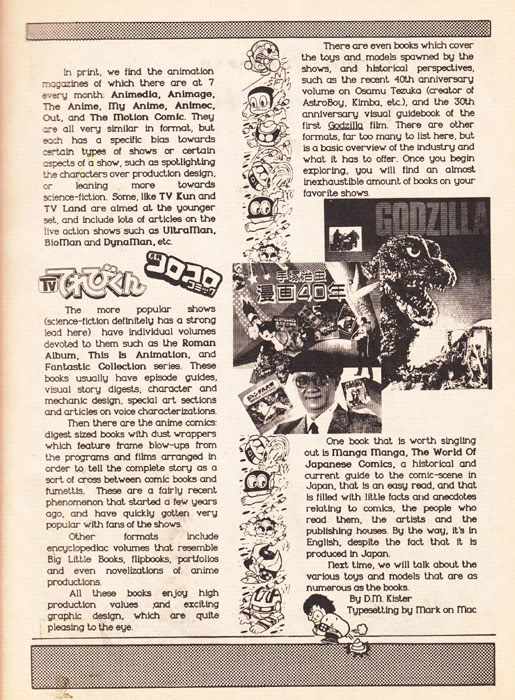
Back in 1984 my family went on a vacation trip to Philadelphia, which for me meant visiting comic book stores and watching Starblazers and Force Five on "Philly 57" in the hotel room. It also meant my first look into the world of free urban weekly zines, the mere sight of which impacted my youthful consciousness in ways that have not quite yet finished bouncing around my brain-pan.


REAL FUN was a shock: a cheap newsprint thing full of badly toned photographs, ugly comics, cut and paste typesetting, one or two colors somehow making the whole package look CHEAPER than if it was just black and white. Handwritten columns were next to primitive Macintosh typesetting. Ads for independent punk rock labels, record stores, and head shops coexisted with strips by Peter Bagge, Dennis Worden, Bill Griffith, Spain, the mysterious XENO, Henriette Valium, and other future stars. Fake news articles, anti-McDonalds editorials, and a general contempt for Reagan's America made REAL FUN authentic subversive literature for this suburban kid. What else did REAL FUN have? Japanese cartoons!


This article by D.M. Kister and F. Couch continued across two issues and not only was it filled with amusing typos and blatant editorializing, it was living proof of my firm conviction that Japanese animation was a vital element of America's mass media zeitgeist, that it had a place at the trash-culture table along with comic books, Pez dispensers, the 45 single, and late-night diner food.


As it turns out Mike Kister had a business selling Japanese animation books and magazines so I suppose there was an ulterior motive behind this article.


Remember, this was a time before businessmen even considered the idea of selling Japanese cartoons to America as anything but edited, dubbed syndicated children's television. The thought that there might be something worthwhile in these robot cartoons... that the degree of artistry and design in your Macross or your Nausicaa might be of interest to more than sugar-addled 8-year olds... this was SUBVERSIVE THOUGHT in 1984.

Was Japanese animation as transgressive as the "Ugly Comics" of Atlanta's own "Baby Sue"? Only "Bob" knows for sure. Memorize his predictions for 1985!


And if "Bob" can't heal you through slack, your only hope is Fred Lane And His Hittite Hot Shots.


Remember, the wing tip of destiny casts no shadow.

You doubt the convergence of underground culture and Japanese cartoons? You fool! Perhaps this "Dead Planet" comic strip will convince you with its clip-art Unico.


Also in REAL FUN: this ad for the WCC Animation Comics STAR BLAZERS.


The day of the free ad-zine might be over, but that doesn't mean I don't miss the punk-rock typography or the casual thrown-together design. If I had my way ALL magazines would look like this, which probably explains why I failed Graphic Design. There just wasn't room in the future for this kind of breezy insolence that can't help being REAL FUN.



Monday, April 18, 2011

the wonderful children's book of Honey Honey

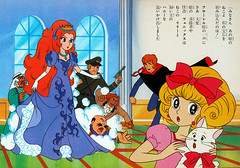
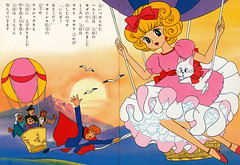
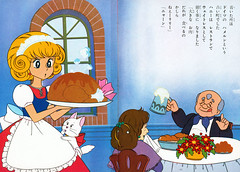
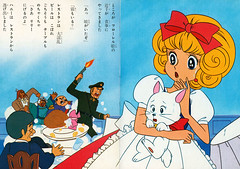
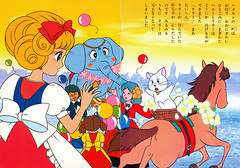
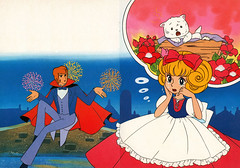
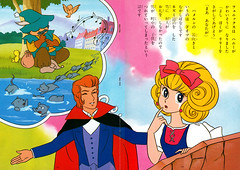
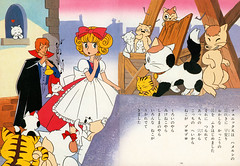
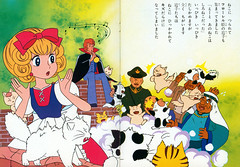
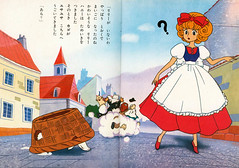
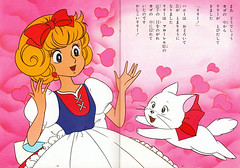
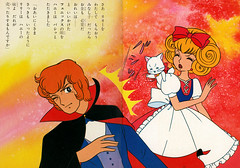
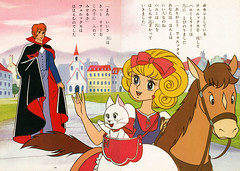
HONEY HONEY'S WONDERFUL ADVENTURES children's book published by Eikosha circa 1981. Based on episode #6 of the Kokusei Eigasha HONEY HONEY television series, "Hamelin Is Full Of Cats". Click on smaller images to enlarge, and enjoy!

Special thanks to Rick Zerrano for the translation assistance!


hhbook2


hhbook3


hhbook4


hhbook5


hhbook6


hhbook7


hhbook8


hhbook9


hhbook10


hhbook11


hhbook12


hhbook13


hhbook14


Will Phoenix capture Lily?  Will Herr Gustav catch Phoenix?  Will Princess Flora finally decide to marry somebody? And will these people ever leave Honey Honey alone? Tune in to the next exciting episode of the Wonderful Adventure Of Honey Honey! 

Tuesday, March 15, 2011

anime and manga bloggers for japan


As I hope you're aware, Japan is reeling in the aftermath of the worst earthquake since they started keeping records on earthquakes. Whether you call it the "Great Tohoku Earthquake" or the "Great Sendai Earthquake", what you need to do is to haul out the cash you fritter away on the sort of goofy junk I usually write about here, and send it to any one of these relief agencies. Hell, send them ALL some money.
Doctors Without Borders You know, Medecins Sans Frontieres, risking life and limb to help people around the world.
The Red Cross is in on this action, of course, as they always are. In America you can text REDCROSS to 90999, which will donate $10 that's added to your cell phone bill (seriously, how easy is that?) or call 1-800 RED CROSS. In Canada you can text REDCROSS to 30333 to donate, or call 1-800-418-1111.
Shelterbox is fascinating, they send premade emergency kits to disasters. "Each box supplies an extended family of up to 10 people with a tent and lifesaving equipment to use while they are displaced or homeless."

You can join the
Humanitarian Coalition - that's CARE, Oxfam Quebec, Oxfam Canada, and Save The Children. And there are a dozen, a hundred different other places to donate time & money. Get busy.

This post is thanks to
all about manga, whose "Anime & Manga Bloggers For Japan" post inspired me to quit watching disaster footage on TV and actually do something. If you ever enjoyed reading Let's Anime or any other anime & manga blog, or enjoy cartoons or comics from Japan; well, the time to say 'thank you' is now. Right now, this minute, go.

Saturday, March 5, 2011

Tomo Book No. 47

Depending on who you ask, the “golden age” of American comics starts somewhere in the late 1930s and ends anywhere from the Korean War to the Kennedy inauguration. Straitjacketed by this America-centric comic book collectors mindset, it’s tough to categorize Japanese comics from the same period. Is there a Golden Age of manga? Is there a Bob Overstreet-san categorizing faded Shonen Magazines and dusty stacks of tankubon, grading each according to condition and scarcity and injury-to-the-eye-motif
covers? God I hope not.


It’s this lack of raw data – raw data in a language I can read, anyways – that makes uncovering this kind of mid-Showa period manga (hah, here I am, categorizing away) so thrilling. What is this? Where did it come from, who was tracing Tezuka characters when they drew it, and what was it doing in an estate sale in Marietta GA in the mid 1980s? That’s where I found it, casually placed on an antique dresser next to a O.E.S. New Testament.

Number 47 in the “Tomo Book” series, this particular volume is titled “THE VANISHING WORLD” (forgive my rough translation) and features 4 stories of rockets, robots, Martian flying saucers, atom bomb tests, jet pilots romancing jungle girls, and general science fictional adventure; the Japanese equivalent of the Tom Swift sci-fi juveniles that American ten year olds were devouring at the time.


The artwork is generally pretty crude. You can get away with faking the cartoony Tezuka style once or twice but eventually the lack of structure or perspective, the weak crosshatching, the general ineptitude of the artwork (inside front cover signed “Yasuhiro Kozako”) shows through. And this is 1955: Tezuka was right in the middle of one of his most productive periods, Ishinomori was just getting into his Shonen Magazine groove, Tatsumi was moving beyond current styles and percolating the ideas that would, in a couple of years, emerge as "gekiga". Our Tomo Book No. 47 is an anachronism, even for 1955. Still, the breakneck pacing manages to brute-force the stories right through the weaknesses of the illustration, and the blue ink gives the entire production a reassuring elementary-school handout atmosphere.


Sometimes you meet robots on Mars;


And then sometimes the robots turn out to be beautiful girls. Life's like that.

Budding manga geniuses aside, most comic books everywhere are pretty much like “The Vanishing World” here – crude lowest-common-denominator distractions for children barely able to read. Impulse purchases for those who are barely old enough to have enough pocket money to learn what an impulse purchase is. Fifty years on, its value as a cultural artifact may outweigh its utility as an adventure story for children. But that’s OK. Rest easy, Tomo Book No. 47.


Monday, February 14, 2011

Magnos The Robot, I Suppose

This review originally appeared at the Anime Jump website in 2004.

Many people think of Japanese animation as high-tech, sophisticated entertainment for adults; animation that breaks the boundaries of animated entertainment and stuns audiences with originality and innovation.

These people are of course completely wrong.

As evidence to the contrary, I present the only possible argument; a rebuttal that is smashing in its impact and draws one to an inexorable conclusion that brutally shatters paradigms, even as it opens up new worlds of possibility.

The argument? MAGNOS THE ROBOT aka MAGNETIC ROBO GAKEEN, a mid-1970s Toei giant robot show that combines all the classic elements of Japanese anime: hackneyed plot, clichéd characters, outlandish and impractical mechanical design, and bizarre, incomprehensible villains and monsters. Combined with deadpan American dubbing, the end product can only be described as kitsch. Released on DVD in the US by "Liberty International Publishing", MAGNOS is a simple, tape-glitches-and-all transfer of an earlier VHS release that once graced the kiddie section of America's video rental stores and thrift shops.


No grand vision went into making MAGNOS. Driven by market forces, the creators simply threw together whatever elements they could rip off from other, more successful anime shows. Giant super robots, fantastic ultra-scientific secret bases, grotesque evil creatures – they’ve all been done before, and done better. However, the producers of MAGNOS took the bizarre visuals and childish storylines of your typical robot drama and cranked everything up to eleven – and as with all kitsch, their efforts had the opposite effect. Instead of appearing fantastical and awesome, MAGNOS THE ROBOT simply looks outlandish, impractical, and faintly ridiculous.


Earth is in big trouble; horrific creatures from the depths of the earth, actually ancient astronauts from outer space, have declared war on the surface world. Even though national monuments are being blasted into pieces, the United Nations refuses to listen to Sir Miles Nevers, the only one with any sort of idea who’s attacking us. Apparently the UN believes that sometimes things just explode for no reason. Is Sir Nevers a scientist, a naval officer, a industrialist? MAGNOS never tells us. Nevers has a gigantic nuclear powered flying battleship, a combat unit of helicopters and antiaircraft cannon, and a complicated combining-robot fighting system. However, all this equipment is completely useless, because what Nevers DOESN’T have is a hairy, disgruntled, denim-clad, kung-fu-fighting 70s style antihero to pilot his robot and save the world.

Enter Janus, who is a disgruntled karate champion with bad hair and a wardrobe straight out of the Levis department of your local Sears. Anybody who’s ever seen any 70s giant robot show can tick off the subsequent plot elements: Janus is asked to pilot the robot. Janus refuses because he’s the 70s style antihero and they never volunteer for nothin'. The horrific monsters attack! Janus, shocked at the fighting ineptitude of Nevers’ gang, is compelled to show these amateurs exactly how he did it in the karate ring. He changes into a tacky jumpsuit and is tossed into the robot cockpit, where his fighting spirit and cocky, never-say-die attitude succeed where skill and training fail.


But wait! What about the girl? There’s ALWAYS a girl in these shows, and it’s ALWAYS the professor’s daughter, and her and the hero NEVER get along, for at least three episodes. Well, MAGNOS is no exception. In fact, Nevers’ daughter Ester is absolutely vital to the plot. You see, Nevers built his Magnos robot in two parts, and one part is piloted by his daughter, and another part has to be piloted by a tough karate champion guy. I know some parents go to extreme lengths to hook their children up, but this is ridiculous. Actually the male-female thing fits in with the whole “magnetic” theme of the show – with a positive and a negative, MAGNOS evokes both your Electrical Engineering 101 syllabus AND your Tantric Sex manuals.

You see children when a man robot pilot and a woman robot pilot love each other very much...

The 1970s were known as the decade of the ridiculously elaborate pilot-entering-his-giant-robot scene, and MAGNOS upholds the tradition magnificently. First our heroes don stupid-looking jumpsuits. They get into rocket-propelled elevators and make special arm movements, which magnetically change their jumpsuits into even stupider-looking jumpsuits. Once inside little flying cars, they’re shot out of the nuclear battleship, along with the parts of their robots. The flying cars dock with the robots, and Janus and Ester wind up fighting evil inside some of the most inept looking machinery ever designed for a Japanese cartoon. Seriously, these two robots – “Magnon” and “Magnetta”- resemble gingerbread men more than they do combat equipment. Naturally they’re useless against the monsters of Xerxes Tire-Iron Dada, so they must combine into Magnos. This requires the following sequence: Janus and Ester leap out of their robots in mid-air and whirl around each other face to face, while the pieces of Magnos are shot out of the nuclear battleship. All this whirling somehow turns both Janus and Ester into some sort of rectangular yellow box, and as the pieces of Magnos come together in the sky, this rectangular yellow box becomes Magnos’ belt buckle. Magnos itself is another terrible robot design – think of Go Nagai’s STEEL JEEG and then exaggerate the less plausible, more outlandish features. Magnos has pumped-up steel muscles, a head that doesn’t turn, blades that pop out of the hands, and tiny wrists and ankles (this becomes a plot point later, believe it or not).


Meanwhile, of course, the enemies of mankind have been chilling out and watching this entire transformation take place. Xerxes Tire-Iron Dada is far away in another galaxy, so he’s forced to rely upon his minions to conquer Earth. Led by Brain, a grotesquely ugly green fellow with a giant brain that resembles an afro, they include a robot guy, a woman made out of fish parts, and some kind of lion person. They’re all full of great plans for defeating Magnos and conquering the Earth. Most of these plans involve gigantic monsters made from combining Earth animals – resulting in LSD-inspired combinations like Batroacher and Octo-Crabus X-3. Yes, it’s monster design via Conan O’Brien’s “If They Mated”.


The Brain, Xerxes Tire-Iron Dada, and the majestic Octocrabus X-3

The dubbing is terrible. The mix is awful, resulting in incidental music drowning out nearly every important line of dialog. The actors read their lines competently enough, but the script can’t decide if it wants to be silly and self-referential or deadly serious. Of course, when the bad guy is named Xerxes Tire-Iron Dada and most of Brain’s lines consist of “What treachery is THIS?” it’s hard to maintain a serious tone. At least SOMEBODY was having fun with MAGNOS.

It’s hard to say how seriously this was taken in Japan, anyway. After all, this IS a show where a giant bat-cockroach attacks an oil refinery, where our karate hero Janus is shown karate-chopping a BULL in a flashback. The show is just wild enough, just kitschsy enough to make me think that everybody was in on the joke. At least I HOPE nobody was taking this seriously. The animation isn’t as lame as the storyline; perfectly competent Toei TV show animation, much as you’d see in any TV anime of the day. Some of the fighting scenes are actually fairly well done. “Well done” – never thought I’d use that phrase in connection with MAGNOS.


KARATE BULLFIGHTER!!

Curiously, the Spanish track on the DVD has a better audio mix than the English track. MAGNOS was a big hit in Italy under its original GAKEEN title, and it would have been nice to see the Italian opening credits, maybe some Italian dialog. But this is a bargain basement DVD release, and anyway, special features would destroy the low-rent atmosphere MAGNOS works so hard to maintain.


Grace Jones - actress, model, musician, Bond Girl, otaku?? This is a REAL Grace Jones LP.

Yes, I said DVD – MAGNOS THE ROBOT makes a fine addition to anybody’s DVD collection, as a counterpoint to all those expensive box sets full of anime designed for the hip, artsy, with-it, modern aficionado of the animated art. MAGNOS takes us directly back to the time when the term “Japanese cartoon” meant cheap, lurid, violent children’s entertainment. If you’re concerned about the image of Japanese animation as a mature art form for intelligent adults, avoid MAGNOS, because it will make you cry. However, if you’re in the mood for outlandish junk-food cartoons about clumsy-looking giant robots battling the monsters of Xerxes Tire-Iron Dada, then MAGNOS is the one to watch.

-Dave Merrill