Wednesday, October 30, 2013

Top Ten Least Essential OVA Of The 80s

The internet is filled with sequentially numbered, attention-getting listsicles all claiming to be the authoritative judgment on the top fifteen party schools to visit after you master your five best workouts or the twenty-five movies you must not fail to see with the ten people you meet when you die. And here at Let’s Anime we are not any better,  even though our focus is classic Japanese cartoons. So here’s an less than exhaustively researched, completely subjective and totally arbitrary list of the Top Ten Least Essential OVAs That Honestly, You Don’t Need To Watch.  You can safely go on about your life without ever having wasted your time watching these 1980s Japanese anime OVAs; other than filling the shelves of neighborhood video rental shops, they are inconsequential in every sense of the word.  Some of them are bad, some of them are boring, and others make no sense whatsoever, their only common denominator being their total uselessness. And remember, like every other stupid list you find on the internets, this is completely arbitrary, subject only to the reviewer’s whimsical notions, and may not reflect your personal taste or reality in any way whatsoever. 

Headbands are an essential part of your 1980s fashion
 
Cosmos Pink Shock - 7-21-1986 This one’s a lightweight and knows it, but the great Toshiki “Iczer One” Hirano is here at the height of his powers, giving us the story of Michi, a space leotard girl who blasts across a goofy universe in her ship, the Pink Shock,  in pursuit of her boyfriend.  It’s got good AIC animation, some gags – not great gags, but gags nonetheless – and cultural references that we didn’t get in the 80s because our knowledge of Japan was limited to Robotech, ninja movies and metal robot toys. It’s the OVA equivalent of a 12” remix by Bananarama or the Mary Jane Girls – a perfect artifact of its time whose greatest virtue is being a perfect artifact of its time.
 
Dead Heat - 8-7-1987 In the future, auto racing is known as ‘FX’ and the drivers don’t drive cars, they drive car-robot hybrid vehicles, and they don’t just race, they grapple with each other as they go around the track. Seems like a lot of mechanical engineering simply to replicate roller derby, but who am I to argue with the future?  This Sunrise OVA is of interest mostly to people who for some reason are unable to watch either roller derby or auto racing, and who wonder if our hero Makoto will win the big race so he can take his surprisingly male-looking girlfriend to a love hotel. If you had a dedicated 3D compatible VHD player with 3D glasses,  you could watch Dead Heat in thrilling 3D, with the exciting bonus of witnessing an extra character who was only visible in 3D. Legend has it this character holds up a sign marked with the Japanese characters for “sucker”. 

Makoto and "girlfriend"

Elf 17 - 1-4-1987  Based on the manga by Atsuji Yamamoto, Elf 17 is a cutesy lightweight romp through the galaxy as our title character, the strongest little teenage girl elf in the universe, teams up with the eccentric zillionaire prince Mascot Tyler and the battle-suit otaku K.K. as they battle their way through the pro-wrestling areas of outer space. This airy trifle comes complete with giant walking tanuki statues and a Mitokomon reference, and it completely misrepresents Yamamoto’s manga work, which started off kinda lurid and just got more lurid with time. Later Yamamoto works include “Battle Goddess” and the super bloody, ultra lurid “Arnis In Sword Land.”  Yamamoto also provided the story for another completely non-essential OVA, Ultimate Teacher.

Ruu, aka Elf 17, will kick your ass
 
Phantom Gentleman aka Dream Detective Gentleman (Mugen Shinshi: Boken Katsugeki Hen) - 2-21-1987 Mamiya Mugen is a famous detective, a famous, kinda girly-looking kid detective, who works in a weird retro 1930s Japan.  Strange kidnappers target club dancer Atsuko “Akko” Fukune - but Mugen is on the case to protect Tokyo’s exotic dancers! This 49 minute video mixes cutesy character designs with what you’re led to believe is going to be some kind of detective story but instead detours into magical relics, mythical monsters, and Indiana Jones-style adventure, but all the busty dancing girls or archeological destruction can’t help make this inexplicable film any more explicable. If we were Japanese we’d be familiar with the popular Mugen Shinshi manga by Yosuke Takahashi, but his eerily sensual pen line failed utterly to make the transition to this anime.  
underage drinkin', underage detectin'

Roots Search - 9-10-1986
This one is bad and it should feel bad.  Roots Search, aka “Life Devourer X”, is like something a dollar store or a truck stop chain would produce to cash in on what they heard was the exciting new “Japanimation” fad, like something you find hundreds of dumped at a Goodwill for a tax loss; poorly animated, badly designed characters wander through various spaceships having ESP visions and dodging a horrifying vagina dentata alien that murders astronauts. And then it just ends, denying the remaining few viewers any sort of closure.  This one is by some of the same people that brought us Crystal Triangle, another really terrible OVA that at least has an ending.

Good Morning Althea - 12-16-1987 This might be the exact point where Japan just gave up and decided to just throw mechanical designs at their OVA projects in the hope that the resulting confusion would resolve itself into some kind of interesting pattern. This is the sort of OVA you watch without subtitles and naturally assume that what’s going on makes sense and is in some way purposeful and of interest, and then later somebody fansubs it and you find out that the pattern your brain attempted to impose upon it actually made more sense than what was originally intended. There’s a spaceship, there are robots, there are people in robots fighting other people in robots from another spaceship. Somebody wakes up.
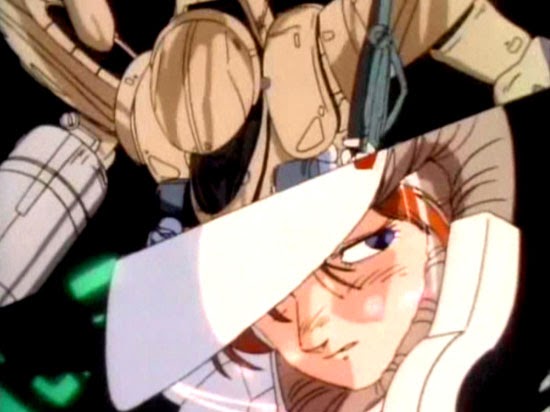
rise and shine Althea

The Humanoid - 3-5-1986
If you spent any time in the 1980s you’ll recognize his work: the shiny airbrush work of Hajime Sorayama appeared on the covers of Playboy and Heavy Metal and on album covers for bands like The Cars and Aerosmith. And if you find the idea of a shiny metal woman interesting enough to support a 40-minute animated video, then The Humanoid is for you! Antoinette, the sexy robot in question, was built by Dr. Watson on the planet Lazeria, which is about to be destroyed by the evil Governor Proud, right when Dr. Watson’s daughter Sheri and her hunky fiancĂ© Alan arrive. Terrible timing!  Luckily, this all happens when Antoinette’s sexy robot heart starts to have robot feelings of love, and she uses her sexy robot power to save the day. This 40-minute time-waster has lackluster character designs, cheesy 80s ballads, and an inexplicable obsession with coffee. 


Digital Devil Story (Megami Tensei) - 1987 Based on the Japanese horror novel series by Aya Nishitani, this one’s about a student computer genius, who’s also the reincarnation of an ancient Japanese deity, who uses his giant clunky 80s mainframe to summon up some horrifying devils. This involves some not-bad animation of a well-endowed teacher’s frilly brassiere heaving up and down as she becomes the conduit for horrifying monsters from another dimension to invade our world. Then giant piles of red goop start crushing students and a big blue hairy devil named Loki fights our student computer genius hero, who fights back with his reincarnated girlfriend and his magic sword and his pet devil animal throughout several alternate universes.  If you want lots of mid 1980s computer technology and lots of scenes of people staring intently at old-fashioned CRT monitors, followed by hairy devils and magic swords, this is the one for you! The Hiroyuki Kitazume character designs aren’t bad, if you’re into that sort of thing.  Apparently there are a lot of video games based on this novel, and I suspect they aren’t very essential either. 

Chojiku Romanesque Samy – Missing 99 - 7-5-1986  Let’s see, what we have here is your typical everyday story of a typical anime schoolgirl who finds out she actually has amazing mystical powers that not only transport her into an amazing fantasy world but give her amazing super battle armor that doubles as a bikini. Raise your hands if you’ve seen this all before. Can she survive the attack of the reconstructed demon beast warriors in time to reveal her true Bodhisattva nature? 


Girls Detective Club (Katsugeki Shoujo Tanteidan) - 11-25-1986  You’d think that a video starring three high school girls armed with automatic weapons battling an evil girl-genius with a giant flying battleship would be jam packed with the same sort of excitement and flash that made Project A-Ko such a success, but you’d be wrong. This stunningly boring piece of junk – from TMS, shockingly enough - limps from nonsensical setup to nonsensical setup, never explaining who these girls are, why they have a detective club, why one of them lives in a mansion filled with machine guns, or why this was animated in the first place. It feels like a Cream Lemon with all the sex removed, like an episode of Urusei Yatsura without gags, fun characters, or pleasant design, like a half hour of your life without anything productive or fulfilling accomplished. What purpose Girls Detective Club served other than clogging shelves down at Tsutaya Video is a mystery which I suppose we’ll need to hire a Girls Detective Club to solve. 

get detecting, you
 
What’s that? I didn’t mention The Wanna-Bes or Twilight Q or Twinkle Heart or even Twinkle Rock Me Nora? Didn’t see your favorite least essential OVA listed here? Ready to take this to social media and tell the world how Let’s Anime arbitrarily ignored your favorite least essential OVA in its totally subjective list? Sure, why not. Make sure to let us know what YOUR time-wastingest OVA is, or was; maybe we can get another column out of ‘em.

-Dave Merrill

Thanks for reading Let's Anime! If you enjoyed it and want to show your appreciation for what we do here as part of the Mister Kitty Dot Net world, please consider joining our Patreon!

Saturday, October 5, 2013

you know, for kids

Here's a fun thing, a translation of a children's book from the 1982-83 Nippon Sunrise anime series SENTO MECHA XABUNGLE.  Let your children drift off to dreamland with this tale of one man's search for bloody outer-space wild-west vengeance! Translations by, and many thanks to, Ric Zerrano.

(Click on images to do an enlarging Mecha-Change)


Thanks for reading Let's Anime! If you enjoyed it and want to show your appreciation for what we do here as part of the Mister Kitty Dot Net world, please consider joining our Patreon!

Sunday, September 22, 2013

that time of year again

Yes, it's September, and that means I go down to Anime Weekend Atlanta and spend three days immersed in that sea of costumers, anime fanatics, lost children, hucksters, and confused parents known as an "anime convention". Lots of great stuff happening this year - star voice talent, cybernetic musical acts, key video game designers, and me!  What am I up to?

Thursday night at 7 - before the convention even starts, really -  we host a yard-sale garage-sale swap-meet event we like to call the "SuperHappyFunSell". 


Then at 9 I take whoever's still hanging around on a fun trip through the world of TCJ, the studio that brought us Gigantor, Eighth Man, Prince Planet, and Kamui, and is still going strong as Eiken!


On Friday at 3:30pm I've been dragooned into the Mega 80s Panel where we'll talk about what it was like to be an anime fan in the 80s!  This will contain substandard fan art, so look out.


Then at 10pm it is time for all of us to go to hell. Anime Hell, that is! 


On Saturday at 11:30 I will be exploring the world of Knack, the studio responsible for Ninja The Wonder Boy, Chargeman Ken, Cybot "Robby The Rascal" Robotchi, and more (or less)! 


Then on Sunday at 11am I'll be joining reps from the various Atlanta anime conventions and from anime cons around the country and beyond to discuss matters of vital importance to the furtherance of our goals. And gossip.  And at 3 Neil Nadelman, Elizabeth Christian Smith and myself will be discussing what anime we'd take with us to keep us sane if we were trapped on a desert island! 


That will pretty much take us up until the end of the convention, at which point it's time to pack everything away and see ya next year. If you're in the Atlanta area I highly suggest you drop by, it's gonna be a great show!  You can find a full schedule for AWA here!


Saturday, August 17, 2013

zine-o-riffic


Two new old-media offerings deliver the classic anime goods in the so-unfashionable-they're-fashionable print medium, available not from whatever local business in your area still sells zines or from a begrudgingly-given “fan table” at a nearby anime con, but from the convenience of your own easy chair, thanks to modern electronic technology. 

Colony Drop, the opinionated collective enfant terrible of the anime blog scene, has been outraging the easily outraged and Telling It Like It Is on their blog since 2008; and as testament to their love of the traditional, so far they've released two print-on-demand anime fanzines. The second, THE LAST AMERICAN FANZINE #2, recently appeared and is both larger and pinker than the first; 74 perfect-bound pages of full color Japanese animation culture data. Contributors include Benjamin "Anipages" Ettinger, Patrick Macias, me, Mike Toole, and Daryl Surat, a veritable who's who of the charmingly obsessed, all discoursing on topics like VHS worship and basic-cable OAV appearances in the 1980s, the eye-opening adults-only Pop Chaser, and the real-life background to Patlabor.  The zine also features an enlightening discussion between two Japanese anime journalists, a behind-the-scenes look at animecon scandal with the mysterious "Director X”, and a sad photo essay of the otaku ghetto at New York Comic Con.


As a Kinko's-scarred veteran of the fanzine heyday, I've read a lot of anime zines, and it's my opinion that these CD zines are state of the art. The writing is confident and knowledgeable, the artwork is classy, the layout is uncluttered. It's as close to the Platonic ideal of 'anime zine' as you're ever going to get. 


Meanwhile a few fathoms down, Marine Boy is bravely and freely fighting evil beneath the sea, as he's done in various forms since 1967. If you watched Marine Boy as a boy or girl or if you only came across him on the UHF dial in hotel rooms in far-off cities, you need MARINE BOY: UNDERWATER ADVENTURE, the new book from Xenorama aka David McRobie.  Xenorama has been assembling this comprehensive guide to Marine Boy together for years, and his 40-page book features full episode guides to both the English and Japanese versions of the series, as well as an interview with the late Peter Fernandez, who produced the English version.  With the recent release of the first season on DVD by Warner Archive, interest in Marine Boy is at high tide, and dismay at the horrible pun I made there is also pretty high. Sorry. The UNDERSEA ADVENTURE trade paperback is produced by Amazon's print-on-demand service and can be yours with just a few splashes of your swim fins, or clicks, if you prefer. 


Sunday, August 11, 2013

Spooks A'Poppin

Haints and ghostlies abound in Drawn And Quarterly’s new gigantic volume of Kitaro, the seminal yokai-busting horror-fantasy-folklore-adventure-comedy manga  by Japan’s one-armed manga master Shigeru Mizuki.  Kitaro started out as “Graveyard Kitaro”, but it wasn’t until a slight retooling as the less scary, more funny “Ge Ge Ge no Kitaro” that the series took off with a ten-year run in Weekly Shonen and five separate TV animated shows spread out over five decades, leaving an indelible mark on Japan’s popular culture landscape.  Supposedly manga-crazy North Americans spent most of the “manga boom” here in the West ignoring the hell out of Mizuki’s work – it’s more comforting to believe Japanese comics are nothing but high-tech adventures of sexy schoolgirl ninjas – but even the ignorance of Americans is no match for the spiritual power of Kitaro.


D+Q’s Kitaro collection is a big brick of  60s manga, nearly 400 pages of the best of Kitaro stories from 1967-69, with an enlightening introduction by yokai scholar Matt Alt, wonderful jacket design, and large pages - nearly twice the size of typical manga tankubon – to bring every bit of Mizuki’s yokai terror to life.

Kitaro, the mysterious one-eyed boy with the striped vest, comes out of nowhere to serve as diplomat between the human and the spirit world. When ignorant people tamper with forbidden mystical secrets, when yokai cross the line and menace humanity, Kitaro will keep the peace by any supernatural means necessary, whether it’s using his hair as yokai-detecting antennae, battling an army of possessed cats, or freezing himself to deal with the water monster lodged in his belly. Just wait ‘til you see how he deals with being turned into a tree! At first Kitaro wanders the earth dispensing lone justice, but bit by bit his world is fleshed out with supporting characters like the disreputable Nezumi Otoko and Kitaro’s eyeball father.  When you get to the part where Kitaro is injected with monster blood and becomes an enormous, hairy, Godzilla-sized whale monster that lumbers through Tokyo destroying landmarks, to be confronted by – what else?  - a giant robot, the off-kilter logic of Mizuki’s yokai world starts to make sense in its dreamlike matter-of-factness.

 Mizuki’s pen work combines the mundane and the terrifying with his technique – eerie pointillist dots bring glowing spirit meteors to life and an almost inhuman mastery of cross-hatching showcases every wrinkle and hair and giant eyeball of his more repulsive monsters. The overgrown mountains and creaky, crumbling shacks of rural Japan are the background for his cartoony, sketchy characters, whose comical simplicity highlights our insignificance in the face of ultimate cosmic horror.
Kitaro’s mid 60s success echoed the monster boom that had the United States in its grasp, and while we had the Munsters, Weird-Oh kits and decals, Ghoulardi and Famous Monsters magazines to satisfy our lust for weird horror heroes, single-handedly brought Japan’s folkloric terror titans out of the musty past and into modern Japan, starting a yokai boom that’s still reverberating throughout the nation. Rightly regarded as one of Japan’s masters of comic art, it is high time the Western world got its chance to go monster crazy for Shigeru Mizuki and Kitaro; the thanks of the manga-reading world, as well as the spirit realms, go to D+Q for making this possible.

everything is sprouting hair.

Thanks for reading Let's Anime! If you enjoyed it and want to show your appreciation for what we do here as part of the Mister Kitty Dot Net world, please consider joining our Patreon!

Monday, August 5, 2013

take you on a journey

I first saw Galaxy Express 999 on a bootleg VHS bought from one of Atlanta's hairier comic-con video pirates, sometime in the mid 1980s. The Kodak T-120, with the words "Galaxy Express" markered on its orange-yellow label, was a copy of the home video release of New World Pictures' version of the 999 film, which received an American theatrical release for about fifteen minutes before moving to HBO and video-rental shelves. I knew none of this. What I knew was that there was something called "Galaxy Express" that Leiji Matsumoto had created, and he was the guy behind Captain Harlock and half of Star Blazers and who knows what else? At that time, we knew Japanese animation as a weird neverland that existed only in the colorful hieroglyphs of Roman Album fold-out posters and My Anime cassette labels, glimpses caught on afternoon UHF stations between ads for Cookie Crisp and Fruit Roll-Ups, peering out at us in the form of model kits from something called "Gundam" that had suddenly appeared in the toy stores. 

Certainly Japanese animated films weren’t something you could just sit down and watch any old time you felt like it. Only now you could, provided you could get access to the family TV for a couple of hours. And in spite of the hacky dub, in spite of the comical name changes, in spite of the jarring edits (seriously, the New World version edits out all the cats), in spite of the fuzzy duplication of a copy of New World's less-than-stellar transfer, there's something about Galaxy Express 999 that shines. Recently, we got the chance to see the film, not on bootleg VHS or late night cable TV but as God and Rintaro intended, uncut and in a real theater.

There's a lot of good stuff in that late 70s-early 80s sweet spot of Japanese animation that some call the Yamato Boom and others refer to in terms of Gundam, when public interest, creative talent, and licensing cash all coincided to create a kaleidoscope of film and TV of every conceivable topic and level of quality. Out of that boom came many great projects, but I’ll always have a weakness for Galaxy Express 999.

999's pedigree is top-notch. It has Rintaro stretching his muscles in his first feature film and Yoshinori Kanada bringing his talent and his timing from dozens of the best TV animation. It has character designs by K. Kazuo and lush Tadao Kubota backgrounds featuring the crumbling, overbuilt Earth, the lurid jungles of Titan, the outer-space Wild West of Heavy Meldar, and the neon and black of the Mechanized Planet.


Thematically, the film works as space fantasy, as a childhood fairy tale, as a humanist polemic, as class-war fable. Sometimes, as when the giant death-skull of Harlock's Arcadia smashes the eternal-life headquarters on the Mechanized Planet, the film's subtext erupts out of theory and just sits there on the screen daring you to call its bluff. And as a condensation of a 113-episode TV series it gets us from Earth to the Andromeda Galaxy and back again in just over two hours, hitting the high notes, rearranging story elements but retaining the Bildungsroman of Tetsuro Hoshino, orphaned on a future world where the rich live forever in machine bodies while the poor scurry like rats to starve, freeze or be hunted. 

how many machine men will you see before you stop believing
To avenge the death of his mother at the hands of the feudal machine lord Count Mecha, Tetsuro finds himself on the Galaxy Express 999, the limited express space train that delivers people to the Mechanization Planet in Andromeda, where eternal machine bodies are distributed to the wealthy.  Accompanied by the mysterious beauty Maetel, Tetsuro meets his childhood heroes, satisfies his lust for revenge at Count Mecha’s Time Castle, and learns the terrible truth behind his traveling companion in a planet-destroying cataclysm that shakes the political and social structure of two galaxies.


For a while that bootleg Kodak was our only copy of 999.  Then somebody in the local anime club dug up an English-subtitled copy, not fansubs but typeset-on-the-35mm-print emulsion subtitles, and we found out about all the missing cats.  Later we’d pool our cash and get the Galaxy Express movie laserdisc set and fansub the sequel Adieu Galaxy Express, and then Viz released both films in subtitled and dubbed versions.  Now in the 21st century, Discotek has released both films – and the third 999 film, Eternal Fantasy -  on DVD.


There’s nothing like seeing a movie with a crowd of strangers to force an objective evaluation, and the recent screening highlighted what may be the film’s weakest point; how well it works with people who don’t already know who Harlock and Emeraldas and Tochiro are. Japanese audiences in 1979 were likely familiar with the Captain Harlock and 999 television anime, or they’d read the Harlock manga in Play Comic or the Shonen King 999 manga serial.  To be fair, the 999 movie is quick to educate us – not five minutes in, we get a loving zoom of Harlock’s wanted poster on a crumbling Megalopolis wall, and elementary adventure-movie macguffin-hunting brings the three characters into the film with reasonable logic. 

While it’s still not really clear who Emeraldas is or what she does, top marks for strangeness must go to Tochiro Oyama’s bachelor digs in the guts of a ruined space battleship, a beautiful if confusing sequence for audiences who hadn’t had months of Captain Harlock on TV preparing us. You can actually see otaku-nerd culture seeping into popular culture with this scene – the idea that vital script elements can come from completely separate media, and if the viewer is confused as to why the squat little dude is having lightning shot into his body and as to why this film seems to think it’s important, tough darts, pal. 


 This might explain why the backstory so meaningful to Japanese audiences failed to impress execs at New World when the pic was readied for American release in 1980. Apart from editing out all the cats, New World made extensive cuts to many sequences, downplayed the Matsumotoverse callbacks to Tochiro’s mom, and left out tragic 999 waitress Crystal Claire’s end-of-film sacrifice (which, to be honest, feels superfluous).  Taken in context, New World’s decision to give Harlock a comedy John Wayne voice almost (almost) makes sense – without the necessary pop-culture preparation, audiences don’t know or care who Captain Harlock is; but give Americans a recognizable cultural signifier and suddenly his archetype fits neatly into our mental picture, as a manly hero who is at home, as Wayne was, both on the open range and on the bridge of a warship. 


I saw this in action last week in Toronto; you can feel the audience starting to get antsy somewhere out near the orbit of Pluto, not quite buying into this whole space-train thing, and then suddenly we’re on Heavy Meldar, the space-western zeitgeist clicks into place, and the crowd relaxes with an audible sigh of familiarity, able to finally place this film in their mental filmic landscape, even if they’re still fuzzy on who Harlock, Tochiro, and Emeraldas are. The screening at TIFF Bell Lightbox was part of the TAAFI’s yearly Toronto animation festival, in conjunction with the Japan Foundation, who provided the 35mm print from their library. The theater was pleasantly filled – we were informed this event had the largest crowd of any TAAFI event – and I found myself explaining the plot of Adieu Galaxy Express afterwards to anyone who would listen, having fallen in love with this movie all over again. The film had always been on the shortlist of titles I’ve sought out on the big screen; we finally got to see an uncut Nausicaa in North American cinemas with the recent Ghibli retrospective, and if they can ever get the Macross rights cleared up maybe I can cross that one off my bucket list, too. However, a pass on the Galaxy Express 999 was always my anime-cinema dream, now realized thanks to TAAFI, the Japan Foundation, the TIFF Bell Lightbox, and the boundless generosity of mysterious beauties from space.

-Dave Merrill

Thanks for reading Let's Anime! If you enjoyed it and want to show your appreciation for what we do here as part of the Mister Kitty Dot Net world, please consider joining our Patreon!