The six “escapades” contained in this
Seemingly tireless in its mania to promote lawlessness and
crime, Pioneer has released this
The six “escapades” contained in this
Seemingly tireless in its mania to promote lawlessness and
crime, Pioneer has released this 
![]() |
| Doublecheck and Honeybee the Woman-Headed Bee |
![]() |
| some of Dr. Zen's quality animation |
![]() |
| a giant turtle laughs at Dr. Zen. No, you're not on drugs. |
![]() |
| Dr. Zen will return? I sure hope not. |
Hisamatsu’s manga work would inspire another TCJ series that
premiered in April of ’67- Boken Gaboten Jima aka Adventure On The Gaboten Island.
This “Swiss Family Robinson/Robinson Crusoe” style story involves a lost island
full of strange animals and the story of five teenagers who wash up on its
shores. Tomato and Ryuga sneak onboard a
submarine at an amusement park late at night, joining Gabo, Cucumber and Igao
who were already there. Launched accidentally, the sub drifts on the ocean
until beaching on Gaboten Island,
where the five must survive as castaways. They build treehouses, make
friends with the animals, explore the hidden tunnels and caves of the island,
discover ancient relics, build irrigation canals, a waterwheel, indoor
plumbing, a little island train, meet local islanders, and hold a boxing match between a gorilla and
a baby dinosaur. As fun as all this is, they know eventually the volcano is
going to erupt, so they must find a way off Gaboten
Island! A great mambo-style theme song and interesting use of live-action footage make the opening credits fun.I’d love to see more of this series. ![]() |
| Hit me, dealer |
Nihon Doga/TV Video/whatever would also produce Kaito Pride AKA Dr. Zen, a primitive series of brain-damagedly simple shorts starring the
mysterious thief Pride (or Dr. Zen) and his attempts to steal all the children’s
toys. Opposing this criminality is the boy detective Doublecheck and his pals
Gabby and Honeybee, who is a little talking bee with a woman’s face. Time to
quit drinking.![]() |
| in the future we'll wear helmets with little wings |
Meanwhile, back in the non “Tele-Cartoons” world of TCJ, in
the Sengoku Era/Warring States period of Japan
(16th century) – or 1968, if you like - the remnants of Sanada
Daisuke’s men were hunted by Tokugawa’s ninja led by Hattori Hanzo, and among
these survivors was the ninja Sasuke Sarutobi. Sasuke has made pop-culture
appearances for years, but in Sanpei “Ninja Bugeicho” Shirato’s 1961 Sasuke manga (based in turn on a novel by Kazuo Den), Sasuke is a young boy struggling
to survive in a ninja-infested Japan
crazy for his young ninja blood. TCJ’s 1968 Sasuke series did a decent job replicating
Shirato’s amazing brushwork and idiosyncratic character design, and delivered
the first of a very few “gekiga” anime series. Sasuke ran for 29 episodes and
would eventually find its way to American markets as a one-episode dub titled
“Kiko – Boy Ninja.” ![]() |
| date night, Kamui style |
It’s around this time that TCJ underwent a transformation
into Eiken, a move that would see it through the end of the 20th
century and beyond. Spearheading this bold new direction is none other than the
cheerful housewife Sazae-San, whose TV adventures started in October of 1969
and ended… let’s see. Sazae-San is STILL ON THE AIR. That makes Sazae-San the longest-running TV cartoon of all time, anywhere. Based on
the Machiko Hasegawa comic strip which started in 1946 and took Sazae and her
family through Japan’s
occupation up into the 1970s, the success of Sazae-San made Hasegawa one of Japan’s
pre-eminent female manga-ka and allowed her to, among other things, start her own art museum. Although the strip was
controversial at first for its portrayal of Sazae as a modern, independent
woman capable of making her own decisions, the series is now seen as a light
family comedy (see also The Simpsons, which were once controversial enough to be condemned from the White House. I know, right?) enjoyed by generations of
Japanese young and old, and ignored completely by so-called “anime fans” in the
West. Get with it, people.Somebody - St. Francis Xavier, I think - said “Give me the child until he is seven and I’ll give you the man”. That’s what happened to me with Japanese cartoons. My young brain endured years of ultra-high-frequency TV exposure to Japanese animation, and the result was an inevitable and otherwise inexplicable love for pop culture from the other side of the world. Speed Racer, Ultraman, and Prince Planet burrowed into my skull and never left. Years later I’d find out the studio behind Prince Planet, or Yusei Shonen Papi as it would be known in Japan, was a pioneering outfit responsible for many of the firsts of the industry, and would go on to premiere, among other things, the longest-running TV cartoon in the world. Recently at AWA, I conducted a research seminar into this studio, known then as TCJ . The following are my findings.
Their first TV series was Sennin Buraku, aka “Hermit Village”, a fall ’63 late-night
show for the grownups. It’s based on the long-running manga series by Ko Kojima
– and when I say “long running” I mean it’s been running since 1956, making it
Japan’s comic strip long distance champ.
Sennin Buraku’s anime incarnation lacks Kojima’s sketchy look, but the
peace of Hermit Village Taoyuan’s strict
Taoist ascetism is still interrupted by lazy, lustful hijinks and nonsensical
action as disciple Zhi Huang follows his own Tao by chasing girls.
Robot action would continue with TCJ’s next series; 8 Man. The Jiro “Batman” Kuwata/Kazumasa Hirai manga leapt from Shonen Magazine with its Dick Tracyesque
story of a tough detective killed by gangsters but resurrected as the
invincible, shape-shifting cyborg 8 Man, whose adventures thrilled children
across Japan and whose popularity drove an overworked Kuwata to the brink of
suicide. TCJ’s 56-episode series was produced at breakneck speed by a TCJ staff
already overworked at producing Tetsujin-28, setting the pace for an
overworked, underpaid anime industry that remains so even in the 21st century. In America,
ABC’s syndication arm licensed the series, and after a pilot film dubbed by
Peter “Speed Racer” Fernandez, went with Copri International Films in Miami
for the localization of the full series. Copri, staffed by Cuban expatriates,
dubbed a huge number of American shows into Spanish for the Latin American
market, and also did work for the CIA and
the Voice Of America propaganda radio service, as well as Standard Oil and Pan
Am. Voice talent for 8-Man came from the
local Miami radio and theater scene
and a new opening title sequence was animated, probably by Oriolo “Mighty
Hercules” Studios. Interestingly, the Japanese theme song was sung by Katsumi Shigeru, a rockabilly singer with the band “Rock Messengers”. In 1976 got a 10 year prison sentence for murder;
he’d killed his girlfriend and stuffed her body into the trunk of his car.
SF marched on in TCJ’s output – their next series, 1965’s
Super Jetter, is the story of Time Patrolman 723567 who flies from the future
in his time-ship Ryusei-go (“Shooting Star”) in pursuit of the criminal Jaguar.
Trapped in the 20th century, Super Jetter finds himself using his
future powers to battle for justice. Super Jetter was created by Fumio
Hisamatsu, an assistant to Osamu Tezuka, and his other manga work included
adaptations of Godzilla Vs Mothra, Ultra Seven, Mighty Jack, and Mirrorman.
Broadcast on TBS, the show achieved enough foreign popularity to warrant a
second color series.
The world of Outer Space would remain a theme for TCJ with
their next show, 1965’s Uchuu Shounen Soran, which would run 96 episodes through
‘67. Dr. Tachibana invents the anti-proton bomb, and despairing of its use as a
weapon, flees into outer space with his wife and children. After a crash
landing on the planet Soran, his young son is raised by space aliens and
returns to Earth years later with super powers and a sidekick, Chappy the Space
Squirrel. While righting wrongs and defending justice, Soran also searches for
his long-lost sister. Space Boy Soran would, along with Cyborg 009, Space Ace,
and Princess Knight, be broadcast in Portuguese on the pioneering South
American TV network TV Tupi.
June of ’66 would see the premiere of another TCJ space
epic, Yusei Kamen, aka “Planetary Mask” or “Asteroid Mask” as we used to call
it. Based on the manga by Jiro Kuwata assistant Kusonoki Kochi, it turns out
that in 2001 we discover the planet Pineron, a counter-Earth always on the
opposite side of the sun. Relations between the two planets are friendly enough
so that Johansen of Pineron and Maria of Earth fall in love, are married, and
raise a son, Peter. 15 years later, a nuclear accident allows a dictator to
seize control of Pineron and start a war with Earth. Pineronians on Earth are
interned and things look bleak for the solar system. Suddenly a mysterious
figure appears to fight for justice – people call him Yusei Kamen! The identity
of this masked hero, an outer space Zorro, is always a secret, even in the
show’s credits. 39 episodes of this series would air on Fuji TV and in Spanish
and Portuguese-speaking markets.
We in the States would first get a glimpse of this show
courtesy one of those compilation VHS tapes of anime opening credits that were
passed around like Bibles in Soviet Russia, an hour or two of blaring rock
guitars, crashing super robots and inexplicable kanji that filled many a TV
screen during late-night gatherings in hotel rooms hidden away from the prying
eyes of KGB thugs and/or convention security. PlaWres Sanshiro stood out even
among the Daitarn 3s and the Acrobunches; visually, the spectacle of tiny
muscular robots battling each other while drifting through an airbrushed
landscape of computer diagrams and geometric shapes stood out, and the rockin'
opening included amusing if inexplicable English lyrics like "P.M.P.
Fight", "Super Heavyweight", and what sounded like
"Survivor Communication."
As the show opens, Gengo Kurosaki's muscular PlaWrestler Mad
Hurricane is the undisputed champion. Kurosaki is the lead proponent of the
"Fighting-Type" PlaWrestlers, a school
of PlaWrestling that focuses on destructive power and winning at all costs.
Alternatively, competitors like Shingoku Narita and his Icarus Wing PlaWrestler
encourage the Hobby-Type PlaWrestling philosophy of skill and sportsmanship. Watching
the tournaments from behind the scenes is Sheila Misty, the mysterious beauty
who may be involved with the evil Jose Garcia, who manipulates the World PlaWres
Association and uses it as a testing ground for military technology. Will all
this great, crowd-sourced PlaWrestling technology be used for war and
destruction, or will Dr. Warmer’s brain-wave induction biochip help the little
crippled children walk again? Could the technological work of computer
hobbyists have real-world tactical value? I think history says "yes".
PlaWres Sanshiro's moderate showing in the toy arena didn’t
match Juohmaru’s ring achievements; newer Revoltech and Figma toys have made an
appearance in recent years, including a fascinating manga-style Juohmaru (he's
got hair). The original solitary line of Bandai vinyl figures from the 80s now
command prices well in excess of what most would consider reasonable, especially
Juohmaru’s opponent robots. But if you absolutely must stage your own JPWA
matches in the privacy of your bedroom, they are essential.![]() |
| Headbands are an essential part of your 1980s fashion |
![]() |
| Makoto and "girlfriend" |
![]() |
| Ruu, aka Elf 17, will kick your ass |
![]() |
| underage drinkin', underage detectin' |

![]() |
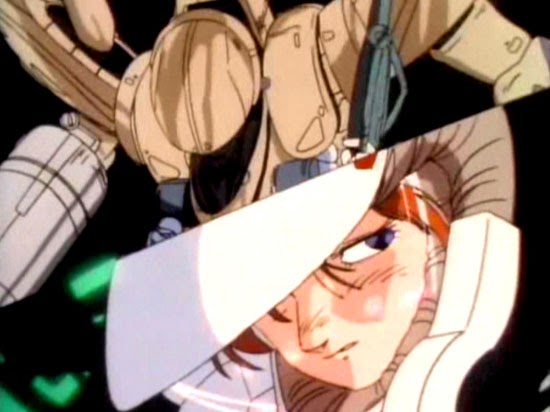
| rise and shine Althea |

Digital Devil Story (Megami Tensei) - 1987 Based on the
Japanese horror novel series by Aya Nishitani, this one’s about a student
computer genius, who’s also the reincarnation of an ancient Japanese deity, who
uses his giant clunky 80s mainframe to summon up some horrifying devils. This involves
some not-bad animation of a well-endowed teacher’s frilly brassiere heaving up
and down as she becomes the conduit for horrifying monsters from another
dimension to invade our world. Then giant piles of red goop start crushing
students and a big blue hairy devil named Loki fights our student computer
genius hero, who fights back with his reincarnated girlfriend and his magic
sword and his pet devil animal throughout several alternate universes. If you want lots of mid 1980s computer
technology and lots of scenes of people staring intently at old-fashioned CRT
monitors, followed by hairy devils and magic swords, this is the one for you!
The Hiroyuki Kitazume character designs aren’t bad, if you’re into that sort of
thing. Apparently there are a lot of
video games based on this novel, and I suspect they aren’t very essential
either.
Chojiku Romanesque Samy – Missing 99 - 7-5-1986 Let’s see, what we have here is your typical
everyday story of a typical anime schoolgirl who finds out she actually has
amazing mystical powers that not only transport her into an amazing fantasy
world but give her amazing super battle armor that doubles as a bikini. Raise
your hands if you’ve seen this all before. Can she survive the attack of the
reconstructed demon beast warriors in time to reveal her true Bodhisattva nature?
Girls Detective Club (Katsugeki Shoujo Tanteidan) - 11-25-1986
You’d think that a video starring three
high school girls armed with automatic weapons battling an evil girl-genius
with a giant flying battleship would be jam packed with the same sort of
excitement and flash that made Project A-Ko such a success, but you’d be wrong.
This stunningly boring piece of junk – from TMS,
shockingly enough - limps from nonsensical setup to nonsensical setup, never
explaining who these girls are, why they have a detective club, why one of them
lives in a mansion filled with machine guns, or why this was animated in the
first place. It feels like a Cream Lemon with all the sex removed,
like an episode of Urusei Yatsura without gags, fun characters, or pleasant
design, like a half hour of your life without anything productive or fulfilling
accomplished. What purpose Girls Detective Club served other than clogging
shelves down at Tsutaya Video is a mystery which I suppose we’ll need to hire a
Girls Detective Club to solve. ![]() |
| get detecting, you |