It's that time of year again, when my already slow blogging pace slows down to a crawl and everybody starts wondering what happened. Well, what happened is what happens every year around this time, it's AWA, the anime con we started 20 years ago in a cut-rate hotel in an iffy part of town. The hotel got demolished, the neighborhood is gentrifying, and what was a 300 person weekend is now roughly 20,000 people filling a hotel and a convention center and another hotel and a few more hotels down the way. Because, let's face it, people like Japanese cartoons.
This year's convention is jam packed with guests and excitement, and I am not just tossing hyperbole around here; guests like anime theme song legend MIQ, the voice talents behind Gundam's Amuro Ray, Sailor Saturn, and Space Dandy, and indy rock legends Shonen Knife. Main Events is moving into one of the convention center's giant halls, freeing up space for new events. Thursday night is a full-fledged convention day with panels, karaoke, and registration opening at 2pm. And... the food trucks are back.
What am I up to at AWA? Well, Thursday night there's the Super Happy Fun Sell.
This freewheeling yard-sale event has expanded and will be a three-hour whirlwind of bargains and treasures. And yes, all the tables are sold.
Later that night it's time for the Old School Classroom!
I'll be doing a live version of the popular column I did last year about the least necessary original anime videos of the 80s. I expect to annoy the Persona fans and endure the lightning-fast "you forgot about..." comments from the audience! It'll be great.
Friday I will be on a panel about 70s anime and TV, and then at 10pm it is time for Hell.
Anime Hell, that is! This crazy clip show is a mainstay of audience bewildering fun at AWA and I promise to confuse and amuse or triple your money back. And that is me there in the Astro Boy shirt.
Saturday at 6 the surviving members of Atlanta's first anime club are going to re-unite and catch up with what all we've been up to since 1988. Yes, it's a C/FO Atlanta reunion!
Saturday night it's time for the grownups to socialize, and that means the AWA Mixer. This is a new event that's going to let the 21+ crowd have somewhere to relax and enjoy a drink or two from the cash bar, away from the milling throngs of noisy kids.
Sunday morning Neil Nadelman and I will be nursing our hangovers as we discuss the suffering of a famous shoujo heroine and her many trials and tribulations.
Yes, it's Candy Candy, idol of millions, whose anime existence hangs in legal limbo, as discussed on this very same anime blog.
Will YOU be at this landmark 20th AWA? Will you be one of the survivors barely hanging on as the last event wraps up Sunday night? See you there!
Tuesday, September 23, 2014
Saturday, August 2, 2014
leftover Candy
I had a bunch of images that for whatever reason didn't make it into last time's Candy Candy post. In the weeks since posting the article, I also found some more interesting Candy imagery out in the hinterlands. So, in the interests of completeness, here's some more Candy Candy.
I completely neglected to show any of Igarashi's original Candy Candy manga artwork, a mistake I'm now making right to the best of my ability, with my beat-up used edition of volume 8. 
Many screencaps of the show were made for the article, and some of them didn't make the cut. Here's Candy and Annie enjoying the school dance. Candy is the one in the mask dressed as a man.
Later in the show Candy made a daring leap at a dramatic moment to save somebody or something from somebody or something, I forget.
The World Cup was happening at the time I was working on this article, and that is really the only excuse I have for what I did next.
The French-language Candy Book we mentioned earlier contains a lot of useful information for young girls - makeup tips, crafts, health and beauty advice, articles about pets and hobbies, and the importance of staying active with various sporting activities, like, say, roller skating.
Another fascinating part of the Candy Book was the sequence in which Candy gets an ill-advised tattoo.
The French and Italians and other European markets were inundated with anime merchandise in the 70s and 80s, and Candy was no exception, as we see from this charming fumetti advertisement for children's costumes and toys. Remember that one time that Grandizer and somebody in a Fantastic Four costume went to a birthday party with Candy? You don't? Well, here's proof!
Here's a closeup of that Candy play house / tent. Just the thing for your tea parties with Grandizer and Mr. Fantastic Four.
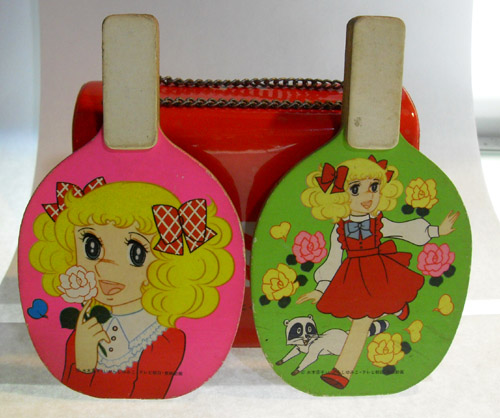
While on vacation recently, we stopped in an antique mall, as we are in the habit of doing from time to time, and we spotted this little bit of possibly unauthorized Candy Candy merchandise:
This children's sewing machine seemed to be in pretty good shape and was reasonably priced. If you're in the area (I-5 north of Seattle), it might make a good addition to your bootleg anime character merchandise collection. You do have one of those, right?
We were tempted to pick it up ourselves, but the logistics of getting this thing onto an airplane and back home in one piece are kind of daunting. So it remains, an example of the offbeat anime treasures that lie undiscovered across our great land. Much like Candy Candy itself - an anime series trapped in an eerie no-man's land, just out of reach. Let's all keep our spirits up and remain hopeful that all the parties involved can resolve their legal issues and bring Candy Candy back to her fans, old and new.
Sunday, July 13, 2014
it's candy candy's world, we're just living in it
Our heroine’s about to be sold into Mexican child slavery,
and that’s when the casual viewer begins to sit up and take notice, to realize
that the girl’s cartoon Candy Candy is going to go way, way past frilly dresses, young
loves, and funny animal sidekicks. Located somewhere near the kitsch-intersection
of Mauve Decade tearjerker and 1970s anime, the struggles of Candice White
Adley conquered shoujo manga, became a Toei anime and a worldwide phenomenon,
and today are notable by the giant gaping hole its absence leaves in our pop
culture map.
Want a forgettable romantic comedy starring a generic smiling
tomboy and her charming pets? Go watch Lun Lun the Flower Angel, you wuss.
Candy Candy is the real deal; a 100% tear-injected emotion-wringing pile-driving
machine that spares nothing in its drive to deliver repeated jack-hammer emotional
shocks to Candy.
But Candice White can take it. With a Shonen Magazine hero’s
sense of justice and the horseback-lasso skills of a dime novel Wild West
cowboy, Candy makes her own luck as she soldiers through an orphan’s life in
the American Midwest, the social pitfall-infested lifestyles of the
ultrawealthy, harsh British public school discipline, and the front lines of
nursing during the pain and loss of a world at war. Even though her heart is broken again and
again, a healing return to Pony’s Home puts her right and before you know it,
she’s back out in the world blazing her own trail.
![]() |
| my Candy Candy cel |
Author Kyoko Mizuki premiered Candy in a 1975 novel, shortly
thereafter teaming up with mangaka Yumiko Igarashi to serialize Candy Candy’s
adventures for several years in the venerable shojo monthly Nakayoshi. Mizuki and Igarashi teamed up again with Nakayoshi’s
Tim Tim Circus while Mizuki herself created kiddy comedy series Shampoo Oji in
2007. Igarashi’s post-Candy career includes the popular shojo series Lady
Georgie, some work on the Anne Of Green Gables manga, and creating the seminal
character “Boo Boo” in the 1983 anime Crusher Joe.
Toei’s Candy Candy anime series would premiere in October of 1976, airing at 7pm Fridays on NET
(now TV Asahi) for the next three years, and that’s when the Candy Candy
merchandise train really got up a good head of steam, creating a blizzard of
licensed goods for Japanese kids and eventual headaches for everybody’s legal departments. But I’m getting ahead of the story. Candy Candy showed up right as
Europe was going crazy for Japanese cartoons and, as the girls’ counterpart to
popular super robot mayhem, proved successful in France, Italy, Spain, Russia,
China, Korea, the Arabic nations, Mexico, Nicaragua, Venezuela, Peru, Portugal,
Colombia, Costa Rica, the Netherlands, the Philippines, and Francophone Canada
via the CBC . Echoing the changes inflicted on Japanese
anime by American localizers, some of the less fortunate characters in Candy wind
up “hospitalized” rather than “dead” in foreign versions. Sadly, the good old US wouldn’t get its Candy;
apart from one videocassette release via ZIV, Candy Candy would never appear in
her home country. Chances are the good citizens of La
Porte Indiana have no idea their
most famous daughter is actually a Japanese manga character.
![]() |
| Candy Candy 33rpm story record w/ extra crayon |
Both
Candy and her future best friend Annie were abandoned as infants in a snowstorm
outside Pony’s Home orphanage somewhere near La Porte in the early part of the 20th century. When Annie is adopted, her wealthy new family
forbids any contact with the orphans, and young Candy’s heart suffers the first
of many shocks. Her sorrow is eased by the appearance of a mystery boy in a kilt
and bagpipes who charms Candy’s tears away and then vanishes, to be forever
remembered by Candy as “The Prince on the Hill.”
Candy’s
destiny would see her adopted into and buffeted by the social machinations of
the wealthy and powerful Adley clan. Brought into the venal Leagan branch of
the family, as a playmate for the spoiled Neil and Eliza, Candy is protected by
their noble cousins, Archie and Alistair Cornwall and the boy who strangely
reminds her of her hilltop prince, Anthony Brown. Hated by the jealous Eliza, the malicious Neil,
and their pretentious mother, Candy is saved from the Leagans’ ire when she’s
officially adopted by the Adley family’s secretive patriarch, Grandfather
William.
![]() |
| the spoiled rotten Neil and Eliza, who should die by leeching |
Reunited
with Annie, abused by Neil and Eliza, imperiled by the crazy inventions of
Alistair, and saved from drowning by the teenage hermit Albert, Candy’s budding
romance with Anthony is destroyed just as it begins, in the series’ first major
tragic turning point that shocked a generation of young fans. Heartbroken, the
children are sent to an exclusive English private school, and en route Candy
meets the rebellious young man who will soon become very important in
her life, the moody bad boy Terry. At
St. Pauls, Candy will again face the wrath of Eliza as well as the stern
discipline of an English public school, but even being unjustly locked in the
punishment tower can’t break her spirit.
![]() |
| Archie, Anthony, Alistair |
Terry
reveals his tender side one glorious summer in Scotland , but their relationship is sidelined by Eliza’s
jealousy, and when Terry quits school and returns to America to follow his theatrical dreams, Candy follows. She braves the Atlantic as a stowaway and survives a snowy death-march
back to Pony’s Home. Her newfound
determination to become a nurse finds her in the Merry Jane Nursing School , where the stern Merry Jane labels her a “dimwit”
and contempt positively radiates from her older fellow student Franny. The cataclysmic
European war brings the young nurses to St. Joanna Hospital in Chicago to learn advanced surgical nursing training –
where Albert, returning to the narrative as an amnesiac war refugee, needs
Candy’s skill to survive.
Terry’s
acting career takes off as he grabs the lead in Romeo & Juliet on Broadway,
and in spite of every plot contrivance, Candy and Terry reconnect. The
rekindled flames of the Candy-Terry romance are threatened by sabotage from
both Eliza and Susanna, Terry’s desperately lovesick costar. However, a tragic
accident with a heavy stage light that finally destroys everyone’s chance at
happiness, and the love triangle is demolished forever one snowy night in one
of the more impressive displays of passive-aggressive behavior seen in the
anime field, and only a healing retreat to Pony’s Home can help Candy recover.
![]() |
| a rare scene of Terry not smoking or drinking |
After
a car accident Albert’s memory returns, and he’s faced with a momentous
decision. A chance encounter on the
streets of Chicago between Candy and Neil sparks a long-suppressed
and possibly unbalanced desire. Candy has to deal with the repulsive attentions
of Neil, while Eliza schemes to cause Candy eternal misery – halted
at the last minute by the sudden appearance of the family’s patriarch, Candy’s
mysterious benefactor Grandfather William. Candy learns not only the identity
of Grandfather William but also the truth behind Candy’s first love, the
“Prince on the Hill” – just in time for the series to end.
![]() |
| Candy and Albert, living in sin |
Even
for 115 episodes that’s a lot of story to get through, and I’ve breezed past so
much – threatened by white slavers, Candy’s raccoon pet Kurin who was created
just for TV, defying customs by smuggling said raccoon into England, Candy’s
gender-bending waltz with Annie, the casual way Albert and Candy violate
profound social mores by sharing an apartment, Candy demonstrating the horrors
of mass warfare to a confused boy via a field of massacred cattle. We see fights
in bars, a clinic that treats humans and animals alike, alcoholism, urban
poverty, disease and death, crippled nurses returning from the Western front, and
the tragic end to the romance between Alistair and Candy’s school chum Patty. Even
the late-period “catch-up” story detour – to let the manga catch up with the
anime, so they’d end together – is filled with drama, pathos, and
cattle-stampede action.
![]() |
| French Candy book |
The anime series only occasionally matched Igarashi’s lovely
manga artwork, and vast liberties were taken in regards to the geography of
North America – there aren’t any mountain ranges in Indiana, and you can’t get
to Mexico in a day via carriage- but even the limited palette of mid 70s TV animation
can’t hide the power of Candy, whose reach was inescapable. If you’re a woman
of a certain age who was anywhere near a television in 1977-1980, you probably
watched Candy Candy, read the manga, or bought the toy purse or the play house
or the rack toys or saw the 1979 stage show starring Caroline Yoko… unless you
lived in the States.
Two
short Manga Matsuri films and a 1990 Toei OAV retold key story points, and the
third Mizuki novel carried the story further into the 20th century,
but for millions the television series remains the Candy canon. It’s an entertaining show for all, no matter your age,
ethnic background, or gender; the soap opera wizardry keeps you tuned in episode after episode to find out what fresh hell Candy will suffer next. I’m testament to this; I’m clearly so not the
target audience for this show, and yet here I am, a middle-aged guy
experiencing the confused stares of Mandarake clerks as I blunder through their
shojo section, protected only by the presence of my wife.
![]() |
| Neil has totally lost it |
Candy Candy was even referenced on Saturday Night Live in their infamous “anime club” skit. Sadly,
this seminal shoujo series now languishes in Copyright Limbo, kept from a generation
of fans who would love nothing more than to open up their wallets and hurl cash
at Candy merchandise. Locked away by dueling creator lawsuits and corporate unwillingness to approach a property located in such a legal minefield, Candy Candy bides
her time. Mark my words; when these
petty legal issues are cleared up, there will be an explosion of pent-up Candy
Candy enthusiasm that will rock the pop-culture world from Tokyo
to Timbucktu.
![]() |
| Keep your candy in your Candy Purse |
![]() |
| Candy Candy Ping Pong set (?) |
The problem? Mizuki and
Igarashi shared the copyright on Candy Candy with Toei taking a side interest. However,
in the 1990s, Igarashi unilaterally started selling Candy merchandise,
prompting Mizuki to file suit against her. The Tokyo
district court awarded both Mizuki and Igarashi joint custody of Candy in 1999.
This didn’t stop Igarashi from legally challenging Toei’s TV stake in Candy,
the effects of which were to cause Toei to place a hold on both the original
show and any new Candy productions. With
a checkered past on both sides of the law – 200,000 bootleg Candy Candy
t-shirts were seized in 1979, and an attempt at selling Candy Candy puzzles in
2003 led to a 7.8 million yen judgment against the two management outfits who
commissioned their manufacture – it’s easy to see how corporate Japan would shy
away from the spunky orphan.
![]() |
| Candy matsuri mask in its natural environment |
This hasn’t stopped other Candy-crazed countries from releasing their own questionably-legal Candy merchandise, and right now the
only way to see Candy Candy is through gray-market DVD
sets with foreign dubs or iffy subtitles in three languages. Of course, here in
the new age Candy Candy can be seen in various languages on the YouTubes, but
streaming video is a convenient but temporary solution. Will this embargo ever be lifted? Will the three-way legal struggle ever be
resolved to allow Candy Candy to once again return to and from Pony’s Home, to
seek happiness and fulfillment wherever she can? One thing’s for sure; the
melodramatic journey of Candice White Adley is far from over.
special thanks to my Candy friends James, Neil, and Dylan, and of course the hardworking staff at Pony's Home, La Porte, Indiana.
Thanks for reading Let's Anime! If you enjoyed it and want to show your appreciation for what we do here as part of the Mister Kitty Dot Org world, please consider joining our Patreon!
Tuesday, June 17, 2014
the return of prince planet manga
Remember a couple years back when we posted some translated pages of Yusei Shonen Papii (aka Prince Planet) manga from the 1960s? Remember how those pages were scanned out of a tattered, yellowing 1965 issue of Kobunsha's Shonen and we figured we'd never see any more Prince Planet manga? Well, we were wrong. Recently Japan's manga industry smiled on us and released a two-volume set of Yusei Shonen Papii manga.
This of course, allows us to enjoy the manga adventures of Yusei Shonen Papii, Riko, Strong, Adji Baba, and that doofus on Radion who keeps forgetting to keep Prince Planet's medallion powered up. You had ONE JOB, fella. This manga also enables us to present the next chapter in our exciting Prince Planet manga adventure! So sit back, try to remember where we were when we left off - and to read from right to left - and enjoy!
Thanks to Kayt for shipping these over and to Rick for the translations and to the planet Radion, without which any of this would have been necessary. Stay tuned to your local UHF station, or Let's Anime, for upcoming Prince Planet news!
This of course, allows us to enjoy the manga adventures of Yusei Shonen Papii, Riko, Strong, Adji Baba, and that doofus on Radion who keeps forgetting to keep Prince Planet's medallion powered up. You had ONE JOB, fella. This manga also enables us to present the next chapter in our exciting Prince Planet manga adventure! So sit back, try to remember where we were when we left off - and to read from right to left - and enjoy!
Friday, May 16, 2014
Anime North time
Yes gang, it's time once again for Canada's pre-eminent Japanese cartoon festival, Anime North. And for me that means doing some panels and events, and THAT means a lot of time assembling clips and researching things and finding out when people are coming in to town and who can bring me Moon Pies. What am I up to next week? Let's see.
ANIME HELL returns for its tenth year of bringing crazy clip madness to the AN audiences. As always its 10pm Friday night in the big ballroom in the International Plaza Hotel, which used to be called the Doubletree and which we'll likely continue to mistakenly call the Doubletree for at least another year.
Saturday at noon Geoff Tebbets and I will attempt to blast our way through fifty years of Japanese anime TV goodness as we examine 1964, 1974, 1984, 1994, and 2004, and talk about the Golden Ani-versary blog that sparked all this discussion.
At 2pm Shaindle Minuk, Neil Nadelman, and myself will have some Candy! We'll be talking about Candy Candy, the immensely popular shoujo anime series that charmed the entire world with its blend of melodrama, romance, heartbreak, and world war.
Sunday at noon Shain and I will bring our popular "Stupid Comics" feature from Mister Kitty to the big screen as we take a look at some of the worst comic books ever sold to an unsuspecting public. Now with 50% more manga, fake manga, fake anime, and various iterations thereof.
And Sunday at 2 I'll be taking everyone on a trip through the history of what may be, pound for pound, the least competent anime studio to ever anime anime. Yes, it's Knack, the folks who brought us Charge Man Ken, Robby The Rascal, and Ninja The Wonder Boy.
Of course there's tons of other events and attractions at Anime North next week! See you there!
Subscribe to:
Posts (Atom)


