Friday, March 17, 2017

In The Days Of Anime Hasshin


Starting in the '80s and lasting until the year 2001, one of America's largest national anime clubs began in America's smallest state. This club would last the longest, have the widest reach, and the largest membership of any national anime fan group... and you might not have ever heard of it. For fifteen years Anime Hasshin published a regular newsletter full of artwork and articles, connected fans with tape-trading volunteers spreading the VHS wealth, and even had a few meetings here and there. Stretching from the VHS days to the Bittorrent era, Anime Hasshin's influence on anime fandom has few equals and was largely the work of one person, founder Lorraine Savage. I caught up with Lorraine recently and she answered a few questions about the club.
In 1986 I discovered anime by watching Cat’s Eye episodes in straight Japanese at a local Boston convention. I had never seen anything like it. I also learned that the afterschool show Star Blazers that I liked so much was actually the translated version of Japan’s Space Cruiser Yamato. Through other fans I heard about the C/FO, and then I attended the 1986 Atlanta Fantasy Fair where I met the wonderful folks Dave Merrill, Lloyd Carter and Jeff Roe who helped me get information about anime and gave me the encouragement to start my own club in Rhode Island. At the Atlanta Fantasy Fair in the anime room, people filled out a mailing list if they wanted to join the anime club. After reading the list, Dave called out incredulously, “Who’s here from Rhode Island??”

In 1986, North American anime fandom was in transition. Small groups of anime fans met in cities throughout America with only the loosest of connections. The C/FO (Cartoon Fantasy Organization) was changing from its California based leadership and Florida based publications team to administration by Texas fans. The Star Blazers Fan Club had published its last newsletter in 1984. The Battle Of The Planets Fan Club had not published a newsletter since 1981. The Earth Defense Command in Dallas was actively publishing their fanzine NOVA, but it was appearing sporadically at the time (only one issue would appear in 1986). The anime fan organizers inspired by Astro Boy, Battle Of The Planets, and Star Blazers were becoming overwhelmed by the popularity of Robotech and the subsequent wave of new interest in Japanese animation this new show inspired.


In those days it was very difficult to get information about anime and manga because everything was in Japanese. There was very little in the way of translations and no fan subtitles yet. I couldn’t find what I was looking for so I started a club for people who could share the information they could get. I had a journalism degree so publishing a newsletter was an easy solution for me. Originally called Hasshin RI (for Rhode Island), the club began in January 1987 with The Rose #1 at 10 pages.


Hasshin RI would begin with local meetings and a newsletter. The Rose would start off as a bi-monthly but soon became quarterly. A typical issue would run around 36 pages and include manga reviews, translations of interviews with anime producers, news of upcoming comics releases from Viz, Eternity, Dark Horse, and Antarctic Press, what was coming up in future issues of Animerica, Mangajin, and Anime UK, news of upcoming anime TV series coming to the American market, Anime Hasshin anime poll results (favorite show as of April 1993 – Ranma 1/2), overviews of anime shows like Galaxy Express 999 or Heroic Legend Of Arslan, reviews of translated and Japanese-language manga, translated song lyrics, convention reports from various SF and anime conventions, and classified ads from Kimono My House, Stratus Pagoda, Trans Pacific Laser, Nikaku Animart, Laser Perceptions, and the Brain/Wash Network, as well as a yearly humor supplement called The Thorn. Found throughout every issue would be spot fan illustrations from artists like Widya Santoso, Johnathan Luce, Robert DeJesus, Dan Kellaway, Akito Tanemura, Lester Swint, Shaindle Minuk, and many many others. Convention coverage included Otakon, Dragoncon, Atlanta Fantasy Fair, Arisia, and the ill-fated Tezuka Awards handed out at Anime East's last convention.


Hasshin RI/Anime Hasshin came into being at a time when the leadership of several extant anime clubs were feuding with each other, and from the start Lorraine was adamant that Anime Hasshin would not be a chapter of any national organization, but it would be its own independent club. Subsequent attempts to involve AH in the fan politicking endemic to the scene failed, and Anime Hasshin outlasted most of these clubs by a fair margin.


The first meeting was in 1986 in my apartment with four local friends. We watched Queen Millennia, Endless Road SSX, and Lupin III Mystery of Mamo. When the local club in Rhode Island got bigger we had monthly meetings at a library and at a bank’s meeting room for a few years. It drew attendees from as far away as Boston, and we usually had about 4 to 8 people attend. Peak Anime Hasshin membership was 404 members from 14 countries on 6 continents, including Canada, Mexico, Japan, Malaysia, Brazil, South Africa, Australia, Poland, Germany, and England.


An important part of Anime Hasshin was its Tape Traders List; the club maintained a list of volunteers who were willing to copy anime from their collection for other Anime Hasshin members. I believe the first iteration of the list even included people willing to copy Beta tapes and PAL format videos. In the 1980s many anime fans would only copy their tapes in exchange for copies of other shows, which left new fans without many options to acquire new Japanese animation. The Anime Hasshin tape traders list featured addresses of dozens of fans who volunteered to copy items from their own collection for anyone who sent a blank tape and return postage. There were dozens of people on the list, all with widely varying collections, so no one trader got overwhelmed with requests (as frequently happened with local clubs) and anime fans in out-of-the-way places, without local clubs or conventions, could experience Japanese animation.


list of synopsis packets available for the language-impaired
Another valuable print-media service AH provided was their synopsis packets. Translations, episode guides, film synopses, and character guides culled from APAs, convention guides, out of print zines, and official sources were available for the cost of photocopying; at least 10 different packets of information were available giving language-impaired nerds a chance to figure out what was going on in Orguss, SPT Layzner, Saint Seiya, Dangaio, Amon Saga, Dagger of Kamui, and dozens of other anime titles. The Rose itself was printed in black and white on standard 8.5 x 11 copy paper, with a colored sheet for the cover, and with two or three staples holding it all together.

Anime Hasshin highlights from The Rose #50
I used a desktop publishing program to lay out the newsletter and Kinko’s to print and collate it. I labeled and stuffed envelopes myself. I got a bulk mail account at the post office to save money on postage. I was fortunate that I never had to worry about getting enough contributions. For every issue, I had numerous members sending me articles, reviews, artwork, games, classified ads, etc. That’s why there was so much variety in the newsletter. I just let people send whatever they wanted; the only rules were it had to be anime/manga related and no X-rated stuff. People loved to see their work published in The Rose. The Roses page count reached a high of 44 pages. 
The Rose covers NASFIC & Otakon


In the late 1980s, Japanese animation fandom was venturing online with messaging systems like the newsgroup rec.arts.anime, a text-based platform accessed via university computer networks, volunteer-run BBS systems, or through services like GEnie, Compuserve, or AOL. The first webpage appeared in the early 1990s, inspiring fans to create pages about their favorite shows, and the Anime Web Turnpike went live in 1995, collecting links to these websites. Sailor Moon began airing on US television the same year, and in 1998 the Pokemon TV anime would have its American debut; both shows inspiring new generations of anime fans. By the late 90s anime fans could enjoy DVDs purchased at Best Buy or Suncoast, share anime via peer-to-peer computer networks, and get their anime news from the Anime News Network website. Anime conventions would pop up in every major American city by 1999, giving fans across the country somewhere to go to get their anime fix for at least one weekend. By the end of the decade anime fandom was thriving, above and beyond the 1980s fan club model. Throughout this entire period of growth, Anime Hasshin connected anime fans, covering the new anime conventions, detailing new shows, and giving fans an outlet for communication, reviews and artwork.

Interesting observation: In the 1980s, anime fans felt lucky when VCRs came into use. We could trade copies, and fans made subtitles. We had it made. Then later, when video stores started selling anime, we were astounded to see a whole section devoted to anime with rows and rows of videos. We felt we had paved the way, and that the professional production companies had discovered that there was a market for anime.

I think Nikaku Animart is still at the same location
The last issue of The Rose was #66 in October 2001 after 14 years of publication. It was a sad farewell as membership declined, but with a promise of Anime Hasshin still existing but moving to a website. However, I had been laid off from my job a year earlier and the club just ended. People were turning to the Internet to get more and faster information.


There was surprisingly little controversy over Anime Hasshin and The Rose (if there was, I didn’t hear about it). I always got the newsletter out on time, and people got what they paid for. I was very proud to accept awards on behalf of the club: Outstanding Fan Publication from ChibiCon 1993, Best Anime Fan Club from AnimEast 1994 & 1995, and Best Anime Newsletter from AnimEast 1994 & 1995.


I had a blast making the award-winning anime fan videos “My Euthanasia” and “What’s New Pussycat.” When someone saw the murder and mayhem in “My Euthanasia,” he said, “Sweet little Lorraine made that?!” to which someone else told him, “You don’t know her very well, do you?”


One of the funniest moments I can remember from fandom was at Otakon 1995 or ‘96. A bunch of us were sitting around tired late one night and we were just staring down at the hotel’s floor, and we happened to notice that the pattern in the carpeting looked exactly like the face and rabbit ears of Ryo-Ohki from Tenchi Muyo. We couldn’t stop laughing! I also remember how excited people were at the first AnimeCon in 1991 in San Jose. It felt like we hit the big time with a big convention with Japanese guests. Anime fans and pen pals got to meet each other face-to-face and cosplay and mingle. One of the geekiest moments for me was meeting the voice actors from Starblazers at I-Con on Long Island in 2010: Amy Howard (Nova), Eddie Allen (Desslok), and Tom Tweedy (Mark Venture). Just before Allen got up to speak on the panel, a bunch of us started chanting, “Desslok, Desslok, Desslok!”

I really enjoyed running Anime Hasshin and publishing The Rose. I met so many nice people who enjoyed sharing their love of anime and manga.


Thanks again to Lorraine for sharing the story of Anime Hasshin!


Thanks for reading Let's Anime! If you enjoyed it and want to show your appreciation for what we do here as part of the Mister Kitty Dot Net world, please consider joining our Patreon!

Friday, February 3, 2017

my advice? stay on the train

Previously at Let's Anime we discussed the English-language promotional book Toei used to sell their 1978 Captain Harlock television series to broadcasters worldwide. This time we're going to look at a similar publication, their Galaxy Express 999 pitch.


Galaxy Express 999, the popular Leiji Matsumoto space-fantasy manga series about a young boy and a mysterious beauty travelling through space on a mission of self-fulfillment and revenge, ran in Shogakukan's Manga-Kun (later Shonen Big Comic) and became the basis for Toei's TV anime series that aired from September of 1978 until March of 1981, for a total of 113 episodes. France, Italy, Spain, Sweden, and southeastern Asia also saw the series on their respective television screens, but the series never aired on American television. Not really. We'll get to that. In the meantime, Toei spent the late 1970s pitching their then in-production series at various industry gatherings, and to that means produced an English-language booklet promoting the series.


More philosophical than the action-oriented Captain Harlock, 999 must have been a harder sell to worldwide markets. First, the potential buyer has to accept the series' odd juxtaposition of "old fashioned trains" and "super science fiction interstellar travel." That's enough of a hurdle. And then we're confronted with the larger themes of Galaxy Express, the emphasis the show places on "living and dying naturally," which might be a red flag to potential children's television markets that might not be ready for a show where somebody dies pretty much every episode.


Having lost his mother, who was murdered by the man-hunting Count Mecha, the young Tetsuro's only wish is to reach the Mechanized Planet in Andromeda. On the Mechanized Planet, eternal machine bodies are freely given to all who ask, and Tetsuro wants to become a machine man himself in the name of revenge. He is given an unlimited pass on the Galaxy Express 999 by Maeter, an aristocratic, enigmatic blonde who seems to have an agenda all her own. Together they ride the space-rails, stopping and visiting the various planets on the 999's schedule, where marvels and threats await at every station.


Produced before the series had even aired in Japan, this book features illustrations taken from Matsumoto's manga and early production art of the 999. We learn about Tetsuro's tragic past and the mysterious Maeter (or Maetel as her name would later be translated), and we meet a wide variety of Galaxy Express 999 characters who die tragically, or meet with a tragic death, or who are drunken Tarzans who live on a drunken monkey continent, or who are shot to death by our hero. Again I point out how unlikely it would have been for a show this melancholic, this filled with violent death, to make it anywhere near American cartoon television in 1978, a year of Galaxy Goof-Ups, Fangfaces, and SuperStretches and Microwomen.


America's broadcasters passed on Galaxy Express 999, but the 1979 feature film was picked up by New World Pictures and screened in theaters across the US in 1980 as "Galaxy Express". New World's infamous yet not entirely charmless localization features celebrity impersonation voice dubbing and unfortunate name changes. 


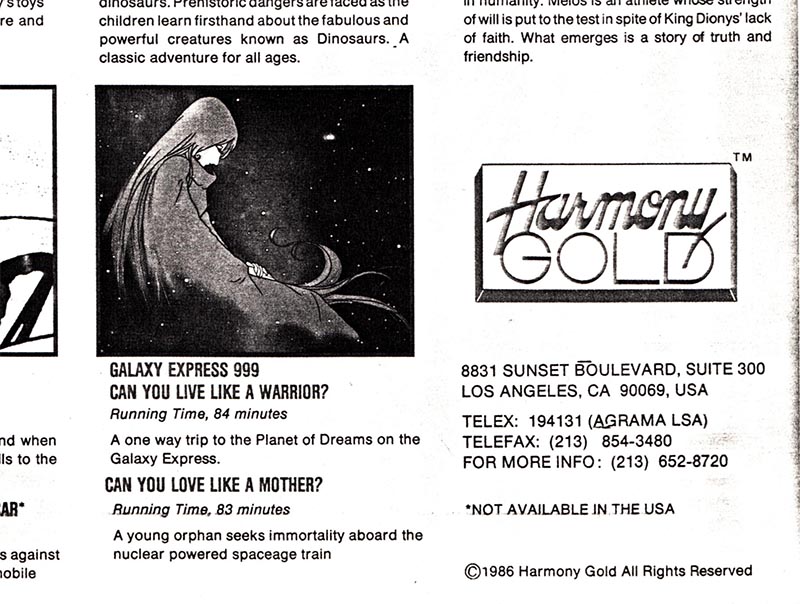
A few years later, international film & television production company Harmony Gold would package two television movies compiled from 999 episodes for sale to English-speaking markets around the world. These two 999 telefilms, "Can You Live Like A Warrior" and "Can You Love Like A Mother", feature Intersound voice work and enjoyed spotty (and possibly nonexistent) release.


that's some good proofreading there Harmony Gold

The Galaxy Express TV series would eventually find itself broadcast over the American airwaves on various Japanese-language UHF television stations, in the original Japanese but with English subtitles. This arrangement lasted until somebody at Fuji-TV headquarters in Tokyo realized that potentially valuable licensed properties were being broadcast without benefit of adequate licensing, royalties, or permission, and pulled the plug on everything.


999  would get a legitimate 2012 North American release on DVD from low-end media conglomerate S'more Entertainment in a box set that didn't quite meet expectations, being compressed badly and hard-subtitle encoded. The 999 films, on the other hand, would receive gentler DVD treatment from Discotek Media. Galaxy Express 999 the series would finally appear on Crunchyroll, where the entire show is currently streaming along with Space Pirate Captain Harlock. Fascinating, isn't it, how these shows started out together as hopeful English-language pamphlets, only to see their paths diverge, meander, circle back, and come together again? As the pitch book puts it, that's some "overflowing poetic sentiment" right there.

-Dave Merrill


Thanks for reading Let's Anime! If you enjoyed it and want to show your appreciation for what we do here as part of the Mister Kitty Dot Net world, please consider joining our Patreon!


Saturday, January 14, 2017

Assemble the Assemble Insert

Portions of this article originally appeared at the now-defunct Anime Jump.


A power-suit crime wave paralyzes Tokyo, and only one person can stop their reign of terror - a 13 year old girl with superhuman strength, an ultra-high-tech fighting suit, and an idol singing contest to win! That’s how we assemble Assemble Insert, one of those late 80s OVAs that spent a few years on the knowledgeable anime fan's dream release list alongside titles like the similarly themed Prefectural Earth Defense Force. Thankfully, both got North American releases, so nerds like us can quit complaining.

Insert is a 2-part original anime video story of Tokyo in the near future, where more and more crimes are being committed by miscreants using powered armored mechanical suits, confronted by a special division of the Tokyo Metropolitan Police specially set up to combat this menace. If this is all sounding a lot like Patlabor, there's a good reason. Both Assemble Insert and Patlabor share the same author/character designer, Masami Yuuki. So if you're a fan of eminently workable mecha designs and dazed-looking municipal slackers, you're in luck. Yuuki’s original 1985 Assemble Insert manga ran in AniParo Comics, which was published by Minori Shobo, who also published the seminal Japanese animation fan magazine OUT from 1977-1995, without which we might not even be wasting our time on this whole Japanese animation fandom thing, so there’s that.


Patlabor and Assemble Insert part ways, however, in their approach to combating mechanized crime; while Patlabor fights fire with fire, Assemble Insert takes a different approach, one that involves talent contests and idol singers. The Counter-Demon Seed Special Agent Bureau, the crew of fairly indistinguishable, fast-track-to-early-retirement police functionaries charged with stopping this power-suit crime wave, decides their best course of action is to sponsor talent-contest style auditions in the hopes of finding someone who can battle Demon Seed. Sure, Chief Hattori was drunk when he came up with the idea, but maybe the ancients were on to something when they said “in vino veritas.” Anyway, it’s nice to see police thinking about putting their best face forward to the public for a change, and the Counter-Demon Seed Special Agent Bureau wants to make sure their Demon Seed-fighting is done with maximum public appeal.

you're it
Enter Marin, a shy sub-deb who happens to be strong enough to bend steel in her bare hands. She's cute, she's innocent, she has all the doe-eyed naivete necessary for every Japanese idol, and she's just the size to wear Shimakobe's suit. But can Marin-chan overcome her stage fright long enough to pound Demon Seed's robot suits into scrap?

Similar to but less boisterous than the aforementioned Prefectural Earth Defense Force, Assemble Insert spoofs the pop-culture tropes of Japanese SF media – robot suits, super-gals, evil geniuses – but adds its own touches, like energy-drink product placement in the anime that smash-cuts to a live-action commercial break for the same energy drink, starring Assemble Insert voice talent. The opening scene mimics sentai legend Changeman (and stars characters from Yuuki’s Ultimate Superman R) and Assemble Insert’s staff makes numerous appearances as characters, along with a cameo by Patlabor’s Noa Izumi. Demon Seed’s leader Dr. Kyozaburo Demon is from the same mold as any one of the hundreds of evil scientists battling Gigantor or Prince Planet, while his henchmen wear giant eyeball masks in tribute to Kamen Rider Stronger’s Titan. And of course, comedically accidental destruction wrought by our well-meaning heroes is in full effect.

Maron vs Demon Seed
The Counter-Demon Seed Squad schedules Maron’s debut for maximum press attention. What appears to be the big Seibu department store at Ikebukuro Station is hosting a collection of rare artifacts, priceless artworks from the Mu Empire. This allows Assemble Insert to reference both old Toho SF movies and 70s super robot cartoons, and gives Demon Seed a target for pillage. When Demon Seed arrives right on time, Maron’s first public appearance is filled with both awkward stage-fright jitters and shocking damage to Ikebukuro, one of Tokyo’s busier neighborhoods and currently the site of several otaku-destination shopping experiences.

treasures of the Mu Empire
Flush with victory, the second episode sees our heroes become victims of their own success. Without Demon Seed around it’s tough to justify the expense of an Anti-Demon Seed Task Force, and Chief Hattori (based on Masami Yuuki’s editor) is now focused on the earning potentional of Maron’s idol career. Soon Maron is making the rounds of product endorsements and chat shows instead of battling for justice. It's up to Professor Shimakobe to secretly supply the enemy with the necessary trouble-making equipment and give his task force a reason for existence, and shortly Demon Seed announces an attack on the National Mint! Of course, this climactic battle coincides with Maron’s appearance at the Music Awards. Will the Counter Demon Seed Task Force put on their big-cop pants and fight Demon Seed single-handedly? Will Maron choose idoling over enforcing?

the Maron publicity machine rolls on

Just like its characters, the second episode suffers from a bit of the sophomore slump. Once our Assemble Insert world is assembled and Maron does her thing, there’s little left for anybody to do – heck, the episode fades out before Maron punches a single Demon Seed power suit, as if it’s bored with itself. Characters as thinly drawn as Insert’s aren’t going to drive much of a story; the only emotion Maron is allowed to verbalize about her singing super-cop status is “kind of embarrassed”, her handlers are phone-gabbing, note-taking nonentities, and Doctor Demon himself, though claiming to be “fair and square for evil”, limits his do-baddery to broad Batman ’66-type villainy. Still, as an airy OVA confection, Assemble Insert does its job well; which is to deliver manufactured-idol comedy robot-crime busting in 25 minutes or less.

Dr. Demon and pals

Released in Japan in late 1989/early 1990, both OVAs were released in North America by The Right Stuf in 2001, with a reissue in 2004. Directed by Del Power X veteran Ami Tomobuki, the staff included mecha design by Gundam/Patlabor designer (and future Yamato 2199 director) Yutaka Izubuchi and some animation by Studio DEEN, who have been involved in pretty much everything animated in Japan for the past three decades, go ahead, look it up. Dedicated Assemble-ologists can find a small but significant collection of merchandise that includes VHS and Laserdisc releases as well as model kits of Demon Seed’s mecha and figures and garage kits of Maron. The original manga has been released in tankubon form on a few occasions, and if Ikebukuro is still standing after Maron destroys Demon Seed, you can probably pick it up in their Book-Off location up the street from the Sunshine 60 building.

manga and model
The Right Stuf’s DVD was translated by C.B. Cebulski and the English subtitles feature formatting assistance from anime localization superstar Neil Nadelman. The English dubbing features a star turn by Jessica Calvello as Maron, and there are some interesting Muppet-voice impressions used for the Demon Seed henchmen, while one of the police is a dead ringer for SNL’s 70s stoner-comedy puppet Mr. Bill. There's not a whole bunch of extra stuff on the DVD, but hey - this is a 2-part OVA from decades ago, so relax.


Assemble Insert never goes as far as contemporaneous girl-power gagfests like Project A-Ko, Dirty Pair or Urusei Yatsura; destruction is never as total and gags aren't as extreme. But that’s okay; not everything needs to be cranked to 11. The reserved yet ridiculous nature of Yuuki's characters helps Assemble strike a middle ground between gonzo comedy and the grounded, humanistic SF of another, more popular Masami Yuuki creation, Ultimate Superman R... no, wait, I mean Patlabor.

and now a word from our sponsor


Editors’ note: fans of Yuuki and Patlabor may want to check out Colony Drop’s latest Last American Fanzine; this one’s devoted to Patlabor and features art and articles by a whole host of contributors, including yours truly! Get it today!

-Dave Merrill

Sunday, December 11, 2016

God And/Or Tatsunoko Don't Make No Junk


It's the 1980s. You're bored in front of the TV, punching buttons on that weird multiplex cable TV channel box with all the buttons and three levers, and you come across a Japanese cartoon that you've never seen, and it's about two kids, and a robot, and Jesus. Yeah, THAT Jesus. And you ask youself, how did I get here? 

high-tech 1980s channel-changing device
The liberating influence of the Reformation put religion in the hands of anybody who could shout the Gospel and stir up a crowd, taking salvation out of the hands of a centralized bureaucracy and allowing a million tent revivals to bloom. Heir to the traditions of mass-media evangelists like Billy Sunday, Father Joe Coughlin, and Aimee Semple McPherson, Southern Baptist minister Pat Robertson founded the Christian Broadcasting Network in 1960 with the purchase of a small UHF station in Portsmouth Virginia. CBN's early days were financed via a telethon requesting 700 volunteers each giving $10, this "700 Club" becoming the genesis of Robertson's flagship current events/prayer series. Amidst the growth of cable television in the late 1970s, Robertson bought a cable TV channel in the area and soon CBN was a basic-cable fixture on TV sets, reaching 10 million homes by 1981. 


In the late 70s, CBN hired ad agency giant Young & Rubicam to promote sales of Christian literature in Japan. This is Japan in the late 1970s we're talking about here, in the midst of an unprecendented animation boom fueled by hits like Yamato, Gundam, Gatchaman, and others. Anyone with two eyes could see that animation was the way to go. Hooking up with Japan's Yomiko Advertising Agency and perhaps emboldened by the prior ad agency/animation studio success of former SCDP exec Lou Avery's partnership with Tatsunoko to produce Scout's Honor, CBN would contract Tatsunoko to produce a Bible-themed cartoon for young people. 

The resulting cartoon, Anime Oyako Gekijo, or "Anime Mother & Child Playhouse", would be directed by veteran Masakazu Higuchi (Vickie The Viking, Urikupen Rescue Team, The Real Ghostbusters) and would premiere Oct. 9, 1981 across the spectrum of Japanese broadcast television, on Fuji TV, TV Tokyo, Asahi TV, and TBS. 

Chris, Joy and Gizmo
The story stars young Chris Peeper (Sho Azuka), his friend Joy (Azusa Yamato) and toy robot Gizmo (Zenmaijikake) as they discover a mysterious old book in the attic of Chris' father, Professor Peeper. Opening up, the book transports them back in time to experience many of the stories of the Bible's Old Testament, with a few New Testament stories thrown in for good measure, but always returns them to the Peeper house at the end of the adventure in time for snacks. There's a very Tatsunoko look to the characters, particularly Professor Peeper, thanks to the work of veteran Muteking/Temple The Balloonist character designer Akiko Shimamoto. 

Chris, Joy, Gizmo, and the Peeper parents 
CBN was reportedly unsure about localizing the series for America, but let's get real, they did own a cable network and you always gotta have something to show on your cable network. The dub cast featured veterans of anime classics Astro Boy and Kimba The White Lion, including Billie Lou Watt, Ray "Aquaman" Owens as Jesus, Gilbert Mack, Peter Fernandez, Hal Studer, and others. Owens had been featured in CBN's Christian soap opera "Another Life", which is where he got wind of the upcoming cartoon-voice gig. The series was given the title Superbook and in 1982 it premiered on CBN and became available to other broadcasters through CBN Continental Syndication. 

Superbook wasn't CBN's only big-eyed Japanese cartoon; other anime appearing on CBN included the Sonic International dubs of Honey Honey and Leo The Lion, and 3B Productions' compilation films of Voltes V, Fighting General Daimos (as "Starbirds") and Tatsunoko's 1979 "Daddy Longlegs" telefilm (directed by Superbook's Masakazu Higuchi). 

Anime Oyako Gekijo was followed immediately by "Adventure Of Tondera House", or as we'd know it, Flying House. While playing in the woods, youngsters Justin Casey (Gen Adachi) and his pal Angie (Kanna Natsuyama) and Angie's even-younger brother Corky (Tsukubo Natsuyama) are caught in a storm and seek shelter in a mysterious house where they meet an astonishing robot. This mysterious house and its robot inhabitant belong to Professor Bumble (Dr. Tokio Taimu – "time" – get it?), who has created an amazing time machine built into the house itself, like those great intercom systems you see in mid-century suburban tract homes. A lightning strike reboots the robot S.I.R. into its combat mode and his flailing robot attacks send the house flying back through the ages to New Testament times. During an amazing series of 52 adventures our lost travellers witness the birth of Jesus and the early days of the Christian religion. Airing in Japan from April '82 until March of 1983, the series was also localized by the same cast and distributed by CBN. 


While both Flying House and Superbook use the same basic structure of "modern kids in Bible times", Flying House embedded those kids in the stories themselves, like AP stringers with the 3rd Infantry Division in Anbar Province. Justin, Angie and Corky visibly struggle alongside their new scriptural pals as the timeline asserts itself and the stories come to their King James-decreed conclusions. This distinguishes Flying House from Superbook, where characters having vague memories of these seemingly immortal kids is just a running gag, and any attempts by Chris or Joy at direct involvement unsupported by Leviticus, or Exodus, or whatever, see them yanked out of the past with an abrupt, unsettling counterclockwise sequence. The two shows feature very different kinds of involvement: enmeshment vs active observation.

the gospel according to Superbook

In the tumbling wake of the Flying House came the third part of Tatsunoko's Bible Trilogy. We know the further adventures of Chris, Joy, Gizmo as Superbook II, but in Japan the title is Pasocon Travel Tanteidan, or Personal Computer Travel Detectives, or PC Travel Detective Group, take your pick. As you may remember, the early 1980s were a boom time for personal computers both here and in Japan. When the Superbook and a PC team up, it means new Bible adventures for our Superbook kids, joined here by Chris's dog Ruffles and his cousin Uriah (in Japan, Sho's brother Yuu). Character designs are softened a little to reflect mid-80s aesthetics and the ravages of time, the show being set two years after the events of the first Superbook. PC Travel Tanteidan aired 4-4-83 to 9-26-83, adding 26 episodes to the Superbook canon. 

Superbook II cast and the exciting Atari 2600 Superbook II game

Scriptural fidelity is probably too much to expect from a series that involves different sets of children travelling through time and witnessing different iterations of the same Biblical events, and each series handles interaction with religious events and characters differently, Superbook's kids being passive observers and Flying House's Justin and Angie doing their best to mess with history. Both shows take dramatic liberty with the Gospels; for instance, Flying House has Justin, Angie and Corky being tempted by Satan alongside Jesus, and the show reinterprets the dance of Salome into a children's talent show and involves the kids in an ethical capital-punishment quandary with the son of Barabbas (the murderer set free instead of Jesus).

The Dance Of Salome, as interpreted by Flying House
Tatsunoko's utilitarian animation lacks both the tricky special effects we'd see in their more fantastical series and the props or gadgets typically inserted into shows for the toy market. Since Tatsunoko already had CBN financing, they didn't need Takatoku. The second series of Superbook improves slightly, but lacks visual excitement when compared to concurrent series like Orguss, Dunbine, Mospeada, and Vifam

Jesus and the Flying House kids are tempted by Satan via animation reference from "Little Norse Prince"

In 1985 CBN produced a Spanish language version of Superbook. Eventually the series would reach fifty nations, including a Soviet Union in the throes of Glasnost and Perestroika. Superbook on Soviet Central TV was immensely popular in the twilight days of the USSR and when party bigwigs threatened cancellation, the series sparked a revolt among the Children's Television Department. At one point the show was receiving 30,000 letters from viewers every day. In 1990 CBN rebranded as the Family Channel, which was sold and became Fox Family, which was sold and became ABC Family. Superbook and Flying House relocated to the Trinity Broadcasting Network, run by the televangelist Crouch couple. As streaming video became a thing CBN began streaming Flying House for free while keeping most of Superbook behind a paywall, and building an online interactive children's experience around a Superbook reboot. 

TV ad for Superbook VHS only $24.95 each, a bargain
In spite of the interest in Japanese animation, most self-professed "otaku" would be hesitant to list Superbook as being an influential anime import. And yet, the worldwide reach of this franchise rivals or surpasses titles like Robotech, Sailor Moon or Star Blazers. Superbook/Flying House has been shown continuously for decades in dozens of languages, impacting millions and millions of viewers. Few TV shows of any sort can boast that kind of reach. Of course, Superbook has built-in educational and religious advantages attractive to parents desperate for wholesome family entertainment that their kids will actually sit still for. Prior to Superbook, seekers of scriptural kids TV had to rely on Davey & Goliath or Jot, or the occasional Moody Institute of Science short.

rare "Flying House" edition of The Bible

Superbook/Flying House videos were available in retail and Christian specialty stores and advertised on TV, unheard of in the anime field at the time. Among its target audience of easily impressed children with limited access to TV remote controls, Superbook has remained surprisingly resilient. The series continues to entertain with the original series and with a new, computer-animated Superbook update currently in vogue among the Sunday School set around the world, starring an updated Gizmo and Chris Quantum, who is reportedly "an awesome skate-boarder." The new Superbook is featured on websites, DVD purchasing clubs, online games, and broadcast and streaming video, while the neglected Flying House has yet to receive any updates or reboots at all.

Superbook Club is in the house
We may have Eastern Europe's love of Superbook to thank for the show's longevity; Ukraine's Emmaneuil TV started airing the children's show Superbook Club in 1996, based on a Superbook-themed youth group initiative. The live-action series stars lots of kids and a long-suffering suit actor in a Gizmo costume – over there he's known as Robik, and yes, he did upgrade to the new CG Superbook look - and kids 6-14 can write or email Robik with any question they may have, and can even call him on his toll-free Robik Hot Line. Meanwhile, the kids of the Superbook Club are ready 24/7 to sing, dance, and have low-key adventures across the CIS states of Europe and Western Asia.

Sure, Superbook and Flying House are simplistic children's cartoons selling a watered-down Gospel ultimately for the benefit of multi-millionaire Gospel grifter Pat Robertson. But nothing illustrates the global reach of Japanese animation like Virginian televangelists hiring Asian studios to animate the Middle Eastern cultural traditions that formed the religions of the Western world. Perhaps anime does indeed, as the song says, have the whole world in its hands.

-Dave Merrill


Special thanks to William J. Brown and Benson P. Fraser for their scholarly and informative "The Diffusion of Superbook: One of the World's Most Popular Entertainment-Education Television Series", and a big super Let's Anime thanks to fellow recreational Christianity researcher Wednesday White for her invaluable insight into the world of Superbook and Flying House! 

Happy Holidays from Superbook Club & Let's Anime!


Thanks for reading Let's Anime! If you enjoyed it and want to show your appreciation for what we do here as part of the Mister Kitty Dot Net world, please consider joining our Patreon!