Showing posts with label OVA. Show all posts

Tuesday, May 31, 2022

Blue Sonnet On It


When the five part Crimson Fang: Blue Sonnet original video series was released in 1989, American anime fans immediately thought of one thing - the margarine brand "Blue Bonnet." But even without any knowledge of Masahiro Shibata's original Crimson Fang manga, fans in the US immediately grasped familiar story beats, which include an evil organization bent on world conquest, innocent youngsters turned into fighting cyborgs, latent ESP awakened by stress or disaster, and the old standby, a Japanese high school where students secretly have amazing powers. Blue Sonnet’s story was digestible even without English translation. The terrific theme song by GO! helped seal the deal, and even if the anime doesn't quite live up to the promise of the OP, we felt it was worth at least a watch in 1989, and still do today.


Matsusaka City native son mangaka Masahiro Shibata debuted in 1973 with “The Sea Of White Roses” and spent some time as assistant to Sukeban Deka creator Shinji Wada before hitting it big with his most successful work, Crimson Fang: Blue Sonnet, a sprawling eight-part (19 volumes) shoujo-manga SF epic published from 1975-1986 in Hana to Yume, Deluxe Margaret and Bessatsu Margaret. The series focuses on the life of Ran Komatsuzaki, the titular Crimson Fang. Ran is that most stereotypical of Japanese pop culture characters, a super-powerful psychic girl whose immense abilities both prevent her from having a normal life and make her the target for those would use those powers for, say it with me, eeeEEEeevil. By the time the Blue Sonnet OVA appeared, Shibata had moved on to other projects, his next big series being the post-apocalyptic combat maid series Sarai, which ran in Shonen Gahosha’s Young King for a decade starting in 1998.


But let’s put some Blue Sonnet on it, shall we? Turns out the new student at Tokyo’s Osei High School is actually Sonnet, a super powerful ESPer girl rebuilt into a combat cyborg by Dr. Josef Merikus under orders of the evil world-domination conspiracy TALON (Directive No. 1, released July 16, 1989). Sonnet is enrolled at Osei to check up on student Ran Komatsuzaki, whom TALON suspects is also a powerful ESPer. And they're correct; not only was Ran orphaned in a plane crash and raised by wolves and later by her father’s friend Jin Kiryu, but it also turns out she’s harboring the immense psychic power of the entity known as Crimson Fang (Directive No. 2, released September 25, 1989). After a few arranged incidents Sonnet is convinced of Ran's power, but at the same time is confused by the friendship and warmth of normal human society (Directive No. 3, released November 25, 1989). Will Sonnet's loyalty to TALON and their world domination plans win out over her long-suppressed humanity? Is there a blooming romance between Ran and Shuichi “Bird” Torigai? What happens when the nurse at Osei High finds out Sonnet is a cyborg? Will Ran survive Sonnet’s attacks, and will her humanity endure possession by the Crimson Fang (Directive No. 4, released March 25, 1990)? Can Kiryu, Ran’s little brother Wataru and the esper Yuri invade the TALON fortress and rescue Ran? Will Ran’s romance with Bird – aka renegade Cyborg RX-606 – be allowed to flower, or end in tragedy (Directive No. 5, released June 25, 1990)?

Produced by several different studios including AIC, Mushi Production and Tatsunoko, the Blue Sonnet anime is very much a product of the late 1980s. The original manga’s story and characters are compressed severely, and we’re left with generic OVA-style characters staring into computer monitors, Bubble-Era Tokyo scenery being smashed, and square-faced middle-aged men with glasses hollering orders in high-tech laboratories, instead of the knock-down, drag-out Sonnet vs Ran fight the OP promised.


If you’ve seen a sci-fi OVA from the 80s you know what you’re going to be seeing in Blue Sonnet – lots of high-tech control rooms filled with data readouts, corporate office blocks headquartering the dastardly conglomerates bankrolling our conspiracy, and underground bases guarded by sensors, jumpsuited goon squads, and mechanical man-killing monsters.


The sketchy, zip-a-tone energy of manga is difficult to translate to the TV screen, and the dramatic freeze-frames and expressionistic background effects of shoujo manga seem to suffer most. Blue Sonnet is no exception, the melodramatic emotional beats of the story struggling to overcome pedestrian animation and generic late 1980s character design. Regarding the OVA series, Shibata himself commented “It was too bad to be talked about.” Director Takeyuki Kanda was a veteran of Mushi Pro and Sunrise – he directed Dougram, Galatt The Great, and his masterpiece Round Vernian Vifam – but translating years of manga story into five direct-to-video chapters might not have been the best opportunity for him to shine. The same could be said for Blue Sonnet producer Walker Company, which went bankrupt after the release of the 4th episode.


To American anime fans who weren’t familiar with the manga, Blue Sonnet seemed like just one more entry in a Blockbuster shelf full of big-eyed girls hollering while their latent psychic powers make everything explode. It’s no surprise the subtitled Central Park Media release failed to make much of an impact. The anime market of the early 1990s was still looking for the next Akira, and Blue Sonnet is definitely not that. But then again, what is? For all its faults, 30 years on we still have that kickin’ theme song in our head, and that’s proof Blue Sonnet still counts for something. The video is long out of print but you can find them on the YouTubes if you yourself want to watch Ran explode into Crimson Fang, see Sonnet recover her humanity, and perhaps find out, what is love? 

-Dave Merrill 

A version of this article originally ran in Patrick Ijima-Washburn's fanzine Mangaverse.


Thanks for reading Let's Anime! If you enjoyed it and want to show your appreciation for what we do here as part of the Mister Kitty Dot Net world, please consider joining our Patreon!

Monday, July 20, 2020

Scoopers Redux

One of the great things about anime blogging is that I can take a column I wrote way back at the start of Let's Anime and basically rebuild it from scratch. That's what I'm doing here, dusting off an old column that had broken links, sentence fragments and dead image files and giving it new life for a new era of talking about old cartoons. Enjoy! 


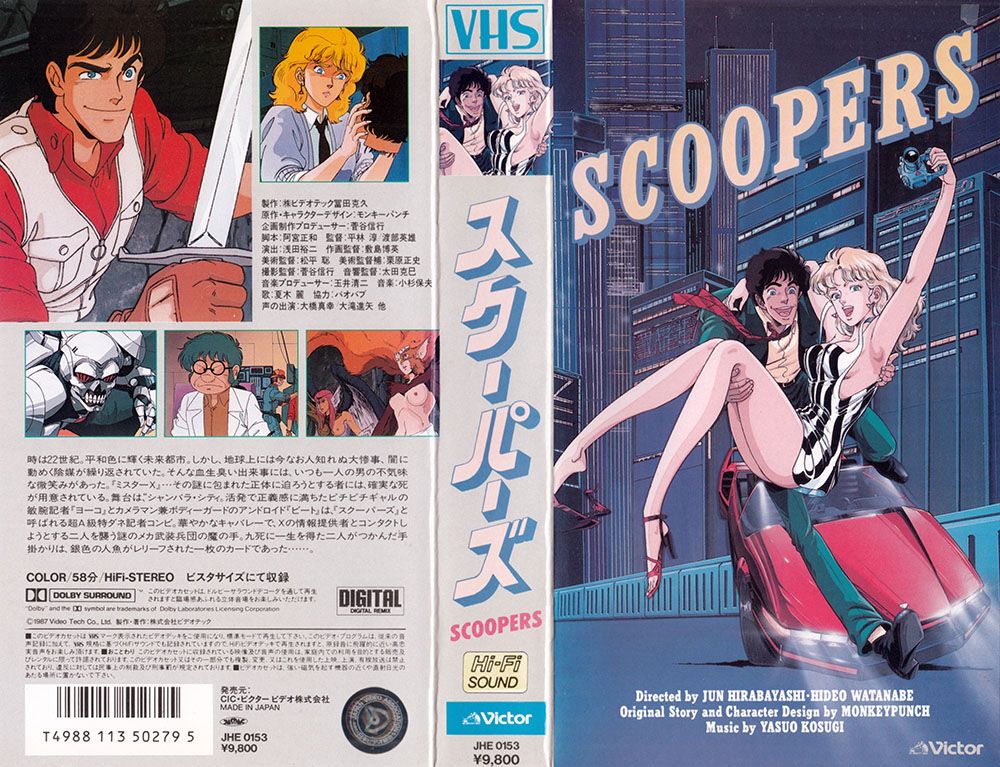
Can intrepid journalists outwit gangsters, corrupt politicos, android monsters, and an evil genius with a destructive master plan? That's the story of Scoopers, an original Japanese anime video released in December 1987 on both the VHS and VHD formats. Best known for boasting an original story and character designs by Monkey "Lupin III" Punch, our titular Scoopers are Yoko, a 22nd century reporter for Shambala City's Private Eyes Magazine - yes, they still have magazines, newspapers, and corded telephones in the 22nd century - and her cameraman partner Beat who is, by the way, an android. Sometimes Beat is a typical sassy, leering, gropey Monkey Punch character, and sometimes Yoko takes out her remote control and Beat is no longer in charge of Beat, which puts their relationship in a weirdly nonconsensual light. Anyway, the mysterious Mister X has been blowing up space shuttles and murdering anyone who dares to reveal his secrets and Yoko and Beat are on the beat tracking him down. Before he's murdered by goons in powered exo-suits, their informant clues the Scoopers into investigating Technoland, a futuristic amusement park Mister X runs as a sideline when he's not trying to take over the world. So basically what we're dealing with here is Westworld crossed with The Terminator and a little bit of Tron thrown in, as executed by Generic Japanese Animation Studio Of The 1980s, namely ACC, who's worked on everything from Hellsing to One Piece. 


Scoopers creator Kazuhiko Katō, aka Monkey Punch, passed away in 2019 (and doesn't that seem like a million years ago?) and is famed for creating Lupin III, which is understandable considering the, let's see, five decades of anime and manga success the character has enjoyed around the world. 

Monkey Punch's Ginza Whirlwind & Time Agent
But Katō, a protean creator, never rested on his laurels, letting his Mort Drucker-inspired style lend itself to works as varied as Gun Hustler, Playboy School, The Ginza Whirlwind Child, Mysterious Jaguarman, Time Agent, Transparent Gentleman, the personality-switching future detective comedy Cinderella Boy, the almost-anime Space Adventure Team Mechadventure, and TMS's early 90s international rescue team Saver Kids. Like Saver Kids, Scoopers was written for animation without a preliminary manga stage, therefore becoming peak bubble-era anime; bright colors, 80s fashions, big office buildings, and clunky robot-suited henchmen adventure for the rental markets of Tsutaya Video.

let's go on a space mechadventure

A scoop of extra 80s Scoopers cheese is provided by a completely inept sequence involving "cyberspace" as our heroes go "inside the computer" which where everything is rendered as "wireframes" and animated by "cheap video effects". Think of the kind of instantly dated, late night informercial kitsch Video Toaster effects as seen on MTV videos and "Captain Power", that's what we're talking about here. Admittedly, the spectacle of the floating, rotating, sometimes snowflake-embedded head of Mister X is admittedly entertaining, in a Zardoz kind of way.

quote cyberspace unquote

Mister X is the kind of evil genius who wears a giant puffy half-face mask that reveals his giant mustache. He sports an enormous overcoat with a collar the size of a manhole cover. This ensemble is accentuated with gigantic medals and epaulets. Since all his henchmen are robots, one wonders why he bothers to wear anything more than a T-shirt, but who cares? It's the 80s! Anyway, it's not as if Mister X's true identity is of any importance - Scoopers never gives us a big unmasking scene. Mister X isn't really Old Man Johnson in disguise, there's no reason for him to even wear a mask. 

please scream inside your hearts

A forgettable Casio keyboard soundtrack and off-the-shelf character designs featuring a remarkable array of balding middle-aged men make Scoopers a perfect example of what Japanese cartoons looked like in the late 1980s - all shiny cities, high-tech robot weapons, aviator shades, and phone booths. Nothing dates a SF cartoon like phone booths. There are a few bloody killings and some bare-breasted killer android monster Valkyries to remind viewers that this isn't some kiddy cartoon, this is serious entertainment for mature adults who want to sit down and relax with this mature adult tale of android cameramen battling android beast women on super rollercoasters of the future. I do kind of like the cleaned up character design of Beat and Yoko - they look recognizably like Monkey Punch characters while at the same time avoiding any resemblance to Lupin or Fujiko, and that's a tough needle to thread right there. 


Scoopers was pitched to the export market via the infamous "GAGA Communications" pilot reel - you know, the one that retitled Project A-Ko as "Super Nova" and Bubblegum Crisis as "Futurescape." A-Ko and BGC eventually found their way to America, but nobody bit on Scoopers, which is not surprising. If you owned JVC's VHD player and their Scoopers VHD release, you could enjoy Yoko and Beat's adventures in 3D courtesy the VHD's LCS glasses. Does this experience improve what's basically a forgettable, less than essential 1980s anime OVA? We may never know.


-Dave Merrill

Thanks for reading Let's Anime! If you enjoyed it and want to show your appreciation for what we do here as part of the Mister Kitty Dot Net world, please consider joining our Patreon!

Wednesday, July 31, 2019

Anime Hell 80s Night II: The Return

It's summertime and that means just one thing: I take over the screening room at one of North America's last remaining video stores and drop a few hours of ANIME HELL upon an audience of scenesters and cineastes. This Saturday night I'll be in the back of Eyesore Cinema here in Toronto showing three 80s anime classics, some of which were anime-fan must-haves, others virtually-unseen cult classics, and still others modern-day icons of outrageousness. 


Fight! Iczer One, the thrilling saga of lushly-illustrated space lesbians battling for the fate of Earth itself, was released in October 1985. Written, directed and character designed by 80s anime MVP Toshiki Hirano, Iczer One tells the story of an Earth under attack by alien invaders called "Cthulhu" who infiltrate and replace humans with parasites known as "Vedims". Mysterious fighter Iczer One must find a human with whom she can "synchronize" and control the Izcer Robo to defeat the aliens! Iczer One is based on the original manga that appeared in the magazine "Lemon People," portions of which are probably illegal in Canada. 


Flying Warped Boy Ranpou aired for 21 episodes in 1984, produced by the animation division of an ad agency and broadcast opposite major league baseball, not a great programming decision on somebody's part. Ranpou was a normal high school kid who was kidnapped by a flying saucer and returned to earth shorter and goofier and with a talking mouse companion who is also a genius inventor. When he's not harassing Coach Hiroshi or Miss Iwasaki, his teachers, he's harassing his girlfriend Mutsumi. This zany gag comedy series is based on a manga that ran for nearly ten years in Shonen Champion, and has never been released on any kind of home video anywhere. Without 80s anime nerds swapping VHS tapes through the mail we'd never be able to see this show. You're welcome!


Mad Bull 34 the anime was released in December 1990, which completely defeats my 1980s theme, but hey, it's based on the 1980s manga drawn by Noriyoshi Inoue and written by Kazuo Koike, who also gave us Lone Wolf And Cub and who passed away recently. So relax. This is the story of Daizaburo Ban, a New York City cop assigned to the tough 34th Precinct, where his partner is John "Sleepy" Estes, a giant monster of a policeman who is WAY OUTTA LINE, YOU'RE THROUGH, TURN IN YOUR BADGE! This ridiculously hardboiled piece of attempted grindhouse mixes cartoony slapstick with ultra-violence and is one of those "not for kids" Japanimations you're always hearing about. 


If you're in town, come on over Saturday! Doors open at 7:30, show starts at 8! That's Eyesore Cinema, 1176 Bloor West, Toronto Ontario Canada!
 
Thanks for reading Let's Anime! If you enjoyed it and want to show your appreciation for what we do here as part of the Mister Kitty Dot Net world, please consider joining our Patreon!

Saturday, January 14, 2017

Assemble the Assemble Insert

Portions of this article originally appeared at the now-defunct Anime Jump.


A power-suit crime wave paralyzes Tokyo, and only one person can stop their reign of terror - a 13 year old girl with superhuman strength, an ultra-high-tech fighting suit, and an idol singing contest to win! That’s how we assemble Assemble Insert, one of those late 80s OVAs that spent a few years on the knowledgeable anime fan's dream release list alongside titles like the similarly themed Prefectural Earth Defense Force. Thankfully, both got North American releases, so nerds like us can quit complaining.

Insert is a 2-part original anime video story of Tokyo in the near future, where more and more crimes are being committed by miscreants using powered armored mechanical suits, confronted by a special division of the Tokyo Metropolitan Police specially set up to combat this menace. If this is all sounding a lot like Patlabor, there's a good reason. Both Assemble Insert and Patlabor share the same author/character designer, Masami Yuuki. So if you're a fan of eminently workable mecha designs and dazed-looking municipal slackers, you're in luck. Yuuki’s original 1985 Assemble Insert manga ran in AniParo Comics, which was published by Minori Shobo, who also published the seminal Japanese animation fan magazine OUT from 1977-1995, without which we might not even be wasting our time on this whole Japanese animation fandom thing, so there’s that.


Patlabor and Assemble Insert part ways, however, in their approach to combating mechanized crime; while Patlabor fights fire with fire, Assemble Insert takes a different approach, one that involves talent contests and idol singers. The Counter-Demon Seed Special Agent Bureau, the crew of fairly indistinguishable, fast-track-to-early-retirement police functionaries charged with stopping this power-suit crime wave, decides their best course of action is to sponsor talent-contest style auditions in the hopes of finding someone who can battle Demon Seed. Sure, Chief Hattori was drunk when he came up with the idea, but maybe the ancients were on to something when they said “in vino veritas.” Anyway, it’s nice to see police thinking about putting their best face forward to the public for a change, and the Counter-Demon Seed Special Agent Bureau wants to make sure their Demon Seed-fighting is done with maximum public appeal.

you're it
Enter Marin, a shy sub-deb who happens to be strong enough to bend steel in her bare hands. She's cute, she's innocent, she has all the doe-eyed naivete necessary for every Japanese idol, and she's just the size to wear Shimakobe's suit. But can Marin-chan overcome her stage fright long enough to pound Demon Seed's robot suits into scrap?

Similar to but less boisterous than the aforementioned Prefectural Earth Defense Force, Assemble Insert spoofs the pop-culture tropes of Japanese SF media – robot suits, super-gals, evil geniuses – but adds its own touches, like energy-drink product placement in the anime that smash-cuts to a live-action commercial break for the same energy drink, starring Assemble Insert voice talent. The opening scene mimics sentai legend Changeman (and stars characters from Yuuki’s Ultimate Superman R) and Assemble Insert’s staff makes numerous appearances as characters, along with a cameo by Patlabor’s Noa Izumi. Demon Seed’s leader Dr. Kyozaburo Demon is from the same mold as any one of the hundreds of evil scientists battling Gigantor or Prince Planet, while his henchmen wear giant eyeball masks in tribute to Kamen Rider Stronger’s Titan. And of course, comedically accidental destruction wrought by our well-meaning heroes is in full effect.

Maron vs Demon Seed
The Counter-Demon Seed Squad schedules Maron’s debut for maximum press attention. What appears to be the big Seibu department store at Ikebukuro Station is hosting a collection of rare artifacts, priceless artworks from the Mu Empire. This allows Assemble Insert to reference both old Toho SF movies and 70s super robot cartoons, and gives Demon Seed a target for pillage. When Demon Seed arrives right on time, Maron’s first public appearance is filled with both awkward stage-fright jitters and shocking damage to Ikebukuro, one of Tokyo’s busier neighborhoods and currently the site of several otaku-destination shopping experiences.

treasures of the Mu Empire
Flush with victory, the second episode sees our heroes become victims of their own success. Without Demon Seed around it’s tough to justify the expense of an Anti-Demon Seed Task Force, and Chief Hattori (based on Masami Yuuki’s editor) is now focused on the earning potentional of Maron’s idol career. Soon Maron is making the rounds of product endorsements and chat shows instead of battling for justice. It's up to Professor Shimakobe to secretly supply the enemy with the necessary trouble-making equipment and give his task force a reason for existence, and shortly Demon Seed announces an attack on the National Mint! Of course, this climactic battle coincides with Maron’s appearance at the Music Awards. Will the Counter Demon Seed Task Force put on their big-cop pants and fight Demon Seed single-handedly? Will Maron choose idoling over enforcing?

the Maron publicity machine rolls on

Just like its characters, the second episode suffers from a bit of the sophomore slump. Once our Assemble Insert world is assembled and Maron does her thing, there’s little left for anybody to do – heck, the episode fades out before Maron punches a single Demon Seed power suit, as if it’s bored with itself. Characters as thinly drawn as Insert’s aren’t going to drive much of a story; the only emotion Maron is allowed to verbalize about her singing super-cop status is “kind of embarrassed”, her handlers are phone-gabbing, note-taking nonentities, and Doctor Demon himself, though claiming to be “fair and square for evil”, limits his do-baddery to broad Batman ’66-type villainy. Still, as an airy OVA confection, Assemble Insert does its job well; which is to deliver manufactured-idol comedy robot-crime busting in 25 minutes or less.

Dr. Demon and pals

Released in Japan in late 1989/early 1990, both OVAs were released in North America by The Right Stuf in 2001, with a reissue in 2004. Directed by Del Power X veteran Ami Tomobuki, the staff included mecha design by Gundam/Patlabor designer (and future Yamato 2199 director) Yutaka Izubuchi and some animation by Studio DEEN, who have been involved in pretty much everything animated in Japan for the past three decades, go ahead, look it up. Dedicated Assemble-ologists can find a small but significant collection of merchandise that includes VHS and Laserdisc releases as well as model kits of Demon Seed’s mecha and figures and garage kits of Maron. The original manga has been released in tankubon form on a few occasions, and if Ikebukuro is still standing after Maron destroys Demon Seed, you can probably pick it up in their Book-Off location up the street from the Sunshine 60 building.

manga and model
The Right Stuf’s DVD was translated by C.B. Cebulski and the English subtitles feature formatting assistance from anime localization superstar Neil Nadelman. The English dubbing features a star turn by Jessica Calvello as Maron, and there are some interesting Muppet-voice impressions used for the Demon Seed henchmen, while one of the police is a dead ringer for SNL’s 70s stoner-comedy puppet Mr. Bill. There's not a whole bunch of extra stuff on the DVD, but hey - this is a 2-part OVA from decades ago, so relax.


Assemble Insert never goes as far as contemporaneous girl-power gagfests like Project A-Ko, Dirty Pair or Urusei Yatsura; destruction is never as total and gags aren't as extreme. But that’s okay; not everything needs to be cranked to 11. The reserved yet ridiculous nature of Yuuki's characters helps Assemble strike a middle ground between gonzo comedy and the grounded, humanistic SF of another, more popular Masami Yuuki creation, Ultimate Superman R... no, wait, I mean Patlabor.

and now a word from our sponsor


Editors’ note: fans of Yuuki and Patlabor may want to check out Colony Drop’s latest Last American Fanzine; this one’s devoted to Patlabor and features art and articles by a whole host of contributors, including yours truly! Get it today!

-Dave Merrill

Saturday, October 31, 2015

10th anniversary of 15th anniversary of Metal Skin Panic Madox-01

This review of AnimEigo’s Madox-01 15th Anniversary Special Collector’s Edition first appeared in 2005. Since then, I’ve learned a few more things about Madox-01, namely that Hideaki “Evangelion” Anno did some key animation for it, and that my DVD of this title has mysteriously vanished. Did I loan it to you?

Notable for being AnimEigo’s first release, Metal Skin Panic Madox-01 led the way for uncut, subtitled Japanese animation to the American market.  Before this release, anime in the States was available either as chopped-and-dubbed kidvid for the afterschool UHF audience, or as cheaply designed videotapes in the “Family” section of your local video rental. After AnimEigo and Madox, America would see an invasion of unadulterated, sometimes adults-only anime aimed directly at the shelves of your local Blockbuster, and things would never be the same again.


Apart from this note of historical interest, Madox is otherwise unremarkable except to serve as an example of several things: of the mid-1980s Original Video Animation boom, of the persistence of abnormal hair color in Japanese anime characters, and of just how obsessive and nitpicky a design team can get when it comes to military hardware.

The OVA era of the 1980s is an important time in Japanese animation; creative teams raised on groundbreaking animation like Gundam and Yamato seized the means of production and started producing direct-to-video animation. Titles like Vampire Hunter D, Bubblegum Crisis, and M.D. Geist would become legends, while others like Digital Devil Story and Cosmos Pink Shock would vanish into sometimes well-deserved obscurity.  Unrestrained by the mores of television broadcasters or the financial obligations of theatrical release, OVA productions used their freedom to produce groundbreaking, artistically challenging works that were too risky for traditional release, animation that reflected more personal visions, rather than the needs of the toy company sponsors.  Plus, they were easier for American fans to get, since you didn’t have to know somebody in Japan to tape anime from television broadcasts- you could just buy the damned things and have done with it. 

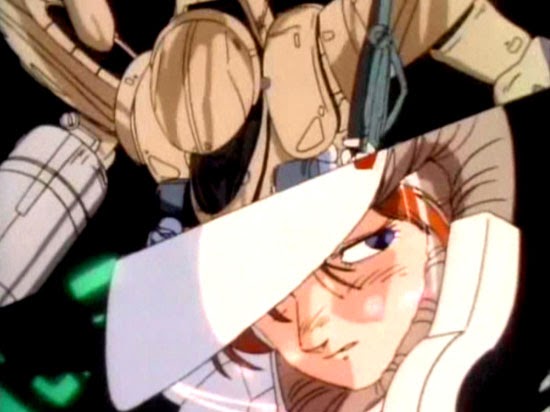
Lack of toy company sponsorship is kind of a shame in the case of Madox-01, since the mechanical hardware on display in this video cries out for a highly detailed toy.  This 1988 release is the story of the MADOX, a self-contained personal armored combat machine; in other words, a very plausible looking, technically feasible version of that hoary old staple of Japanese animation, the giant robot.  Developed by Japanese heavy industry under contract with the US Army and the Japanese Self Defense Forces, we first see the MADOX in action as it defeats three heavy tanks in fierce combat. The American tank commander Kilgore wants a rematch, but MADOX’s test pilot Kusomoto, who is naturally a sexy Japanese woman with orange hair and a tight combat suit, isn’t interested.  The MADOX is crated up and put on a truck to be sent to the US HQ in Tokyo. 


After Tokyo’s bad drivers cause the truck to crash, the crated-up MADOX winds up in an auto repair shop.  Teenage greasemonkey Kouji takes it home to spend the afternoon messing with the whatever-it-is before he meets his girlfriend that night.  So he puts the MADOX on, which by the way was shipped while in “scramble mode”, and before he knows it the thing is rocketing through the Tokyo streets, out of control, with the JSDF and the US Army in hot pursuit.


Now Kouji has to dodge Kusomoto who’s in MADOX-02, he’s under attack from Col. Kilgore riding a cute little articulated tank, the skies are full of Apache attack helicopters – and he’s got to meet his girlfriend atop the NSR Building before she leaves forever!!  What’s a Japanese teenager to do?


What follows is standard-issue anime-style urban property destruction, replete with authentic otaku-approved guns & ammo and a mysterious lack of civilian casualties.  You remember what high-tech war is like – lots of expensive precision machinery operated by skilled, highly trained professional technicians, waged far away from noncombatants, and not much at all like the real thing.  For all its fetishization of military hardware, Madox-01 is as much of a fantasy as the dumbest, most outlandish transforming robot cartoon. Which, by the way, is UFO Diapollon. Or maybe Magnetic Robo Ga-Keen.

The theme of military action destroying an unwitting civilian Tokyo has been visited in the world of anime many times, most notably by Hayao Miyazaki in Lupin III episode #155, “Farewell Lovely Lupin”, where the spectacle of tanks and artillery blasting away at Tokyo landmarks was shown to have terrible consequences. There’s no such moralizing here in Madox, where the full panoply of warfare is unleashed with total casualties being, um, one.

Of course, expecting any kind of editorial position from a 40-minute OVA is probably asking too much, but jeez, the guys who made this video lived within a subway ride of some of the heaviest firepower on that side of the globe, and you’d think they had some sort of opinion about it other than, “boy, isn’t this stuff cool.”  Then again, this was the 1980s; destruction without context was just the way things were done back then.


Giant shoulders, suspenders, and a wimped-out synthesizer soundtrack constantly remind the viewer that he is back in the days of Max Headroom and New Coke.  Tamura Hideki’s character designs reach a nadir of sorts in Kusomoto; her giant forehead and weirdly angled chin resemble nothing so much as the specter of perennial TV game show guest Dorothy Kilgallen.  ARTMIC’s  animation is naturally obsessive and detailed in scenes containing military ordinance, and surprisingly inept with the human figure; there are some rather basic animation errors towards the end of Madox-01 that show us exactly where the studio’s mind was.

The English dub, by Swirl, isn’t really anything special; there’s not a lot of dialog in this OVA to begin with, and what we do get is rendered competently but without flash. Subtitles include details on what “N.B.C.” warfare means, and suffice to say we’re not talking Leno versus Letterman. There are two Japanese language tracks, one with English subtitles and another with minimal subtitles, a nice touch for those conversant with the language.

Further evidence as to what floats Madox-01’s boat is evident in the ten-minute accompanying featurette, a live-action documentary look at the JSDF’s heavy hitters circa 1988.  Apache helicopters, tanks, howitzers, rocket launchers, recoilless rifles, and other crowd-pleasers are shown at the Mt. Fuji proving grounds, blasting helpless paper targets into oblivion as we’re shown the real-life versions of all those models in Godzilla films. It’s an interesting look at Japan’s defense-only military during the height of cold-war bubble-economy budgets.


Madox-01’s place in AnimEigo history is confirmed with another extra, a Q&A session with CEO Robert Woodhead that reveals, among other things, that for their first release he chose Madox over Project A-Ko. Another Q&A with audio director Eric Tomosunas of Swirl Recordings & Film isn’t quite as interesting.  The commentary track features Eric and several of the lead Madox voice talent.  Early on diverges from commenting on Madox to a round-table discussion on what it’s like to dub Japanese cartoons in general;  interesting, but not anything that hasn’t happened at every anime convention ever.

As an historical artifact, this 15th anniversary edition of Madox-01 is about as classy a package as you’re going to get for a 40-minute, otherwise forgotten OVA.  It’s a relic from the early days of direct-to-video animation, and much like its counterparts from those days, isn’t a bad piece of anime for an evening’s rental.  There’s something to be said for a short, self-contained story with enough action and suspense to keep itself going for 40 minutes.  You’re not asked for a long investment of time, there aren’t legions of characters to keep track of or a backstory to research; just put it on the TV and enjoy watching the stuff blow up. 


Thanks for reading Let's Anime! If you enjoyed it and want to show your appreciation for what we do here as part of the Mister Kitty Dot Net world, please consider joining our Patreon!

Wednesday, October 30, 2013

Top Ten Least Essential OVA Of The 80s

The internet is filled with sequentially numbered, attention-getting listsicles all claiming to be the authoritative judgment on the top fifteen party schools to visit after you master your five best workouts or the twenty-five movies you must not fail to see with the ten people you meet when you die. And here at Let’s Anime we are not any better,  even though our focus is classic Japanese cartoons. So here’s an less than exhaustively researched, completely subjective and totally arbitrary list of the Top Ten Least Essential OVAs That Honestly, You Don’t Need To Watch.  You can safely go on about your life without ever having wasted your time watching these 1980s Japanese anime OVAs; other than filling the shelves of neighborhood video rental shops, they are inconsequential in every sense of the word.  Some of them are bad, some of them are boring, and others make no sense whatsoever, their only common denominator being their total uselessness. And remember, like every other stupid list you find on the internets, this is completely arbitrary, subject only to the reviewer’s whimsical notions, and may not reflect your personal taste or reality in any way whatsoever. 

Headbands are an essential part of your 1980s fashion
 
Cosmos Pink Shock - 7-21-1986 This one’s a lightweight and knows it, but the great Toshiki “Iczer One” Hirano is here at the height of his powers, giving us the story of Michi, a space leotard girl who blasts across a goofy universe in her ship, the Pink Shock,  in pursuit of her boyfriend.  It’s got good AIC animation, some gags – not great gags, but gags nonetheless – and cultural references that we didn’t get in the 80s because our knowledge of Japan was limited to Robotech, ninja movies and metal robot toys. It’s the OVA equivalent of a 12” remix by Bananarama or the Mary Jane Girls – a perfect artifact of its time whose greatest virtue is being a perfect artifact of its time.
 
Dead Heat - 8-7-1987 In the future, auto racing is known as ‘FX’ and the drivers don’t drive cars, they drive car-robot hybrid vehicles, and they don’t just race, they grapple with each other as they go around the track. Seems like a lot of mechanical engineering simply to replicate roller derby, but who am I to argue with the future?  This Sunrise OVA is of interest mostly to people who for some reason are unable to watch either roller derby or auto racing, and who wonder if our hero Makoto will win the big race so he can take his surprisingly male-looking girlfriend to a love hotel. If you had a dedicated 3D compatible VHD player with 3D glasses,  you could watch Dead Heat in thrilling 3D, with the exciting bonus of witnessing an extra character who was only visible in 3D. Legend has it this character holds up a sign marked with the Japanese characters for “sucker”. 

Makoto and "girlfriend"

Elf 17 - 1-4-1987  Based on the manga by Atsuji Yamamoto, Elf 17 is a cutesy lightweight romp through the galaxy as our title character, the strongest little teenage girl elf in the universe, teams up with the eccentric zillionaire prince Mascot Tyler and the battle-suit otaku K.K. as they battle their way through the pro-wrestling areas of outer space. This airy trifle comes complete with giant walking tanuki statues and a Mitokomon reference, and it completely misrepresents Yamamoto’s manga work, which started off kinda lurid and just got more lurid with time. Later Yamamoto works include “Battle Goddess” and the super bloody, ultra lurid “Arnis In Sword Land.”  Yamamoto also provided the story for another completely non-essential OVA, Ultimate Teacher.

Ruu, aka Elf 17, will kick your ass
 
Phantom Gentleman aka Dream Detective Gentleman (Mugen Shinshi: Boken Katsugeki Hen) - 2-21-1987 Mamiya Mugen is a famous detective, a famous, kinda girly-looking kid detective, who works in a weird retro 1930s Japan.  Strange kidnappers target club dancer Atsuko “Akko” Fukune - but Mugen is on the case to protect Tokyo’s exotic dancers! This 49 minute video mixes cutesy character designs with what you’re led to believe is going to be some kind of detective story but instead detours into magical relics, mythical monsters, and Indiana Jones-style adventure, but all the busty dancing girls or archeological destruction can’t help make this inexplicable film any more explicable. If we were Japanese we’d be familiar with the popular Mugen Shinshi manga by Yosuke Takahashi, but his eerily sensual pen line failed utterly to make the transition to this anime.  
underage drinkin', underage detectin'

Roots Search - 9-10-1986
This one is bad and it should feel bad.  Roots Search, aka “Life Devourer X”, is like something a dollar store or a truck stop chain would produce to cash in on what they heard was the exciting new “Japanimation” fad, like something you find hundreds of dumped at a Goodwill for a tax loss; poorly animated, badly designed characters wander through various spaceships having ESP visions and dodging a horrifying vagina dentata alien that murders astronauts. And then it just ends, denying the remaining few viewers any sort of closure.  This one is by some of the same people that brought us Crystal Triangle, another really terrible OVA that at least has an ending.

Good Morning Althea - 12-16-1987 This might be the exact point where Japan just gave up and decided to just throw mechanical designs at their OVA projects in the hope that the resulting confusion would resolve itself into some kind of interesting pattern. This is the sort of OVA you watch without subtitles and naturally assume that what’s going on makes sense and is in some way purposeful and of interest, and then later somebody fansubs it and you find out that the pattern your brain attempted to impose upon it actually made more sense than what was originally intended. There’s a spaceship, there are robots, there are people in robots fighting other people in robots from another spaceship. Somebody wakes up.

rise and shine Althea

The Humanoid - 3-5-1986
If you spent any time in the 1980s you’ll recognize his work: the shiny airbrush work of Hajime Sorayama appeared on the covers of Playboy and Heavy Metal and on album covers for bands like The Cars and Aerosmith. And if you find the idea of a shiny metal woman interesting enough to support a 40-minute animated video, then The Humanoid is for you! Antoinette, the sexy robot in question, was built by Dr. Watson on the planet Lazeria, which is about to be destroyed by the evil Governor Proud, right when Dr. Watson’s daughter Sheri and her hunky fiancé Alan arrive. Terrible timing!  Luckily, this all happens when Antoinette’s sexy robot heart starts to have robot feelings of love, and she uses her sexy robot power to save the day. This 40-minute time-waster has lackluster character designs, cheesy 80s ballads, and an inexplicable obsession with coffee. 


Digital Devil Story (Megami Tensei) - 1987 Based on the Japanese horror novel series by Aya Nishitani, this one’s about a student computer genius, who’s also the reincarnation of an ancient Japanese deity, who uses his giant clunky 80s mainframe to summon up some horrifying devils. This involves some not-bad animation of a well-endowed teacher’s frilly brassiere heaving up and down as she becomes the conduit for horrifying monsters from another dimension to invade our world. Then giant piles of red goop start crushing students and a big blue hairy devil named Loki fights our student computer genius hero, who fights back with his reincarnated girlfriend and his magic sword and his pet devil animal throughout several alternate universes.  If you want lots of mid 1980s computer technology and lots of scenes of people staring intently at old-fashioned CRT monitors, followed by hairy devils and magic swords, this is the one for you! The Hiroyuki Kitazume character designs aren’t bad, if you’re into that sort of thing.  Apparently there are a lot of video games based on this novel, and I suspect they aren’t very essential either. 

Chojiku Romanesque Samy – Missing 99 - 7-5-1986  Let’s see, what we have here is your typical everyday story of a typical anime schoolgirl who finds out she actually has amazing mystical powers that not only transport her into an amazing fantasy world but give her amazing super battle armor that doubles as a bikini. Raise your hands if you’ve seen this all before. Can she survive the attack of the reconstructed demon beast warriors in time to reveal her true Bodhisattva nature? 


Girls Detective Club (Katsugeki Shoujo Tanteidan) - 11-25-1986  You’d think that a video starring three high school girls armed with automatic weapons battling an evil girl-genius with a giant flying battleship would be jam packed with the same sort of excitement and flash that made Project A-Ko such a success, but you’d be wrong. This stunningly boring piece of junk – from TMS, shockingly enough - limps from nonsensical setup to nonsensical setup, never explaining who these girls are, why they have a detective club, why one of them lives in a mansion filled with machine guns, or why this was animated in the first place. It feels like a Cream Lemon with all the sex removed, like an episode of Urusei Yatsura without gags, fun characters, or pleasant design, like a half hour of your life without anything productive or fulfilling accomplished. What purpose Girls Detective Club served other than clogging shelves down at Tsutaya Video is a mystery which I suppose we’ll need to hire a Girls Detective Club to solve. 

get detecting, you
 
What’s that? I didn’t mention The Wanna-Bes or Twilight Q or Twinkle Heart or even Twinkle Rock Me Nora? Didn’t see your favorite least essential OVA listed here? Ready to take this to social media and tell the world how Let’s Anime arbitrarily ignored your favorite least essential OVA in its totally subjective list? Sure, why not. Make sure to let us know what YOUR time-wastingest OVA is, or was; maybe we can get another column out of ‘em.

-Dave Merrill

Thanks for reading Let's Anime! If you enjoyed it and want to show your appreciation for what we do here as part of the Mister Kitty Dot Net world, please consider joining our Patreon!