Showing posts with label tatsunoko. Show all posts

Thursday, August 28, 2025

1965: The Year Anime Went Beyond The Moon

Right now it's 2025, and that means it's as good a time as any to take a look back sixty years and see what Japanese animation looked like in 1965. Except it wasn't called "anime" back then, the term of art was "terebi manga," largely because a lot of what was showing up on Japanese TV in cartoon form had started as newspaper comics, or weekly comics, or comics in general.  However, by 1965 those lines were beginning to blur.  Mass media marketing began its synchronized attacks upon the spare change of Japan's youth. We're still living in the Dentsu age where animation is but one part of a vast promotional machine, and it all got started in those days of the 1960s. But what did what we'd later call "anime" look like, six decades ago? Well, it kind of looked like this. 


Space was the place in 1965! America and Russia both sent probes to the Moon and Mars, while both astronauts and cosmonauts ventured outside their space capsules for the first time. Meanwhile on TV screens, Tatsunoko's first-ever series Space Ace arrived... from space! Based on Tatsuo Yoshida's manga, Space Ace is a boy from the lost planet Parum who was separated from the rest of his people and landed on Earth. Found by Doctor, uh, Tatsunoko, Space Ace uses his amazing Parum abilities of having a stretchy body, a silver energy ring, and a platinum ray to help his new friends and the Earth. Ace replenishes his energy by chewing special energy gum - candy company Kanebo Harris (now Kracie) was a sponsor, and Ace also appears in the bubble gum commercials that air during the show. Tatsunoko pitched Space Ace to American syndication, but nobody in the US took the bait. I've long heard rumors of an English pilot for this series, but so far all that exist are rumors. 


Meanwhile in '65, the TCJ crew responsible for Tetsujin-28 aka Gigantor were hard at work bringing Space Boy Soran to Japanese TV, where it would air from May 1965 until March of 1967. Soran is the son of noted scientist Dr. Tachibana who designed a super bomb and then fled with his family to outer space, as one does. Only Soran and his sister survived the crash of their spaceship. Soran was raised by space aliens who rebuilt him into a cyborg and he returns to Earth years later with super powers and a sidekick, Chappy the Space Squirrel, to search for his sister and also to battle evil, of course. Was Space Boy Soran's space squirrel adventure a little too similar to Osamu Tezuka's "No. 7" manga, and did Soran's production cause Tezuka to forestall production of a No. 7 anime series and instead retool the concept into Wonder 3? Only Galactic Command has the answers.


TCJ's Super Jetter is the story of Time Patrolman 723567 who flies from the future in his time-ship Ryusei-go (“Shooting Star”) in pursuit of the criminal Jaguar. Trapped in the 20th century, Super Jetter finds himself using his future powers to battle for justice! This series was commissioned by TBS as an original work rather than adapting an existing property; after TBS found out they'd inadvertently sold all the international rights to Eight Man to ABC Films, they wanted another show they could control exports of. Super Jetter was created by Fumio Hisamatsu, who also did manga for Ultra Seven, Godzilla Vs Mothra, Mighty Jack, UFO Warrior Daiapollon, and Yatterman. The series was originally in black and white but 26 episodes were remade in color for export, screening in Mexico as "El Hijo de Meteoro."


Also from TCJ, starting in June of 1965, was Planet Boy Papi, the story of the boy from the planet Clifton sent to Earth to sell Glico candy - the show was the second after Tetsujin-28 to air in "Glico Theater" time slot -  and fight evil with his powerful Metalizer pendant and the help of a top evil-fighting combo made up of an Arabian wizard, a professional wrestler, and a little girl. We here at Let's Anime were deeply affected by Prince Planet in our youth, and subsequently have written extensively about this series and its English language release as Prince Planet, which was dubbed by Miami's Copri International Studios and syndicated by American International Television.  


Toei's Space Patrol Hopper was sponsored by Daimaru Department Store and later was retitled Patrol Hopper: Space Kid Jun. The titular Jun is an Earthling who got caught up in a conflict involving space aliens. Injured, Jun was rescued by planet Hopper's Space Patrol. The Hopperians, or Hopperites, or Hopperutians, whichever, those guys rebuild Jun as a cyborg using their scientific power, and he becomes a member of their Space Patrol, fighting to protect peace in the universe and on Earth. The terrific Yasuji Mori character designs are all over this show, which is peak mid century design throughout its 44 episodes, airing from February to November 1965.


The year's only Japanese animated theatrical release was also an outer space adventure. Gulliver's Space Journey is a Toei film about a homeless boy named Ted; he and his friends come across Gulliver, you know, the one from Jonathan Swift's 1726 satirical novel Gulliver's Travels. Our modern Gulliver is about to take off in his rocket ship to the Hope Star, which has been conquered by robots! Gulliver's Space Journey has an all-star pedigree. The film's screenplay is by Shinichi Sekizawa, who wrote the lost film "Fearful Attack Of The Flying Saucers" as well as cinematic milestones like Godzilla Vs Mothra, Latitude Zero, Destroy All Monsters, and Jack And The Witch. Gulliver's music is by Isao Tomita, who would also score Jungle Emperor for Tezuka's Mushi Pro. 


Key Gulliver animation was by Yasuo Otsuka, with in-betweening and certain scene concepts by Hayao Miyazaki. Ted's voice actor is Kyu Sakamoto, the first Japanese singer to hit number one on the US charts with his hit song "Ue o Muite Arukō", or, as it was incongruously renamed in the States, "Sukiyaki." The English language version, retitled Gulliver's Travels Beyond The Moon, would be released in US theaters by Walter Reade - Continental in 1966, with new music by Milton & Anne Delugg and Darla Hood from "Our Gang" voicing the Princess. The film would continue to play US theaters through 1975, and would be the last Japanese animated film to hit America until 1971's The World Of Hans Christian Andersen.


A more earthbound series from Toei's 1965 stable is Hustle Punch, which might be the closest Japan ever got to the Hanna Barbera style zany talking animal slapstick comedy adventure formula.  Punch (a bear), Touch (a mouse), and Bun (a weasel) all live in a scrapyard and battle the evil plans of Professor Garigari, a wolf who wants to build his own city over their hometown. This TV show delivered rollicking fun from  November '65 until April '66. Hustle Punch creatives Yasuo Otsuka, Isao Takahata and Hayao Miyazaki would later bring this sort of chaotic amusement to human-being shows like Lupin III.


Fujiko-Fujio's Obake no Q-Tarō becomes animated in a 1965 series broadcast on TBS and produced by A-Production and Tokyo Movie, who would later become TMS. Q-Tarō is a friendly, sometimes timid ghost somehow attached to the Ohara family. Our ghostly star is voiced in a breakout role by the protean talent of Machiko Soga and lives, if that's the right word, to cause mischief. This is much to the chagrin of elementary school student Shōta Ohara, Q-Tarō's best pal. The success of this goofy ghost's adventures caused what was called a "Q-Tarō Boom" which would later inspire, among other things, the ghosts in Pac-Man. The Fujiko-Fujio team would also create Ninja Hattori-kun, Kaibutsu-kun, Perman, and Doraemon, which is to say they're behind some of the most popular cartoons in Japan, and in some cases, the world. The 1971-72 Q-Tarō series was broadcast on some US television stations as "Little Ghost Q-Tarō."


Perhaps the biggest star of 1965 was Mushi Pro's Jungle Emperor. Based on Osamu Tezuka's 1950 manga, the TV series was the first color animated series produced for Japanese television. The story of (stop me if you've heard this one before, Disney) how the son of the king of the jungle returns to regain his rightful place as leader of the animals, this show was animated by Tezuka's Mushi studio and began airing in October of 1965, Wednesdays 7-7:30pm on Fuji-TV. The animation may have been simplistic, and the character designs cartoony even by Tezuka standards, but the epic scope of the series, punctuated by Isao Tomita's grand soundtrack, elevates Jungle Emperor into legendary status. 


NBC Films helped to finance the production and exported the series to America as "Kimba The White Lion." Consequently, the series episodes didn't feature continued storylines, violence was toned down, and as the corporate history states, "particular care was taken in the depiction of black people." Absent NBC financing, Mushi's 1967 sequel series "Go Leo" was more faithful to the original manga storyline. Go Leo featured continued stories and more violent content, and subsequently did not air in America until 1982. 


1965 brought us some impressive milestones, but also some confusing missteps, in the shape of Mysterious Thief Pride. Otherwise known as Dr. Zen And The Magic Machine, this weird Tele-Cartoons Japan series of five minute shorts stars the titular thief Pride and his canine companion. Pride & Co. commit zany robberies while being pursued by boy detective Doublecheck, his big pal Broken, and their honeybee fairy friend Honey. Airing on Fuji TV at 6:10pm, this series was in black and white, but was colorized and dubbed for export under the "Dr Zen" title. It's unclear if this series ever made it to air on North America. And why would it?


1965 continued anime's path towards lucrative property licences and blizzards of toy tie-ins, into increased international audiences and full color productions, a year 1966 and 1967 would build upon in new and exciting ways. Other shows of 1965 include warring-states period boy ninja Fujimaru Of The Wind, the Tezuka cyborg Big X, the live-action/animation hybrid Bibi The Alien, and of course Wonder 3, the Tezuka adventure of a bunny, a duck, and a horse, sent here by Galactic Control to save or destroy the Earth. 


Sixty years later, what remains of 1965? They're making another Jungle Emperor. You can still buy Obake no Q-Tarō merchandise, TCJ still exists as Eiken and still has animated shows on the air every week. Sponsors still build ad campaigns around TV animation and studios like Toei, TMS and Tatsunoko continue as major players in the biz. 1965 helped build the pipeline that fed the superhighway that laid the rails that blazed the trails that brought us to today, a world where kids of all ages around the world still watch Japanese animation. Next up: 1975!

 -Dave Merrill


Thanks for reading Let's Anime! If you enjoyed it and want to show your appreciation for what we do here as part of the Mister Kitty Dot Net world, please consider joining our Patreon!


Monday, June 30, 2025

Robotech II: The Sentinels?


When the anime series Robotech came to the rescue of syndicated American TV in the mid 80s, its success created an audience eager for more, and producers Harmony Gold were ready to capitalize on that desire. The trouble with continuing that story was, well, Robotech was originally three different Japanese television shows, all with their own writers, artists, production teams, schedules and budgets, all completed before “Robotech” was even a trademark. Harmony Gold’s role in rewriting, editing, and repackaging the material, while not insignificant, was still less work than coming up with an entirely new series from scratch. Which is probably why HG’s first Robotech sequel took the easy way out. Robotech The Movie was a dubbed and rewritten Megazone 23, amended with some Southern Cross footage and some dialogue intended to fit the whole business in with the Robotech storyline. The result, immediately suppressed after test screenings, was an incoherent mess.

However, Harmony Gold’s next shot at a Robotech franchise opportunity took a completely different approach. New characters and mecha were designed, new storylines were composed, the production team constructed a galaxy-spanning epic that would reveal the mysteries behind the foundation of the entire Robotech saga. And the final result was… also an incoherent mess.
 

pre-production trade advertisement for Robotech II


But in 1988, all we fans knew was that show that had brought a lot of us into Japanese animation now had a sequel titled “Robotech II: The Sentinels,” and that this sequel had finally been released on home video, and that we were about to watch it at our local anime club meeting. Then we watched all 74 minutes of that video and we finally knew the truth, which is that Robotech II: The Sentinels is terrible.

Rather than being assembled, rewritten and recut from disparate elements, The Sentinels was conceived and commissioned from the ground up by Harmony Gold. Yet, due to production problems and various financing crises, The Sentinels we eventually wound up with was, ironically enough, also assembled, rewritten and recut. Production on Sentinels began even as the original TV series was airing. However, HG’s 65 episode plan ran into problems when on September 22, 1985 the Plaza Accord was signed, which among other things revalued the Japanese yen against the US dollar. What had at one time been cheaply produced Japanese animation was now significantly more expensive to produce. As a result, the price tag on The Sentinels ballooned and sponsor Matchbox pulled out, leaving Harmony Gold with a mere three episodes of usable footage. This, along with material from the original Robotech television series, is the Sentinels video release we were given. 
 

either too much hair, or not enough hair


Robotech II should have been an easy slam dunk, even with the show’s self-imposed goal of showing what happens to the Macross Saga characters after the events of that series arc while also providing connective material to the Robotech Masters (Southern Cross) series and laying the groundwork for the New Generation (Mospeada) batch of episodes. Had it been planned from the start as a direct-to-video special, it might have worked. Fans loved these characters and were ready to see more of their adventures. That is not what we got. 


What Robotech II delivers instead are once beloved characters redesigned to avoid copyright issues, because Macross copyright partners Studio Nue and Big West had not and would never sign off on any Robotech sequels starring their Macross IP. This results in scenes of the new-look Rick Hunter and retooled Lisa Hayes preparing for their wedding alongside their friends Slightly Off Lynn Minmay and Is That Claudia Grant, I Guess It Is. Yes, this wedding is taking place ten years after the end of the Macross Saga, because good space station caterers are hard to find, maybe. 
 
 
Comedy relief is provided by the hilarious little-kid antics of Little Dana Sterling and Little Bowie Grant, who apparently are the only ten year olds left alive on Earth. These domestic scenes are intercut with events across the galaxy on the planet Tirol, the homeworld of the Robotech Masters, who at this point in the story are on their way to Earth to make the Robotech Masters TV series a thing, and who have left their planet in the hands of an elderly man with an amazing beard. 
 

some of the amazing beards of Robotech II

 
A disturbing proportion of Robotech II: The Sentinels is devoted to middle-aged bores lecturing everybody in various contrived accents while sporting a startling variety of facial hair choices, epitomized by Tirol’s chief scientist Kabel as he wrinkles his elderly brow in confusion as their planet is invaded by the robot panthers and humanoid, phallus-dangling mechanoid destroyers of the Invid. You might recall the Invid as the Earth-invading baddies from Robotech The New Generation. 
 

Can this marriage be saved?


Here the foundation is laid for their future Earth attack as the bickering husband-and-wife team of Regent the tadpole-faced slug man and Regis the human-faced slug lady argue and whine their way through scenes which will have audiences thinking about couples counseling or divorce lawyers. Occasionally the slug man talks to a giant brain in a tank, merely one of many Robotech II scenes where dialog is spoken by people without mouths, or people wearing masks, or people with things obscuring their mouths, or people with their backs to the camera, so as to avoid the trouble of animating lip movements.

I watched and enjoyed the original Robotech TV series, and I can assure you that this show was not a success because of giant slugs talking to giant brains. Robotech was a success because it featured transforming robot fighter planes, well-animated action scenes, and cute girl singers. Robotech II: The Sentinels has none of this. All the returning characters are uglier and have stupider hair, and the new characters are also ugly and also have stupid hair. Popular Robotech singing star Minmay gets one song, which she’s forced to share with a brand new character that Robotech II never gets around to introducing. Other familiar Robotech characters are reduced to standing around asking plot-furthering questions, arguing their way through board meetings or sporting what appear to be gimp fetish masks, as we see Zentraedi commander Breetai wearing as he walks Lisa Hayes down the matrimonial aisle.
 

There’s very little Robotech mecha in Robotech II, which might have influenced Matchbox’s decision to yank the plug. The only transforming mecha we see in Robotech II are training flights flown by Alpha fighters, and all the other various Invid destructo-bots and mecha-dogs aren’t what we’d call toyetic. The Sentinels' mechanical design was by Tatsunoko’s in-house mecha design team Ammonite, previously seen mecha-designing shows like Starzan S and Southern Cross. Ammonite would create a slew of original mecha for Robotech II, and several designs would be repurposed for future projects like Red Photon Zillion, an ecological solution that proves every dark cloud has a silver lining.  After 74 minutes of confusing edits, flashbacks to Robotech episodes, a scene where some anonymous captain is profoundly and court-martially  insubordinate to Major General Rick Hunter, ponderous arguments between different sets of boring old guys, and Tirol’s beardo wizard staring into computer screens as robot dogs destroy his planet, viewers may cheer any hope of redemption. 


Of course, Harmony Gold would wring every bit of profit they could from the remains of this abortive series. Robotech II first got a home video release from Palladium, the Robotech RPG people, choosing for their cover art one of the Invid’s swinging-dick robo-marauders. Is there a better way to sell a Robotech sequel than  images of a scary dong robot? Later Streamline Pictures would offer a Robotech II VHS with distribution from Orion Pictures. A slightly altered version would appear on A&E’s Robotech The Complete Set DVD box, along with other sequel projects like Robotech The Shadow Chronicles and the Robotech version of the Mospeada OVA “Love Live Alive.”
 
yup, that robot has a wang

Robotech II: The Sentinels achieved its greatest success in other media. Del Rey would roll out the entire Sentinels story through five novels, while three different comic book companies released Sentinels-based comics and Palladium released a Sentinels RPG. Perhaps one of these ancillary media iterations dares to tell the audience exactly who the Robotech Sentinels are. This video never does. 
 

Robotech is a franchise that spawned novels, comic books, games, a large toy line, and a fandom that continues to this day.  What it hasn't spawned is a satisfying sequel, in spite of the efforts of Harmony Gold and a myriad of creative hopefuls, and in defiance of all the 80s nostalgia, remake obsession, and reboot mania that Hollywood can muster. Currently Sony Pictures is churning through the third attempt at making a live-action Robotech film. All we can say to this is good luck, go easy on the beards, and don’t put Breetai in a gimp mask.

-D. Merrill


Thanks for reading Let's Anime! If you enjoyed it and want to show your appreciation for what we do here as part of the Mister Kitty Dot Net world, please consider joining our Patreon!

Saturday, October 14, 2017

speeding into fifty

SUMMER, 1970s: The suburban neighborhood is full of active children. Baseball, Big Wheels, yellow metal Tonka dump trucks, plastic army men, Barbies and GI Joes create a carnival of playtime - until 2:30 in the afternoon, that is. That’s when the yards clear of children, when kids up and down the street vanish into houses. It may be your house or that of some family you’ve never met. Just come on in and sprawl in front of the wood-paneled console television and start spinning that UHF dial and working the rabbit ears, because it’s two-thirty: time for Speed Racer.


Speed Racer! Pioneer in children’s action cartoons, arguably the most popular anime ever released in America, touchstone of a generation’s obsession with fast cars and gadgets, wellspring of two hemisphere’s worth of sequels and merchandise and big-budget Hollywood films and speeding tickets for millions of grownup kids. It’s been fifty years since Speed and Trixie and Spritle and Chim Chim first came racing down the track. Fifty years! Yet the series is still a pop culture icon, not just in the anime-fan world, but anywhere kids watched cartoons and occasionally got behind the wheel of the safely-parked family car and made ‘vroom vroom’ noises.


Japanese animation studio Tatsunoko Productions’ first TV show, the Astro Boy-esque Space Ace, missed international success by inches. Studio head Tatsuo Yoshida produced their next series in color and shifted the concept away from cherubic Osamu Tezuka-style space kids, skewing older, creating a slightly more mature show. Mixing motor sports with everything else the mid 1960s had to offer – spies, rock and roll, robots, rockets, beehive hairdos, gals in clamdiggers flying helicopters, and a hero who raced in white pants and loafers, always ready to leap out of the drivers seat to help a damsel in distress or battle a secret plot to take over the world, Yoshida’s concept became 1967’s Mach Go Go Go. A success for Tatsunoko in Japan and the first in a long line of popular cartoons including Science Ninja Team Gatchaman, Casshan, Time Bokan, Honeybee Hutch, The Brave Frog and Macross, Mach Go Go Go would put the studio at the forefront of television animation for decades.


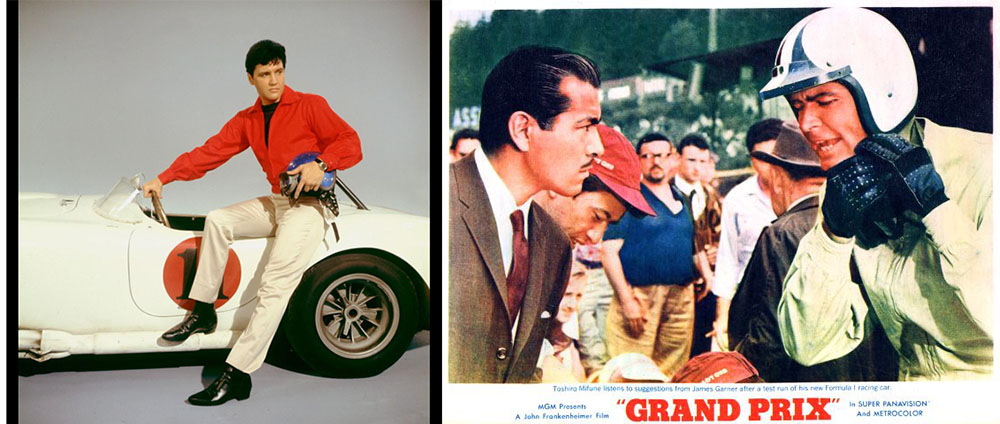
Elvis in Speed Racer cosplay, Toshiro Mifune as "Pops" Racer

In the mid 1960s Japan’s nascent anime industry was just shifting into color with Tezuka’s Jungle Emperor (Kimba The White Lion) and Japan Tele-Cartoons/Terebi Doga’s Kaitei Shonen Marine (Marine Boy) leading a pack of magical schoolgirls, rainbow android teams, golden skull-faced demons, Prince Planets, Asteroid Masks, and Pirate Princes through cartoon fantasies. At the same time Japan’s motorsports industry was becoming more and more popular. The postwar middle class, encouraged by Japan’s revitalized economy and the vast national infrastructure spending on roads and highways, had the income for cars and the need for speed. The first Japanese Grand Prix was held in 1963 and the Suzuka Circuit and the Mt. Fuji track (opened in 1966) were arenas where champions of Toyota, Honda, Hino Motors, Mazda, and Nissan battled each other to the finish line, cheered on by fans who enjoyed racing films starring Elvis, Frankie & Annette, and even hometown favorite Toshiro Mifune in Frankenheimer’s Grand Prix. The glamour, excitement, and international intrigue made auto racing the perfect hook for an animated television series.


Shonen Book's Speed Racer manga
Tatsuo Yoshida was a veteran manga artist whose work straddled the line between the cartoony Tezuka school and the grittier gekiga scene. His last great manga series, Mach Go Go Go, would appear in Shueisha’s Shonen Book from June ‘66 until May of 1968 and would break both speed records and the boundaries of televison cartoons. Assisted by his brothers Kenji Yoshida and Ippei Kuri, the Tatsunoko studio would create entire new worlds of well-designed adventure for TV anime. In Mach Go Go Go, Mechanical design was highlighted for the first time as beautifully illustrated machines took center stage, and the action revolved not around magic children, robots, or superhero space aliens, but about the mysterious world of grown-ups – families, jobs, cars, police, criminals, teams of motorcycle-riding Native American bandits, and monster cars controlled by computers competing in high stakes auto racing. Hey, it could happen.


The title of the series itself is a three-way pun: “go” can be a signifier indicating a vehicle (for instance, Captain Harlock’s spaceship referred to as “Arukaadia-go”), as well as Japanese for the number “five”, and the name of the main character, Go Mifune. You can also throw in the English definition for extra credit. So maybe it’s a four-way pun. Go figure.

Broadcasting trade publication ad for Speed Racer

Bringing the series to America was the task of Peter Fernandez and his crew of veteran voice talent; he’d just finished dubbing the seminal super-robot Gigantor (Tetsujin-28) for Trans-Lux and the Oxy-Gum-chewing Marine Boy for Seven Arts. With his background in radio drama he’d been working steadily to satisfy America’s drive-ins and UHF television stations with imported Italian space operas, Mexican monster epics, Westerns of mixed European heritage, and Japanese rubber-suit kaiju dramas. His rapid-fire line direction and the melodic tones of co-star Corinne “Trixie” Orr, along with Jack Grimes and Jack Curtis handling mysterious older brothers, helpful mechanics, and Inspector Detectors, helped fix Speed Racer firmly in our preadolescent subconscious.

two of the fine stations bringing you Speed Racer

As a syndicated television cartoon Speed Racer ran for years on Turner’s WTBS, which in the early days was known as WTCG while airing another Fernandez dub known as Ultraman. Occasionally the station would feature an on-camera Ted Turner earning his reputation as “Captain Outrageous.” Other stations like “Philly 57” (home of Star Blazers and Force Five) helped make Speed Racer a must-see for the afterschool set. As a non-network series Speed Racer was exempt from the standards and practices that kept guns, knives, conflict, and entertainment away from the Saturday morning cartoons of the Big Three networks. This incurred the condemnation of Action For Children’s Television, a consumer watchdog group who described Speed Racer as an “animated monstrosity” featuring the “ultimate in crime, evil characters, cruelty, and destruction” that nevertheless was being inflicted upon our nation’s children “five days per week in afternoon slots when children are the least supervised and the most available.” To which I say, right on.


There isn’t another show from that era – American OR Japanese – that inspires such fond memories and devotion. Love it or hate it, you can’t forget the rampage of the Car With A Brain, the cycle acrobatics of the Motorcycle Apaches, the cubist-masked terrorists hijacking airliners with boobytrapped headphones, or the top-hatted petulance of The Car Hater. The race against Laser Tanks, menacing gangs of lady assassins, stolen gem-bearing pineapples or the trials of the Supersonic Car were all branded in our memories with Mach 5 tire marks. We were touched by the melancholy tragedy of Rex Racer – separated from his family by pride and arrogance, yet never far from Speed’s side, always there to lend a hand. The Racer X plot point of a long lost family member who wears a mask and shows up to save the hero in the nick of time would return in the character of Red Impulse in Gatchaman. What kid – heck, what adult - didn’t want a car that could jump over obstacles, drive under water, cut down trees, and never needed a fill-up or an emissions test? No kid, that’s who.


Fifty-two episodes of Speed Racer were produced, many of them two-part stories, a rarity at the time for animated series. The international success of Mach Go Go Go would inspire Tatsunoko to market other works to a worldwide audience; Honeybee Hutch and The Brave Frog would be shown throughout the world and Gatchaman would become a hit in America under the title Battle Of The Planets, eventually receiving four separate English language adaptations. Tatsunoko’s 1982 super space romance MACROSS would be another international hit that inspired sequels and imitations alike.

Fine role models for the youth of the world

Other Japanese anime studios would try to capture the Mach Go Go Go magic with their own racing series – the cheesy 70s mechasploitation fantasy Gattiger The Combo-Car featured a transforming combination car versus the Demon Auto Company while Hawk Of The Grand Prix did a thematic 180 and strove for racing realism, though it did feature a mysterious masked racing mentor. Fly, Machine Hiriyu was a 1978 Toei/Tatsunoko coproduction that took a goofy Time Bokan tack. The 80s saw Yoroshiku Mechadock and F! highlight plucky young go-getters racing for the checkered flag, and the late 1990s brought anime in line with modern tricked out spoiler-equipped drift-style street-racing culture in the series Initial D.


American kids raised on daily doses of Speed Racer grew up and moved through life with the show as a cultural signifier; as Dark Horse Comics manga editor (and occasional Speed Racer cosplayer) Carl Horn says in the documentary Otaku Unite, “…any standup comedian in the country can do a joke about Speed Racer, and people are going to get it.” In the 1980s MTV worked Speed Racer into the late night camp-value timeslot, eager to entertain nostalgic Generation Xers (while at the same time avoiding the shame of actually, you know, showing music videos). The Austin folk foursome Two Nice Girls served up a acoustic version of the theme song with slightly changed lyrics, while soon-to-be legendary producer Steve Albini and his industro-punk outfit Big Black delivered a punch-press paean to Speed’s cooler brother on their“Racer X” EP.

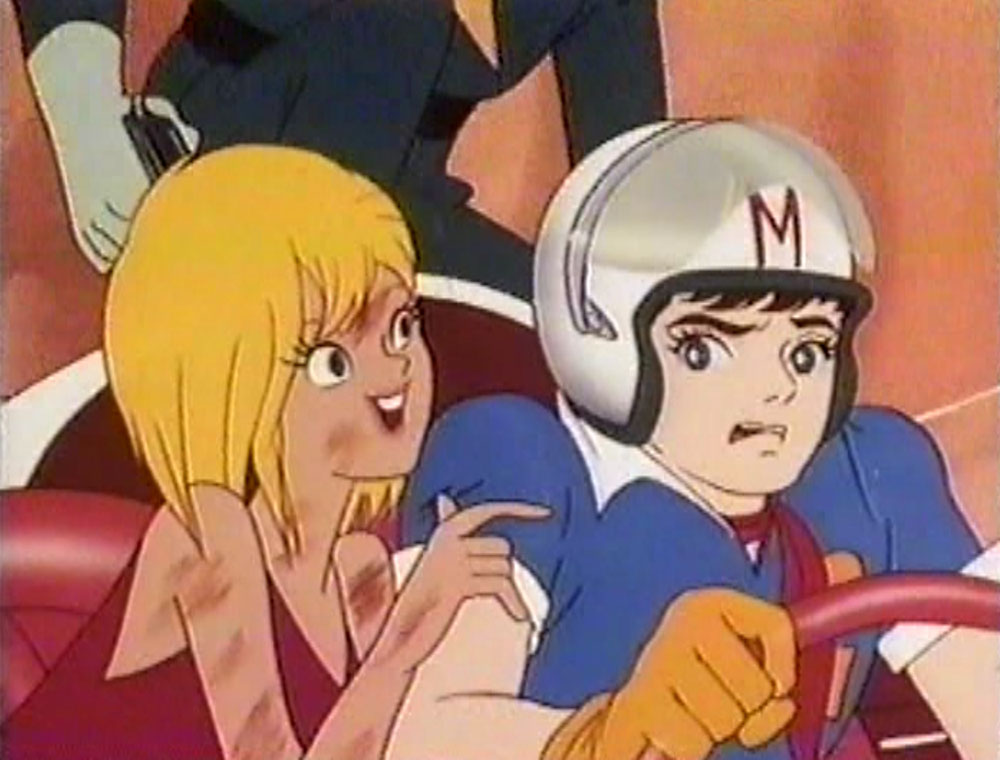
Sometimes Speed is a little unsure of the adventure waiting just ahead

Meanwhile, a steady stream of licensed material including buttons, posters, color comic books, T-shirts, and one of the earliest home video releases of an anime series (on double-bill VHS tapes shared with Trans-Lux’s Mighty Hercules) put Speed Racer on the shelves of kitsch boutiques and retro-themed college dorms across America alongside fellow deities Gumby and Felix the Cat.

Now Comics' licensed Speed Racer comics & merchandise delivery service

As the 1990s dawned Streamline Pictures packaged “The Car Hater” and “The Mammoth Car” on home video as “Speed Racer The Movie”, with a slight assist from Alpha Team’s techno club hit remix of the Speed Racer theme song. Yes, “Alpha Team”, named after the rival racing outfit seen in episodes 3 and 4, “Challenge Of The Masked Racer.”

Your Clinton-era lifestyle can be filled with Speed Racer; screen-printed club shirts, fake vintage tin signs, magnets, bumper stickers, belt buckles, bendy figures, a McFarlane Toys Mach 5 scaled to fit figures of Speed, Trixie, Spritle and Chim Chim, and slot car racers of the Mach 5 and Racer X’s Shooting Star can ensure no waking moment is untouched by Speed and Trixie. The five-volume DVD set from Lion’s Gate came packaged with steering wheels, diecast cars, and license plate holders, and those not content to merely watch could throw the Speed Racer Playstation game into their PSX and race against all comers.

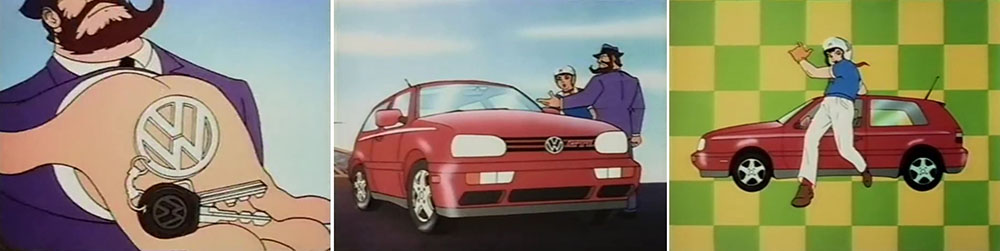
Speed Racer returned to the Turner media empire as their Cartoon Network programmed the show for five solid years, inaugurated by a marathon spiced with a Dexter’s Laboratory spoof. Speed, Trixie, and the Mach 5 appeared in ads for Volkswagen and Geico car insurance. You could pony up a few hundred grand and drive away in your own custom street-legal Mach 5, based around a Corvette chassis and complete with buzz-saw blades. On exactly which street are those legal? Saturday Night Live’s “TV Funhouse” combined Speed and celebrity culture in “Go George Clooney”. And two pop culture worlds collided as the Speed Channel, home of America’s prospering NASCAR culture, began programming Speed Racer in between Peter Fonda biker films and coverage of nitro-burning funny cars. As long as America continues her automotive love affair, Speed Racer will have a home on our televisions.

the mysterious "Racer D"

Outfits on both sides of the Pacific have attempted to revive the franchise as a new animated series. Murakami-Wolf’s 1990s production of The New Adventures Of Speed Racer, a lackluster sequel starring feeble adulterations of our heroes and their super-car, lasted only 13 episodes. Tatsunoko’s own 1997 re-imagining of the Mach GoGo Go concept had edgy 90s character designs and a time-travel storyline that went where no autosports enthusiast had gone before. Dubbed by DIC and shown on an abortive Nickelodeon action-cartoon timeslot as Speed Racer X, it didn’t make it through the first time trials.

Speed Racer VW GTI ad 

Remakes and reinvisionings came and went but it was 2008 before a Speed Racer remake firmly gripped the public imagination. Fresh from the Matrix trilogy and their anarcho-fantasy V For Vendetta, the Wachowski siblings threw their computer-generated weight behind a Warners/Village Roadshow feature adaptation of Speed Racer. The film starred Christina “Monster” Ricci as Trixie, Emile Hirsch as Speed, Matthew Fox from “Lost” as Racer X and Tinseltown veterans like Susan Sarandon, John Goodman, and Richard “SHAFT” Roundtree. A near-psychedelic hybrid between live-action overacting and wild CGI environments, Speed Racer was a film audiences weren’t really ready for.

Speed Racer screen-printed club shirt - racing helmet and/or fedora not included


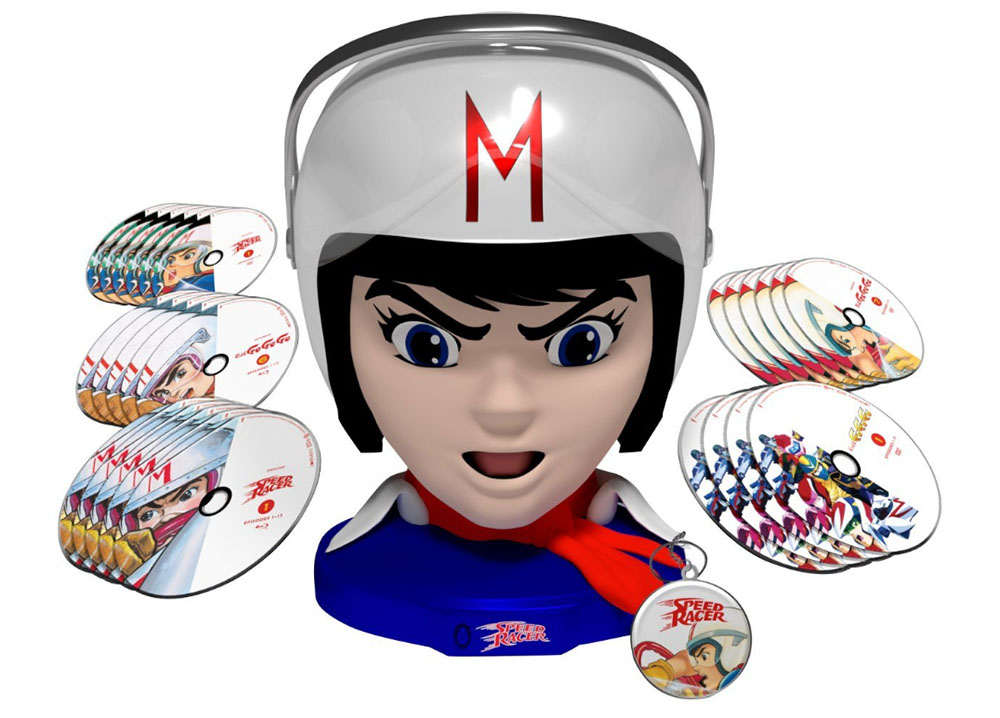
Though a critical favorite in some circles, the movie underperformed at the box office – but this didn’t stop Hollywood from continuing to produce money-losing anime adaptations like Astro Boy and Dragonball Evolution and the recent Ghost In The Shell. Hot on the heels of Speed Racer’s release was a new Nicktoons animated show and a tidal wave of Speed Racer merchandise that continues to this day. And soon, along with your toy Mach 5s, your t-shirts, and your DVD and Blu-Ray sets you’ll be able to purchase the entire series on Blu-Ray packaged inside Speed Racer’s head!

Bring Me The Head Of Speed Racer

That’s the world we live in, filled with Speed Racer merchandise enjoyed by two and three generations of Speed Racer fans, yet sadly lacking a real-life Race Around The World. Will Speed Racer find it difficult to thrill in a world of electric cars, boxy SUVs, and traffic calming zones? Or will the innate desire of every child to race towards adventures waiting just ahead keep Speed Racer in the winner's circle? And seriously, will Speed ever find out Racer X is his older brother? Because it's really obvious, Speed. 


-Dave Merrill

A version of this article previously appeared in Otaku USA magazine.


Thanks for reading Let's Anime! If you enjoyed it and want to show your appreciation for what we do here as part of the Mister Kitty Dot Net world, please consider joining our Patreon!

Monday, April 24, 2017

your bird ninja update


If you're like me, you grew up watching Battle of The Planets. Well, actually, I preferred Star Blazers. It took a while for me to really understand what was going on with those 5 bird ninjas and their struggle against Galactor. Actually, what it took was finally catching the original 1972 Tatsunoko Japanese version, the tremendously popular Science Ninja Team Gatchaman. Created by manga pioneer Tatsuo Yoshida, Gatchaman was a wild, colorful SF reimagining of his early 60s adventure series "Phantom Agents," remixed with space aliens, supercars, giant mechanical monsters, and all the bell bottom jeans the 1970s could provide. Gatchaman would return in the 1978 sequel Gatchaman II and its followup, 1979's Gatchaman Fighter


The success of Star Wars brought science fiction to the attention of every media executive in America, and Tatsunoko's earlier export Speed Racer had given the studio a beachhead in America. However, since the 1960s, new standards for children's television had prevailed in the US, so TV producer Sandy Frank's Gatchaman iteration Battle Of The Planets was chopped, channeled, rewritten, repainted, lowered, and had a new, vastly inferior transmission installed. And that's as far as I'm going with that car metaphor.

industry ad pitching BOTP to US TV markets

At any rate it's a terrific titan of 70s anime, featuring super monsters, colorful heroes, lots of kid-friendly action, anime melodrama, muscular, fairly realistic character designs, and a great Hoyt Curtin musical score. As dated and clumsy as the BOTP dub can be at times, the greatness of the original show still shines through. The series inspired a wide range of American merchandise, including model kits, lunchboxes, Gold Key comics that are not worth $20 each, sorry, and various magic slate and frame tray puzzle toys.  


Once 1978's Battle of The Planets had run its syndication course, the entire series was re-dubbed by Fred "Astro Boy" Ladd for Turner, under the new title G-Force. This new, uncut version of the series (1986) featured goofy character names ("Ace Goodheart") and new, synthesized, incessant, maddening background music. The series was shown a few times on the various channels of the Turner cable network before vanishing mysteriously.

In the 1990s Saban (you know, the Power Rangers people) took the second and third Gatchaman series (Gatchaman II and Gatchaman Fighter) and dubbed them under the title "Eagle Riders". This fairly nonsensical dub worked its way into syndication and vanished opposite a late-decade wave of newer, more popular anime imports like Sailor Moon.

Once DVDs made their appearance, Rhino Video produced six volumes of Battle Of The Planets - each release featuring two BOTP episodes, two subtitled Gatchaman episodes, and one G-Force episode.


Four years later,  anime localizer A.D.Vision released the entire 105-episode Gatchaman series, with new, accurate dubs AND subtitles, in DVD box sets with extras. Suddenly anime fans could not only enjoy the entire Gatchaman series as it was intended to be seen, but anime con panelists could spend an hour discussing the show, and then go to the dealers room and purchase an officially licensed, uncut, super-high-quality edition of the actual show under discussion, in order to demonstrate that the original series, while more violent than typical American cartoons of the period, was not the blood-drenched gore-fest popular imaginations would have you believe. The series continues to live on in the American video market: ADV's successor Sentai Filmworks has released the TV series and its compilation film on Blu-Ray and DVD. The 1990s OVA remake, the abortive CG film, the live-action film, the Zip! "Good Morning Gatchaman" shorts,  and kinda-sorta-sequels like Gatchaman Crowds remind us all that the bird ninjas continue to thrive in the Japanese cultural landscape. 

Chinese-language Gatchaman II book

Gatchaman was one of the first American anime releases to have a substantial fandom built around it; when I got into anime fandom in the 1980s, Gatchaman fans were there already, publishing APAs and writing fan fiction, cosplaying and drawing fan artwork and swapping 13th generation copies of the last 5 episodes of Gatchaman F. It's an enthusiasm that's mirrored in the culture at large; Battle of The Planets inspired two completely separate American comic book releases and continues to be a minor cultural touchstone among former 70s cartoon kids, wide-eyed with wonder at a future that gives us both Battle Of The Planets and Gatchaman and Gatchaman II and soon, Gatchaman F

-Dave Merrill

(this post has been modified from its original 2007 form to fix links and include updates circa 2017)