It was the 1980s. There was no way this movie wasn't going to be treated like exploitation trash, have half an hour hacked out of it and wind up in video stores with a dopey new title. This is how the world worked back then, Asia was a sweatshop cranking out cheap movies, cheap cars, cheap electronics, cheap cartoons, it was all fodder for the K-Marts, the Zayres, the Richways. They all needed discount junk for the ninja-obsessed kids and the developmentally-disabled adults who'd traded the sticky seats of the downtown grindhouse theater for the sticky buttons of their VCRs. After all, there were shipping deadlines to make and shelves to fill, everything was raw material for this machine, even big-budgeted Madhouse-animated Japanese films directed by Rintaro, which is what we're talking about today, the movie about the orphan with nothing but a sword and a secret and a destiny that would shake nations, we're talking about Dagger Of Kamui, a film that came and went and whose Blu-Ray revival is about to once again reveal its hidden treasures to a North America that might pay attention this time.

I've mentioned already how teenage me first saw this film, as a copy of a copy of a copy on a hotel TV during an Atlanta Fantasy Fair, sitting on the hard floor, ignoring the heat and whatever else I was missing at the convention, mesmerized in spite of the film’s punishing length and lack of English subtitles or dialogue. For those 132 minutes Dagger Of Kamui became our entire universe, our perception focused on the sweeping vistas of Bering Sea ice, mystical Hokkaido mountains, the American West, the neon slashes of ninja blades shattering the night with glowing crimson, and the surprising introduction of what we’d soon call Ninja Dog, all set to a pulsating rock soundtrack. When the film was over, returning to the beige suburban reality of the mid 1980s was hard.

Anime fandom wrote this film off in the 90s. Lumped in with other mid-list Just For Kids releases like Technopolice 21C and Dallos, Kamui wasn't lurid or extreme enough for the Ninja Scroll crowd, didn’t star outer space bikini teens or combination robots, was too long to fit on the tape-traders’ standard T-120, and even when AnimEigo released it on VHS (1993) and DVD (2003) the only reaction was to give Rintaro doubters something besides Harmagedon to poke unwarranted fun at.
 |
| Tetsu Yano's Kamui novels |
How did Japan react to this boom-era epic from Haruki Kadokawa’s media-mix hit factory? Middling box office and a PC-88 game, that’s how. Kadokawa's third animated film after the groundbreaking Harmagedon and the mystifying atavism of Shonen Kenya, Dagger Of Kamui would come from author Tetsu Yano, whose path to fiction began by collecting garbage on US military bases. Intrigued by the lurid covers of discarded American SF pulps, Yano would go on to translate writers like Heinlein, Herbert, and Pohl into Japanese, as well as write SF himself, becoming the first Japanese SF author to visit the US. First novelized in 1970, Yano would continue Dagger of Kamui for Kadokawa Shoten in 1984 and 1985. The 80s editions of Yano's Kamui novels were illustrated by Moribi Murano, who would design characters for this Kamui film, and who also did character designs and manga for Toho's 1984 feature Lensman, bringing us full circle to the pulps.

Pulp is indeed what we're talking about here, mass-market historical pulp fiction. If Dagger Of Kamui was an American novel, it'd be 500 pages wedged into a drugstore rack, a bare-chested pioneer on the cover struggling for survival and glory while manhandling a busty wench against the backdrop of a savage frontier, a promise of sweeping melodrama built partly out of history and partly on the need to have something exciting happen every fifteen pages.

Of course, to fully enjoy historical fiction it helps to know the history, but where this film is concerned, well, they aren’t teaching the Meiji Restoration in American high schools, so pay attention. In the tail end of the Edo period, the Tokugawa Shogunate was losing its grasp on power. Desperation leads to extreme measures, which is why one day in the northwest Shimokita peninsula, way up there near Hokkaido, our hero Jiro returns home and finds his adoptive mother and sister dead in the darkness, mother fallen over a short sword wrapped in Ainu cloth, the same short sword and cloth that were found with infant Jiro 14 years before. Jiro unsheathes the flashing blade, the soundtrack kicks in with hypnotic drums, jangling guitar, and unearthly chants, and ladies and gentlemen, we have Dagger Of Kamui. Chased out of town during the opening credits, Jiro runs straight into the care of Tenkai, head monk of Tengen temple, and incidentally also the leader of the Shogun's secret shinobi squad, who takes Jiro and trains him in the ways of the shadow warriors, which this film is careful to never call “ninja.”

A hidden treasure, a secret warrior caste, an orphan destined for glory raised as a warrior, Japan itself at stake in a struggle that spans the Pacific, it doesn’t get pulpier than this. The story moves across what was then called Ezo and is now Hokkaido, as Jiro rescues an Ainu kid, reunites with his own Ainu mother, finds a treasure code in his father’s empty grave, realizes he’s a pawn in Tenkai’s game, and learns his own short sword is the titular Dagger, the Of Kamui one. Kamui in this case doesn’t mean the Sanpei Shirato manga, but the divine spirits of the Ainu, embodied in Hokkaido’s holy mountain Kamuinupuri, which we’ll see a few times in this film. The idea of a vast treasure connected with the Ainu should come as no surprise to viewers of what might be the Hokkaido indigenous people’s most comprehensive representation in anime, 2018’s Golden Kamuy, but in 1985 Dagger Of Kamui might have been one of the earliest, most realized representations of Ainu culture we’d see in the anime and manga field, apart from the Tetsuya Chiba manga (and Hayao Miyazaki TMS pilot) Yuki’s Sun and the Osamu Tezuka manga Brave Dan. Of course, later series like Samurai Champloo and Shaman King would feature characters of Ainu ancestry.

For Dagger’s Jiro, defying Tenkai means battling every one of Tenkai’s henchmen and henchwomen, from Shingo’s mind bending paralysis poison to the beautiful Oyuki and her duplication jutsu, their fight turning the Ezo hot springs landscape blood red in a flashing, possibly seizure-triggering hurricane of colors while cranking the soundtrack electric guitar up to eleven.

Samurai dropout Ando Shouzan shows Jiro a globe of the world and Japan's small place in it, and together they find the Dagger’s secret pointing to America and Santa Catalina Island, later famous as the shooting location for a bad Tommy Kirk beach movie. But before Jiro can embark on his own Catalina Caper, he must battle Tenkai's next killers, the Matsumae Trio, aptly named after a northern Japanese clan who ruled the northernmost approaches to Hokkaido and the Ainu. This trio of Toad Guy, Blowgun Hippy and Boomerang Samurai battle Jiro in a psychedelic nightmare showdown of eerie pastel fire accompanied by a soundtrack of ominous groaning and ethereal bells.

At a Kunashir Island port, Jiro saves the black American sailor Sam and defeats Oyuki in a struggle onboard Sam’s whaling ship and we’re halfway through the film. Jiro and Oyuki are on their way to America, until suddenly they’re ditched in Kamkatcha, to share backstories of being raised as assassins by Tenkai. In the snow they find both a puppy and maybe puppy love, but whoops, there's Tenkai who gives Oyuki a six-gun and tells her to get the job done. What Tenkai fails to realize is "the job" means "causing an avalanche that allows everyone to escape."

Smash cut to Nevada – yes, this is a film that handwaves 3500 miles of ocean - where a raggedy Jiro once again arrives to rescue a total stranger, saving the blue-eyed Indian maiden Chico from being assaulted by two outlaws. Reminiscent of Natalie Wood in The Searchers, Chico turns out to be not Navajo but actually French, orphaned and raised by the tribe, whose chief is, of course, Geronimo. In Carson City, Jiro inquires after Santa Catalina Island, has a Wild West high-noon shootout with the two outlaws, and gets directions from celebrated author Mark Twain, who tells him of the legend of Captain Kidd's gold.

Fun fact, the real Captain Kidd actually did leave a prize ship at a Santa Catalina Island in 1699, while he travelled to New York City and later London to defend himself unsuccessfully against charges of piracy. However, that ship didn't have any treasure on it, and Kidd's Santa Catalina was/is a completely different Santa Catalina Island, offshore from the Dominican Republic instead of Los Angeles.

If you want to put a message in your movie, maybe the best way to get it across is to have a world famous author deliver it. That’s what happens here when Mark Twain looks right at the camera and tells us all how he saw something wild and vital in Jiro, something that humanity might be in danger of losing in our fast-paced modern world of telegraphs, steam locomotives and ninja movies.

On California's Santa Catalina, Rintaro's cinematic skill reveals the treasure’s secret in a signature spectacle of light bursting out of darkness, a shining cross marking the crumbling cave in which there is only a throne and one solitary chest of coins - and Tenkai, sending Oyuki against Jiro in a final showdown interrupted by sudden betrayal and faithful Ninja Dog attack. Hidden behind a secret wall, the full treasure hoard is inadvertently revealed by Tenkai’s corpse – if it IS Tenkai’s corpse, because in true pulp fiction fashion it turns out secret shinobi bosses always have two or three body doubles, just in case.
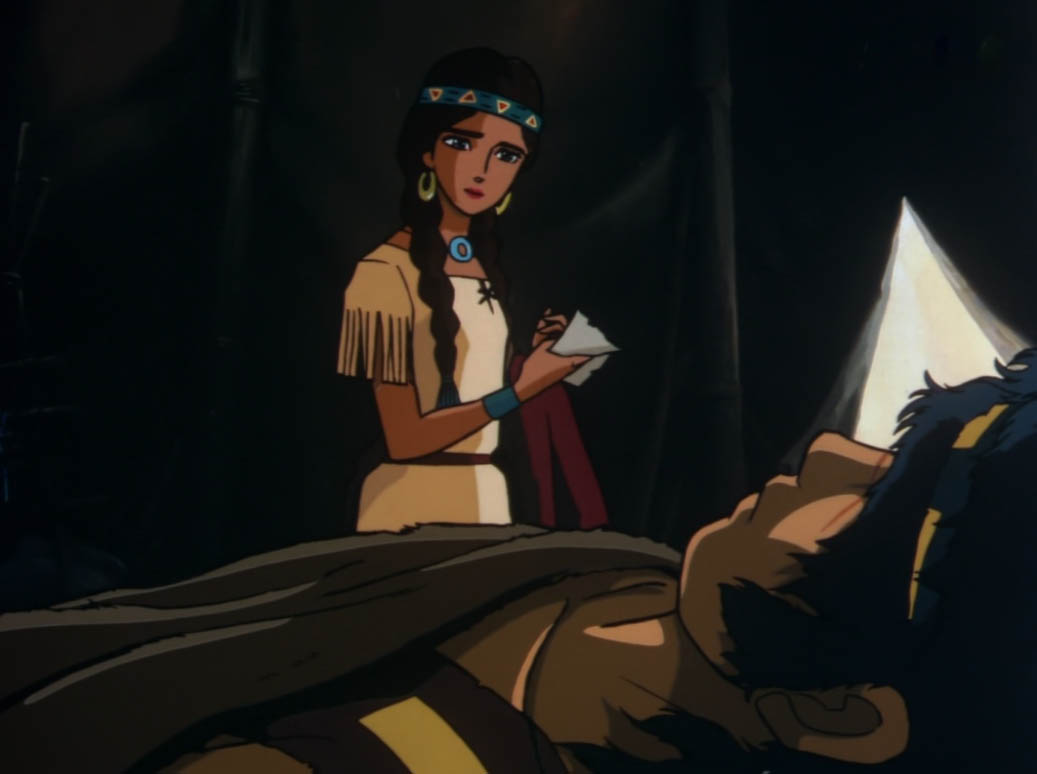 |
| Chico And The Man |
Meanwhile in Japan, the real Tenkai's master the Tokugawa Shogunate is challenged by the Satsuma-Chōshū army, in what will be known later as the Boshin War. As the film says, "the 300 year reign of the Tokugawa Shogunate is crashing down!" But Tenkai meets with Lord Sadonokami (a real person) and Lord Kozukenosuke (another real person) and in spite of the Kidd treasure not working out for them, another plan is proposed, to mortgage Hokkaido to foreign powers in exchange for money to continue the war. Is their no end to their perfidy?

But Jiro, enriched by the treasure, hires his own band of Iga shinobi to carry on his own personal war with Tenkai. We see the down payment travel from woodblock-print Osaka to Nara, back to Iga, and into a ninja double cross that turns into a ninja triple cross! Soon Tenkai’s temple is in flames and he’s left to linger in defeat, just as in real life the Tokugawa government retreated to Hokkaido to set up the Republic Of Ezo with the military help of defecting French advisors. This was the first democratic government in Asia (well, okay, only samurai could vote) and it lasted almost a year before it fell in the Battle of Hakodate, the setting for Jiro’s final battle with Tenkai, set among artillery duels between the Imperial Navy and the star fortress of Goryōkaku.

Shellfire and explosions punctuate the percussive soundtrack as Tenkai, throughout the film thwarted by the infants he himself trained, defeated by his own intricate plans, halted even by the sacrifice of children and the elderly, is finally defeated both by Jiro and by historical forces no amount of ninjutsu can conquer. In the aftermath of the battle Jiro sees Tenkai for what he was, one more power-hungry monster in the service of any number of governments far removed from the people they supposedly govern.

And that’s Dagger Of Kamui, a movie where Jiro either saves or fights pretty much everyone he meets, sometimes both at the same time, in which randomly appearing characters turn out to be vital narrative anchors, a film that inserts real life famous personalities into the narrative to tell us how amazing the hero is, where we’re given not one but two body-double fakeouts and two - wait, three completely different sets of murdered relatives, and an intricate scheme that involves raising a ninja from birth and turning him loose to...let’s see, he’ll kill all your other ninja, how did that work out for you, Tenkai? In lesser hands, the bare-faced ridiculousness of Dagger’s melodrama would devolve into campy parody or get bogged down, like this review, in historical details.

But this is Rintaro we’re talking about here. He puts Madhouse and Project Team Argos to work delivering the shining sparks and neon traces of shuriken and kunai zipping through the darkness, animating bakufu armies and Old West steam locomotives and shifting Kuril ice floes, depicting shinobi bouncing across the landscape like Adieu 999 Mechanized Empire stormtroopers, artillery barrages and Ainu villages alike with consummate skill, all set against the beautiful landscapes of art director Mukuo Takamura, fresh from his location scouting trip to Hokkaido. Dagger screenwriter Masaki Mori and character designer Murano Moribi worked on the Madhouse adaptation of the similarly set late-Edo period Haguregumo together, and Murano also contributed to Madhouse's mid-80s animation domination with his work on child-frightener Unico In The Island Of Magic. Dagger Of Kamui’s visuals are by a top-tier list of talent, every minute driven forward by the amazing soundtrack largely the work of Ryudo Uzaki and his Ryudo Group, a whirling mix of traditional and modern, intense and propulsive, the perfect companion to the mind-bendingly hallucinatory visuals of shinobi vs shinobi combat that are the film’s highlights.

These animated psychedelic showdowns would have been lost had Kadokawa gone with their first choice and shot Dagger Of Kamui as a live-action film. Thankfully for anime fans, budget challenges dictated a move to animation. Sonny Chiba protege Hiroyuki “Burning Fire” Sanada, featured in Kadokawa's GI Samurai, Ninja Wars, and Legend Of The Eight Samurai, would voice the role of Jiro. Seen recently in the FX on Hulu remake of the historical miniseries Shogun, Sanada was no stranger to ninja danger, having done voice work in the anime series Igano Kabamaru, as well as starring in its live-action adaptation. You might recognize Tenkai’s voice actor Tarō Ishida as the voice of Count Cagliostro in Lupin III Castle Of Cagliostro – or he might have been your local Kyoto Buddhist priest, because he was one! Oyuki was voiced by Mami Oyama, whose career runs the gamut from Candy Candy’s Annie Brighton to X-Bomber’s Lamia to Arale in Dr. Slump. Mark Twain’s voice actor, Iemasa Kayumi, was the go-to actor for Frank Sinatra and Donald Sutherland’s Japanese voices, as well as the evil Lepka in Future Boy Conan.

Distributed by Toei and released in March of 1985 on a double bill with the modern-day surfer romance Bobby’s In Deep, Dagger would make 210 million yen at the Japanese box office, a mediocre showing in a year when both The Burmese Harp and Be-Bop High School would break the one billion yen mark. Dagger Of Kamui merch would include a four volume film comic by Fujimi Shobo, a FM-7 cassette tape-loading PC-88 computer adventure game that required several minutes of load time with every move, and of course the motion picture soundtrack by Ryudo Uzaki and the Ryudo Group, featuring Noriko Watanabe singing the insert song "Kamui's Lullaby.”

Only a few years later the movie would find itself on VHS in North America, retitled “Revenge Of The Ninja Warrior,” cut to 96 minutes and released along with other anime titles in Celebrity Home Video’s “Just For Kids” package. Pioneering anime localizer AnimEigo would release an uncut, subtitled Dagger Of Kamui on VHS and Laserdisc in the 90s and later on DVD, the sleeve of which even highlights Rintaro's direction and namechecks his "Space Galaxy 999," whatever that is. North American anime fandom of the 90s and beyond sometimes dismissed Dagger as overlong, nonsensical, pompous and boring – and hey, I’ll give you those first three. For non-Japanese audiences the film definitely needs subtitles, and most of us wouldn’t be seeing it with English subs until that AnimEigo release, which failed to change the fortunes of a film that never really found an audience on either side of the Pacific. Who knows, perhaps the film was too historical for the ninja movie crowd and too weird for the historical fiction fans. Maybe the thing was twenty or twenty five minutes too long for moviegoers who had spent the past five years grinding through Be Forevers and Super Galaxys, Cosmozones Of Love and other animated endurance contests.

However, don’t bury this treasure yet. In August of 2024 AnimEigo founder Robert Woodhead announced the Kickstarter for The Dagger of Kamui Treasure Trove Edition, a deluxe limited edition Blu-Ray featuring an HD transfer of the original film with English subtitles, art galleries, a digital archive of production materials from Kadokawa, and a new commentary track featuring Rintaro. The successful funding campaign is over, and discs should ship sometime around June 2025, but don't worry, you can still get one of these limited edition Blu-Rays for yourself.

It’s been a forty year journey of 7000 miles from Hokkaido to California and back, but if the gods of Kamuinupuri are with us and the Kamui wind is at our backs, maybe this time Dagger Of Kamui can finally find the audience it deserves, an audience of viewers able to enjoy both preposterous historical yarns and high-definition hallucinogenic hypno-shinobi, all in the same movie. I can’t be the only one!
-Dave Merrill

Thanks for reading Let's Anime! If you enjoyed it and want to show your appreciation for what we do here as part of the Mister Kitty Dot Net world, please consider joining our Patreon!