Showing posts with label yas. Show all posts

Friday, March 31, 2023

A Time Slip Of Forty Years: 1983 In Anime Film


Let's look at the numbers. In 1982 there were 21 animated movies released in Japanese cinemas with a total running time of 1881 minutes. The next year saw slightly fewer films-  only 19 - and a concomitant shrinkage of total length down to a mere sixteen hundred sixty-five minutes. You could marathon that in less than a day! But when you look at the actual films themselves forty years ago, a different story emerges, a story of Crushers, Fantastic Trips, long-distance murder professionals, magic islands, time slips, Final Yamatos, and horrific disasters both real and imaginary. 1983 was a year of Japanese animation pulling away from its terebi manga roots and finally becoming real, slightly overstuffed roadshow capital-c Cinema in brand new ways. Let's take a look at the anime films in the order in which they were released forty years back!


Urusei Yatsura: Only You planted its tiger-striped-booted feet firmly into February 1983 and said, this is what it's gonna look like for the next few years, anime is going to be an outer space carnival of pop music, cute girls, interstellar hijinks, and frustrated romance. Based on the popular Shonen Sunday manga by Rumiko Takahashi, Urusei Yatsura, or "Those Obnoxious Aliens" as we used to call it, ostensibly is the story of Lum the invader gal and her hapless boyfriend, the dopey, skirt-chasing Ataru. Quickly overwhelmed by its equally obnoxious cast and a creative team that included Mamoru Oshii and Akemi Takada, the series became an ensemble comedy that bent the laws of time, space, propriety and gender. Only You is the first of six feature films that together with with 194 episodes of the Urusei Yatsura TV series would go a long way towards defining the 80s anime style.


One month later would be the premiere of Crusher Joe, a film directed by Yoshikazu "Yas" Yasuhiko, produced by Studio Nue and Nippon Sunrise, their first non-TV compilation film. Crusher Joe is based on the SF novels by Haruka Takachiho, who would go on to create the similarly-motifed and possibly canonically connected Dirty Pair. The far-future galactic troubleshooters known as Crushers operate throughout the galaxy, and the number one team is known as Crusher Joe after its leader Joe. His teammates the pretty princess Alfin, the cyborg Talos, engineering genius Ricky, and the 'droid Drongo uncover a conspiracy that threatens the galaxy while dodging both the murder plots of the space-pirate guild and the red tape of the United Planets. Pulpy science-fiction adventure in the classic style, Crusher Joe would get two more OVA sequels and this film would be gifted a terrible English dub that features new songs from "Bullets." Fret not, the Blu-Ray is subtitled.


The short feature Dr Slump HoYoyo! The Race Around The World premiered March 13, 1983 and the movie is just what it says on the tin. Indeed, this film is a wacky race as Akira Toriyama's zany Arale and the rest of the goofy Penguin Village gang pop the clutch and tell the world to eat their respective dusts. It's part of Dr. Slump's only American video release!
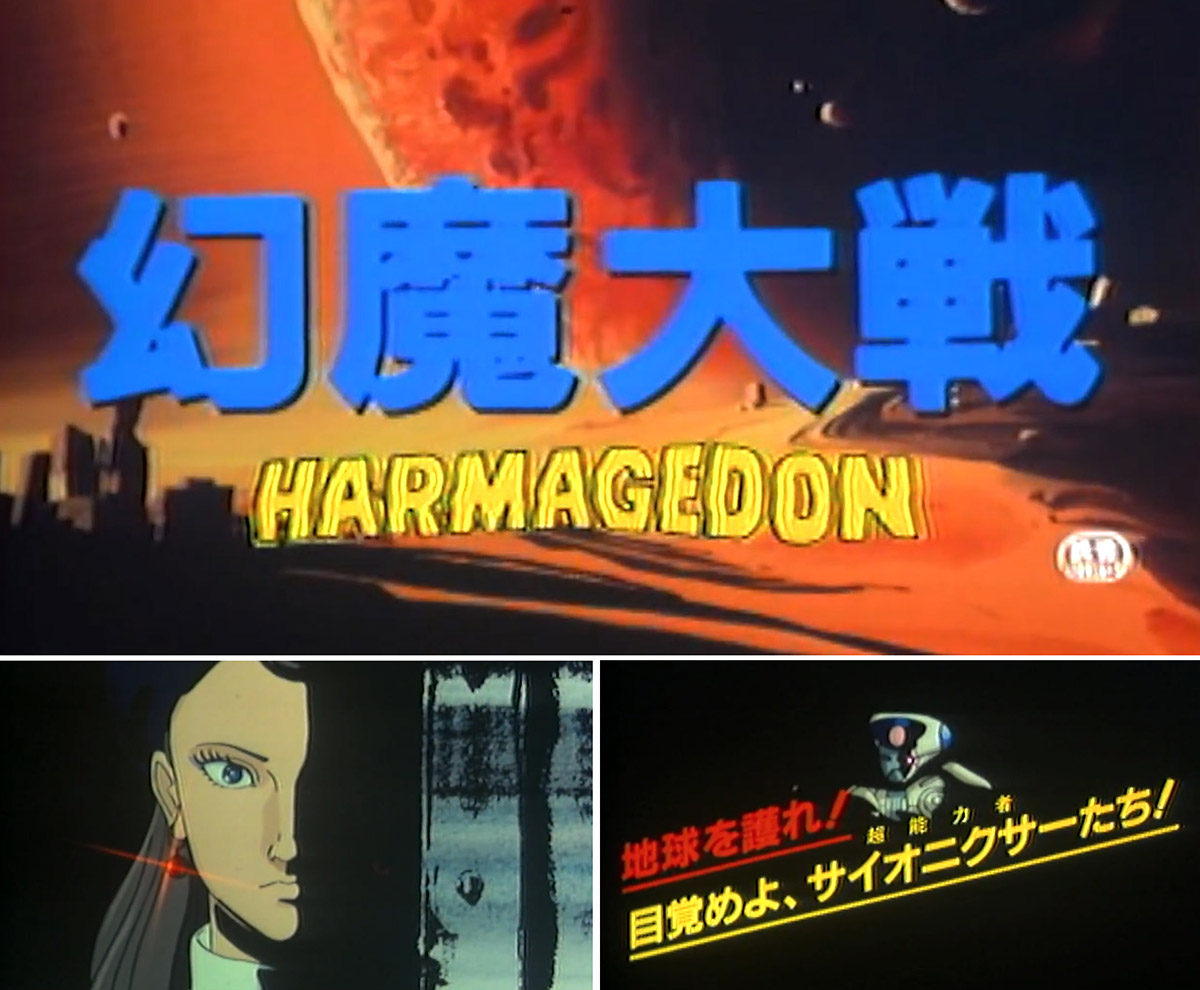

 
March 12 saw the release of Harmagedon, the first anime feature by publisher-turned-film-producer Haruki Kadokawa. This expensive, overstuffed epic features music from prog rock legend Keith Emerson and character designs by future prog manga legend Katsuhiro Otomo. Harmagedon, or Genma Taisen if we're going by the kanji, is based on the 1960s manga drawn by Shotaro Ishinomori and written by Kasumasu Hirai, who wrote manga classic 8-Man, pulp novel/Sonny Chiba vehicle Wolf Guy and a lengthy series of Harmagedon sequel novels. Hirai's interest in syncretic New Age religions is no surprise considering Harmagedon's script, filled with the vast darkness of Entropy fought across time and space by psychic warriors empowered by universal love consciousnesses. Harmagedon was released on VHS in the US in the 1990s, but earlier in the 80s you may have seen the laserdisk videogame it inspired, Bega's Battle.


The Space Battleship Yamato faces its ultimate challenge in Uchuu Senkan Yamato Kanketsu-hen, Space Battleship Yamato the Final Chapter (or as the English language text in the promotional material likes to call it, simply Final Yamato) as the evil Denguils, outer space legions descended from Mesopotamians rescued from the Biblical flood of Noah by the actual Satan, send the water planet Aquarius to literally drown the planet Earth again. Only the Yamato - captained by a surprisingly alive Captain Okita - can save us all. This epic spectacle's extended version clocks in at 163 minutes, which includes scenes producer Yoshinobu Nishizaki added into a 70mm re-release nine months after its initial March 19 premiere. Perhaps this film's butt-demolishing length helped Yamato fans weather the full decade before they'd see another Yamato project (the ill-fated Yamato 2520).


Noel embarked on her Fantastic Trip on April 29 1983. This movie feels like a vanity project for producer and Noel's voice actor Iruka, a Japanese folk singer who since 1970 has released 26 LPs, three books, four childrens' books, 8 radio shows, and acted in a medical TV drama. Iruka is really Toshie Hosaka, and she got the Iruka nickname in high school when she saw a crowd of music students carrying their guitar cases and said "it looks like a school of dolphins (iruka in Japanese)." So this particular Fantastic Trip of Noel's is a loosely plotted string of vignettes that allow the film to express simple concepts about pollution or friendship while delivering various Iruka songs. Noel lives on an island in space with her friend Pup and a bunch of animal friends. One day after singing a song about wanting to be a country girl, she decides the sun's too hot and would like some ice cream. So Noel and Pup take off in her airplane to give the Sun some ice cream. They stop at Planet Gaudy where she convinces everyone to become nudists. 

Meet The Beatles (And Noel)

After giving the Sun ice cream, they sing a few songs with the Yellow Submarine-era Beatles on the bottom of the ocean. Then smog attacks, but they are rescued by the super whale Super Zoomer. The source of the smog is an urbanized industrial planet, and the immediate threat is stopped by Super Zoomer and then there's an extended sequence involving babies on tricycles and a song about pollution controls. The end. Noel is voiced by Iruka in the original and by Corinne Orr in the American version, which aired on cable TV and was released on home video to a confused and bewildered nation.


First he was portrayed by Ken Takakura. Then Sonny Chiba took on the role. But the definitive Golgo 13 may be the 1983 anime film directed by certified genius Osamu Dezaki. The first animation production starring Takao Saito's legendary assassin Golgo 13 was this eponymous TMS film, released May 28. Known in the West as "The Professional," Golgo 13 is jam packed with slow-motion murder, mayhem, early computer animation, and the "postcard memories" Dezaki became famous for, as Duke Togo weathers a series of increasingly bizarre attempts on his life, which, let's be honest, is itself a series of increasingly bizarre attempts to take the lives of others.


Jiron Amos saddles up his Walker Machine and rides out on the vengance trail in the July 9 release Xabungle Graffiti, a theatrical compilation of the Xabungle TV series from Nippon Sunrise that was released in a double bill with Sunrise's Dougram film. Will Jiron and the crew of the gigantic transforming land-battleship mecha Irongear defy both the traditions of their violent land and its mysterious ruling class? You'll say "yes" by the time the new MIO song starts. Available as part of Sentai's Xabungle Blu-Ray set, this Tomino series lacks the seriousness and the death toll of his other works.


On July 9, the compilation film of the Nippon Sunrise Fang Of The Sun Dougram TV series was distributed by Shochiku with the title "Document Dougram". Created by Votoms helmer Ryousuke Takahashi, the film is a condensed retelling of the struggle of guerrilla fighters battling to free the planet Deloyer from the oppressive Earth occupation forces, and is one of the few series we're discussing today that has yet to get any sort of English language release. Come on fellas, let's get it together here. Document Dougram was released along with the super deformed comedy short "Choro Q Dougram," a combination of Dougram sponsor Takara's popular deformed minature spring-powered car toy Choro Q with characters from Dougram.


Another not-available-in-America title, Maya Mineo's serio-comic gagfest manga Patalliro first appeared in Hana to Yume in 1978, switched to Bessatsu Hana to Yume in 1991 and is still going strong. Bratty boy-genius Patalliro is both king of Malynera and heir to a diamond fortune and lives to confuse and irritate everyone around him, including his dreamy bodyguard Bancoran, who attracts a variety of beautiful boy admirers. The Patalliro Toei anime series ran for 49 episodes while this film, Stardust Keikaku (Keikaku means "plan") was released on July 10 and clocks in a mere 48 minutes.


Unico In the Island Of Magic was a July 16 release. Osamu Tezuka's Unico was created for the Sanrio magazine Lyrica, a lost little unicorn propelled through worlds of magic and legend on the whims of the Wind Goddess. Here in Unico's second movie he finds himself on the Island of Magic as a succession of increasingly disturbing Madhouse-animated creations threaten him and his friends, and the enigmatic wizard Torby must decide whether to defy his master, or turn us all into lifeless dolls. Both Unico films received English dubs and home video releases, frightening entire generations of 80s kids on both sides of the Pacific.


Based on the semiautobiographical manga by Hiroshima survivor Keiji Nakazawa, Barefoot Gen / Hadashi no Gen, a July release, was directed by Mori Masaki and produced by animation powerhouse Madhouse. This film, the first of two Barefoot Gen movies, details the life of an ordinary Japanese family struggling to survive in a militarized total-war Japan and the aftermath of that war's cataclysmic conclusion. Barefoot Gen's manga was one of the first Japanese comics to be translated and published in America (by Leonard Rifas' Educomics) and the film received a 1992 American release with a subsequent dub and release by Streamline Pictures in 1995.


Prime Rose: A Time Slip Of 10000 Years was broadcast August 21 as part of Nippon TV's 24 hour "Love Saves The Earth" telethon. The demon Bazusu sends both Kujukuri City in Chiba and Dallas in Texas ten thousand years in the future and makes them battle for his amusement. Tanbara Gai of the Time Patrol fights to stop this fighting along with the barely-dressed Emiya Tachi/Prime Rose in this Tezuka Pro/Magic Bus production.


Wrapping up the year, September and December would see two Nine movies from Gisaburo Sugii and Group TAC, based on Mitsuru Adachi's popular baseball manga about Aohide High School's center fielder Katsuya and the team manager, the mysterious beauty Yuri Nakao.  Adachi would keep working that baseball angle in his next 80s series Touch, perhaps his biggest manga hit in a career that is woefully underrepresented in the West.


And that's what 1983 looked like if you spent your year in Japanese theaters watching cartoons. If you ask me to pick a favorite, well, that's a tough question. Urusei Yatsura Only You might not be as critically acclaimed as the next UY film Beautiful Dreamer, but I think Only You is a rock-solid 90 minutes that takes the Urusei Yatsura cast out of Tomobiki and into the kind of big-screen science-fiction nonsense that movies were made for.


I'm always going to have a soft spot for Harmagedon, as maligned as the film may sometimes be. It's a movie made up of some terrific, fantastically realized pieces of animated cinema, separated by long stretches of not much at all. Not to generalize, but Japanese film is, well, we might say sometimes it's deliberately paced. Discursive. Meandering. Tends to wander. That's Harmagedon in a nutshell, it's all over the map.
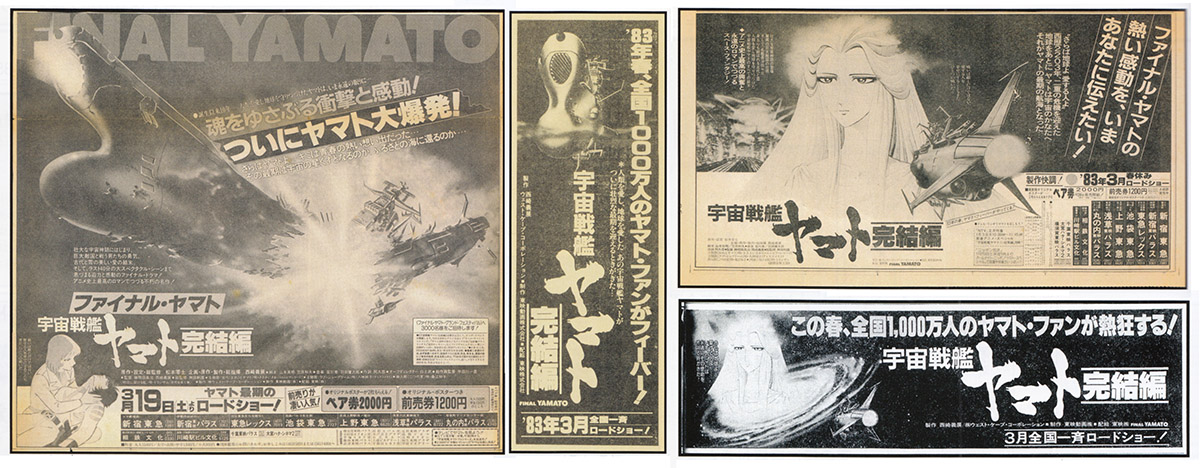
 

And as meandering as Harmagedon might be, at least it's forty minutes shorter than the long version of Final Yamato, a film that hopes you're as excited as Nishizaki is about This Being The Last Yamato Film Ever Swear To God. If you're on board with this, fine, and if you aren't, if everything isn't as epic and as majestic and as awe-inspiring as it possibly can be, well then you might think this movie's too long. And it probably is. But as the Japanese iteration of those bloated Cinemascope studio-destroying historical epics midcentury Hollywood was throwing its cash at - your Liz Taylor Cleopatras, your How The West Was Wons, your Fall Of The Roman Empires, your Lawrence Of Arabias, your Spartacuses - as one of those overbudgeted overture-preceded pray-for-intermission endurance contests, Final Yamato fits right in.


As a big fan of Saito's Golgo 13 manga it's interesting to see various G13 stories turn up in the script of the TMS Golgo 13 film, but at times the connecting threads of plot stitching them all together are overwhelmed by the sheer hallucinogenic power of Dezaki's visuals. Not that this is a bad thing, you understand. Similarly, Crusher Joe from Yas and Sunrise looks great and is filled with terrific science fiction action sequences, and those sequences pile on top of each other until the film's had what feels like one or two climaxes too many.


Pound for pound, frame for frame, perhaps 1983's most enduring animated film is Madhouse's Unico In The Island Of Magic, a movie that throws goggle-eyed witches in our faces, fills the screen with nothing but the blue of Torby's cloak, and forces Unico to flee, scared to death through an island made entirely of the petrified remains of Torby's victims. A film that feels as fresh today as it did on that hand-me-down in the kids' mid-1980s playroom, Island Of Magic holds up today against everything forty years has thrown at it, and that's not something a lot of movies - let alone people, even - can say.

-Dave Merrill


March 1983 issue of OUT

Thanks for reading Let's Anime! If you enjoyed it and want to show your appreciation for what we do here as part of the Mister Kitty Dot Net world, please consider joining our Patreon!

Sunday, June 20, 2010

NAUGHTY AND ANCIENT

KUM KUM THE PREHISTORIC MENACE


I’d seen stills from this show and some of Yas’ typically excellent artwork here and there for years, but I’d never thought it was anything more than some illustrations, maybe a children’s book or two. I certainly didn’t think it was a Nippon Sunrise series produced in 1975 that ran for 26 episodes, and was not only a success in most of Europe, but was dubbed into English by Paramount and became an integral part of the TV childhoods of kids in Australia and England. America, however, was bereft of KUM KUM. We had to satisfy our prehistoric desires with LAND OF THE LOST and KORG, 70,000 BC and VALLEY OF THE DINOSAURS and CAPTAIN CAVEMAN. Okay, that last one, not so much.


WANPAKU (“naughty”) OMUKASHI (“ancient”) KUM KUM is a fun little series, a prehistoric children’s adventure show that freely mixes comedy, action, myths and facts but remains firmly grounded in the day to day lives of the Mountain Folk, a tribal people just on the cusp of civilization. Kum Kum lives while mankind transitions from being hunter-gathering wanderers to becoming a agricultural, settled, animal-domesticating language-developing society. The Mountain Folk have learned to plow and plant, but still do a lot of gathering.


The Wise One has writing, but only he can read it. Occasional travelers demonstrate things like wheels, wagons, and war; but the Mountain Folk still make do with hunting and fishing. A rudimentary religion is demonstrated by Dark Eyes, the resident fortune-teller and soothsayer, who also demonstrates that this level of civilization possesses sophisticated hairpiece technology.


Our hero Kum Kum isn’t a BAD kid, just curious, mischievous, impulsive, sometimes unthinking, occasionally vindictive. Sure, those ingredients sometimes add up to “bad”, but when he crosses the line, the Wood Cave is always waiting. That’s where we find Kum Kum when the show opens, waiting out yet another stretch of hard time as a result of yet another prehistoric escapade.


Kum Kum’s world is a fun place to be a kid; plenty of forests and mountains to roam through, animals to chase, fish to catch, and friends to tease. Kum Kum’s gang – Butterfly (Chiru Chiru) , Little Rock (Aaron), and Bumbles (Mochi Mochi) run roughshod through the little Mountain Folk tribe, causing no end of headaches to Kum Kum’s dad Strongarm ((Paru-Paru), mom Flora (Malu-Malu), toddler brother Tum Tum and teenage sister Wildflower (Furu). Wildflower is smitten with the Wise One’s son Roman who lives up to his name by roaming far and wide across the unknown prehistoric landscape. Roman roams because his home life is mostly occupied by arguing with his hairy, pipe-smoking father, whose original Japanese name is “Kuropedia.” In spite of courtship attempts made by Little Rock’s enormous, slightly slow brother Jumbo (Goron) and Roman’s temptation to join the Nomad tribe and marry Rose, - not to mention opposition from both Strongarm and the Wise One - true love triumphs and Wildflower and Roman are (SPOILER!) married in the final episode.


Just a few things keep KUM KUM from being an animated, archeologically approved version of one of those natural history museum dioramas; one is the dinosaur that lives in the lake, and the other are the Cheeky-Squeakies.

Saurus is the dinosaur; this old and amiable Apatosaurus is possibly the last surviving dinosaur. He’s happy to chew his cud in the lake and occasionally act as a giant playmate for the children. Sure, we all know that dinosaurs and human beings were separated by a few million years, but here at KUM KUM scientific rigor takes a back seat to cartoon fun.


However, the Cheeky-Squeakies (“Pyonki” in Japanese) have no analog in the fossil record. These bouncy, big-eyed little mascots hop all over the countryside and give the children something to chase in idle moments. Occasionally they catch some, harness them up, and go skiing over the tall grass. We learn in a very special episode that the Cheeky-Squeakies are vastly older than man, have a language and a culture, and occasionally go to war with each other underground in ritualized combat that recalls the classic Uncle Scrooge story “The Land Beneath The Ground”, though unlike the struggle between the Terries and the Fermies, the Cheeky-Squeaky war does not cause earthquakes.

It’s pretty clear that this prehistoric land is supposed to be Japan. We’re treated to establishing shots of blossoming cherry trees, the volcanic nature of the land is remarked upon in several episodes, and we even get to see monkeys enjoying hot springs and an instance of the Japanese folk belief that fish can predict earthquakes. But the question of whether or not Kum Kum's people represent the Jomon culture will have to be answered by more knowledgeable archeologists.


The English language dub firmly presents Bumbles as a male, but I’m not convinced that Mochi Mochi isn’t a girl, a gangly, Big Ethel sort of gal. The female Japanese voice actress and the hair bow may be circumstantial evidence, but it wouldn’t be the first time a character’s gender was switched in the localization. The English voice is a hoarse goofball intonation that could go either way. And let’s face it, these are six and seven year old kids, gender is pretty much academic at this point. (editors note: recent footage screened here at the HQ proves conclusively that Bumbles is a cave-boy)

Kum Kum makes an appearance on an all-Yas character poster


KUM KUM carves its own niche between the One Million BC melodrama of Ishinomori’s ’71 Toei anime RYU THE PRIMITIVE BOY and the 1974 TMS caveman gag comedy GIATRUS THE FIRST MAN- the laughs and life lessons are parceled out in equal doses. Kum Kum’s bad behavior has consequences beyond the Wood Cave and frequently the tribe is forced to struggle for their very survival against the elements, destructive animals, or even other tribes. Parents and children fight and things don’t always wrap up neatly before the end credits. Kum Kum – and by extension the young viewing audience - are forced to come to terms with rather adult concepts like, you know, death. But the Mountain Folk’s life isn’t particulary nasty, brutish, or short – sure, there’s hard work and primitive conditions, but there are also strong family and community bonds, festivals, friends, dinosaurs, and a whole world full of wonders without any schools or homework. It’s no wonder this show was appealing to an entire generation of kids around the world, including the relatives of Argentine footballer Sergio Aguero, who thought the young future soccer star resembled Kum Kum and dubbed him a mispronounced “El Kun.”

(I now pronounce you caveman and cavewife)

KUM KUM was produced by Banjiro Uemera, who would later produce the fine Star Wars ripoff MESSAGE FROM SPACE. In his capacity as head of ITC Japan, he was responsible for 1982’s sf actioner TECHNOVOYAGER, otherwise known as THUNDERBIRDS 2086. He also produced the When Animals Attack film ROAR, starring Tippi Hedren and her animal friends (and daughter Melanie Griffith). Interestingly enough the show is an early directorial attempt by Rin “Shigeyuki Hayashi” Taro, who would go on to work for Toei and direct SPACE PIRATE CAPTAIN HARLOCK, the two GALAXY EXPRESS MOVIES, and from there to direct HARMAGEDDON, DAGGER OF KAMUI, METROPOLIS, X, DOOMED MEGALOPOLIS, PHOENIX, and other anime works. But the primary creator behind KUM KUM is obvious from even the most casual glance; the distinctive art style of Yoshikazu “Yas.” Yasuhiko. Yas.’ CV includes MOBILE SUIT GUNDAM, BRAVE RAIDEEN, DIRTY PAIR, VENUS WARS, ARION, GIANT GORG – Yasuhiko’s classy linework and graceful characters are an unmistakable hallmark of the classic era of Japanese animation. KUM KUM’s Yas. character designs are front and center; Kum Kum and his pals wouldn’t be out of place roaming the corridors of White Base as refugees from Side Whatever, and the flowing robes, bearded giants, and vital natural landscape would return in works as diverse as GORG and ARION.


What makes KUM KUM so fascinating, for me anyway, is that I’m a guy who spends way too much time thinking about Japanese cartoons (obviously). Have been this way for years. And yet here’s a show with a pretty impressive pedigree (Yas, Rin Taro) that not only had I never heard of, but that had been dubbed into English and shown around the world, to boot! It just goes to show, the more you know, the more you realize there’s yet to learn.

(no-pants cave kids)

Why did KUM KUM never make the transition to American television? One reason leaps to mind: prehistoric children don’t wear pants. So the next time you’re thinking darkly of American exceptionalism, remember that sometimes Uncle Sam is, like Kum Kum, still trapped in the dark of the Wood Cave, waiting to be set free.

(bye bye Kum Kum!)

-Dave Merrill

Thanks for reading Let's Anime! If you enjoyed it and want to show your appreciation for what we do here as part of the Mister Kitty Dot Org world, please consider joining our Patreon!

Wednesday, February 25, 2009

the little prince and the new power revolution

It's time once again for another exciting installment of our popular high-tech feature ANIME ON CED! That's right, Capacitance Electronic Disc AKA RCA Selectavision, possibly the most useless video format ever created! Was it a temporary home for Japanese anime home video releases in North America? Yes it was, and it's our mission to seek out and document all examples of... ANIME ON CED.


The best part about buying CED discs is that invariably you find enormous piles of them in thrift stores and antique malls, and once you start thumbing through them, somebody will always come up to you and (1) ask you if you know what they are, (2) inform you that they are laser discs, and (3) ask you if you have a player for them.


All these things happened when I came across today's offering, THE LITTLE PRINCE. Based on the 1943 children's book by Antoine de Saint-Exupéry, this tale of the boy who lives on the asteroid B612 was very freely adapted by the Japanese anime studio Knack into a 39 episode series that aired in 1978 and '79.


The original novel is a popular and influential work that's influenced readers around the world with its charming, dreamlike qualities. The anime series, not so much; our little Prince spends each episode hitching comets down to Earth so that he can express amazement at all the wonderful things and help people with their problems. Broadcast on Nickelodeon in the 80s, the American version's Little Prince was voiced by Katie Leigh, who would later go on to do voice work for "Dungeons & Dragons" and "Totally Spies".


It's tough writing about this show because it's really dull. It doesn't have the crazed thievery of other Knack series like Groizer X or Astroganger, and it lacks the total sub-standard lousy of Ninja The Wonder Boy. My Nickelodeon time was spent watching "You Can't Do That On Television" and "Tomorrow People", so I have no fond memories to fall back on. You can see Knack's team trying to emulate the Nippon Animation Company's World Masterpiece Theater Miyazaki-Takahata style of vaguely Europeanish characters - and it gives Little Prince a class not normally found in Knack productions -but "Heidi" this ain't. On the other hand, the animation style is downright sophisticated for Knack, probably due to series director Yoshikazu Yasuhiko. The series pairs nicely with Nickelodeon's other Euro-style anime offerings Belle & Sebastian and Mysterious Cities Of Gold. 


The two episodes on this CED feature the Little Prince helping a mountain-climbing kid climb the Andes only to be rescued by a surrealistic balloon decorated with a giant eye, and then he visits London where he aids a chimney sweep in his star-crossed romance with a nanny - wait, I mean, with a ballet dancer. Many life lessons are learned.

This disc actually does NOT feature the scene illustrated on the back cover, which seems to be from a "very special" episode of The Little Prince, one endorsed by NAMBLA.

Unlike so many other shows, The Little Prince has been released on DVD, so you're in luck. The bargain retailer East/West also released at least two Little Prince DVDs, one of which coincidentally contains the same exact two episodes that are on CED. I guess somebody at East/West knows what Selectavision discs are, and has a player.


If you have fond memories of watching the show on Nickelodeon, then by all means I would seek this show out in whatever format currently is in vogue. If, on the other hand, your psyche was not imprinted at an early age with the story of the little asteroid guy who loves a rose and tends volcanoes, this one might make for some tough watching.


-Dave Merrill

Thanks for reading Let's Anime! If you enjoyed it and want to show your appreciation for what we do here as part of the Mister Kitty Dot Net world, please consider joining our Patreon!

Sunday, August 31, 2008

anime data file

Stay informed on the vital statistics of all your favorite anime characters with these handy cards, provided free with your purchase of certain Japanese anime magazines circa 1980.


Thanks for reading Let's Anime! If you enjoyed it and want to show your appreciation for what we do here as part of the Mister Kitty Dot Net world, please consider joining our Patreon!

Sunday, June 8, 2008

GIANT GORG

The giant blue robot never got a US release, never had any sequels or films, and only inspired a smattering of merchandise from its release 25 years ago. But the 1984 Nippon Sunrise television series GIANT GORG became a fan favorite, partly because it was in the right place at the right time, and partly because of good old fashioned quality.

A 26-episode show created by Yoshikazu "Gundam" Yasuhiko, ostensibly it's that most generic of anime cliches, the 80s giant robot show. And yet it avoids the 'monster of the week' scenarios, the outlandish outer-space settings, the armies of super robots waiting to be sold as 6-inch diecast toys, and all the other trappings of the genre. Instead it's a thoughtful science fiction adventure that cheerfully wanders between wonder, comedy, action, horror, and occasional moments of shock, all wrapped up in great Yas artwork and surprisingly high-quality Nippon Sunrise television animation. It's the anime equivalent of all those Newberry-award winning juvenile SF books you spent library time reading in middle school.
Yu, Doris, Sarah, Algos, and Gorg
The series takes place in the future year of... 1998. There's a big secret on Austral Island, a small island in the South Pacific, that was deliberately exised from maps after an undersea volcano explosion. On the trail of this secret are several groups - the giant multinational corporation GAIL, a band of international spies led by the alluring Lady Lynx, and our heroes Yu Tagami, Dr. Wave and his sister Doris, their Great Dane Algos, and their compatriot the giant, hairy, beer-guzzling, handgun-equipped Sencho. Wishing everybody would get off Austral Island and leave them the hell alone are the Austral Islanders, and lurking mysteriously behind it all is the figure of Giant Gorg.

The adventure starts in a graffiti-splattered New York, where GAIL attempts to silence Dr. Wave by the simple expedient of knocking their entire apartment building down with a wrecking ball. There's a rollicking three-way chase across America involving Greyhound buses and a profitable Vegas side trip. GAIL and Lady Lynx shoot it out in the desert as our heroes escape in a stolen RV. Once across the Pacific, they find Austral Island is divided between GAIL's scientific/military expedition - led by GAIL heir apparant, the flashy young billionaire Rod Balboa - and the islanders, who shoot at everybody and worship their ancient god, Gorg. Between the two groups, the center of Austral Island is home to giant monsters. Separated from Dr. Wave and Doris, Yu and Algos are saved by a indigo-hued metal giant.
Dr. Wave, Sencho, Alois & Sarah shootin' it out
GORG hearkens back to an earlier show, a Yoshiyuki Tomino/Yas collaboration - BRAVE RAIDEEN - in which our hero telepathically merges with a super robot left here by an ancient advanced civilization. Yu doesn't "fade in" to Gorg, but he quickly bonds with the semi-sentient mecha. Not to spoil the show, but Gorg is a castaway mecha from a race of space aliens who visited the Earth thousands of years ago, an intelligent machine with a desire to protect humans. The series is an appealing mix of Indiana Jones style jungle adventure crossed with TETSUJIIN-28/GIANT ROBO boy-robot action, grounded with solid, real-world mechanical design and a story that isn't afraid to throw some consequences around when the lead starts flying. Sencho is particular is a tremendous contrast to Yu; he's a brusque mercenary who does whatever it takes to get the job done, whether it's stealing cars from total strangers, abusing women, or shooting guys right in the head, and there's a real conflict between the two characters.
the evil Lady Lynx of the "Cougar Connection"
Together with Islander rebels Alois, Sarah, and Dominic, our heroes brave the interior of Austral, attack GAIL's underground base, are separated, betrayed, reunited, captured, escape, and battle both GAIL-built construction mecha and giant alien tentacle robot-monsters - again, reminiscent of RAIDEEN's Dorohme - and in the end learn the secret of the aliens presence on Earth, while facing nuclear annhiliation from both the United States and Russia. Will armies of alien Gorg-type robots emerge from the caverns of Austral to wreak havoc on humanity - as shown in a great "robots invade New York" sequence - or can Yu and Gorg prevent disaster?
Doris and Tomeniku

Watching the show, you're struck by how it makes modern anime shows look cheap in comparison. There aren't any recycled "transformation" scenes. Every episode features new backgrounds and new characters, and there's none of this business where characters talk in silhouette or with their faces turned away so mouth movements don't have to be animated. There aren't any shoddy digital zooms or pans. There's none of the painfully transparent appeals to fetishes - no maids, no harems, no DD+ cups, no Nazi uniforms or elaborate goth outfits - that make up so much of the modern anime market, at least the anime market we see here. Nope, just good old fashioned adventure anime made the old-fashioned way, by hand.

Compared to other shows, GORG didn't inspire a whole lot of merchandise. The show features just two robots, an armored personnel carrier, and some helicopters and tentacle monsters, so there isn't a lot of mecha to work with, toy-wise. A 1/100 scale Gorg toy was produced, as well as a sweet 1/20 scale Jumbo Machinder version. A "Kyapi Kyapi" super-deformed model kit was also released starring cutesey versions of Gorg, Yu, and Rod Balboa. A one-volume, tremendously abridged manga adaption -without Yas artwork -was also published. In Japan the show has been released on VHS, Laserdisc and DVD.
Gorg Kyapi Kyapi Kit and manga
For American audiences the show is a treat; New York is lovingly rendered with every decaying brownstone and graffiti-tagged subway train fully evident, in complete defiance of how Rudy Giuliani's NYC of the 90s would actually look. The later half of the series is punctuated with high-level video conferences between GAIL's Chairman Balboa and a thinly-disguised Ronald Reagan. And every episode ends with Batman-inspired text exhorting us to tune in to the next episode, same GORG time, same GORG channel.
New York's all right, if you like saxophones
As a mid 1980s robot anime show, GIANT GORG came at just the right time to catch the attention of American anime fans; the Yas pedigree was enough to leap the language barrier, and GORG's obvious class - as well as the fun of the early New York setting - helped to make the show palatable to 80s Ameriotaku. When Toren Smith put together the program guide for the anime room at the 1986 Baycon in San Francisco, he helpfully included a synopsis for the first two episodes, and as the "Baycon Book," as it would come to be known, became the Bible for anime fans, GIANT GORG became part of the pantheon of Anime That We Happen To Have Information About In English. But the fickle finger of anime fan fate moves rapidly, and the late 80s saw American anime fandom seduced by more current fare like the high-tech rock video world of BUBBLEGUM CRISIS or the cosmos-feeling rock'em-sock'em action of SAINT SEIYA. As the 90s rolled around, GIANT GORG was remembered as just one more 80s show, and if it wasn't GUNDAM nobody had time for it.

But what comes around goes around, and as the American anime DVD market bubble swelled, so did the fortunes of all anime, even overlooked 80s shows about giant blue robots on Pacific islands. GORG was slated for an American DVD release by Bandai along with another cult classic anime series, the stylish SF robot drama SPT LAYZNER. However, production issues - the lack of suitable masters - put the project on the back burner. It's not likely to be fast-tracked in today's post-anime-bubble market as companies scramble to stay afloat and boutique projects - even those of obvious quality and wide appeal, like Giant Gorg - are once again denied legit American release. One may posit that had the industry released more shows like Gorg, instead of fad-packed fetish dominated shows du jour that in future will only be remembered as bargain-bin filling evidence of a culture in decline, the industry wouldn't be in quite so much trouble now.

Today things come full circle as the winds of change blow the sand of time past the rock of ages, and anime fans once again take matters into their own hands and fansub their favorite series. Diligent investigation by interested parties will no doubt reveal fan-subtitled GIANT GORG available through a variety of sources. In the meantime, the ancient gods slumber dreamlessly in their dark caverns. Will they awake again? None can say.


2016 UPDATE: Discotek Media, one of North America's premier anime localizers, has released Giant Gorg on DVD with English subtitles!  Yes, the ancient gods heard our heathen prayers and have answered. We here at Let's Anime encourage all our readers to purchase this DVD set immediately, either through your favorite anime con dealer, your favorite brick and mortar retailer, or for a limited time via a nice discount at Amazon dot com.
same GORG time, same GORG channel

-Dave Merrill

Thanks for reading Let's Anime! If you enjoyed it and want to show your appreciation for what we do here as part of the Mister Kitty Dot Net world, please consider joining our Patreon!