Showing posts with label home video. Show all posts

Friday, September 2, 2022

Annoying Adventures With The Tape Trading Taskforce

this column originally ran in 2003 at Mike Toole’s “Anime Jump” website, and has been amended with minor corrections, slight alterations, and additional annoyances. Names have been changed to protect the innocent and guilty.

Back in the pre-DVD. pre-streaming era, when you had to swap stuff with strangers through the mail to get any kind of decent Japanese cartoons, brave nerd pioneers would find ourselves having to get too close for comfort to certain specimens of the genus “anime-fannus North Americanus.” These are but a few of the many tales that make up the warp and woof of the rich tapestry that is your anime nerd heritage, and they should serve both as amusing anecdotes and cautionary examples. 

actual anime VHS tapes received via the US Mail
 

Oh so many. The person who created his own home-made flyers for our anime convention and posted them around town. The guy who spent weeks arguing on BBS message boards about how Masamune Shirow invented manga as we know it and then tried to track us down at Project A-Kon to argue about it with us some more but got thrown out of the con due to the weed and bong he brought to the staff room he was crashing in. The letters about 60s cartoons that segued quickly into being letters about sex acts. But let’s focus on a few.

1.

Back when I was copying tapes for people through the Anime Hasshin tape traders list, a California fan got in touch with me with an aim to getting copies. He sent his list, I sent my list back, he replied with a large letter back commenting (negatively) on the contents of my tape list and asking why I didn’t make copies in 6-hour EP mode. I replied that (1) EP sucks in terms of video quality, and anyway, (2) they’re my VCRs and I’ll do with ‘em what I want.
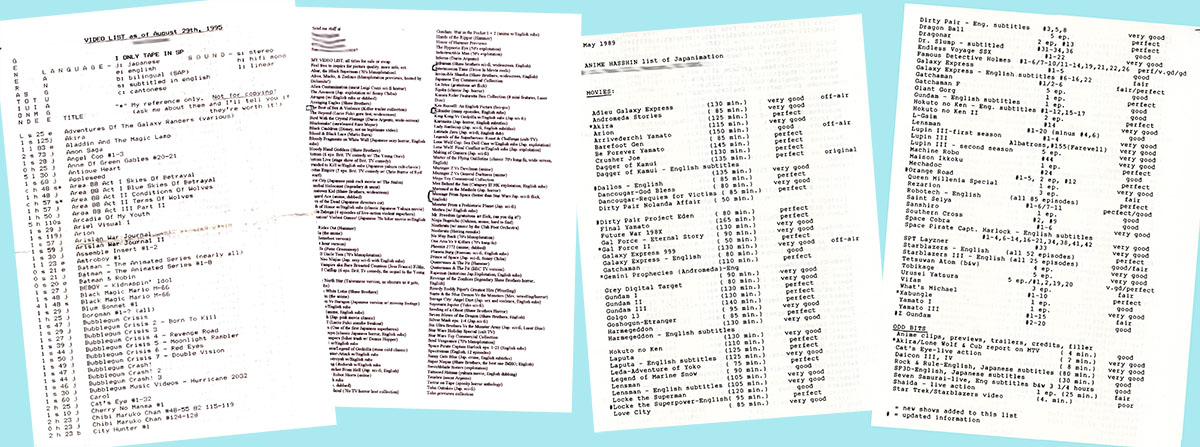
lists of anime tapes in the collections of anime fans circa 1990


His reply letter more or less agreed with me, or at least admitted that we all have our own preferences. I figured I’d never hear from him again, Well, a week later a tape arrived in the mail from him, along with return postage and a request list that was almost exactly six hours long. A movie, two OVAs, some TV episodes, just cram it all on there, please.

I’m like, whatever. The tape goes on the pile of tapes to be copied. You see, at the time I was copying a lot of tapes from people both through the mail and right at home. I’d come home from the local anime club with a stack of blanks and a list of requests, and I spent a lot of time violating copyright law so Bob McBobbob and his pals could watch Project A-Ko or “Dirty Pair Does Dishes” at their leisure.

One week later, I get a long, pissed-off letter from the guy, asking where the hell his tape is, how dare I treat anime fans in this way, where do I get off behaving in such an obnoxious fashion, HE always makes sure HE gets HIS tapes done quickly, etc etc.
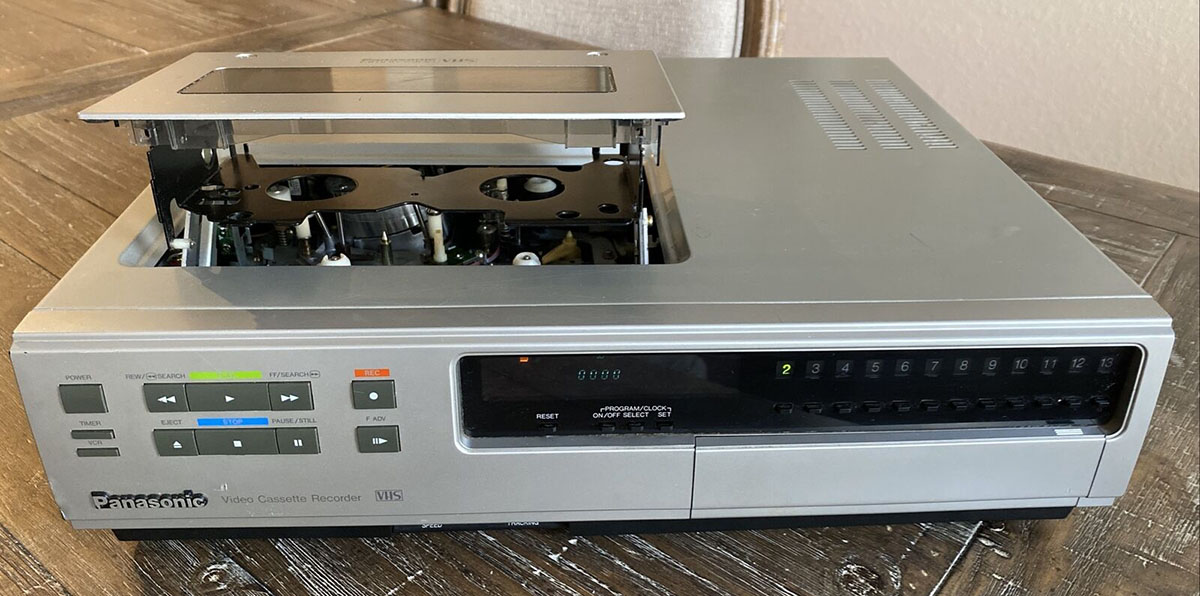

So this gets my full attention. What I do is I dig out my oldest, funkiest, top-loading 2-head VCR that only records in black and white. It was a Panasonic that suffered a drop onto a concrete landing after I tripped on some stairs while carrying it to a Saturday night let’s-copy-anime-and-eat-pizza gathering at a now demolished apartment complex at Lindbergh and Piedmont in Atlanta. I used this Panasonic as the recording deck. Every so often as I passed the machine I gave it a mighty smash with my hand or other suitable blunt instrument. Talk about hashtag VHS Artifacts! They got all six hours of anime, though. Was it watchable? I don’t know. I never heard from them again. 
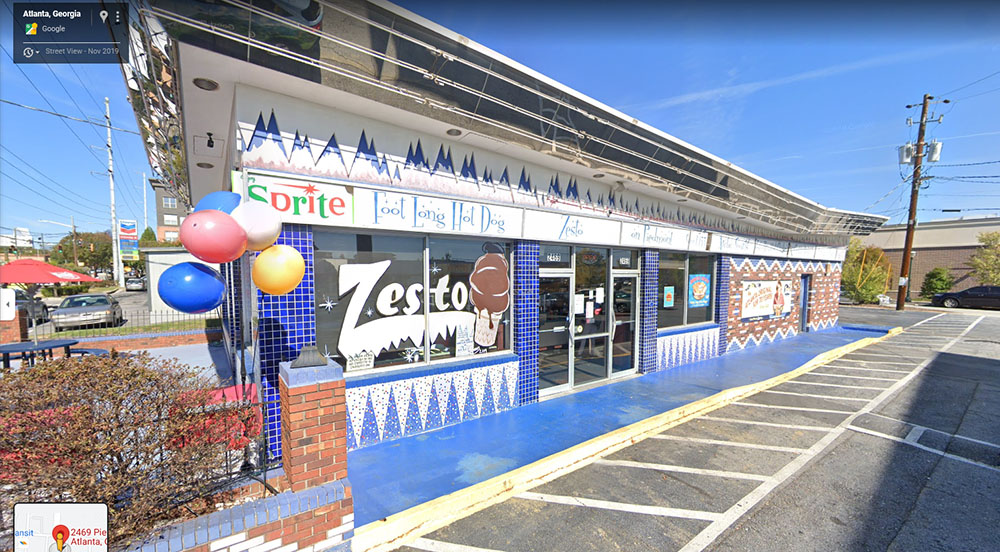
 

meet you at Zesto's on Piedmont


2.

A few years later we were fan-subtitling Captain Harlock though the auspices of Corn Pone Flicks. A VHS, a SASE, and a request for episodes arrived, as per our guidelines. We put the Harlock episodes on the tape, which was placed into its already-stamped return envelope, and mailed back.


A month later the emails started – that tape never arrived. Which is a thing that happens sometimes. Mail gets lost. It’s a thing. What made this email special was the demand we replace and mail this person their replacement tape on our own dime. Because, as the email stated, we were running a business and as such had a responsibility to our customers. Since we were most definitely NOT running a business, we actually had NO such responsibility. By that time we’d learned just ignoring the kooks was the best plan of action, which is what we did to the increasingly angry emails that continued to arrive, eventually accusing Corn Pone Flicks of running an elaborate swindle, stealing blank VHS tapes from an unsuspecting public. The perfect crime!

3.

Speaking of copying tapes, it was the custom of the time for anime nerds such as myself to have lists of their available anime titles photocopied and available to send out, because it’s difficult to ask for tapes you don’t know exist. If you were a member of an anime club or two, you might have access to the anime lists of five, ten, twenty anime tape traders. You might not consider these lists themselves a valuable commodity, but a Pacific Northwest outfit known as Kinosei Anime thought otherwise! For a small fee of six dollars, they would send you the tape lists of fans and clubs who were willing to copy anime for strangers! I found out about Kinosei when I started getting letters from people who had acquired my name and address from them. And no, Kinosei Anime never asked permission to send anyone’s name, address, and list of tapes out to the world as part of their low-stakes unethical behavior game. I mean, it’s not a big deal – I’m sure this scheme netted them, what, thirty, forty bucks, max – but ask first, people.

"Dear Dave, I have sold your name and address to strangers. Do you have any Kimba The White Lion. Thanks, Jeff"


4.

So back in, like, 1989-1990, our phone rang. It was the operator, asking if I would accept the charges on a collect call from a person whom I didn’t know. I figured it had to be an emergency, or at least really important, so I said “yes”. BIG MISTAKE. The mystery caller is a guy who fished my name out of the C/FO Directory. He figured he’d call me collect and ask lots of questions about Japanese TV shows in general and the live-action superhero show Spectreman in particular. No emergency, no crisis, not even a very interesting conversation. Definitely not worth my dime or my time. 
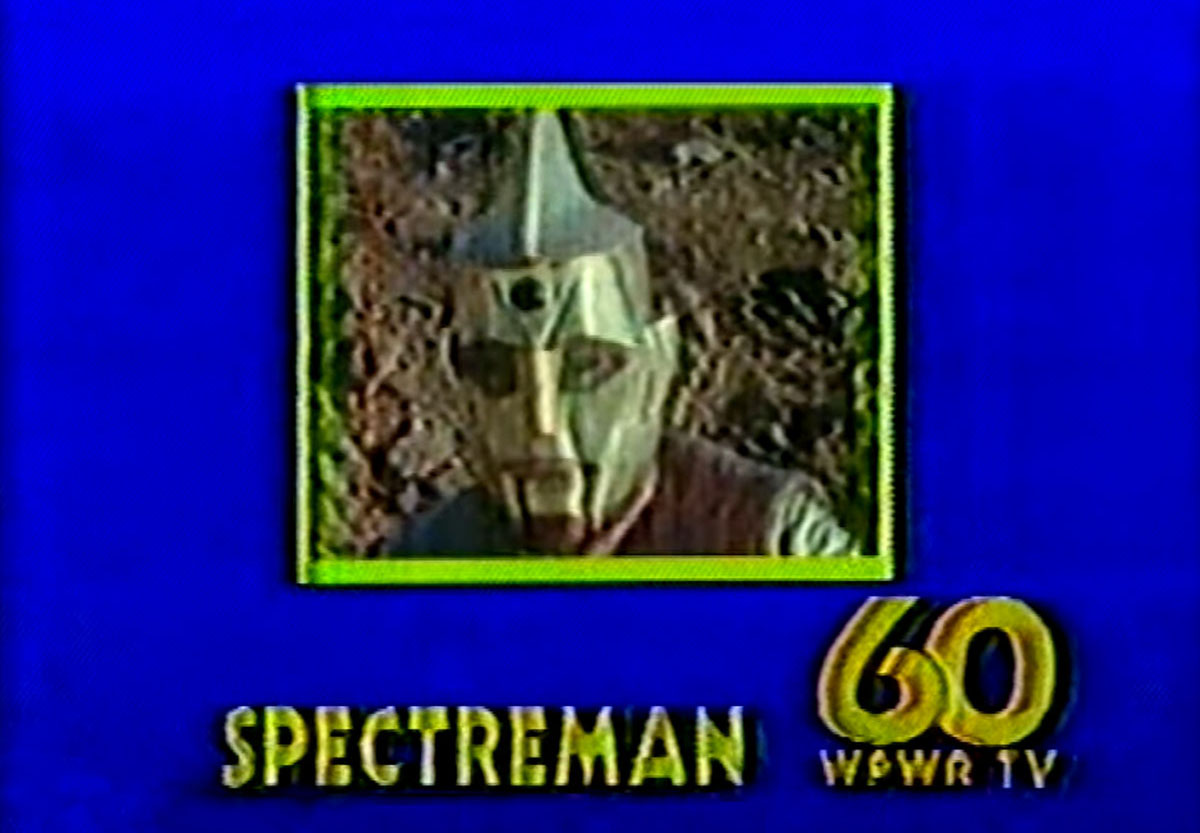
a mystery with a name

He wanted to know this. He wanted to know that. He wanted me to mail him tapes. He wanted me to mail him fanzines. He wanted everything as free gifts from the goodness of my heart and the bottomlessness of my bank account, the extent of both having been greatly exaggerated somewhere down the line. I gathered from his rambling conversation that his caregivers wouldn’t let him call people unless it was collect, and they also wouldn’t give him any money for fanzines or tapes. So obviously, collect-calling to panhandle from strangers was his only option. I finally got off the phone without agreeing to send him anything. Sure, I should have just hung up on the guy, but I was raised to be polite.

the 1988 C/FO Membership Directory - personal information redacted
 

He called right back the next day. I refused the charges. He called back several times over the weekend. We refused the charges. About a year later he called AGAIN. I heard the operator ask if I’d accept the charges from this guy’s name, and I threw the phone across the room while hollering “NOOOOOO!!” in slow motion, just like the movies.

Found out later I wasn’t the only person to get the collect treatment. A pal of mine in South Carolina also got nailed, and at least one former C/FO generalissimo was on the receiving end of who became known as “The Collect Call Bandit.” My guess is that the guy was in some sort of managed care or group home situation and whenever he got a chance, he leaped to the nearest telephone and started collect-calling people like a maniac until the white coats could pry him loose and get that straitjacket back on him.

Anyway the moral of the story is never, ever accept collect calls from strangers. Those 1-800-Collect people are LYING TO YOU. Oh, and also, never let anyone print your home phone number anywhere.


don't do it

Of course, these days we’re deluged by scam calls and robocalls from duct cleaning services and extended warranty salesmen and important messages threatening imminent arrest from the IRS, Immigration or the Social Security Administration. Compared to all this, simply being desperate for Spectreman sounds downright wholesome.

5.

The hands down most annoying guy I ever swapped tapes with was a person I’m going to call named “Bert Ernieson.” He’s another someone I got in touch with via anime club trader lists. Where do I begin? His video lists were handwritten in barely legible pencil on three-hole lined notebook paper. These letters were typically five or six double sided pages filled with scores of trivial questions. Tape requests from Bert would be for odd, hard-to-dig-out titles – in the VHS days this meant fast forwarding to the middle of a tape to find the exact requested episode of Urusei Yatsura or whatever. Let me tell you after four or five tapes, all this cueing time adds up. His mail would include various right-wing pamphlets, for instance the famed, completely bogus urban legend alert about how a cabal of atheists, led by Madalyn Murray O'Hair herself, were going to get all religious programming banned from TV. This right-wing Christian material seemed at odds with some of the selections on Bert’s own tape list, which, to be fair, featured a lot of obscure anime titles, but also included hard-core triple-X American adult films.


But all that was just mildly annoying. Bert, however, took it to the next level. For one thing, he shipped EVERYTHING Media Mail® (Book Rate), the cheapest, slowest, most error-prone way to mail anything. Nothing could induce him to ship things first class, not even sending him the extra postage. Invariably he would use and re-use and re-re-re-use cheap, fiber-particle filled padded mailing envelopes. Items shipped thusly would wind up covered with tiny bits of paper and fiber. This might be OK for books. However, trying to play VHS tapes covered with tiny bits of paper and fiber will result in a VCR mechanism coated with tiny bits of paper and fiber. This is, shall we say, contraindicated by the operating manual.


And then we have the VHS tapes themselves. The tape trading custom of the time was that you’d buy brand new tapes and copy trade requests onto the brand new tapes. But Bert had another plan. He’d copy YOUR requests onto whatever tapes he happened to have lying around. Brand new from the store, or used over and over again, didn’t matter to Bert. Quality brands like Sony, TDK, Fuji or Maxell? Awful house-brand K-mart tapes or clearance bin rejects? It’s all videotape to Bert. He explained his method was to re-copy every incoming video onto 6-hour tapes, apparently to save space in his closet or dungeon or whereever. In practical terms, this meant every single movie or TV show you requested from him had already been transferred to one of his grab-bag mystery-brand video tapes, at a recording speed ensuring the worst possible audio and video quality.

Avoid these brands
 

This tape-recycling meant leftovers at the end of tapes, just in case you enjoy being surprised by, say,13th-generation English dubs of partial Cream Lemon episodes at the end of the super robot cartoon you were showing friends while parents were in the room. Try it, it’s embarrassing and fun! Or when you agree to swap three tapes, and he sends you four, the extra one full of unasked-for junk, just so he can say “hey, I sent you four tapes, now you owe me four tapes instead of the three we agreed on.”

And yet, I continued to swap tapes with him (there were a LOT of obscure titles in his Crawlspace Of Questions), until one day he tried to pull a fast one on a friend, let’s call this friend Lisa Black. He couldn’t or wouldn’t follow Lisa’s simple requests for “new tapes” and “no fiber mailers,” so she refused to copy any more tapes for him. In order to get around her embargo, he started to send her blanks under a different name, utilizing the concept of “sock puppets” before the internet was really even a thing.

I dunno. Maybe it WAS his cousin, like he said. I don’t care. Anyway, she saw through the ruse, because Bert wasn’t smart enough to change his distinctive ordering habits, or his distinctive handwriting. Around this time I happened to mention Lisa in a letter to Bert and his reply was that he was disappointed “I was still dealing with that Nazi, Lisa Black.” Well, I replied that I’d been trading with Lisa for 10 years, that she was, to the best of my knowledge, not an adherent of National Socialism, that she was one of the few truly decent people in a hobby full of obnoxious jerks, and that Bert and I were done swapping tapes. Goodbye to shitty copies of obscure robot anime, to ripped fiberpack mailers, to 4th class book rate, to letters full of questions and demands. Somehow, the anime fan world survived without these things.


Life moves on. A fandom of tape-swapping nerds evolves into a fandom of convention-going nerds. Anime became something we watched in theaters, bought at Best Buy, and eventually streamed on computers. Of course, annoying fans still exist, but their annoyances are new and exciting, in ways we could only have dreamed of back in the day. And let’s be honest, the truth is that for every jerk there were and are ten or twenty non-jerks; reasonable, friendly, generous anime fans ready to show up, help out, and bring snacks, fans who send surprises in the mail and bring gifts back from their Japan trips, fans who build friendships that survive decades. Without fandom, my life would have be considerably lonelier, be much less exciting, and would certainly be bereft of many Japanese cartoons and their related paraphernalia and accoutrements.

Yes, there are a few times when I’m exceptionally maudlin or temporarily addled, when I reminisce about the “good old days” of swapping tapes through the mail. Who doesn’t love to get packages in the mail? Those were exciting times, learning about a whole new art form and sharing that knowledge with anyone who’d sit still long enough. Certainly those tape-trading networks proved their worth, educating a continent and forging powerful bonds And yet, if the harsh modern world of the 21st century means I’ll never again get bitched out by total strangers over copies of Japanese cartoons, then I’m all for progress.

-Dave Merrill

Thanks for reading Let's Anime! If you enjoyed it and want to show your appreciation for what we do here as part of the Mister Kitty Dot Net world, please consider joining our Patreon!

Tuesday, May 31, 2022

Blue Sonnet On It


When the five part Crimson Fang: Blue Sonnet original video series was released in 1989, American anime fans immediately thought of one thing - the margarine brand "Blue Bonnet." But even without any knowledge of Masahiro Shibata's original Crimson Fang manga, fans in the US immediately grasped familiar story beats, which include an evil organization bent on world conquest, innocent youngsters turned into fighting cyborgs, latent ESP awakened by stress or disaster, and the old standby, a Japanese high school where students secretly have amazing powers. Blue Sonnet’s story was digestible even without English translation. The terrific theme song by GO! helped seal the deal, and even if the anime doesn't quite live up to the promise of the OP, we felt it was worth at least a watch in 1989, and still do today.


Matsusaka City native son mangaka Masahiro Shibata debuted in 1973 with “The Sea Of White Roses” and spent some time as assistant to Sukeban Deka creator Shinji Wada before hitting it big with his most successful work, Crimson Fang: Blue Sonnet, a sprawling eight-part (19 volumes) shoujo-manga SF epic published from 1975-1986 in Hana to Yume, Deluxe Margaret and Bessatsu Margaret. The series focuses on the life of Ran Komatsuzaki, the titular Crimson Fang. Ran is that most stereotypical of Japanese pop culture characters, a super-powerful psychic girl whose immense abilities both prevent her from having a normal life and make her the target for those would use those powers for, say it with me, eeeEEEeevil. By the time the Blue Sonnet OVA appeared, Shibata had moved on to other projects, his next big series being the post-apocalyptic combat maid series Sarai, which ran in Shonen Gahosha’s Young King for a decade starting in 1998.


But let’s put some Blue Sonnet on it, shall we? Turns out the new student at Tokyo’s Osei High School is actually Sonnet, a super powerful ESPer girl rebuilt into a combat cyborg by Dr. Josef Merikus under orders of the evil world-domination conspiracy TALON (Directive No. 1, released July 16, 1989). Sonnet is enrolled at Osei to check up on student Ran Komatsuzaki, whom TALON suspects is also a powerful ESPer. And they're correct; not only was Ran orphaned in a plane crash and raised by wolves and later by her father’s friend Jin Kiryu, but it also turns out she’s harboring the immense psychic power of the entity known as Crimson Fang (Directive No. 2, released September 25, 1989). After a few arranged incidents Sonnet is convinced of Ran's power, but at the same time is confused by the friendship and warmth of normal human society (Directive No. 3, released November 25, 1989). Will Sonnet's loyalty to TALON and their world domination plans win out over her long-suppressed humanity? Is there a blooming romance between Ran and Shuichi “Bird” Torigai? What happens when the nurse at Osei High finds out Sonnet is a cyborg? Will Ran survive Sonnet’s attacks, and will her humanity endure possession by the Crimson Fang (Directive No. 4, released March 25, 1990)? Can Kiryu, Ran’s little brother Wataru and the esper Yuri invade the TALON fortress and rescue Ran? Will Ran’s romance with Bird – aka renegade Cyborg RX-606 – be allowed to flower, or end in tragedy (Directive No. 5, released June 25, 1990)?

Produced by several different studios including AIC, Mushi Production and Tatsunoko, the Blue Sonnet anime is very much a product of the late 1980s. The original manga’s story and characters are compressed severely, and we’re left with generic OVA-style characters staring into computer monitors, Bubble-Era Tokyo scenery being smashed, and square-faced middle-aged men with glasses hollering orders in high-tech laboratories, instead of the knock-down, drag-out Sonnet vs Ran fight the OP promised.


If you’ve seen a sci-fi OVA from the 80s you know what you’re going to be seeing in Blue Sonnet – lots of high-tech control rooms filled with data readouts, corporate office blocks headquartering the dastardly conglomerates bankrolling our conspiracy, and underground bases guarded by sensors, jumpsuited goon squads, and mechanical man-killing monsters.


The sketchy, zip-a-tone energy of manga is difficult to translate to the TV screen, and the dramatic freeze-frames and expressionistic background effects of shoujo manga seem to suffer most. Blue Sonnet is no exception, the melodramatic emotional beats of the story struggling to overcome pedestrian animation and generic late 1980s character design. Regarding the OVA series, Shibata himself commented “It was too bad to be talked about.” Director Takeyuki Kanda was a veteran of Mushi Pro and Sunrise – he directed Dougram, Galatt The Great, and his masterpiece Round Vernian Vifam – but translating years of manga story into five direct-to-video chapters might not have been the best opportunity for him to shine. The same could be said for Blue Sonnet producer Walker Company, which went bankrupt after the release of the 4th episode.


To American anime fans who weren’t familiar with the manga, Blue Sonnet seemed like just one more entry in a Blockbuster shelf full of big-eyed girls hollering while their latent psychic powers make everything explode. It’s no surprise the subtitled Central Park Media release failed to make much of an impact. The anime market of the early 1990s was still looking for the next Akira, and Blue Sonnet is definitely not that. But then again, what is? For all its faults, 30 years on we still have that kickin’ theme song in our head, and that’s proof Blue Sonnet still counts for something. The video is long out of print but you can find them on the YouTubes if you yourself want to watch Ran explode into Crimson Fang, see Sonnet recover her humanity, and perhaps find out, what is love? 

-Dave Merrill 

A version of this article originally ran in Patrick Ijima-Washburn's fanzine Mangaverse.


Thanks for reading Let's Anime! If you enjoyed it and want to show your appreciation for what we do here as part of the Mister Kitty Dot Net world, please consider joining our Patreon!

Monday, August 31, 2020

1987 catalog of dreams and VHS tapes


When we talk about 1980s North American anime fandom we tend to emphasize the fan art, newsletters, costumes, tape trading, and other home-grown elements of the fandom. And sure, that's because the DIY stuff is interesting and clumsy and charming. Just as interesting might be the contemporaneous Japanese anime merchandise that American fans were, even then, shelling out their hard earned cash for. How buried in anime merchandise could an 80s anime fan get without having to fly to Japan and fill up some suitcases? Surprisingly buried, actually! 


Before specialized websites and email, we relied on business cards, xeroxed catalogs, and addresses we’d find in classified ads and on convention flyer tables. Nascent "otaku" and the Japanese-American community would shop together at Mitsuwa Plazas from New Jersey to Texas to Chicago. We’d haunt Japanese groceries, comic shops, and toy & hobby retailers, and if we had a stamp to gamble we might shop via mail order with companies like Books Nippan, Nikaku Animart, Kimono My House, and something called Wyvern Web Graphics. 


The mid 80s creation of three Florida anime fans, Wyvern Web Graphics (a wyvern is a legendary bipedal winged dragon) combined anime knowledge, language skills and relationships in Japan to start an anime-merchandise import company at a time when options were few for desperate American anime nerds with a few bucks burning holes in their pockets. Wyvern Web would sell via mail order and would table at a small circuit of SF and comic conventions in the Southeast for a few years.

So what were those 1987 American anime nerds able to purchase? An embarrassing amount of stuff, to be honest. Posters, movie booklets, Roman Albums, postcards, buttons, binders, pencil boxes, stickers, sweatshirts, scores of anime soundtracks on LP and CD, and literally hundreds of official release laser discs and tapes of both VHS and Beta variety. But don’t take my word for it, let’s look at the April 1987 Wyvern Web catalog. 


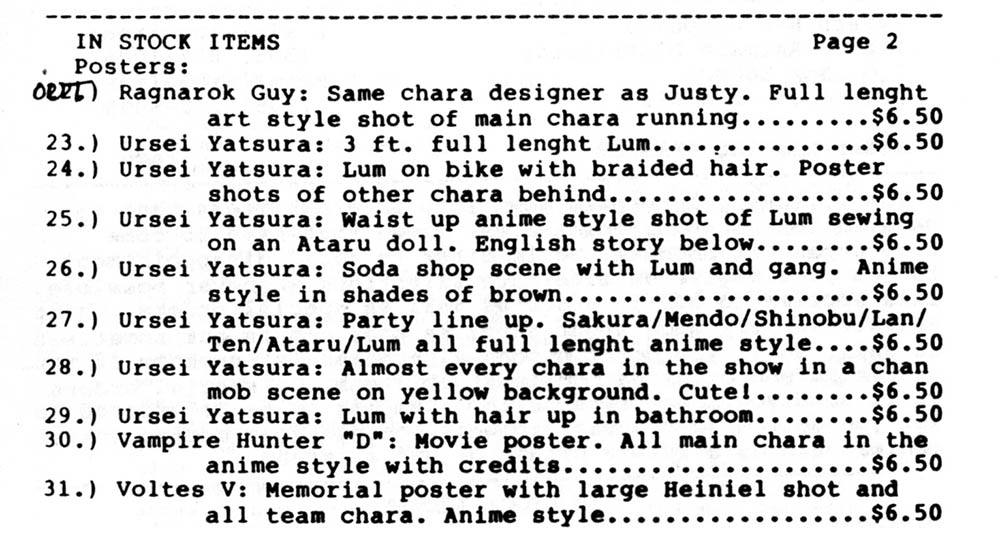
Posters were a big item, reasonably priced from $4.50-$6.50. I can recall paying $8 for the full size Harlock and Galaxy Express 999 posters at Atlanta Fantasy Fairs. Of course $6.50 in 1987 dollars would be $26 today. 


I bought the Locke The Superman and the 3-foot Lum posters from Wyvern. That Lum hung in my room for years, garnering sarcastic comments from every female visitor (don’t mind them, Lum, they’re just jealous). 


I'm fairly certain I purchased this Lum wallet from WWG but I'm pretty sure I didn't spend $16 on it. It's more of a coin purse than anything else. It's not listed in their catalog but I bought this Urusei Yatsura pencil case from them; it's one of my favorite pieces of UY merch, demonstrating exactly how well the series fit into the colorful, New Wave design aesthetic of the late 1980s. 


It's honestly kind of humbling when you see exactly what the anime home video market looked like in the 1980s - I recall actual anime on video being hard to come by, but here we see a comprehensive selection of the Japanese anime field. Of course, we have to remember that these hundreds of titles were all in Japanese with none of English subtitles or dubs we take for granted today.

Let's also take a look at these prices and remember it's 1987, the minimum wage is $3.35 an hour, and a Beta copy of the Daicon openings is going to cost you a cool hundred dollars ($236 today). Captain Harlock Arcadia Of My Youth was $146 on VHS – today you could purchase five Blu-Rays of the film for that much money. Bubblegum Crisis part 1 was only $80 ($190 today) and the Fandora OVA was only $64 for the tape, $57 for the laserdisc. Or you could wait a couple of decades and pick up an ex-rental Fandora VHS for 100 yen. 


I’ve never played Persona, but I’ve seen the Digital Devil Story: Megami Tensei OVA on sale here from WWG on VHS for a mere $78. Is it essential? Jury’s still out! 


The selection of anime really is impressive, including Harmagedon. Giant Gorg, God Mazinger, three volumes of Galient, and all three Gundam movies. You could drop $120 on Lensman, or $80 on Karuizawa Syndrome - you know, the OVA by Yoshihisa Tagami about the romantic adventures of a freelance cameraman. You could make it a Tagami double feature with his Digital Target Grey for only $113. Or you could take the safe route and buy the crowd-pleasing Macross movie on laser disc for only $64. 


There isn't a price for this Queen Emeraldas Galaxy Express 999 TV special, but I believe I paid $70 for it. At the time I was making minimum wage at the local K-Mart, which meant I worked twenty hours for 45 minutes of video. I think it's worth it - the thing still hasn't received an official English release. Ditto for the other Leiji Matsumoto Queen here, Queen Millennia, a film that really deserves to be seen in the West. Why no Millennia, people? Get with it, and while you’re at it, sell it for less than $150! 


I did not buy this Urusei Yatsura laser disc from WWG - it's a loaner, and has laser rot to boot. But in 1987 it would set you back $64 ($150 today), and I sure hope you copied it to VHS before the laser rot set in. Price-wise, the most expensive item in the catalog is the extended version of the Final Yamato film, which will run you a cool $160 in 1987 dollars, or three hundred sixty four dollars and ninety-three cents here in 2020. That’s more than two dollars a minute to watch the Earth get drowned and Kodai and Yuki finally get it on. 


Music is a big part of anime, and anime music on LP and CD was a big part of things. The CD was still a relatively new format in ‘87 but a surprising amount of titles were available. I didn't pick up this Captain Harlock Symphonic Suite LP until years later. The Macross Song Collection album was a staple in anime fan record collections for years. 


If you bought this Prefectural Earth Defense Force CD back in 1987 it would set you back sixty dollars in today's money, and I think it's worth it just for the title track alone (I didn't get this from WWG, it was a gift). Similarly priced is the Urusei Yatsura Juke Box 2 CD, not to be confused with Urusei Yasura Music File or Urusei Yatsura Music Capsule or Urusei Yatsura Jam Trip. You'll go broke trying to keep up with Urusei Yatsura album releases. 


Rounding out our music selection is one of the most striking anime covers ever, the Zeta Gundam Symphonic Suite with the amazing Masao Yamazaki artwork that takes the anime right out of those anime characters. A bargain at twice the price! 


Wyvern Web’s operation lasted only a few years. Getting this treasure trove of anime merchandise in front of interested and educated buyers ready to shell out seventy or eighty or ninety dollars for VHS tapes in foreign languages was itself a tremendous challenge. The principal business owners relocated to Japan and the stateside end of the Wyvern Web business collapsed fairly quickly, leaving our part of America sadly bereft of high-quality anime merchandise; for a little while, anyway. But their catalog remains, a testament to the wide gulf between the strong desire of anime fans and the not-so-strong purchasing power of anime fan bank accounts. I guess some things never change.

All merchandise from the personal collection of D. Merrill


Thanks for reading Let's Anime! If you enjoyed it and want to show your appreciation for what we do here as part of the Mister Kitty Dot Net world, please consider joining our Patreon!

Sunday, March 22, 2020

let's rate the anime dubs

Recently in the wake of Oscar success for Bong Joon Ho’s Parasite – the first best picture nod for a subtitled foreign-language film – the old “subs vs dubs” debate erupted anew, and Hollywood’s cognoscenti found itself behind the curve of an eternal anime-nerd argument. Namely, what’s better, watching them there Japanese cartoons with English subtitles, or watching them dubbed into English? I submit that today this is a meaningless debate, as modern technology means we can enjoy both as we choose. Anime titles are delivered more or less intact and many DVDs or streaming titles come with subtitles and English language dub tracks. Gone are the days of haphazard editing or the dumbing-down of complex plot points, and the medium’s Asian roots aren’t disguised but are now a selling point. 

the internet has opinions 


But this was not always the case. For the first thirty years or so, badly edited dubs were all we got! And let’s face it, the UHF TV stations, kiddie matinees, and video rental family sections of America weren’t seeking to advance the cinematic art form, they were interested in selling popcorn, Hot Wheels, and rentals. If that meant goofily-dubbed cartoons from Asia, well, goofily-dubbed cartoons from Asia is what we got. 

But what was it like, watching these primitive, problematic, sometimes culturally insensitive localizations? Can we, from our 21st century perspective, arbitrarily assign our own subjective values to these different English language releases? Well, I sure hope so. Otherwise this column is going to be mighty short. 


Panda And The Magic Serpent is pretty indicative of where these things were headed – the panda is incidental to the story, which in Japan is Hakujaden or “Legend Of The White Serpent”, the first color Japanese animated feature and an adaptation of a Song Dynasty legend about a boy, and a girl, and a snake, who is also the girl. This movie fits perfectly what Americans would think of if they heard the term “Japanese animation” in the late 50s – it’s perhaps the most visually and culturally “Asian” anime film of the period. If you want the cinematic version of a kitschy Chinese restaurant, this is it. Order me the Mu Shu Pork, will you? 

RATING: number one exotic pagoda oriental magic palace and cocktail lounge 


Alakazam The Great might be the first anime film to really impact the West, not only due to repeated TV screenings in the 70s and 80s, but it was also the first localization to fill roles with popular stars of the day, “the day” being 1960. You can nitpick the dub all you want – the Buddhism is removed entirely from this Buddhist folk tale formerly known as “Journey To The West” – but casting Jonathan Winters and Arnold Stang gives this one a unique midcentury comedy vibe that draws us in like a magnet. Can you imagine what kind of nonsense Winters got up to in the outtakes? Somebody find those tapes. 

RATING: Great 


Fred Ladd’s 1964 Gigantor version of TCJ’s Tetsujin-28 is chunky, funky and clunky, just like Tetsujin himself. In the Americanized version produced for Trans-Lux, Jimmy Sparks has never sounded more pre-pubescent and Inspector Blooper channels Gale Gordon at all times. Gale Gordon, he was in The Lucy Show with Lucille Ball, you’ve seen Simpsons characters make fun of him, read a book sometime kids. And that theme song! Half Calypso novelty song, half football chant, it’ll stick in your head long after you’ve forgotten what happens in every single episode of Gigantor. 

RATING: Ten Thousand Gigantors 


ABC Films’ 8th Man didn’t stray too far from TCJ’s cartoon version of Kazumasa “Harmagedon” Hirai and Jiro Kuwata’s cyborg detective manga. Dubbed in Copri International’s Miami studio, which was sometimes used for CIA propaganda broadcasts aimed at Castro’s Cuba, the hardboiled nature of the show came through in bellowing, stentorian Dragnet-style narration and an unshakable conviction to whitewash everything Asian about the show. In practice this meant describing all the Japanese signage as being part of “The Museum Of Oriental Art.” 

RATING: Making those signs Oriental sure doesn’t help find your way! 

Making those signs Oriental sure doesn’t help find your way


Jungle Emperor VHS release


Kimba The White Lion is always said to be the first color Japanese animated TV show, but you know what, I’ve had so many of these stupid factoids shoved into my eyeballs that turned out to be wrong that I can’t even any more. Who knows. It’s a show, it’s in color, it’s been dubbed twice, the first time by Fred Ladd’s radio-drama-veteran crew fresh from Astro Boy, and in the 90s for bubble-gum giveaway DVDs. Billie Lou Watt gives Kimba some jungle gravitas and Ray Owens earns a paycheck shamelessly ripping off Walter Brennan for his Dan’l Baboon voice. You know, Walter Brennan, he was Grandpa on “The Real McCoys” and an entire filmography worth of movies including the terrific “Bad Day At Black Rock” and the stunningly terrible “The Oscar.” 

RATING: Jungle Love 

cursed image #749
The Amazing Three

Amazing Three is one of those lost TV cartoons where the 16mm prints of the English dub are sitting in somebody’s basement while he tries to get $30K for them on eBay. Why won’t one of those Silicon Valley tech-bros pony up the cash and rescue this show from sweet oblivion? You know the story – Galactic Command sends three agents to Earth with a mission to decide whether or not to blow us all to hell, and these three agents transform themselves into Zero the duck, Ronny the horse, and Bonnie the bunny, because Tezuka had a thing for transformations. The localization is by the Prince Planet Copri Productions team, what’s it like? It’s kooky. Our heroes, their human being pal Kenny, Kenny’s Secret Agent Man brother, and a parade of international villains and local goofs bellow, shout, holler, stutter, and smirk their way through the dialogue. Zero, the duck with the Beatle haircut, growls at everyone and everything, all the time. It hurts just to listen. 

RATING: it’s a wonder 

Little does Speed realize that Racer X is actually his older brother
Speed Racer, on the other hand, moves like a lubed-up 500 horsepower engine, blasting through 52 episodes of Tatsunoko auto-racing action. Speed and Trixie and Pops and Racer X and Spritle and Inspector Detector are apparently paid by the word and on a mission to jam as many syllables as possible into every mouth movement, whether they match or not. Peter Fernandez makes it work with a brazen disregard for logic and a breakneck pace that never lets us think how silly it is that a teenage race driver is involved in international espionage or how he wins races in loafers and red socks. There’s a reason everybody remembers this Trans-Lux show, and that’s because it’s great. 

RATING: go speed go 


Fables Of The Green Forest is one of those shows you see on kiddie-shelf Blockbuster rentals and it really challenges your commitment to rent everything that looks Japanese, and you rent it, and that commitment is challenged further. Based on a series of American children’s books from the early 20th century, produced by an early 70s team of Japanese animators that would go on to work on world-famous productions, and dubbed by people recruited from AA meetings and shopping mall hallways, this localization is positively jet-lagged. Entire story arcs are devoted to intensely irritating characters like Chatterer The Squirrel, his speech impediment challenged only by the confusing, almost stream-of-consciousness script, almost Burroughsian in its impenetrability. 

RATING: “oohhh. Ahhhh. Ooohhhh.” 

oohhh. Ahhhh. Ooohhhh


Lupin vs Clone
Lupin III Mystery Of Mamo – this legendary 1978 film has been dubbed into English four or five times, but the first attempt is the best, a jazzy take that fits Lupin like a glove that helps him walk up walls. Sure, some of the names get changed, but TMS was gonna do that anyway. Maybe you saw this one as part of the Cliff Hanger laserdisc video game, maybe you saw a copy of a copy of a copy of a copy, or maybe you bought the recent Discotek DVD release, which you should do. Monster trucks, immortal geniuses, and Pop Rocks make this the finest Lupin movie! 

RATING: compared to him we’re stumble-bums 


Starvengers – Jim Terry Productions released five different Toei anime series as part of their Force Five package and this one, their version of Getter Robo G, is emblematic of how Americans dubbed Japanese cartoons in the 70s and 80s. Their method: take the source material, throw out all the names, keep as much of the story as the visuals force you to keep, and then go wild on it. Starvengers has bad British accents, poor production values, cheap video titles, the occasional celebrity impersonation, and a cheerful energy that keeps the whole thing moving in spite of having to start where the first Getter Robo series ends. This was shown on Atlanta’s WANX-46 in an hour time slot – we got an episode of Star Blazers, and then two of Force Five, either Starvengers and Grandizer or Gaiking and Dangard Ace, or Spaceketeers and something else. Maybe Starvengers again. Somebody at 46 didn’t think this one through. 

RATING: Foul Tip 


Captain Harlock & The Queen of A Thousand Years – this awkwardly named series lives up to its awkward name. The series comprises two completely unrelated TV series, produced five years apart by completely different creative teams, and edited together like a first-year film student’s poorly thought out final project. This hamfistedly made video Frankenstein mystifies viewers, repels fans of Captain Harlock and Queen Millennia, and surely infuriated the typesetters at the newspaper’s TV section trying to cram this title into their layouts. All of Carl Macek’s overwritten pomposity is in full effect here, overworked to the point of incomprehension thanks to an impossible mission. Sample of actual narration: “Across the immensity of deep space, the incalculably powerful Mazone armada pushes relentlessly onward, swallowing everything in its path, sweeping across worlds beyond number. Like a tidal wave of terror, the bulk of the fleet crashes across the surface of planet after planet, drenching world after world in an irresistible tide of subjugation. But as the Mazone snake twists and turns, its constricting coils fail to find the artificial asteroid that now hides Captain Harlock, his ship, and his crew.” 

RATING: tidal wave of terror 

WATL 36's famous "find the unicorn" contest


Dagger of Kamui, the 1984 Rin Taro film animated by Madhouse and produced by notorious producer Haruki Kadokawa, is a hallucinogenic, sprawling epic of gangs of ninjas battling over an immense treasure hoard that can either save or destroy the Tokugawa Shogunate. Caught in the middle, the half-Ainu boy Jiro grows to ninja manhood in a journey that takes him across the Pacific to California and back to confront his ultimate destiny. As an 80s film starring ninjas, this one was pre-sold for export, and America was not slow to glom onto it. Along with Macross, Phoenix 2772, Locke The Superman and others, Kamui was part of the Peregrine Films “Dynamagic" package that was later released to home video in the States under the Just For Kids label. Dagger Of Kamui became “Revenge Of The Ninja Warrior,” got forty minutes hacked out, and received a utilitarian dub that tried at times to match the otherworldly cadence of the Japanese dialogue, but let’s face it, hearing three otherworldly ninja shrilly announce their presence works better in Japanese. 

RATING: WEE ARREE THEEE THREEE DEVILLL NINNNNJA 


Vampire Hunter D, and his friend, D(oris)

Vampire Hunter D was an early star of the OVA world, a keystone in the struggle of 80s anime nerds to show the world that Japanese animation was a Serious Art Form For Adults, Man, and also important in the strategy of Streamline Pictures, the distribution company set up by former Harmony Gold Robotech czar Carl Macek to release Japanese animation outside the constraints of syndicated television. Vampire Hunter D fit the bill as an edgy, violent animated film with enough supernatural shock and the occasional shower scene to clearly define it away from TV kidvid. But Streamline’s less than stellar dub, which features comical, vanishing and reappearing accents, stiff line readings, and bad takes that somehow made it into the final cut – somehow undercuts the seriousness of the endeavor. 

RATING: I won’t return the castle 


In The Aftermath is what happens when you have some army surplus hazmat suits, a permit to shoot at an abandoned power station, and the rights to the Mamoru Oshii / Yoshitaka Amano art film Angel’s Egg. That is to say, you take the dreamlike visuals of what may be Japanese animation’s most arthousey film and tack them into a cheap post-apocalyptic bunker movie. The result is a mess, a boring mess; imagine a world where Angel’s Egg beat Akira to the rep cinemas and wowed the critics, paving the way for an explosion of visionary expression beyond the edgy cyberpunk boob ninja tentacle rape we got in the 90s? But no; this is why we can’t have nice things. 

RATING: rotten 

sure, why not
he's a shock
Fist Of The North Star has been an amazing success. The original Buronson/Tetsuo Hara manga was ridiculously popular, spawning side stories and sequels and prequels, a long-running anime series, nine different spin-off manga stories, four theatrical films, five OVAs, novels, video games, pachinko games, a dedicated e-reader preloaded with the manga, a live-action American direct-to-video movie, and a possibly unlicensed Taiwanese live action film, making it one of the most lucrative media franchises of all time. Of course you wouldn’t know it here in North America, where Fist Fever Failed to Finalize in spite of every attempt. Is this wasteland Mad Max/Bruce Lee fantasy too peculiar for Western tastes, the way the franchise mixes deadpan seriousness with outrageous camp too jarring for our palates? Maybe. All I know Streamline Pictures’ early 90s dub of the 1986 Fist Of The North Star film punched its way into theaters and home video only to be met with viewer apathy. Some of the blame lies with America simply not knowing they should be awed by the amazing martial arts wizardry of Kenshiro and the rest. But the localization didn’t help. A soft-spoken Kenshiro, attempts to mitigate the ridiculous ultra-violence with quips, and a sad under-mixing of the heavy metal soundtrack muted the impact and left viewers confused and unimpressed. 

RATING: I’ve got a splitting headache 


Ninja Robots? You never saw ‘em, unless you lived in Australia, Pakistan, India, or the Philippines, where the English localization of the very 1985 Studio Pierrot series Ninja Senshi Tobikage aired. Was this show dubbed in LA, or in Miami? Sources vary. What we DO know is that this very 80s show got a very 80s theme song, keeping the original Tobikage theme and adding English lyrics about “fighting Zaboom” and “the power’s in you, you’re in the machine” all wrapped around a stirring refrain of “Ninja Robots, Ninja Robots!” It’s all very ‘2001 A New Wave Godyssey’ if you catch the Mr. Show reference. Ninja Robots is a perfectly reasonable localization of one of those anime series that looks amazing and enigmatic when all you’ve seen is the opening credits, but the actual show itself gets rolling and the story of teenage Martian colonists using the titular ninja robots to protect an alien princess from the aliens who seek to conquer the galaxy, well, it’s both overly complex and played-out at the same time, if that’s possible. 

RATING: zaboom 

they could use a Ninja Spellcheck, is what they could use


More successful was the Graz Entertainment version of Sunrise’s Samurai Troopers, known here as Ronin Warriors. Instead of hiding its Japanese roots, this show embraced the very Shinto concept of reverence for the spirits of departed, in this case ancient samurai warriors whose mystical powers enable five good-looking young Japanese men to don primary-colored armor and do battle with the forces of evil. The Ocean-produced dub was earnest, took the more fantastical material seriously, and even had the guts to leave the kid sidekick’s name as “Yulie” which, let me tell you, is a name that had a lot of us checking and re-checking our Japanese to English dictionaries back in the day. 

RATING: Samur-riffic


It was the mid 90s when Ronin Warriors appeared, and North America had been smacked by a one-two punch of (a) films like Akira wowing the critics and forcing us to take Japanese animation seriously as an art form, and (b) shows like Power Rangers making Megazord-sized piles of cash. The twin jackhammer-strength finishing blows of Pokemon and Sailor Moon were just around the corner, and the attitude of the outfits localizing these cartoons had changed entirely. The contempt and disregard of producers who saw anime as a blank slate with which to fulfill their frustrated literary ambitions was replaced with either a refreshingly professional disinterest, or, in the case of companies like AD Vision and AnimEigo, an earnest, fan-driven desire to do right by the source material. 


As always, the final solution to any sub vs dub debate is for you, the viewer, to get off his or her caboose and learn Japanese, thereby opening up an entire world of entertainment no longer gate-kept by professional or amateur translationists. Or, you can simply tell yourself it’s just a show, and you should really just relax.

-Dave Merrill 


Thanks for reading Let's Anime! If you enjoyed it and want to show your appreciation for what we do here as part of the Mister Kitty Dot Net world, please consider joining our Patreon!