SUMMER,
1970s: The suburban neighborhood is full of active children.
Baseball, Big Wheels, yellow metal Tonka dump trucks, plastic army
men, Barbies and GI Joes create a carnival of playtime - until 2:30
in the afternoon, that is. That’s when the yards clear of children,
when kids up and down the street vanish into houses. It may be your
house or that of some family you’ve never met. Just come on in and
sprawl in front of the wood-paneled console television and start
spinning that UHF dial and working the rabbit ears, because it’s
two-thirty: time for Speed Racer.

Speed
Racer! Pioneer in children’s action cartoons, arguably the most
popular anime ever released in America, touchstone of a generation’s
obsession with fast cars and gadgets, wellspring of two hemisphere’s
worth of sequels and merchandise and big-budget Hollywood films and
speeding tickets for millions of grownup kids. It’s
been fifty years since Speed and Trixie and Spritle and Chim Chim
first came racing down the track. Fifty years! Yet the series is
still a pop culture icon, not just in the anime-fan world, but
anywhere kids watched cartoons and occasionally got behind the wheel
of the safely-parked family car and made ‘vroom vroom’ noises.

Japanese
animation studio Tatsunoko Productions’ first TV show, the Astro
Boy-esque Space Ace, missed international success by
inches. Studio head Tatsuo Yoshida produced their next series in
color and shifted the concept away from cherubic Osamu Tezuka-style
space kids, skewing older, creating a slightly more mature show.
Mixing motor sports with everything else the mid 1960s had to offer –
spies, rock and roll, robots, rockets, beehive hairdos, gals in
clamdiggers flying helicopters, and a hero who raced in white pants
and loafers, always ready to leap out of the drivers seat to help a
damsel in distress or battle a secret plot to take over the world,
Yoshida’s concept became 1967’s Mach Go Go Go. A success
for Tatsunoko in Japan and the first in a long line of popular
cartoons including Science Ninja Team Gatchaman, Casshan, Time
Bokan, Honeybee Hutch, The Brave Frog and Macross, Mach
Go Go Go would put the studio at the forefront of television
animation for decades.
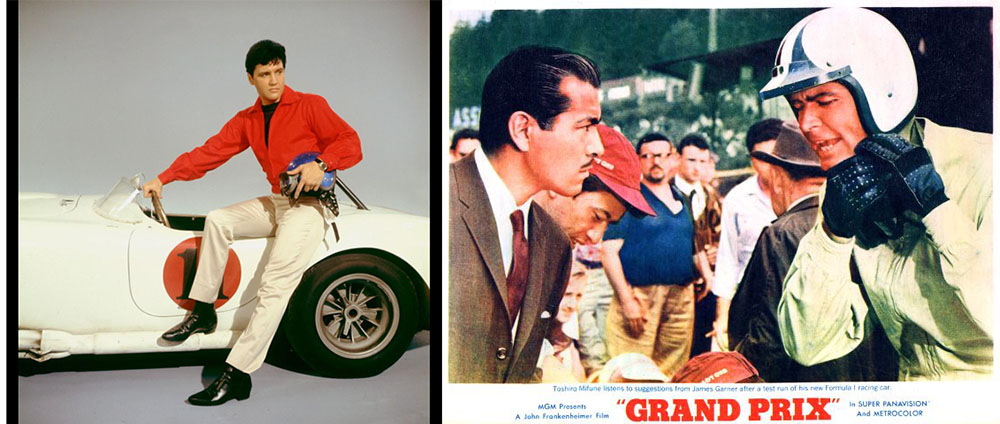 |
| Elvis in Speed Racer cosplay, Toshiro Mifune as "Pops" Racer |
In
the mid 1960s Japan’s nascent anime industry was just shifting into
color with Tezuka’s Jungle Emperor (Kimba The White Lion)
and Japan Tele-Cartoons/Terebi Doga’s Kaitei Shonen Marine
(Marine Boy) leading a pack of magical schoolgirls, rainbow
android teams, golden skull-faced demons, Prince Planets, Asteroid
Masks, and Pirate Princes through cartoon fantasies. At the same time
Japan’s motorsports industry was becoming more and more popular.
The postwar middle class, encouraged by Japan’s revitalized economy
and the vast national infrastructure spending on roads and highways,
had the income for cars and the need for speed. The first Japanese
Grand Prix was held in 1963 and the Suzuka Circuit and the Mt. Fuji
track (opened in 1966) were arenas where champions of Toyota, Honda,
Hino Motors, Mazda, and Nissan battled each other to the finish line,
cheered on by fans who enjoyed racing films starring Elvis, Frankie &
Annette, and even hometown favorite Toshiro Mifune in Frankenheimer’s
Grand Prix. The glamour, excitement, and international
intrigue made auto racing the perfect hook for an animated television
series.
 |
| Shonen Book's Speed Racer manga |
Tatsuo
Yoshida was a veteran manga artist whose work straddled the line
between the cartoony Tezuka school and the grittier gekiga scene. His
last great manga series, Mach Go Go Go, would
appear in Shueisha’s Shonen
Book from June ‘66 until May of 1968 and would
break both speed records and the boundaries of televison
cartoons. Assisted by his brothers Kenji Yoshida and Ippei Kuri, the
Tatsunoko studio would create entire new worlds of well-designed
adventure for TV anime. In Mach Go Go Go, Mechanical design
was highlighted for the first time as beautifully illustrated
machines took center stage, and the action revolved not around magic
children, robots, or superhero space aliens, but about the mysterious
world of grown-ups – families, jobs, cars, police, criminals, teams
of motorcycle-riding Native American bandits, and monster cars
controlled by computers competing in high stakes auto racing. Hey, it
could happen.

The title of the series itself is a three-way pun: “go” can be a signifier indicating a vehicle (for instance, Captain Harlock’s spaceship referred to as “Arukaadia-go”), as well as Japanese for the number “five”, and the name of the main character, Go Mifune. You can also throw in the English definition for extra credit. So maybe it’s a four-way pun. Go figure.
 |
| Broadcasting trade publication ad for Speed Racer |
Bringing the series to America was the task of Peter Fernandez and his crew of veteran voice talent; he’d just finished dubbing the seminal super-robot Gigantor (Tetsujin-28) for Trans-Lux and the Oxy-Gum-chewing Marine Boy for Seven Arts. With his background in radio drama he’d been working steadily to satisfy America’s drive-ins and UHF television stations with imported Italian space operas, Mexican monster epics, Westerns of mixed European heritage, and Japanese rubber-suit kaiju dramas. His rapid-fire line direction and the melodic tones of co-star Corinne “Trixie” Orr, along with Jack Grimes and Jack Curtis handling mysterious older brothers, helpful mechanics, and Inspector Detectors, helped fix Speed Racer firmly in our preadolescent subconscious.
 |
| two of the fine stations bringing you Speed Racer |
As a syndicated television cartoon Speed Racer ran for years on Turner’s WTBS, which in the early days was known as WTCG while airing another Fernandez dub known as Ultraman. Occasionally the station would feature an on-camera Ted Turner earning his reputation as “Captain Outrageous.” Other stations like “Philly 57” (home of Star Blazers and Force Five) helped make Speed Racer a must-see for the afterschool set. As a non-network series Speed Racer was exempt from the standards and practices that kept guns, knives, conflict, and entertainment away from the Saturday morning cartoons of the Big Three networks. This incurred the condemnation of Action For Children’s Television, a consumer watchdog group who described Speed Racer as an “animated monstrosity” featuring the “ultimate in crime, evil characters, cruelty, and destruction” that nevertheless was being inflicted upon our nation’s children “five days per week in afternoon slots when children are the least supervised and the most available.” To which I say, right on.


There isn’t another show from that era – American OR Japanese – that inspires such fond memories and devotion. Love it or hate it, you can’t forget the rampage of the Car With A Brain, the cycle acrobatics of the Motorcycle Apaches, the cubist-masked terrorists hijacking airliners with boobytrapped headphones, or the top-hatted petulance of The Car Hater. The race against Laser Tanks, menacing gangs of lady assassins, stolen gem-bearing pineapples or the trials of the Supersonic Car were all branded in our memories with Mach 5 tire marks. We were touched by the melancholy tragedy of Rex Racer – separated from his family by pride and arrogance, yet never far from Speed’s side, always there to lend a hand. The Racer X plot point of a long lost family member who wears a mask and shows up to save the hero in the nick of time would return in the character of Red Impulse in Gatchaman. What kid – heck, what adult - didn’t want a car that could jump over obstacles, drive under water, cut down trees, and never needed a fill-up or an emissions test? No kid, that’s who.

Fifty-two episodes of Speed Racer were produced, many of them two-part stories, a rarity at the time for animated series. The international success of Mach Go Go Go would inspire Tatsunoko to market other works to a worldwide audience; Honeybee Hutch and The Brave Frog would be shown throughout the world and Gatchaman would become a hit in America under the title Battle Of The Planets, eventually receiving four separate English language adaptations. Tatsunoko’s 1982 super space romance MACROSS would be another international hit that inspired sequels and imitations alike.
 |
| Fine role models for the youth of the world |
Other Japanese anime studios would try to capture the Mach Go Go Go magic with their own racing series – the cheesy 70s mechasploitation fantasy Gattiger The Combo-Car featured a transforming combination car versus the Demon Auto Company while Hawk Of The Grand Prix did a thematic 180 and strove for racing realism, though it did feature a mysterious masked racing mentor. Fly, Machine Hiriyu was a 1978 Toei/Tatsunoko coproduction that took a goofy Time Bokan tack. The 80s saw Yoroshiku Mechadock and F! highlight plucky young go-getters racing for the checkered flag, and the late 1990s brought anime in line with modern tricked out spoiler-equipped drift-style street-racing culture in the series Initial D.

American kids raised on daily doses of Speed Racer grew up and moved through life with the show as a cultural signifier; as Dark Horse Comics manga editor (and occasional Speed Racer cosplayer) Carl Horn says in the documentary Otaku Unite, “…any standup comedian in the country can do a joke about Speed Racer, and people are going to get it.” In the 1980s MTV worked Speed Racer into the late night camp-value timeslot, eager to entertain nostalgic Generation Xers (while at the same time avoiding the shame of actually, you know, showing music videos). The Austin folk foursome Two Nice Girls served up a acoustic version of the theme song with slightly changed lyrics, while soon-to-be legendary producer Steve Albini and his industro-punk outfit Big Black delivered a punch-press paean to Speed’s cooler brother on their“Racer X” EP.
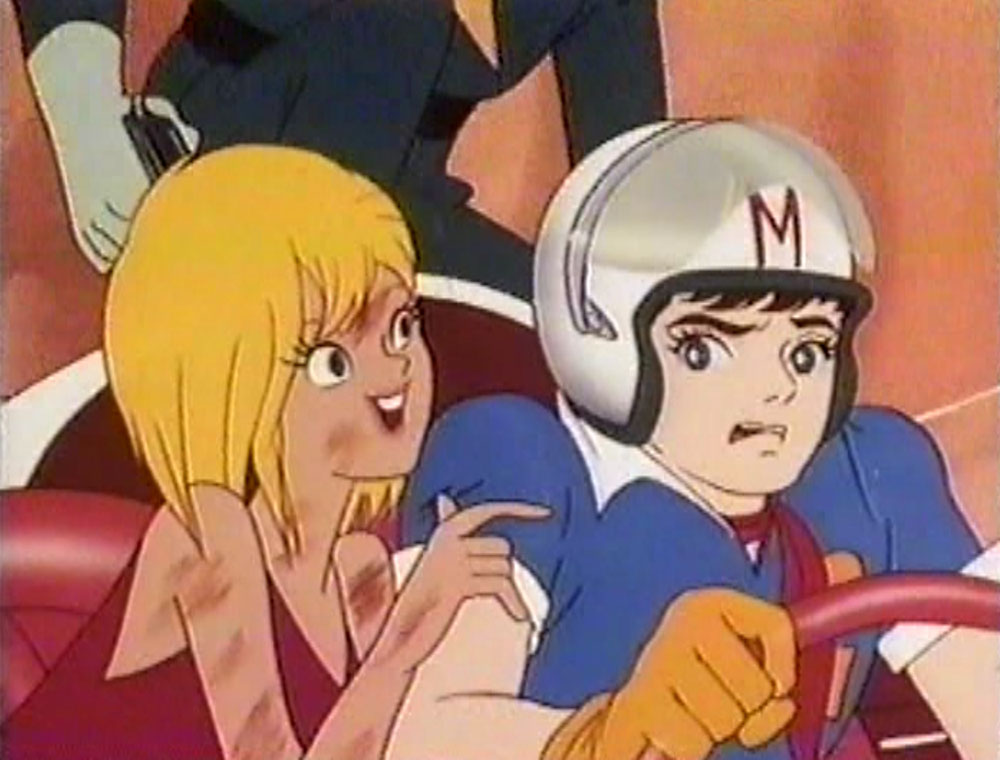 |
| Sometimes Speed is a little unsure of the adventure waiting just ahead |
Meanwhile, a steady stream of licensed material including buttons, posters, color comic books, T-shirts, and one of the earliest home video releases of an anime series (on double-bill VHS tapes shared with Trans-Lux’s Mighty Hercules) put Speed Racer on the shelves of kitsch boutiques and retro-themed college dorms across America alongside fellow deities Gumby and Felix the Cat.
 |
| Now Comics' licensed Speed Racer comics & merchandise delivery service |
As the 1990s dawned Streamline Pictures packaged “The Car Hater” and “The Mammoth Car” on home video as “Speed Racer The Movie”, with a slight assist from Alpha Team’s techno club hit remix of the Speed Racer theme song. Yes, “Alpha Team”, named after the rival racing outfit seen in episodes 3 and 4, “Challenge Of The Masked Racer.”

Your Clinton-era lifestyle can be filled with Speed
Racer; screen-printed club shirts, fake vintage tin signs,
magnets, bumper stickers, belt buckles, bendy figures, a McFarlane
Toys Mach 5 scaled to fit figures of Speed, Trixie, Spritle and Chim
Chim, and slot car racers of the Mach 5 and Racer X’s Shooting Star
can ensure no waking moment is untouched by Speed and Trixie. The
five-volume DVD set from Lion’s Gate came packaged with steering
wheels, diecast cars, and license plate holders, and those not
content to merely watch could throw the Speed Racer
Playstation game into their PSX and race against all comers.
Speed Racer returned to the Turner media empire as their Cartoon Network programmed the show for five solid years, inaugurated by a marathon spiced with a Dexter’s Laboratory spoof. Speed, Trixie, and the Mach 5 appeared in ads for Volkswagen and Geico car insurance. You could pony up a few hundred grand and drive away in your own custom street-legal Mach 5, based around a Corvette chassis and complete with buzz-saw blades. On exactly which street are those legal? Saturday Night Live’s “TV Funhouse” combined Speed and celebrity culture in “Go George Clooney”. And two pop culture worlds collided as the Speed Channel, home of America’s prospering NASCAR culture, began programming Speed Racer in between Peter Fonda biker films and coverage of nitro-burning funny cars. As long as America continues her automotive love affair, Speed Racer will have a home on our televisions.
 |
| the mysterious "Racer D" |
Outfits on both sides of the Pacific have attempted to revive the franchise as a new animated series. Murakami-Wolf’s 1990s production of The New Adventures Of Speed Racer, a lackluster sequel starring feeble adulterations of our heroes and their super-car, lasted only 13 episodes. Tatsunoko’s own 1997 re-imagining of the Mach GoGo Go concept had edgy 90s character designs and a time-travel storyline that went where no autosports enthusiast had gone before. Dubbed by DIC and shown on an abortive Nickelodeon action-cartoon timeslot as Speed Racer X, it didn’t make it through the first time trials.
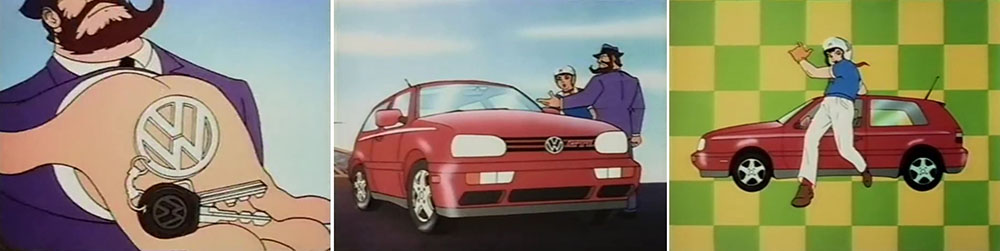 |
| Speed Racer VW GTI ad |
Remakes and reinvisionings came and went but it was 2008 before a Speed Racer remake firmly gripped the public imagination. Fresh from the Matrix trilogy and their anarcho-fantasy V For Vendetta, the Wachowski siblings threw their computer-generated weight behind a Warners/Village Roadshow feature adaptation of Speed Racer. The film starred Christina “Monster” Ricci as Trixie, Emile Hirsch as Speed, Matthew Fox from “Lost” as Racer X and Tinseltown veterans like Susan Sarandon, John Goodman, and Richard “SHAFT” Roundtree. A near-psychedelic hybrid between live-action overacting and wild CGI environments, Speed Racer was a film audiences weren’t really ready for.
 |
| Speed Racer screen-printed club shirt - racing helmet and/or fedora not included |
Though a critical favorite in some circles, the movie underperformed at the box office – but this didn’t stop Hollywood from continuing to produce money-losing anime adaptations like Astro Boy and Dragonball Evolution and the recent Ghost In The Shell. Hot on the heels of Speed Racer’s release was a new Nicktoons animated show and a tidal wave of Speed Racer merchandise that continues to this day. And soon, along with your toy Mach 5s, your t-shirts, and your DVD and Blu-Ray sets you’ll be able to purchase the entire series on Blu-Ray packaged inside Speed Racer’s head!
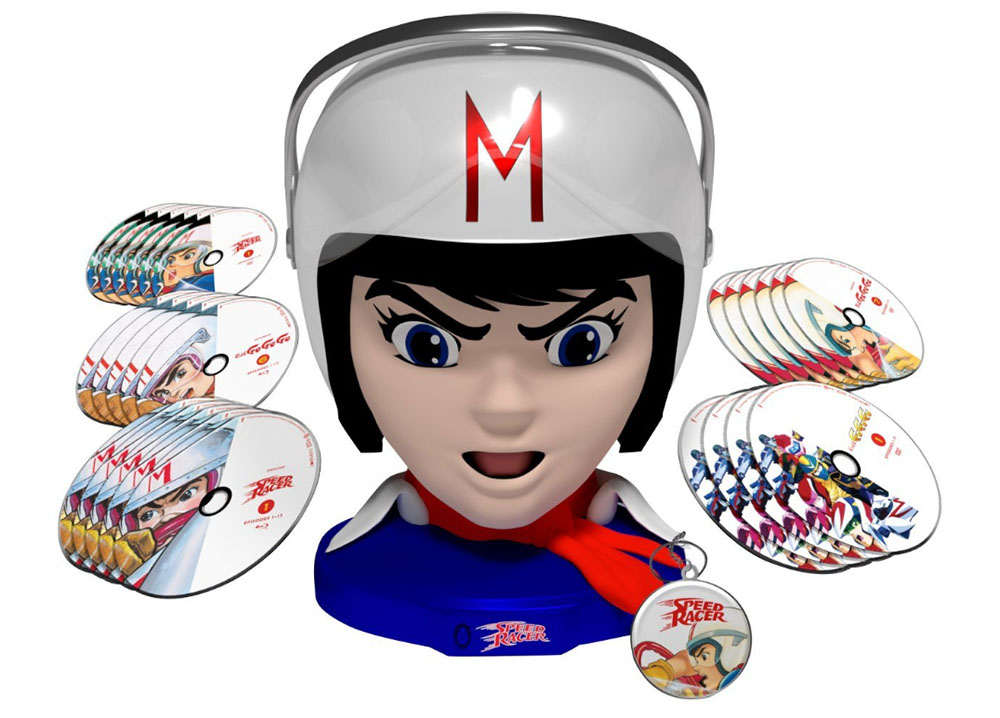 |
| Bring Me The Head Of Speed Racer |
That’s the world we live in, filled with Speed Racer merchandise enjoyed by two and three generations of Speed Racer fans, yet sadly lacking a real-life Race Around The World. Will Speed Racer find it difficult to thrill in a world of electric cars, boxy SUVs, and traffic calming zones? Or will the innate desire of every child to race towards adventures waiting just ahead keep Speed Racer in the winner's circle? And seriously, will Speed ever find out Racer X is his older brother? Because it's really obvious, Speed.
-Dave Merrill
A version of this article previously appeared in Otaku USA magazine.

Thanks for reading Let's Anime! If you enjoyed it and want to show your appreciation for what we do here as part of the Mister Kitty Dot Net world, please consider joining our Patreon!