Showing posts with label tms. Show all posts

Thursday, August 28, 2025

1965: The Year Anime Went Beyond The Moon

Right now it's 2025, and that means it's as good a time as any to take a look back sixty years and see what Japanese animation looked like in 1965. Except it wasn't called "anime" back then, the term of art was "terebi manga," largely because a lot of what was showing up on Japanese TV in cartoon form had started as newspaper comics, or weekly comics, or comics in general.  However, by 1965 those lines were beginning to blur.  Mass media marketing began its synchronized attacks upon the spare change of Japan's youth. We're still living in the Dentsu age where animation is but one part of a vast promotional machine, and it all got started in those days of the 1960s. But what did what we'd later call "anime" look like, six decades ago? Well, it kind of looked like this. 


Space was the place in 1965! America and Russia both sent probes to the Moon and Mars, while both astronauts and cosmonauts ventured outside their space capsules for the first time. Meanwhile on TV screens, Tatsunoko's first-ever series Space Ace arrived... from space! Based on Tatsuo Yoshida's manga, Space Ace is a boy from the lost planet Parum who was separated from the rest of his people and landed on Earth. Found by Doctor, uh, Tatsunoko, Space Ace uses his amazing Parum abilities of having a stretchy body, a silver energy ring, and a platinum ray to help his new friends and the Earth. Ace replenishes his energy by chewing special energy gum - candy company Kanebo Harris (now Kracie) was a sponsor, and Ace also appears in the bubble gum commercials that air during the show. Tatsunoko pitched Space Ace to American syndication, but nobody in the US took the bait. I've long heard rumors of an English pilot for this series, but so far all that exist are rumors. 


Meanwhile in '65, the TCJ crew responsible for Tetsujin-28 aka Gigantor were hard at work bringing Space Boy Soran to Japanese TV, where it would air from May 1965 until March of 1967. Soran is the son of noted scientist Dr. Tachibana who designed a super bomb and then fled with his family to outer space, as one does. Only Soran and his sister survived the crash of their spaceship. Soran was raised by space aliens who rebuilt him into a cyborg and he returns to Earth years later with super powers and a sidekick, Chappy the Space Squirrel, to search for his sister and also to battle evil, of course. Was Space Boy Soran's space squirrel adventure a little too similar to Osamu Tezuka's "No. 7" manga, and did Soran's production cause Tezuka to forestall production of a No. 7 anime series and instead retool the concept into Wonder 3? Only Galactic Command has the answers.


TCJ's Super Jetter is the story of Time Patrolman 723567 who flies from the future in his time-ship Ryusei-go (“Shooting Star”) in pursuit of the criminal Jaguar. Trapped in the 20th century, Super Jetter finds himself using his future powers to battle for justice! This series was commissioned by TBS as an original work rather than adapting an existing property; after TBS found out they'd inadvertently sold all the international rights to Eight Man to ABC Films, they wanted another show they could control exports of. Super Jetter was created by Fumio Hisamatsu, who also did manga for Ultra Seven, Godzilla Vs Mothra, Mighty Jack, UFO Warrior Daiapollon, and Yatterman. The series was originally in black and white but 26 episodes were remade in color for export, screening in Mexico as "El Hijo de Meteoro."


Also from TCJ, starting in June of 1965, was Planet Boy Papi, the story of the boy from the planet Clifton sent to Earth to sell Glico candy - the show was the second after Tetsujin-28 to air in "Glico Theater" time slot -  and fight evil with his powerful Metalizer pendant and the help of a top evil-fighting combo made up of an Arabian wizard, a professional wrestler, and a little girl. We here at Let's Anime were deeply affected by Prince Planet in our youth, and subsequently have written extensively about this series and its English language release as Prince Planet, which was dubbed by Miami's Copri International Studios and syndicated by American International Television.  


Toei's Space Patrol Hopper was sponsored by Daimaru Department Store and later was retitled Patrol Hopper: Space Kid Jun. The titular Jun is an Earthling who got caught up in a conflict involving space aliens. Injured, Jun was rescued by planet Hopper's Space Patrol. The Hopperians, or Hopperites, or Hopperutians, whichever, those guys rebuild Jun as a cyborg using their scientific power, and he becomes a member of their Space Patrol, fighting to protect peace in the universe and on Earth. The terrific Yasuji Mori character designs are all over this show, which is peak mid century design throughout its 44 episodes, airing from February to November 1965.


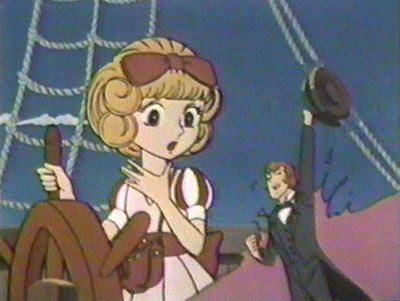
The year's only Japanese animated theatrical release was also an outer space adventure. Gulliver's Space Journey is a Toei film about a homeless boy named Ted; he and his friends come across Gulliver, you know, the one from Jonathan Swift's 1726 satirical novel Gulliver's Travels. Our modern Gulliver is about to take off in his rocket ship to the Hope Star, which has been conquered by robots! Gulliver's Space Journey has an all-star pedigree. The film's screenplay is by Shinichi Sekizawa, who wrote the lost film "Fearful Attack Of The Flying Saucers" as well as cinematic milestones like Godzilla Vs Mothra, Latitude Zero, Destroy All Monsters, and Jack And The Witch. Gulliver's music is by Isao Tomita, who would also score Jungle Emperor for Tezuka's Mushi Pro. 


Key Gulliver animation was by Yasuo Otsuka, with in-betweening and certain scene concepts by Hayao Miyazaki. Ted's voice actor is Kyu Sakamoto, the first Japanese singer to hit number one on the US charts with his hit song "Ue o Muite Arukō", or, as it was incongruously renamed in the States, "Sukiyaki." The English language version, retitled Gulliver's Travels Beyond The Moon, would be released in US theaters by Walter Reade - Continental in 1966, with new music by Milton & Anne Delugg and Darla Hood from "Our Gang" voicing the Princess. The film would continue to play US theaters through 1975, and would be the last Japanese animated film to hit America until 1971's The World Of Hans Christian Andersen.


A more earthbound series from Toei's 1965 stable is Hustle Punch, which might be the closest Japan ever got to the Hanna Barbera style zany talking animal slapstick comedy adventure formula.  Punch (a bear), Touch (a mouse), and Bun (a weasel) all live in a scrapyard and battle the evil plans of Professor Garigari, a wolf who wants to build his own city over their hometown. This TV show delivered rollicking fun from  November '65 until April '66. Hustle Punch creatives Yasuo Otsuka, Isao Takahata and Hayao Miyazaki would later bring this sort of chaotic amusement to human-being shows like Lupin III.


Fujiko-Fujio's Obake no Q-Tarō becomes animated in a 1965 series broadcast on TBS and produced by A-Production and Tokyo Movie, who would later become TMS. Q-Tarō is a friendly, sometimes timid ghost somehow attached to the Ohara family. Our ghostly star is voiced in a breakout role by the protean talent of Machiko Soga and lives, if that's the right word, to cause mischief. This is much to the chagrin of elementary school student Shōta Ohara, Q-Tarō's best pal. The success of this goofy ghost's adventures caused what was called a "Q-Tarō Boom" which would later inspire, among other things, the ghosts in Pac-Man. The Fujiko-Fujio team would also create Ninja Hattori-kun, Kaibutsu-kun, Perman, and Doraemon, which is to say they're behind some of the most popular cartoons in Japan, and in some cases, the world. The 1971-72 Q-Tarō series was broadcast on some US television stations as "Little Ghost Q-Tarō."


Perhaps the biggest star of 1965 was Mushi Pro's Jungle Emperor. Based on Osamu Tezuka's 1950 manga, the TV series was the first color animated series produced for Japanese television. The story of (stop me if you've heard this one before, Disney) how the son of the king of the jungle returns to regain his rightful place as leader of the animals, this show was animated by Tezuka's Mushi studio and began airing in October of 1965, Wednesdays 7-7:30pm on Fuji-TV. The animation may have been simplistic, and the character designs cartoony even by Tezuka standards, but the epic scope of the series, punctuated by Isao Tomita's grand soundtrack, elevates Jungle Emperor into legendary status. 


NBC Films helped to finance the production and exported the series to America as "Kimba The White Lion." Consequently, the series episodes didn't feature continued storylines, violence was toned down, and as the corporate history states, "particular care was taken in the depiction of black people." Absent NBC financing, Mushi's 1967 sequel series "Go Leo" was more faithful to the original manga storyline. Go Leo featured continued stories and more violent content, and subsequently did not air in America until 1982. 


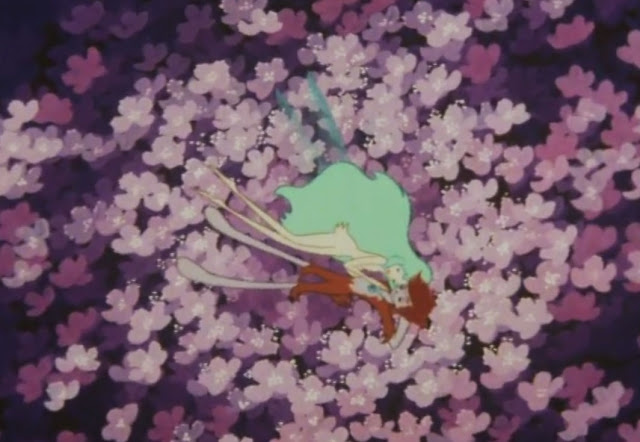
1965 brought us some impressive milestones, but also some confusing missteps, in the shape of Mysterious Thief Pride. Otherwise known as Dr. Zen And The Magic Machine, this weird Tele-Cartoons Japan series of five minute shorts stars the titular thief Pride and his canine companion. Pride & Co. commit zany robberies while being pursued by boy detective Doublecheck, his big pal Broken, and their honeybee fairy friend Honey. Airing on Fuji TV at 6:10pm, this series was in black and white, but was colorized and dubbed for export under the "Dr Zen" title. It's unclear if this series ever made it to air on North America. And why would it?


1965 continued anime's path towards lucrative property licences and blizzards of toy tie-ins, into increased international audiences and full color productions, a year 1966 and 1967 would build upon in new and exciting ways. Other shows of 1965 include warring-states period boy ninja Fujimaru Of The Wind, the Tezuka cyborg Big X, the live-action/animation hybrid Bibi The Alien, and of course Wonder 3, the Tezuka adventure of a bunny, a duck, and a horse, sent here by Galactic Control to save or destroy the Earth. 


Sixty years later, what remains of 1965? They're making another Jungle Emperor. You can still buy Obake no Q-Tarō merchandise, TCJ still exists as Eiken and still has animated shows on the air every week. Sponsors still build ad campaigns around TV animation and studios like Toei, TMS and Tatsunoko continue as major players in the biz. 1965 helped build the pipeline that fed the superhighway that laid the rails that blazed the trails that brought us to today, a world where kids of all ages around the world still watch Japanese animation. Next up: 1975!

 -Dave Merrill


Thanks for reading Let's Anime! If you enjoyed it and want to show your appreciation for what we do here as part of the Mister Kitty Dot Net world, please consider joining our Patreon!


Sunday, December 12, 2021

ninteen anime eighty-one part two


Last time here at Let's Anime, we looked at the Japanese anime television of 1981. And let's make no mistake; that was so much TV, you’d think people didn’t have any time to get out to theaters to see anime films. Remember movie theaters? I miss seeing movies in theaters. Anyway, now we're going to take a look at what those people were looking at when they quit looking at their TVs and instead hit their local cinemas to look at anime films, those anime films of 1981. I'm gonna throw some TV movies and specials in here too, just to confuse everybody. 

 
cosplay at the Gundam I premiere

Mobile Suit Gundam might have not been a big success in 1979, but the show refused to vanish, and two compilation films were released in 1981 to great fanfare with a third, final film screening in 1982. Much like the success of the earlier Space Battleship Yamato film, this new theatrical re-imagining of a television series put Mobile Suit Gundam on the pop culture map, and soon Gundam model kits would be standard issue in every otaku's survival kit. The movies received both dubs and subs here in North America through a variety of formats and localizers, and you can watch all three right now on Netflix.
 
 
The twelfth-century fairy tale of the runaway four musical animals is known in German as "Die Bremer Stadtmusikanten" and was made famous by the Brothers Grimm. Here the story become the basis for Bremen 4 - Angels In Hell, Osamu Tezuka’s fourth TV movie produced for NTV's annual 24-hour charity program Ai wa Chikyū o Sukū ("Love Saves the Earth"), as a space alien sent to save the Earth from war transforms woodland animals into people that just happen to form a rockin' band. Sure, this brings to mind Tezuka’s 1960s series Wonder Three, and why not?


The Hello Kitty company Sanrio front-loaded the rollout of their late 70s magazine Lyrica with a lineup of manga all-stars. Osamu Tezuka’s contribution was Unico, the story of a little unicorn wandering lost through lands of myth and legend. This became a 1981 feature film from Sanrio with animation by Madhouse, and it is an absolute gem, at turns beautiful, haunting, psychedelic, and Margaret Keane-level sugary. Columbia released an English version in the 1980s to home video and cable TV markets, and you can relive your 80s youth today with Unico on DVD and blu-ray from Discotek, and streaming on various platforms.  


Sanrio continued its theatrical anime assault with Sea Prince & Fire Child aka the Legend Of Sirius, a Disneyesque re-telling of Romeo and Juliet recast as a romance between children of the gods of the ocean and of fire. Darker and less cutesy than Unico, Sea Prince & Fire Child also received an English-language Columbia release & subsequent Discotek disc.


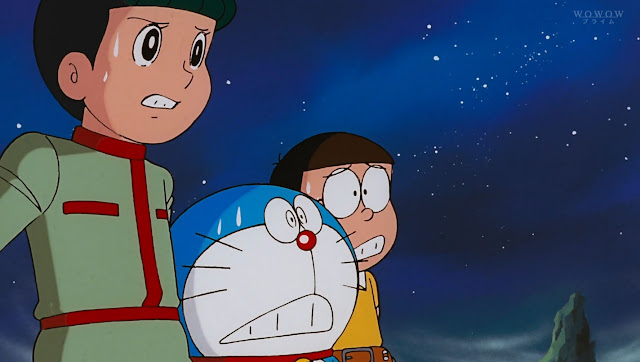
Slightly less mythological is Doraemon: The Legend of Spaceblazer Nobita, an extra-dimensional adventure where amazing robot cat Doraemon and doofusy human kid Nobita must save the planet Koya Koya from total destruction! Popular throughout the world, Doraemon has yet to make it in the American market, and it's a shame because American kids would really enjoy the knock-offy Star Wars vibe of this feature.


Speaking of total destruction, that’s what Tatsunoko did to the original source material when they adapted Jules Verne’s 20,000 Leagues Under The Sea into Kaitei Daisensou Ai no 20,000 Miles aka Undersea Encounter, sometimes called The Great Navy Battle: 20,000 Miles of Love. In the future, the Emperor Darius seeks to rule the entire world, but is opposed by the Nautilus, captained by Captain Nemo with the help of two castaways Ricky and Ben. Harmony Gold had the license to this TV movie, but their English dub is hard to come by.


Mary Shelley’s Frankenstein got slightly better treatment when Toei adapted her groundbreaking, genre-inventing novel for a TV special. Toei's Kyōfu Densetsu Kaiki! Frankenstein was directed by Toei's all-star tag-team of Yugo Serikawa and Toyoo Ashida, and in true Dr. Frankenstein style, great liberties are taken with the original source material. Part of the Toei/Marvel Comics deal that gave us Hamburger Dracula and Spiderman's giant robot, it's unclear how much this feature draws from the Gary Friedrich/Mike Ploog Marvel comic series.  Dubbed by Intersound, this was released on VHS in the United States.


The original master thief battles the original master detective in the Toei TV special Lupin Vs Holmes. The two Victorian-era rivals are pitted against each other in this adventure, based on a 1906 novel that featured Arsene Lupin and a Holmes pastiche that was written by Lupin creator Maurice LeBlanc. This anime has had home video releases in a few countries, but not Japan.


The inspiring true story of Helen Keller became a quadruple-Tony winning stage play, an Academy Award winning film, and also a Japanese anime TV special from TV Asahi. The only version I've ever seen has Finnish narration on top of the Japanese dialogue, making audiences perhaps appreciative of a little silence.


Tchaikovsky's Swan Lake comes to the anime screen in this theatrical version produced by Toei that manages to capture the majesty of the original ballet while also delivering anime-style entertainment. Was the Swan Lake character of "Odille" the inspiration for Vampire Hunter D's Lamika? Hmm.  Swan Lake got an English dub from Turner Program Services for the cable TV market and is currently streaming and on DVD from Discotek.


Jack London’s gritty tale of up-North survival and the journey of Buck from former pet into pack leader alpha dog becomes a telefilm from an obviously overworked Toei. Their Call Of The Wild stays reasonably close to the source material and was dubbed by Intersound, achieving immortality through VHS and bargain-bin DVD releases and screenings of "Totally Lame Anime."


In Enchanted Journey, Gliko the chipmunk punk leaves his comfortable tame life and battles his way to freedom in the great north woods. Known in Japan as The Adventure Of Glicko, this animals-in-peril feature is from Studio Korumi and is based on the children's book by Atsuo Saito. The English dub, featuring voice work from Orson Welles and Jim Backus, aired on HBO and got several home video releases.


Last time Let's Anime discussed the TV anime Jarinko Chie aka Downtown Story aka Chie The Brat, the TMS series based on the Etsumi Haruki manga. That TV show was a followup to this Jarinko Chie film, a Toho/TMS/Telecom feature directed by future Ghibli star Isao Takahata. This cinematic adventure of Osaka's scrappy street kid played in theaters in a double bill with our next feature.


Based on the 4-koma gag manga by Masashi Ueda, Furiten-kun is a goofball salaryman appearing here in his only feature film. Furiten's cinema debut consists of 7 short segments and is a production from Oh! Production and the studio that brought you Chargeman Ken, Knack.


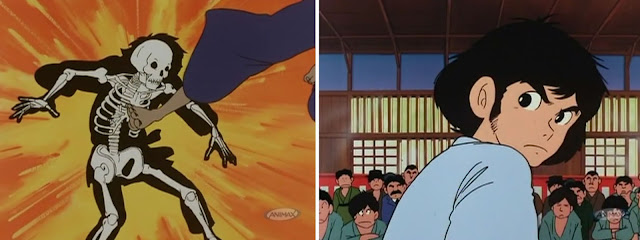
Sanshiro comes to Tokyo to become a martial arts champion, becomes the disciple of judo master Yano, and falls in love with Sayo Murai whose father teaches martial arts to police. Along the way Sanshiro battles his rival, the jujitsu fighter Higaki Gennosuke. It's all happening in the Sugata Sanshiro anime TV special (aired June 8) from TMS/Telecom, based on the novel by Tsuneo Tomita and with character designs by Kazuhiko Kato / Monkey Punch!


Joe Yabuki meets his destiny in the boxing ring in Tomorrow’s Joe 2, a feature based on the immensely popular Tetsuya Chiba manga, as directed by Osamu Dezaki with character designs by Akio Sugino. Is this the first time the Dezaki/Sugino team would revisit a property they'd brought to animated life on television? 


Space Warrior Baldios, the Ashi Pro/MIC environmental disaster super robot series, wrapped up its 1980 TV series with a 1981 feature that recapped the story and added a downer ending. This got a dub courtesy Peregrine Film which made it to VHS and some UHF TV markets in the States in the late 80s before being license-rescued on disc from Discotek and streaming via Crunchyroll/Retrocrush.


Tetsuro Hoshino re-embarks on the 999 for one last trip through and beyond the galaxy to defeat a revived Mechanized Empire and discover the truth about himself in Adieu Galaxy Express 999: Final Stop Andromeda, in theaters August 1, 1981. This is the second 999 film from Rintaro (Shigeyuki Hayashi) and some might say the movie is a redundant retread of the first 999 picture. However, this gorgeously animated story claims its own visual territory while forcing Tetsuro - and the viewer - to re-evaluate everything they thought they knew about eternal machine life. It’s on several streaming services and you can buy the DVD and Blu-Ray from Discotek.

First TV, then movies; that's our roundup of 1981 in Japanese animation. Of course there are series and films that didn't make the cut due to time and space constraints, the limits of research, and me wanting to get this thing done with before 2021 ends. I didn't even mention the shows that carried over from 1980, like Fishing Sanpei, Tetsuwan Atom, Tetsujin-28, Doraemon, Sazae-san, etc. So if I missed something, and I definitely did, don't blow a gasket. But what are the winners? What are the standout anime titles from forty years back that still have an impact today? What are the anime series that keep kicking around inside my skull after decades, and what therapy exists to make them stop?
 

Well, Superbook might have had some extra name recognition on account of it being attached to a two thousand year old religion. There's that. However, this simplistic, clunky show achieved syndicated Japanese cartoon eternal life thanks to cable and broadcast runs that lasted decades, scores of different home video releases distributed via the American Christian media ecosystem, and the show's remarkable popularity in former Soviet bloc nations.


Queen Millennia was the last Leiji Matsumoto property to come out of that 'anime boom' era, the last time his mashup of SF, vintage tech, kids and dream girls would manifest itself in Japan's popular culture. The subsequent succession of Matsumoto remakes, reboots, and reimaginings have had varying degrees of artistic and commercial success, but none have become as popular as his late 70s - early 80s adaptations. The 1981 Queen Millennia show would find itself on American TV screens a few years later, uncomfortably Frankensteined together with 1978's Captain Harlock to make Harmony Gold's "Captain Harlock And The Queen Of 1000 Years," the first many of us would see of either series.


1981 was the year Nippon Sunrise's Mobile Suit Gundam came roaring back out of obscurity to remind us all this series was still in the fight for, and would eventually assume, the throne of Robot King. Sunrise and Gundam's success story has helped move Japanese animation out of our small anime-nerd world and into universal popular culture, and the word "Gundam" itself has come to stand for "SF robots" the world over.


Urusei Yatsura showed up to electrify the anime world in October of 1981. This boy-meets-space-alien series inverted shojo manga tropes and built a subversive, stylish, surrealist romantic-SF-comedy anime empire that would influence the entire field for the next decade and beyond. 


Some of my own personal 1981 favorites might not have been as earth-shakingly impactful. Adieu Galaxy Express perhaps let the visuals get way ahead of the script, but those visuals make a film that sheds its 70s skin and reveals shining neon colors bursting out of the absolute blackness of space, enormous extra-galactic mechanical contrivances contorting in miles-wide convulsions, and a surprise 2001-style Stargate sequence, all to get Tetsuro to yet another showdown with the Mechanized Empire.


And of course, one of my faves from 1981 is the MIC comedy-adventure Honey Honey, based on the 60s Hideko Mizuno shojo manga. If you blinked in either Japan or the US you might have missed this show, but it still made a few fans.

1981 still echoes in today's animation landscape. Urusei Yatsura's manga is being reprinted in English and the films are getting Blu-Ray releases, while Superbook is still on the air in some markets. Grown up kids still talk about Unico and forming Voltron's Blazing Sword. And while Furiten-kun and Bremen 4 remain obscure, while the anime Frankenstein and the Call Of The Wild have passed into kitsch, and nobody anywhere gets to watch Arsene Lupin Vs Sherlock Holmes, the mobile suit aesthetic of Mobile Suit Gundam has conquered the Earth Sphere along with the real world, one plamodel at a time. So long 1981! 
 
-Dave Merrill

Ninja Dog says "see you next time!"

Thanks for reading Let's Anime! If you enjoyed it and want to show your appreciation for what we do here as part of the Mister Kitty Dot Net world, please consider joining our Patreon!

Sunday, November 21, 2021

ninteen anime eighty-one part one


Hey gang, earlier this year during the online Anime North convention, I delivered a virtual presentation all about what Japanese animation was like forty years ago, back in 1981. Well, those convention panels, even online ones, move pretty fast. If you aren’t careful you’ll miss something. I know I did! So that’s why today here at Let’s Anime we’re going to take that presentation and turn it into a column that we all can enjoy at our leisure.

Of course, 1980 was a big year for Japanese animation; big movies, big franchises, big shows. But if you thought 1980 was packed with cartoon goodness, well, you hadn’t ain’t done seen nothin’ yet. 1981 made 1980 look like a quiet Sunday at Grandma’s. Don’t believe me? Just look at what we’re looking at first.


1981 had no idea this show was going to become a massive international success. King Of Beasts Golion was one in a long line of Toei super robot cartoons built around a toy – they literally designed the toy first and the show was written around its five combining lion mecha robot beast fighters. Golion came and went in Japan without making too much of an impact, but when World Events Productions localized it as Voltron, it was exactly what North American kids were looking for. Voltron and its various sequels, reboots, and remakes continue to loom large in our collective memories.


Meanwhile, American televangelist Pat Robertson was looking for a way to sell Bibles in Japan, and the ad agency he hired told him “make a cartoon.” Tatsunoko was contracted and the result was Anime Oyako Gekijo, or as it was called on CBN Cable, Superbook, the story of three children and a time travelling robot experiencing bible stories. Superbook aired on cable and broadcast TV, was released on home video several times, and currently exists, like the Bible itself, in several different versions. We’ve written about Superbook and Flying House and Superbook II before!


Speaking of co-productions, the legendary Greek epic of Ulysses got an anime makeover in Ulysses 31, a TMS-DIC co-production updating the Homeric epic to the 31st century. America didn’t get this show until a few years later but those who saw it were dazzled by the sweet Osamu Dezaki animation, which blew away pretty much everything else on the TV.


Over on the cable channels you might have been watching Nickelodeon when they aired MK Company/Visual 80/Toho’s Meiken Jori, or as we know it, Belle & Sebastian. Inspiring live-action films and Scottish indie pop bands, this adaptation of the 1965 French novel is about a boy and his dog and another dog on a journey through the Pyrenees as they elude the cops and search for mother. I’d say this one’s long overdue for a North American DVD release.


Can a gloomy abandoned girl find happiness again in the paws of a ridiculous stray dog? Find out in Ohayo Spank! This 65 episode TMS series was based on the Nakayoshi manga by Shunichi Yukimuro and Shizue Takanashi, and found success in Japan and Europe. Sadly, Hello Spank’s only North American foothold was an English-narrated promo reel and a children’s plastic chair.


The Robinson family gets marooned on a mysterious island in the Nippon Animation World Masterpiece Theater adaptation Swiss Family Robinson – Flone Of The Mysterious Island, based on the novel by Johann David Wyss. The 1981 anime series adds a Robinson daughter to the cast and you can watch it in English on Amazon Prime, if you want to know if they ever get off that island!


Another western literary adaptation is MIC’s Little Women teleseries, one of the many times Louisa May Alcott’s novel has been translated into anime form. This version lasted 25 episodes and was dubbed by Sound International Corporation, the same people that dubbed Honey Honey and Leo The Lion. Did it exist in America beyond a few VHS tapes?


The Three Musketeers battle again, this time as dogs, in Dogtanian, a co-production between Japan’s Nippon Animation and Spain’s BRB International. Enjoyed by children worldwide – there’s even an Afrikaans dub and an Albanian dub - one version of the English voices were provided by Americans living in Madrid.


Meanwhile over in Scotland, let’s say hello to Hello Sandybell, the Toei series about the young Scots girl with an enormous dog and a cottage surrounded by flowers. Will she finally be reunited with her mother? Will her romance with the handsome rich kid who lives in the castle up the hill finally be realized, or will her rival Kitty win out? Watch the show and find out. Fair warning: this show features a character named “Mark Brunch Wellington.”


1981 was a big year for romantic European gals. MIC’s Honey Honey, based on the manga by Hideko Mizuno, is literally chased around the world because her cat Lily happened to swallow the priceless gem the Star Of The Amazon. It seems Princess Flora of Austria promised to marry whoever retrieved the jewel, which she had inserted inside a fish, fulfilling some no doubt whimsical Central European tradition. A crew of ethnic stereotypes and handsome masked thieves track Honey from Austria to Germany, France, England, Spain, Italy, Iraq, Japan, Norway and Russia only to wind up in New York City. This 29-episode shoujo comedy was dubbed into English by Sound International, aired in the US on Pat Robertson’s CBN Cable, and has only had a few sporadic home video releases.


And in modern day Japan, the glamourous young teacher Miss Machiko is forced to endure a constant parade of sexual harassment from her elementary school class in a Studio Pierrot anime series that lasted 92 (!) episodes and inspired eight (!!!!) different live-action versions, all based on eight volumes of Takeshi Ebihara manga, because Japan loves this kind of thing, I guess. Don’t take my word for it, watch it for yourself on Crunchyroll!


Japan also loves pro wrestling and Tiger Mask II delivers the kind of powerful masked grappling that inspires millions of fans, and also inspires Tatsuo Aku to don the titular mask and become the second Tiger Mask in this sequel to the early 70s Toei hit, which was based on the popular manga by Ikki Kajiwara and Naoki Tsuji, and which also inspired real-life wrestlers, as well as a legacy in the ring and on TV that lasts to this day.


The 65 episode Tatsunoko series Dash Kappei stars diminutive high school sports champion Kappei and was remarkably successful in the ratings, maybe because of Kappei’s panty fetish. Nope, not kidding.


Etsumi Haruki’s Jarinko Chie, or Chie The Brat, or Downtown Story as TMS would have you call it, is the story of a short-tempered Osaka girl named Chie and her ne’er do well gambling father, as Chie valiantly attempts to get Dad meaningful employment and a reconciliation with mom.


Kenichi’s best friend is the little ninja Hattori, who has amazing ninja powers but is deathly afraid of frogs. Based on the manga by Fujiko A. Fujio, the Shin-ei anime series Ninja Hattori-kun lasted an impressive six hundred and ninety-four (694!!) episodes.


You might know Akira Toriyama for Dragonball, but his first manga success was Dr. Slump, the tale of a fumbling genius inventor and his greatest creation, the robot girl Arale. Toei’s cartoony, colorful, crowded, and crazy Dr. Slump anime series ran for 243 episodes, ten movies, a 1997 remake, and at one point crossed over with this series ---


Queen Millenia is based on the Leiji Matsumoto manga of the same name which was serialized one page a day, five days a week, for 1000 days, in the Sankei Shimbun and Nishinippon Sports newspapers. That was the plan, anyway. Toei Doga would animate 42 episodes about of the discovery of La Metal, the 10th planet, which not only is on a collision course with Earth, but whose advanced civilization sends a queen to secretly rule over Earth every thousand years. What happens when La Metal’s queen sides with the Earth people? This mashup of the Princess Kaguya tale, the kook-science works of Immanuel Velikovsky, and the film When Worlds Collide would be edited together with the 1978 Captain Harlock anime and be shown in America as “Captain Harlock And The Queen Of 1000 Years.” And as mentioned, there was that crossover with Dr. Slump.


Over at Tatsunoko, the Time Bokan series continued with the fifth installment Yattodetaman, as Princess Karen and her robot guardian Daigoron travel back in time to 1981 to recruit Wataru Toki and Koyomu Himekuri in a quest to capture the immortal fire-bird Phoenix - no relation to Tezuka's Hi no Tori.


Prince Mito and his loyal retainers set out in the super robot Daioja to inspect the galactic empire in this fifty-episode Sunrise sci-fi update of the popular Mito Komon jidaigeki television series.


Also from Sunrise, Fang Of The Sun Dougram documents the guerrilla rebellion of planet Deloyer from the corrupt Earth Federation and its puppet government. Created by Ryosuke Takahashi, this real robot series featured mecha designs by Gundam’s Kunio Okawara, and toys and model kits of this series’ mecha would appear in North America both badged as “Robotech” and under the Dougram brand, while Dougram manga by Yoshihiro Moritou would see print in Kodansha’s Comic BonBon, not to be confused with the completely different Dougram manga by Yu Okazaki, which was running at the same time in Adventure King, make up your mind Japan.


Robot mayhem continues from TMS with God Mars! Earth is attacked by the Gishin space empire, led by the dark emperor Zule. Our only hope is Crasher Squad member Takeru Myojin, who it turns out is actually a Gishin space alien with ESP powers and a six-god combination super robot that doubles as a planet-destroying bomb sent to demolish the Earth! Based on the manga by Mitsuteru Yokoyama, TMS’s God Mars ran for 65 episodes of colorful, science fictiony, very not-real robot action, and you can watch it right now streaming for free on Tubi.


Speaking of unreal robots, Sengoku Majin Goshogun is all about how the shadow illuminati Dokuga, secretly ruling the world for Lord NeoNeros, comes under attack by Good Thunder and the GoShogun team, using Beamler energy to battle for the fate of humanity! Ashi Pro’s Goshogun only lasted 26 episodes but its mix of colorful action and fun characters captured enough fans to get a compilation film and a sequel OAV. Portions of the show were dubbed into English as “Macron 1,” the television broadcast version of which contains music video segments featuring covers of popular 80s tunes. The Japanese series has been released in North America by Discotek and is streaming on Retrocrush.


Hiro Taikai finds a gold cigarette lighter that instead of helping smokers to get lung cancer, is actually the transforming sentient super robot Gold Lightan, sent to defend the Earth from invasion by the Mechanic Dimension. This Tatsunoko series lasted 52 episodes and is streaming on HIDIVE!


From the studio that brought you Little Women and Honey Honey comes Galaxy Cyclone Braiger, the first in Yu Yamamoto’s J-9 series. In the lawless Asteroid Belt, four outer space commandos for hire use their expanding plasma super robot Braiger to defy the cult-leader crime-lord Khamen Khamen, who plans to blow up Jupiter. Will he succeed? Get the discs from Discotek and find out!


Rumiko Takahashi’s outer space high school comedy Urusei Yatsura concerns itself with the tumultuous relationship between the space princess Lum and the Earthling reprobate Ataru, except when it focuses on their equally wacky friends and neighbors. Urusei Yatsura came to TV in 1981 courtesy Studio Pierrot, and its mix of girls, gags, and galactic shenanigans would last 218 episodes, spawn six feature films, appear in a Matthew Sweet music video, and generally obnoxious-alien its way into pop culture legend. The series was released in English by AnimEigo and the pilot was dubbed into English on two separate occasions.
That’s an awful lot of anime TV shows! Join us next time when we head to the movie theater, buy a ticket, some soda, a large popcorn, and some Twizzlers, and also take a look at the Japanese anime theatrical films of 1981!
-Dave Merrill


Thanks for reading Let's Anime! If you enjoyed it and want to show your appreciation for what we do here as part of the Mister Kitty Dot Net world, please consider joining our Patreon!