Showing posts with label nippon animation. Show all posts

Monday, April 15, 2024

With An "E"

Let me start with a personal note. I grew up in the US, but twenty years back I moved to Ontario to begin a new adventure north of the border. As a new Canadian, I lacked the cultural background that informed the upbringing of many of my new friends and coworkers. I didn't know Mr. Dressup or The Friendly Giant. I was sadly unaware The Littlest Hobo was, in fact, a dog. I'd never been to the Pop Shoppe, didn’t know who Tim Horton played hockey for, never watched Late Great Movies On Citytv. But there was one Canadian cultural giant that I and millions of others were aware of, one that predated SCTV, Celine Dion and the Kids In The Hall. Perhaps the biggest early Canadian pop culture export? An orphan girl named Anne. 

my Anne LDs

The story of a child finding a home and a life in turn of the century Prince Edward Island, Lucy Maud Montgomery’s 1908 novel Anne Of Green Gables has sold fifty million copies, been translated into 35 languages, and has been the subject of films, TV shows and stage plays. This red-headed heroine appears in a bewildering variety of media including dolls, toys, picture books, musicals, museums, costumes, even license plates for the fictional Anne’s very real province of PEI. L.M. Montgomery was from PEI herself and used her childhood as inspiration for what would eventually become a series of Green Gables novels, even as she moved to Ontario and what we’d now call the Greater Toronto Area.

drive carefully, Anne lives here

There's a part in Montgomery's novel where the fire in the Green Gables hearth on a November night is described as "the sunshine of a hundred summers being distilled from the maple cord-wood" and I'm reading this and asking myself, did that L.M. just get away with this? She did, didn't she. The prose of Anne Of Green Gables is filled with minute, evocative, almost-sentimental touches of descriptive poetry - certainly in keeping with the Gilded Age provenance of its origins - and it speaks to the determination of Anne and through her, Montgomery, to find the beauty and wonder in what at first glance might seem to be unexceptional places, humdrum tasks and the sometimes tragic moments that make up life, a tall order for an unwanted child in a world that has almost no sympathy or resources for anything other than itself. 


Anne begins with middle-aged siblings Marilla and Matthew Cuthbert requesting a boy orphan to adopt to help out around their Avonlea farm, as if they were buying a draft horse or ordering a new plow. When Anne arrives instead, there’s some clinical calculus as the Cuthberts weigh their agricultural needs against the literal welfare of a child. At this time, Canada was seen as a convenient destination for the unwanted children of late-period British Empire; from 1869 right up until the late 1940s the UK sent something like a hundred thousand children to homes across Canada. Most would spend their remaining childhood as de facto indentured domestic servants or field hands. The reality is that most of these children weren’t actually orphaned; most had parents overcome by financial or personal disaster, forced by circumstances to break up their families. Anne’s orphan drama played out in real life for decades on train platforms across the country from Nova Scotia to British Columbia.

my Anne cel

We first see Anne as an awkward tween, sometimes overwhelmed as her overclocked imagination battles her desperate desire to belong.  She matures to become a self-disciplined young woman determined to make something of herself, along the way, pulling Marilla and Matthew out of their gruff, glum routine and into a more fulfilled, if less orderly life, while making friends and rivals alike at the local school. Anne's overworked sensitivity shows its negative side when she overreacts to minor things, exploding them into major life-altering events as only a too-dramatic teen - which is all of them - can blow ‘em up. 

that girl is trouble, and is IN trouble
 

Cheerful perseverance in the face of hardship and an ability to tease the fantastical out of the everyday spoke to audiences around the world, even early Taishō era Japan, which is when the novel was first published in Japanese. Though suppressed along with other Western literature during the Pacific War, during the Occupation Anne Of Green Gables was put on General MacArthur’s Recommended Children’s Literature list, along with another classic of rural kid-lit, Little House On The Prairie. Both series would inspire enduring fanbases and Nippon Animation anime series. And that’s where we here at Let’s Anime come in.


Fifty episodes of Nippon Animation's Akage no Anne (“akage” means “redhead”) would air on Fuji-TV from January to December of 1979.  Anne was the first series under the banner of World Masterpiece Theater, a showcase that started as Calpis Comic Theater, then became Calpis Children's Theater and then 1978’s Perrine Story saw the title remixed to Calpis Family Theater, and then next year somehow changed again to World Masterpiece Theater for Anne. In 1986 the banner changed yet again to House Foods World Masterpiece Theater. Stay tuned, who knows what they’ll call it next? Anne of Green Gables would join Nippon Animation’s roster of exports, airing in Korea, Spain, Germany, Portugal, the Arabic world, the Philippines, Italy, France, and French-speaking Canada. A South African English dub would broadcast in Taiwan and South Africa. 

Marilla, Matthew, Anne, and PEI's Strategic Potato Reserve

Directed overall by anime legend Isao “Horus Prince Of The Sun” Takahata, Anne’s character designs were by animation director and fellow anime legend Yoshifumi “Future Boy Conan” Kondo. Reference for the wonderful backgrounds, art-directed by Masahiro Ioka, was provided by a July ‘78 research trip to Prince Edward Island by Kondo, Takahata and Nippon Animation producers Junzô Nakajima and Shigeo Endô. You’ll swear you hear Joe Hisashi in the soundtrack but that’s all Akira Miyoshi there, bringing Anne's fantastical imagination to musical life in a beautiful Hayao Miyazaki-animated OP. 

sure, just put some airplanes in there, Hayao

Miyazaki did layouts for the first 15 episodes of Anne, perhaps repaying Takahata for the help Takahata gave on the recently completed Future Boy Conan. But Takahata’s realistic, textural vision for Anne was at odds with Miyazaki’s desire to expand upon the source material, as he did with Conan. Soon Hayao would leave the show and Nippon Animation entirely. Watching the series with 2024 eyes, we see what legions of internet memelords would later call “the Ghibli aesthetic” are all present in ‘79; the cozy fires, the tempting food, the homey overstuffed sofas and Victorian comfort of the giant overcoats and pinafores and moustaches, far enough in the past to be hazy and nostalgic but not so far in the past that we can’t enjoy ice cream or trains. 

the aesthetic in full force

This nostalgia helps the show - and the novel -  breeze past some of the more brutal realities of the era, the first of which is how orphans were treated like one more exploitable natural resource. Pay attention to how Anne talks about her life before Green Gables, it’s a life of constant toil, either caring for somebody else’s children or cleaning somebody else’s house or trying to keep somebody else from dying from some Victorian illness. It’s no wonder the girl would spend as much time as possible conjuring up fanciful stories about trees and rocks and streams - 19th century reality is harsh. Like the Little House series, Anne seems to work as a subtle hint to modern readers that no matter how awful their own childhood may be, at least they weren’t stuck doing farm chores or battling cholera in a time before Hot Wheels and Barbies. 

before Green Gables, things were a little grim

On television as in the novel, we see a hopeful Anne arrive at the train station en route to surprising everyone at the home she’ll soon name Green Gables. Anne makes a friend in Diana Barry from the next farm over, and a fierce rival in dashing local boy Gilbert Blythe. She meets her own personal Nellie Olesons in the spiteful Pye sisters, charms the various busybodies and old biddies of Avonlea, wins an academic scholarship to Queen’s Academy in Charlottetown, and from there wins another scholarship to a mainland university, forcing her to consider leaving Green Gables behind forever. 

Anne's Style Adventures

Anneheads and Gable-otaku, rest assured all your favorite story beats are in the show, whether it’s the part where Anne dyes her hair green or the part where Anne defies death by walking across the ridgepole of the Barry’s roof. We indeed see Anne conjure up a rich fantasy life as the tragic, raven-haired beauty Lady Cordelia Fitzgerald, which leads to the tragic loss(?) of Marilla’s emerald brooch. Anne gets Diana drunk, Anne bakes the cough-syrup cake, and then Anne gets trapped on the pond, only to be rescued by the last person on Earth she’d ever want to rescue her.

they grow up so fast
 

Seemingly overnight, Anne transforms from a gawky tween into a Young Lady as the rest of her body catches up with her once oversized skull. The last quarter of the series is a show about an adult (teenagers hadn’t been invented yet) dealing with isolation, aging parents, career choices, tragedy, and the kind of exam anxiety staring Japanese viewers right in the face. Also anxious was the Nippon Animation team producing the show. Whatever slack they’d had early in the production was gone thirty weeks in as the crew dealt with an exodus of talent pulled away to work on Galaxy Expresses, Lupins, and Bannertails, not to mention subcontractor issues and staff downtime due to illness. However, the Anne anime remains entertaining even as the animation quality suffers, due to its firm foundation of gorgeous background illustration and solid character design.

will the princess be forced to marry someone she can't stand?

Given free rein with Anne, Hayao Miyazaki probably would have placed more emphasis on fantasy segments conjured out of Anne’s more whimsical notions. But Takahata - whose own daughter was Anne’s age -  put his foot down, keeping the show firmly rooted in PEI’s famous red soil, perhaps hastening Miyazaki’s exit towards TMS and the direction of a popular Lupin III film. Akage no Anne shares the same sensibility as the rest of the World Masterpiece Cinematic Universe; action and spectacle are underplayed in favor of characters and feelings, set against well-researched architecture and lush watercolored backgrounds. Takahata’s quieter, grounded Anne has an emotional weight it might lose if set amidst Miyazaki’s trademark contrabulous fabtraptions and death-defying action sequences. Anne would also be Takahata’s swan song at Nippon Animation; next for him would be Chie The Brat for TMS.

Anne merchandise includes this bicycle (bicycle does not fly)

45 years later Akage no Anne still entertains. There’s a double hit of nostalgia, both for the original property and for its 1979 version, which gleams with those wonderful Masahiro Ioka landscapes and Kondo’s characters. At the time it was up against shoujo opposition like Candy Candy, Lun Lun the Flower Angel, Rose Of Versailles, and Haikara-san ga Tōru, and sequels to Space Battleship Yamato, Science Ninja Team Gatchaman, Cyborg 009, and Star Of The Giants. And there was something called Mobile Suit Gundam that came out that year. But even without a tacked-on animal companion, New Type powers or cybernetic augmentation, Green Gables welcomes and rewards repeat visits.

keep your dreams in your Anne Dream Can

Everyone, that is, but the North American viewing audience, which has seen Anne as the star of silent films, musicals, the Megan Follows CBC show and a Canadian cartoon, but so far hasn’t been permitted to see this anime version. The absence of Nippon Animation’s Anne is a loss for us all, whether we’re students facing book report deadlines, executors of the L.M. Montgomery estate, or the hardworking staff of the PEI Ministry Of Fisheries, Tourism, Sport, and Culture, who’d probably appreciate an extra bit of attention come vacation booking season.

visit PEI this summer!

Nope, Americans can’t watch Anne Of Green Gables. Well, okay, you can, the show is up on YouTube with the English-accented English dub, and with subtitles  But there isn’t a legit Blu-Ray set, no official release, it’s not real here in the way the GKids Future Boy Conan is. Absent the anime show or a trip to PEI, maybe all we can do is spend a fall afternoon in the Ontario countryside, visiting L.M. Montgomery’s 1911-1926 Leaskdale Manse home or maybe the park near where she later lived on Riverside Drive in Toronto. On the way you can stop in anywhere that sells books and pick up the copy of Anne Of Green Gables you’ll find there. 

Leaskdale, just north of Uxbridge, L.M. says "have a seat"

An inescapable layer of Canadian cultural bedrock, Anne is so much a part of the landscape here that one could almost believe she was a real person. If we ever needed someone to remind us what it’s like to dream big dreams once in a while, Anne of Green Gables is the person to do it, real or not, whether live-action or animated, whether in prose or radio or film or TV or whatever medium you choose. Can we dream big enough to see Akage no Anne finally return home? 

-Dave Merrill

I am tremendously indebted to Animétudes and their amazingly well-researched and comprehensive look at the production of Akage no Anne.


Thanks for reading Let's Anime! If you enjoyed it and want to show your appreciation for what we do here as part of the Mister Kitty Dot Net world, please consider joining our Patreon!

Tuesday, December 22, 2020

you are all interested in the future


Frame for frame, cel for cel, the 1978 series Future Boy Conan is the best Japanese animated television show ever. The show is a whirlwind of world destruction, feral children, technofascism, workers’ revolution, colonies of Winnebago-warrior Lost Boys, a pig named “Looks Delicious,” sharks smashing into Porsches, tsunami-triggered PTSD, gigantic flying fortresses, near-drownings, near-stabbings, rockets, machine guns, bombs, flying saucers, acres of abandoned tanks, an outraged Earth striking back at the human race, and gratuitous scenes of unsupervised children smoking, drinking, and peeing freely, without a catch-up episode, a recycled sequence, or a wasted shot in sight- no filler. In short, everything kids of all ages want to see in their cartoons; a wrecked world becoming an endless playground of adventure, animated by future Academy Award winners.

The recent series Keep Your Hands Off Eizouken leaned into Future Boy Conan hard. 2020’s Eizouken – it started airing a million years ago, in January - also rambled through a dense, extremely realized landscape as our three protagonists uncovered treasures and secrets among the architecture and the social dynamics of their quirky seaside town. Also, they watch Future Boy Conan in the first episode, they don’t even change the name. But you? If you’re an Anglo anime fan in North America, here in 2020 when Japanese animation has never been more available, the show remains a fansub-only gray market unavailability. 


But let’s begin at the beginning, with Alexander Key, the American author who would barely live to see this adaptation of his novel "The Incredible Tide" make it to TV screens. If he ever did. Maryland native Key attended the Art Institute in Chicago in the early 1920s and spent the next two decades illustrating, pausing only for a WWII hitch as a Navy officer. In the 1960s he turned to juvenile SF, writing roughly 15 novels between 1963 and his death. A common Key theme was exceptional children fleeing authority, finding help and communion with the natural world. The various Disney iterations of his ‘68 novel Escape To Witch Mountain are well known, and as a kid I saw his “The Forgotten Door” in at least three school libraries. But "The Incredible Tide" is where we’re at, a book I only saw once in print, at the Sandy Springs branch of the Atlanta Public Library, where coincidentally, we were holding our anime club meetings in the early 1990s.

Key’s novel is shorter, grimmer, and much less fun than the TV show. Conan is older and lonelier, the Cold War rhetoric is inescapable, and the book wraps up at a point where the cartoon is just getting started. If you’re a fan of dystopian juvenile SF it’s worth a look, but it’s no John Christopher or H.M. Hoover.


"The Incredible Tide" would be selected by Japanese broadcaster NHK to be the basis for their first animated series. Conan’s future studio Nippon Animation had experience adapting Western works to anime for their Calpis/House Foods sponsored World Masterpiece Theater series airing on Fuji-TV. For their inaugural anime show NHK wanted something more actiony, more SF, more in line with the “anime boom” currently rocking Japan, and producer Junzo Nakajima kept this in mind when selecting the Hayao Miyazaki / Yasuo Otsuka team.  After a decade spent working on Moomins and Pusses In Bootses and Pandas go Pandas, the two might have been eager for something with more of an edge, and Miyazaki agreed to work on Conan provided he had a free hand to make changes to the original story. This would all come together when Future Boy Conan aired on NHK between April and October 1978, Tuesdays at 7:30pm.


Remnant Island


Future Boy Conan’s disaster happened long ago in 2008, when the axis of the Earth was knocked silly during a world war involving “electromagnetic weapons much more powerful than nuclear bombs,” submerging most of the world’s surface. Years later, our titular Future Boy lives comfortably with his grandfather on tiny Remnant Island. Born after the cataclysm, Conan’s never known anything but the island and his crashed rocket ship home. This all changes when Lana washes ashore, the first non-Grandpa person Conan’s ever seen.


The amazement over seeing other humans barely registers before more people appear in a flying boat, new arrivals from what we’ll learn is Industria. Lana’s grandfather, the brilliant and missing scientist Briac Rao, has the secret of solar energy, and Industria will stop at nothing to get it. This includes using Lana, who shares a mysterious mental connection with her grandfather, as a hostage. Monsley, leader of the Industrian search party and perhaps the first appearance of Miyazaki’s warrior-lady archetype, retrieves Lana while inadvertently causing tragedy. This spurs Conan into the greatest adventure of his young life.


Evidently reading from the script for Horus Prince Of The Sun, Conan’s grandpa dies exhorting Conan to get out into the world and find friends. From that moment Conan never stops moving, not for a minute, taking a homemade catamaran to Plastic Island where he finds a friend in Jimsy, the feral Huck Finn of the future. They both wind up cargo monkeys on the trading ship Barracuda, captained by the roguish and occasionally skeevy Captain Dyce, hauling plastic scrap to the next port of call – Industria, whose triple towers mean trouble for Conan, Jimsy, and pretty much everybody. 


The last remnant of the pre-cataclysm world, Industria is an authoritarian city state boasting mechanical genius – anti-gravity, computers, food machines – but its ruling council are puppets controlled by the autocrat Chairman Lepka, its citizens obedient and regimented, and beneath it all, an oppressed slave class keeping the machines fed. 


Conan locates Lana in this fortress-city maze with the help of Lana’s animal friends and his own Future Boy climbing skills. Together they escape, surviving dizzying heights, crushing depths, burning deserts, and the dubious aid of Captain Dyce, who has his own agenda. The pair come across the salvage operation run by the taciturn Patch, who is actually Briac Rao in disguise, hiding in plain sight doing what he can to save people in the face of returning tidal-wave destruction. Earth is returning to its normal, pre-disaster shape, meaning newly-risen land will sink, earthquakes and tsunami will again rock the planet, and, by the way, Industria is doomed.
Not for the first time, here Conan’s moral center is made explicit. Rao could easily walk away and let those Industria jerks sink or swim. But he risks his own freedom to save others, regardless of consequences. Many anime shows talk this talk but it’s rare to see one that walks the walk as Conan, Rao and Lana return to Industria, rescuing a left-to-die Captain Dyce along the way. Rao stays behind to work in secret while Conan returns Lana to her High Harbor home. 

November '78 Animage article


The reverse of Industria, High Harbor is a small agricultural community, a low-tech utopia of peaceful farms, fields and small-town harmony (your own small town experience may vary). Conan and Jimsy chafe a little at the bonds of civilization, and Jimsy finds kindred spirits in the gang of malcontents who roam the other side of High Harbor, led by the surly Orlo. 

Shoes? Ewww!


Just when things reach a tipping point between Orlo’s gang and the villagers, Industria attacks! High Harbor is occupied by Monsley’s Industrian gunboat blitzkrieg, aided by Orlo’s fifth column. Conan avoids capture to lead a tiny guerrilla action, disabling the gunboat and the Barracuda to isolate the invaders. All these insurgencies and counter-insurgencies are interrupted by the first of Dr. Rao’s predicted tsunamis, which spares High Harbor but takes the fight right out of the Industrians, particularly Monsley, whose traumatic memories shock her into insensibility.

memories of the great disaster


knives, tidal waves, it's all in day's work for this Future Boy


Monsley, Jimsy, Lana, Dyce, and Conan, now allies, return again to Industria to face Chairman Lepka with the truth; Industria is doomed. Lepka doesn’t care. Monsley’s literal death sentence is preempted by the revolution of the proletariat. With Lepka deposed and Dr. Rao in charge, Industria is finally connected to the solar power satellite and powered up 100%. Unfortunately, this also means full power for the giant flying battleship Giganto, hidden beneath Industria, which launches from its underground hangar with Lepka at the controls. Can Conan, Dyce, and Jimsy in the tiny Falco flying boat stand up to the armed might of this potentially unstoppable flying fortress, and end the menace of Lepka once and for all? 


At the risk of spoiling a 42 year old show, it’s safe to say Lepka’s plans come to naught. Heck, the show ends with a wedding, merely another way Future Boy Conan puts every single character through emotional changes, a challenge most anime shows, and indeed most TV shows in general never even attempt. 

Captain Dyce and his robot buddy

Another of the show’s most compelling aspects is its tactile physicality, how everything seen in the series lives in the real world, can be dented, scraped, dismantled, repaired, hammered, scarred, rusted, rebuilt, moved, blown up, harvested, repurposed, or sunk. Conan builds what he needs out of the things he finds in his environment, he’s a part of that environment, he moves through it, under it, above it, in it. We’re introduced to Conan fighting a shark amid a sunken urban neighborhood full of junked cars and empty buildings. He lives in a repurposed rocket ship that gets a third life as the raw material for his outrigger canoe. 


Industria survives on plastic dug out of the antediluvian world, sits on a honeycomb of tunnels and catacombs, and encompasses a huge central courtyard that our characters improbably spend a lot of time either standing in, falling through, trapped underneath, or otherwise engaged with. The show uses physical space in a way that is instantly appealing to its audience of 8-12 year olds – the age when you’re learning to build things, move things, construct forts out of cardboard and scrap lumber, dig for treasure in the backyard, explore neighborhoods, vacant lots, abandoned buildings, and construction sites. The whole Tom Sawyer-Huck Finn vibe of Future Boy Conan is always there. Our heroes are always camping, catching fish, building shelters, canoeing, doing all that Boy Scout stuff that gets channeled constructively if you happen to get into the Scouts and your local troop isn’t run by a psychopath.

9 out of 10 Future Boys prefer Camels


American anime fans of a certain age like to pretend Japanese animation was their own private playground, that the only way to enjoy anime was to be in a club, swap VHS tapes, or spend a lot of time in dank comic-con video rooms. But the truth is that Japanese animation was broadcast freely over the airwaves, and this was even the case with Future Boy Conan, which aired across America in the 1980s as “El Nino del Futuro Conan” on the Spanish-language TV station Univision. Merely part of the giant wave of anime that soaked the Romance-language speaking world, Conan was one more bit of evidence proving every other kid got more anime than we did. 

Sponsored by Post, which is Nutrideliciosos


Enough received wisdom had percolated through mid 80s fandom to inform us that Hayao Miyazaki was the Castle Of Cagliostro director and had made something called Nausicaa  that was still being serialized in the back of the Animage magazines we bought at the comic shop, and that he’d worked on a TV show called “Future Boy Conan.” So when somebody in our club with cable TV showed up with Univision Conan episodes, well, that there was a great day. I watched the entire series in Spanish, and then the laserdisc box set came out and we all pitched in to buy it, and then we watched the entire series in Japanese, and then we went to Project A-Kon where somebody had the show on VHS-C with English subtitles. Future Boy Conan is a show I’ve seen repeatedly in more home video formats than I care to remember, and it shines every time.

Conan soundtrack LP with booklet


If you’ve ever been roused from sleep by the whirring of the auto-rewind as one more tape of a fansub finishes recording, telling you to set up the next tape and then try to doze again, well, you’ll remember the opening bars of every episode of Future Boy Conan, that ominous electric guitar droning over the destruction of Earth. Shinichiro Ikebe’s soundtrack gets a lot of mileage out of strings and woodwinds, imparting drama without the kind of pompous brass we’d hear in contemporaneous anime themes. Winner of the “Person Of Cultural Merit” award, professor emeritus of the Tokyo College of Music, composer of hundreds of choral and symphonic pieces, Ikebe’s works include Kurosawa film themes and TV drama, but Future Boy Conan is his only anime soundtrack. 


Future Boy Conan would end on Halloween ‘78, but the story doesn’t end there – the show would be compressed into two feature films produced without the Miyazaki stamp of approval; the first, a two-hour compilation, would screen in 1979, and the second, a 40 minute adaptation of the final battle with the Giganto, would be in theaters along with Locke The Superman in 1984. Conan would be licensed for a wide variety of late 70s merch – calendars, puzzles, books, records, model kits, sandals, stationery, keychains, buttons, and snacks. 

Future Boy Conan laser disc box set


Miyazaki’s plans for a Conan sequel would wind up inspiring both his Ghibli feature film Laputa and Hideaki Anno’s NHK series Nadia. Video games for the PC Engine, the 3DO, and the PlayStation 2 would appear as well as pachinko and pachislot games. Bandai’s 1990 LD set would set sales records, and the show had 3 DVD releases and a BD in 2011. The show has been re-run on Japanese TV several times and now is streaming on the Animelog channel for viewers in certain regions.


So why, here in the new world, where there’s an anime streaming service seemingly born every minute, why has Future Boy Conan not made the step to legitimate English-language release? My understanding is that enough of the original source material was changed to transform Future Boy Conan from an "Incredible Tide" adaptation into its own unique work, and therefore foreign licensing rights are firmly in the hands of its creator, Mr. Hayao “I’m retired, just kidding” Miyazaki, who for reasons known only to himself has not seen fit to sign off on a non-Univision North American version. 

Future Boy Conan plot spoilers, in toy form


And right now, in a world where we can own Astroganger BDs and where formerly obscure classics are now streaming at our fingertips, well, the absence of Future Boy Conan doesn’t seem to make any sense. There’s a reason Eizouken spent so much of its first episode on Conan – the show is fundamental, it’s the bedrock of a generation of animation fans who built their own fully realized worlds to play in. Future Boy Conan is a work of almost universal appeal that speaks to us all, and we should all be able to see it. Make it happen, people. 2008 was a long time ago.

-Dave Merrill


EDITED TO ADD: Earlier in 2021 it was revealed that GKIDS Films was, much to our surprise, releasing Future Boy Conan on Blu-Ray in North America! It's out now, you can buy it for yourself and I urge you to do so, because by golly it looks fantastic and the English dub is great and it's very reasonably priced. Make your next Blu-Ray a Conan Blu-Ray!


Thanks for reading Let's Anime! If you enjoyed it and want to show your appreciation for what we do here as part of the Mister Kitty Dot Net world, please consider joining our Patreon


Saturday, June 30, 2018

Beyond The Valley Of Further Under The Western Influence II: The Return


Almost ten years back I had an idea for a panel I could present at anime conventions; I'd talk about Japanese cartoons that were based on Western intellectual properties. You know, things like the Zuiyo Eizo Heidi anime or the various Little Women anime series or “license me in English” poster boy Future Boy Conan, fairy tale adaptations like Twelve Months, the various Wizard Of Oz versions, and iterations of science fiction icons like Captain Future, Lensman, and Frankenstein. I figured I could fill an hour with clips and discussion, maybe get a Let's Anime column out of the deal, and that would be the end of it. 

Was I wrong! The audience discussion, the myriad comments on the Let's Anime post, and my own research all pointed to one inescapable conclusion – that there are many, many more of these adaptations out there than I thought. I learned this field is seemingly inexhaustible – the more I look, the more of these things I find. There is what appears to be a never ending supply of Japanese cartoons based on American, European, and Middle Eastern sources. And sure, everybody knows about the cross-pollination of artistic styles between East and West, how Tezuka was inspired by Walt Disney cartoons and stacks of American comic books abandoned by G.I.s in Osaka rec centers, but the impact of generations of Japanese anime professionals immersing themselves in the canon of Western literature? That doesn't get a lot of discussion. 

So let this column, and the AnimeNEXT panel that inspired it, be a sequel to my 2009 piece, let me expand on the topic and cover some more anime that was created, as I like to say, under the Western influence. 


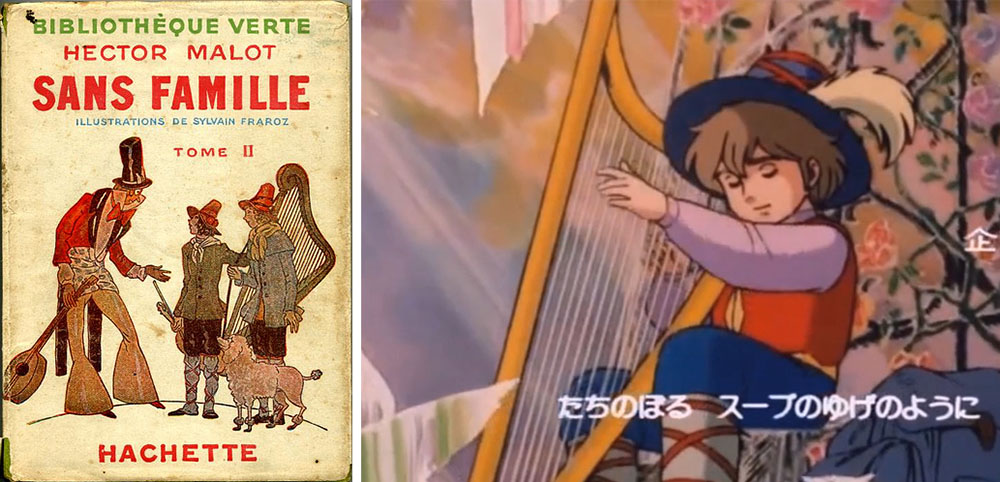
Thanks to fansubs I caught up with Perrine Story, the 1978 Nippon Animation series based on the Hector Malot novel about Perrine, who struggles to make her way from one end of Europe to another to find her estranged grandfather and experience the clash of class and race at the tail end of the 19th century. Nothing explains the power of Japanese animation quite like its ability to transcend genre and it's when you are on the edge of your seat hoping Perrine and her weakening mother and the long-suffering donkey Polikare can muscle their wagon up the muddy 19th century roads through the Alps, that's when you ask yourself, didn't I just watch an anime where an entire solar system was destroyed? - that's when you realize the true power of anime. I defy anyone to fail to be moved when that donkey makes a reappearance later in the show. 


Children's literature in the 19th century was gloomy disaster porn aimed at keeping the kids grateful for their fifteen mile walks uphill both ways to school in the snow, and Dog Of Flanders is no exception, but you wouldn't know it from the opening credits of this '75 Nippon Animation series, which makes the life of Nello and his dog Patrasche seem like swell times. Which they are not. 


Nobody's Boy became a 1970 Toei film and a 1977 TMS television series, another Hector Malot property about an abandoned child struggling to survive. The Toei film is a 60s throwback but the '77 series is pure Osamu Dezaki bringing his A-game to this tale of Remy, who gets sold into carnival slavery, more or less. 


You've read the book, you've seen the musical, and you’ve watched the movie, now enjoy the anime of Les Miserables! Toei's 1979 TV special eschews the big-eye "anime" visual cliche and delivers a more period accurate Jean Valjean struggling to do the right thing in mid 19th century France while Inspector Javert tracks him down. 

the various Treasure Islands
Robert Louis Stevenson's Treasure Island has enjoyed many cinematic adaptations, and the world of anime is no exception. If you want the best, you need to hit the '78 TMS series directed by Dezaki, it's terrific and on YouTube with TMS subtitles. If you want the fun, see Toei's '71 Animal Treasure Island, a cheerful Miyazaki/Takahata/Otsuka romp. If you want the weird, why not visit the 1966 New Treasure Island, a Mushi Productions TV special directed by Gisaburo Sugii, colorized in the early 70s and released to the 16mm rental market by Fred "Gigantor" Ladd? Well, because apart from a partial VHS copy ripped and uploaded to YouTube, you probably can't see it anywhere, that's why. 


I wrote about the Yearling anime earlier and at the time I assumed it was one more WMT series. Well, I was wrong. This show's an MK Company production, and MK stands for Kaneko Mitsuru, an animator who worked on revolutionary French hot pants heroine La Seine No Hoshi, who walked away from the anime world in the 70s and went to USC film school, and who later returned to Japan determined to drag the anime industry kicking and screaming into the modern world via computer technology. He founded the first commercial CG studio in Japan and his Yearling cartoon was the first Japanese TV anime to be colored digitally. MK went on to work on Lensman, which makes sense. His Yearling anime was licensed by MGM/UA and pitched to American broadcasters as “The Yearling” but if it aired in any US markets I have not seen any evidence. The series, as "Fortunate Fawn," is on YouTube with what appears to be Turkish subtitles, and a few public domain DVDs of the show have turned up in the dollar stores. 


watch the show, read the book, buy the merchandise for 40 years

I got through 1500 words on co-productions last time and barely mentioned Rascal The Raccoon, can you believe it? This trash panda's 1977 Nippon Animation cartoon is hands down the king of licensed raccoon character-based marketing - forty years on and they're still cranking out Rascal stuff. Sterling North's 1963 book about a Wisconsin boy growing up during the First World War who rescues a baby raccoon who in turn helps him through a difficult adolescence seems to have struck a responsive note with Japan; the show was responsible for at least 1500 raccoons being imported into Japan as pets, and they're now found in 42 of Japan's 47 prefectures. Sure, there was a 1969 Disney Rascal movie starring Billy "Lost In Space" Mumy, but did it inspire raccoon importation or its own store in Tokyo Station? No. 


Marge’s Little Lulu was a success from her first appearance in the Saturday Evening Post, inspiring Paramount cartoons, licensing deals, and a host of imitators, but it was the smart, loopy Dell Little Lulu comics by Irving Tripp and John Stanley that made the character one of the icons of mid 1950s comic art. Lulu had already inspired a generation of new cartoonists by the time this 1976 Nippon Animation series delivered 26 episodes to Japanese TV, and subsequently to a ZIV International dub and a home video release. I like me some Japanese cartoons but in this case the Stanley/Tripp comics are superior, have been in print consistently for decades, and are well worth your time. 


Little House On The Prairie fans are likely waiting for the Pete Bagge Rose Wilder Lane bio coming soon, but what they’re also waiting for, even though they might not have known it existed, is some kind of acknowledgement from the Wilder estate that the ‘75 Nippon Animation Little House anime is a thing that exists. And it is! “Laura The Prairie Girl” ran for 26 whole episodes, covering the early parts of the Little House saga and giving Anime Laura fun times with Jack and the whole Little House family, including the mighty beard of Pa Ingalls. The show lines up neatly with the original text, including the family surviving their bout with malaria with the help of pioneering African-American Dr. Tann. Sadly the show totally whiffs the opportunity to let Laura enter adolescence challenged by what we can only assume would be the ojosama laugh of “prairie bitch” Nellie Oleson. If you are curious about this iteration of Little House, the whole thing is streaming on YouTube en Espanol. 


In 1968 Toei produced a “World of Hans Christian Anderson” movie, in 1971 Mushi Pro made a 26 episode TV series with the same fairy-tale premise, and in 1975 Toei released their film of what might be Anderson’s most enduring work, The Little Mermaid. In this version, now available from Discotek, her little porpoise chum uses starfish as ninja throwing stars to defeat undersea monsters. 


The 1992 Thumbelina TV series ran 26 episodes and was produced by TV Tokyo/Victor/Enoki Films, and survived to be edited into a 90 minute compilation feature released on home video in North America. 

the many faces of non-Disney Pinocchio
Pinocchio, the venerable Carlo Collodi folktale, has two anime iterations, a 1972 Tatsunoko TV series and a 1976 Nippon Animation series. The Tatsunoko series made it into a dubbed compilation film, look for it in your local thrift store! 


I’d been all about the 1980 Toei Dracula Sovereign Of The Damned and the 1981 Frankenstein, particularly the faithful way the Dracula special follows the Marv Wolfman/Gene Colan comics, and the absolute off-the-rails crazy and the expressive Toyoo Ashida designs on Frankenstein. But what I never thought I’d get to see was the 1981 Tatsunoko TV special 20,000 Leagues Under The Sea. This oddity put Captain Nemo and his Nautilus into the 22nd century, gives him an evil empire to battle, and we see it all through the eyes of Ricky, the young Jacques Cousteau type who finds himself and his fellow explorers suddenly shanghaied into the Nautilus crew roster. This odd duck of a TV special – including a scuba-diving pet parrot – was dubbed into English by Harmony Gold and released somewhere – South Africa? The UK? - as “Undersea Encounter.” There’s a dub of it on YouTube with Russian expository narration on top of the English dialogue, which makes for a singular viewing experience. 


Like most nerds my age I had Bob Heinlein’s “Starship Troopers” handed to me at age 12 or so, just the right age to enjoy the outer space military action while taking the questionable sociopolitical themes at face value. Paul Verhoeven’s film would ditch the mobile suits and frontload the militaristic authoritarianism to a comical degree. However, the 1988 Bandai Visual/Sunrise six-part OVA series would deliver, as nature intended, a Starship Troopers heavy on Mobile Infantry powered combat suit combat and utilizing exact scenes and dialogue from the novel. Yet the anime Starship Troopers remains uninspired, pedestrian, and frankly, kinda dull, which is some kind of accomplishment in itself, I guess. Perhaps Japan had worked on one too many powered fighting armor stories and all the fresh new takes were used up. 

Thanks to everyone who came to my panels at AnimeNEXT and if you're coming to Anime North next year there's a pretty good chance I'll be hauling this one out next May, so stay tuned.  s I said earlier, this field is wide open. After years of poking around looking for these things, I haven’t even begun to scratch the surface. Turn over a rock, look at the stacks of VHS in the thrift stores, do a casual internet search and you’ll likely come across still more Japanese cartoons based on Western literature. 

-Dave Merrill

so long, Captain Nemo


Thanks for reading Let's Anime! If you enjoyed it and want to show your appreciation for what we do here as part of the Mister Kitty Dot Net world, please consider joining our Patreon!