Showing posts with label miyazaki. Show all posts

Monday, April 15, 2024

With An "E"

Let me start with a personal note. I grew up in the US, but twenty years back I moved to Ontario to begin a new adventure north of the border. As a new Canadian, I lacked the cultural background that informed the upbringing of many of my new friends and coworkers. I didn't know Mr. Dressup or The Friendly Giant. I was sadly unaware The Littlest Hobo was, in fact, a dog. I'd never been to the Pop Shoppe, didn’t know who Tim Horton played hockey for, never watched Late Great Movies On Citytv. But there was one Canadian cultural giant that I and millions of others were aware of, one that predated SCTV, Celine Dion and the Kids In The Hall. Perhaps the biggest early Canadian pop culture export? An orphan girl named Anne. 

my Anne LDs

The story of a child finding a home and a life in turn of the century Prince Edward Island, Lucy Maud Montgomery’s 1908 novel Anne Of Green Gables has sold fifty million copies, been translated into 35 languages, and has been the subject of films, TV shows and stage plays. This red-headed heroine appears in a bewildering variety of media including dolls, toys, picture books, musicals, museums, costumes, even license plates for the fictional Anne’s very real province of PEI. L.M. Montgomery was from PEI herself and used her childhood as inspiration for what would eventually become a series of Green Gables novels, even as she moved to Ontario and what we’d now call the Greater Toronto Area.

drive carefully, Anne lives here

There's a part in Montgomery's novel where the fire in the Green Gables hearth on a November night is described as "the sunshine of a hundred summers being distilled from the maple cord-wood" and I'm reading this and asking myself, did that L.M. just get away with this? She did, didn't she. The prose of Anne Of Green Gables is filled with minute, evocative, almost-sentimental touches of descriptive poetry - certainly in keeping with the Gilded Age provenance of its origins - and it speaks to the determination of Anne and through her, Montgomery, to find the beauty and wonder in what at first glance might seem to be unexceptional places, humdrum tasks and the sometimes tragic moments that make up life, a tall order for an unwanted child in a world that has almost no sympathy or resources for anything other than itself. 


Anne begins with middle-aged siblings Marilla and Matthew Cuthbert requesting a boy orphan to adopt to help out around their Avonlea farm, as if they were buying a draft horse or ordering a new plow. When Anne arrives instead, there’s some clinical calculus as the Cuthberts weigh their agricultural needs against the literal welfare of a child. At this time, Canada was seen as a convenient destination for the unwanted children of late-period British Empire; from 1869 right up until the late 1940s the UK sent something like a hundred thousand children to homes across Canada. Most would spend their remaining childhood as de facto indentured domestic servants or field hands. The reality is that most of these children weren’t actually orphaned; most had parents overcome by financial or personal disaster, forced by circumstances to break up their families. Anne’s orphan drama played out in real life for decades on train platforms across the country from Nova Scotia to British Columbia.

my Anne cel

We first see Anne as an awkward tween, sometimes overwhelmed as her overclocked imagination battles her desperate desire to belong.  She matures to become a self-disciplined young woman determined to make something of herself, along the way, pulling Marilla and Matthew out of their gruff, glum routine and into a more fulfilled, if less orderly life, while making friends and rivals alike at the local school. Anne's overworked sensitivity shows its negative side when she overreacts to minor things, exploding them into major life-altering events as only a too-dramatic teen - which is all of them - can blow ‘em up. 

that girl is trouble, and is IN trouble
 

Cheerful perseverance in the face of hardship and an ability to tease the fantastical out of the everyday spoke to audiences around the world, even early Taishō era Japan, which is when the novel was first published in Japanese. Though suppressed along with other Western literature during the Pacific War, during the Occupation Anne Of Green Gables was put on General MacArthur’s Recommended Children’s Literature list, along with another classic of rural kid-lit, Little House On The Prairie. Both series would inspire enduring fanbases and Nippon Animation anime series. And that’s where we here at Let’s Anime come in.


Fifty episodes of Nippon Animation's Akage no Anne (“akage” means “redhead”) would air on Fuji-TV from January to December of 1979.  Anne was the first series under the banner of World Masterpiece Theater, a showcase that started as Calpis Comic Theater, then became Calpis Children's Theater and then 1978’s Perrine Story saw the title remixed to Calpis Family Theater, and then next year somehow changed again to World Masterpiece Theater for Anne. In 1986 the banner changed yet again to House Foods World Masterpiece Theater. Stay tuned, who knows what they’ll call it next? Anne of Green Gables would join Nippon Animation’s roster of exports, airing in Korea, Spain, Germany, Portugal, the Arabic world, the Philippines, Italy, France, and French-speaking Canada. A South African English dub would broadcast in Taiwan and South Africa. 

Marilla, Matthew, Anne, and PEI's Strategic Potato Reserve

Directed overall by anime legend Isao “Horus Prince Of The Sun” Takahata, Anne’s character designs were by animation director and fellow anime legend Yoshifumi “Future Boy Conan” Kondo. Reference for the wonderful backgrounds, art-directed by Masahiro Ioka, was provided by a July ‘78 research trip to Prince Edward Island by Kondo, Takahata and Nippon Animation producers Junzô Nakajima and Shigeo Endô. You’ll swear you hear Joe Hisashi in the soundtrack but that’s all Akira Miyoshi there, bringing Anne's fantastical imagination to musical life in a beautiful Hayao Miyazaki-animated OP. 

sure, just put some airplanes in there, Hayao

Miyazaki did layouts for the first 15 episodes of Anne, perhaps repaying Takahata for the help Takahata gave on the recently completed Future Boy Conan. But Takahata’s realistic, textural vision for Anne was at odds with Miyazaki’s desire to expand upon the source material, as he did with Conan. Soon Hayao would leave the show and Nippon Animation entirely. Watching the series with 2024 eyes, we see what legions of internet memelords would later call “the Ghibli aesthetic” are all present in ‘79; the cozy fires, the tempting food, the homey overstuffed sofas and Victorian comfort of the giant overcoats and pinafores and moustaches, far enough in the past to be hazy and nostalgic but not so far in the past that we can’t enjoy ice cream or trains. 

the aesthetic in full force

This nostalgia helps the show - and the novel -  breeze past some of the more brutal realities of the era, the first of which is how orphans were treated like one more exploitable natural resource. Pay attention to how Anne talks about her life before Green Gables, it’s a life of constant toil, either caring for somebody else’s children or cleaning somebody else’s house or trying to keep somebody else from dying from some Victorian illness. It’s no wonder the girl would spend as much time as possible conjuring up fanciful stories about trees and rocks and streams - 19th century reality is harsh. Like the Little House series, Anne seems to work as a subtle hint to modern readers that no matter how awful their own childhood may be, at least they weren’t stuck doing farm chores or battling cholera in a time before Hot Wheels and Barbies. 

before Green Gables, things were a little grim

On television as in the novel, we see a hopeful Anne arrive at the train station en route to surprising everyone at the home she’ll soon name Green Gables. Anne makes a friend in Diana Barry from the next farm over, and a fierce rival in dashing local boy Gilbert Blythe. She meets her own personal Nellie Olesons in the spiteful Pye sisters, charms the various busybodies and old biddies of Avonlea, wins an academic scholarship to Queen’s Academy in Charlottetown, and from there wins another scholarship to a mainland university, forcing her to consider leaving Green Gables behind forever. 

Anne's Style Adventures

Anneheads and Gable-otaku, rest assured all your favorite story beats are in the show, whether it’s the part where Anne dyes her hair green or the part where Anne defies death by walking across the ridgepole of the Barry’s roof. We indeed see Anne conjure up a rich fantasy life as the tragic, raven-haired beauty Lady Cordelia Fitzgerald, which leads to the tragic loss(?) of Marilla’s emerald brooch. Anne gets Diana drunk, Anne bakes the cough-syrup cake, and then Anne gets trapped on the pond, only to be rescued by the last person on Earth she’d ever want to rescue her.

they grow up so fast
 

Seemingly overnight, Anne transforms from a gawky tween into a Young Lady as the rest of her body catches up with her once oversized skull. The last quarter of the series is a show about an adult (teenagers hadn’t been invented yet) dealing with isolation, aging parents, career choices, tragedy, and the kind of exam anxiety staring Japanese viewers right in the face. Also anxious was the Nippon Animation team producing the show. Whatever slack they’d had early in the production was gone thirty weeks in as the crew dealt with an exodus of talent pulled away to work on Galaxy Expresses, Lupins, and Bannertails, not to mention subcontractor issues and staff downtime due to illness. However, the Anne anime remains entertaining even as the animation quality suffers, due to its firm foundation of gorgeous background illustration and solid character design.

will the princess be forced to marry someone she can't stand?

Given free rein with Anne, Hayao Miyazaki probably would have placed more emphasis on fantasy segments conjured out of Anne’s more whimsical notions. But Takahata - whose own daughter was Anne’s age -  put his foot down, keeping the show firmly rooted in PEI’s famous red soil, perhaps hastening Miyazaki’s exit towards TMS and the direction of a popular Lupin III film. Akage no Anne shares the same sensibility as the rest of the World Masterpiece Cinematic Universe; action and spectacle are underplayed in favor of characters and feelings, set against well-researched architecture and lush watercolored backgrounds. Takahata’s quieter, grounded Anne has an emotional weight it might lose if set amidst Miyazaki’s trademark contrabulous fabtraptions and death-defying action sequences. Anne would also be Takahata’s swan song at Nippon Animation; next for him would be Chie The Brat for TMS.

Anne merchandise includes this bicycle (bicycle does not fly)

45 years later Akage no Anne still entertains. There’s a double hit of nostalgia, both for the original property and for its 1979 version, which gleams with those wonderful Masahiro Ioka landscapes and Kondo’s characters. At the time it was up against shoujo opposition like Candy Candy, Lun Lun the Flower Angel, Rose Of Versailles, and Haikara-san ga Tōru, and sequels to Space Battleship Yamato, Science Ninja Team Gatchaman, Cyborg 009, and Star Of The Giants. And there was something called Mobile Suit Gundam that came out that year. But even without a tacked-on animal companion, New Type powers or cybernetic augmentation, Green Gables welcomes and rewards repeat visits.

keep your dreams in your Anne Dream Can

Everyone, that is, but the North American viewing audience, which has seen Anne as the star of silent films, musicals, the Megan Follows CBC show and a Canadian cartoon, but so far hasn’t been permitted to see this anime version. The absence of Nippon Animation’s Anne is a loss for us all, whether we’re students facing book report deadlines, executors of the L.M. Montgomery estate, or the hardworking staff of the PEI Ministry Of Fisheries, Tourism, Sport, and Culture, who’d probably appreciate an extra bit of attention come vacation booking season.

visit PEI this summer!

Nope, Americans can’t watch Anne Of Green Gables. Well, okay, you can, the show is up on YouTube with the English-accented English dub, and with subtitles  But there isn’t a legit Blu-Ray set, no official release, it’s not real here in the way the GKids Future Boy Conan is. Absent the anime show or a trip to PEI, maybe all we can do is spend a fall afternoon in the Ontario countryside, visiting L.M. Montgomery’s 1911-1926 Leaskdale Manse home or maybe the park near where she later lived on Riverside Drive in Toronto. On the way you can stop in anywhere that sells books and pick up the copy of Anne Of Green Gables you’ll find there. 

Leaskdale, just north of Uxbridge, L.M. says "have a seat"

An inescapable layer of Canadian cultural bedrock, Anne is so much a part of the landscape here that one could almost believe she was a real person. If we ever needed someone to remind us what it’s like to dream big dreams once in a while, Anne of Green Gables is the person to do it, real or not, whether live-action or animated, whether in prose or radio or film or TV or whatever medium you choose. Can we dream big enough to see Akage no Anne finally return home? 

-Dave Merrill

I am tremendously indebted to Animétudes and their amazingly well-researched and comprehensive look at the production of Akage no Anne.


Thanks for reading Let's Anime! If you enjoyed it and want to show your appreciation for what we do here as part of the Mister Kitty Dot Net world, please consider joining our Patreon!

Tuesday, December 22, 2020

you are all interested in the future


Frame for frame, cel for cel, the 1978 series Future Boy Conan is the best Japanese animated television show ever. The show is a whirlwind of world destruction, feral children, technofascism, workers’ revolution, colonies of Winnebago-warrior Lost Boys, a pig named “Looks Delicious,” sharks smashing into Porsches, tsunami-triggered PTSD, gigantic flying fortresses, near-drownings, near-stabbings, rockets, machine guns, bombs, flying saucers, acres of abandoned tanks, an outraged Earth striking back at the human race, and gratuitous scenes of unsupervised children smoking, drinking, and peeing freely, without a catch-up episode, a recycled sequence, or a wasted shot in sight- no filler. In short, everything kids of all ages want to see in their cartoons; a wrecked world becoming an endless playground of adventure, animated by future Academy Award winners.

The recent series Keep Your Hands Off Eizouken leaned into Future Boy Conan hard. 2020’s Eizouken – it started airing a million years ago, in January - also rambled through a dense, extremely realized landscape as our three protagonists uncovered treasures and secrets among the architecture and the social dynamics of their quirky seaside town. Also, they watch Future Boy Conan in the first episode, they don’t even change the name. But you? If you’re an Anglo anime fan in North America, here in 2020 when Japanese animation has never been more available, the show remains a fansub-only gray market unavailability. 


But let’s begin at the beginning, with Alexander Key, the American author who would barely live to see this adaptation of his novel "The Incredible Tide" make it to TV screens. If he ever did. Maryland native Key attended the Art Institute in Chicago in the early 1920s and spent the next two decades illustrating, pausing only for a WWII hitch as a Navy officer. In the 1960s he turned to juvenile SF, writing roughly 15 novels between 1963 and his death. A common Key theme was exceptional children fleeing authority, finding help and communion with the natural world. The various Disney iterations of his ‘68 novel Escape To Witch Mountain are well known, and as a kid I saw his “The Forgotten Door” in at least three school libraries. But "The Incredible Tide" is where we’re at, a book I only saw once in print, at the Sandy Springs branch of the Atlanta Public Library, where coincidentally, we were holding our anime club meetings in the early 1990s.

Key’s novel is shorter, grimmer, and much less fun than the TV show. Conan is older and lonelier, the Cold War rhetoric is inescapable, and the book wraps up at a point where the cartoon is just getting started. If you’re a fan of dystopian juvenile SF it’s worth a look, but it’s no John Christopher or H.M. Hoover.


"The Incredible Tide" would be selected by Japanese broadcaster NHK to be the basis for their first animated series. Conan’s future studio Nippon Animation had experience adapting Western works to anime for their Calpis/House Foods sponsored World Masterpiece Theater series airing on Fuji-TV. For their inaugural anime show NHK wanted something more actiony, more SF, more in line with the “anime boom” currently rocking Japan, and producer Junzo Nakajima kept this in mind when selecting the Hayao Miyazaki / Yasuo Otsuka team.  After a decade spent working on Moomins and Pusses In Bootses and Pandas go Pandas, the two might have been eager for something with more of an edge, and Miyazaki agreed to work on Conan provided he had a free hand to make changes to the original story. This would all come together when Future Boy Conan aired on NHK between April and October 1978, Tuesdays at 7:30pm.


Remnant Island


Future Boy Conan’s disaster happened long ago in 2008, when the axis of the Earth was knocked silly during a world war involving “electromagnetic weapons much more powerful than nuclear bombs,” submerging most of the world’s surface. Years later, our titular Future Boy lives comfortably with his grandfather on tiny Remnant Island. Born after the cataclysm, Conan’s never known anything but the island and his crashed rocket ship home. This all changes when Lana washes ashore, the first non-Grandpa person Conan’s ever seen.


The amazement over seeing other humans barely registers before more people appear in a flying boat, new arrivals from what we’ll learn is Industria. Lana’s grandfather, the brilliant and missing scientist Briac Rao, has the secret of solar energy, and Industria will stop at nothing to get it. This includes using Lana, who shares a mysterious mental connection with her grandfather, as a hostage. Monsley, leader of the Industrian search party and perhaps the first appearance of Miyazaki’s warrior-lady archetype, retrieves Lana while inadvertently causing tragedy. This spurs Conan into the greatest adventure of his young life.


Evidently reading from the script for Horus Prince Of The Sun, Conan’s grandpa dies exhorting Conan to get out into the world and find friends. From that moment Conan never stops moving, not for a minute, taking a homemade catamaran to Plastic Island where he finds a friend in Jimsy, the feral Huck Finn of the future. They both wind up cargo monkeys on the trading ship Barracuda, captained by the roguish and occasionally skeevy Captain Dyce, hauling plastic scrap to the next port of call – Industria, whose triple towers mean trouble for Conan, Jimsy, and pretty much everybody. 


The last remnant of the pre-cataclysm world, Industria is an authoritarian city state boasting mechanical genius – anti-gravity, computers, food machines – but its ruling council are puppets controlled by the autocrat Chairman Lepka, its citizens obedient and regimented, and beneath it all, an oppressed slave class keeping the machines fed. 


Conan locates Lana in this fortress-city maze with the help of Lana’s animal friends and his own Future Boy climbing skills. Together they escape, surviving dizzying heights, crushing depths, burning deserts, and the dubious aid of Captain Dyce, who has his own agenda. The pair come across the salvage operation run by the taciturn Patch, who is actually Briac Rao in disguise, hiding in plain sight doing what he can to save people in the face of returning tidal-wave destruction. Earth is returning to its normal, pre-disaster shape, meaning newly-risen land will sink, earthquakes and tsunami will again rock the planet, and, by the way, Industria is doomed.
Not for the first time, here Conan’s moral center is made explicit. Rao could easily walk away and let those Industria jerks sink or swim. But he risks his own freedom to save others, regardless of consequences. Many anime shows talk this talk but it’s rare to see one that walks the walk as Conan, Rao and Lana return to Industria, rescuing a left-to-die Captain Dyce along the way. Rao stays behind to work in secret while Conan returns Lana to her High Harbor home. 

November '78 Animage article


The reverse of Industria, High Harbor is a small agricultural community, a low-tech utopia of peaceful farms, fields and small-town harmony (your own small town experience may vary). Conan and Jimsy chafe a little at the bonds of civilization, and Jimsy finds kindred spirits in the gang of malcontents who roam the other side of High Harbor, led by the surly Orlo. 

Shoes? Ewww!


Just when things reach a tipping point between Orlo’s gang and the villagers, Industria attacks! High Harbor is occupied by Monsley’s Industrian gunboat blitzkrieg, aided by Orlo’s fifth column. Conan avoids capture to lead a tiny guerrilla action, disabling the gunboat and the Barracuda to isolate the invaders. All these insurgencies and counter-insurgencies are interrupted by the first of Dr. Rao’s predicted tsunamis, which spares High Harbor but takes the fight right out of the Industrians, particularly Monsley, whose traumatic memories shock her into insensibility.

memories of the great disaster


knives, tidal waves, it's all in day's work for this Future Boy


Monsley, Jimsy, Lana, Dyce, and Conan, now allies, return again to Industria to face Chairman Lepka with the truth; Industria is doomed. Lepka doesn’t care. Monsley’s literal death sentence is preempted by the revolution of the proletariat. With Lepka deposed and Dr. Rao in charge, Industria is finally connected to the solar power satellite and powered up 100%. Unfortunately, this also means full power for the giant flying battleship Giganto, hidden beneath Industria, which launches from its underground hangar with Lepka at the controls. Can Conan, Dyce, and Jimsy in the tiny Falco flying boat stand up to the armed might of this potentially unstoppable flying fortress, and end the menace of Lepka once and for all? 


At the risk of spoiling a 42 year old show, it’s safe to say Lepka’s plans come to naught. Heck, the show ends with a wedding, merely another way Future Boy Conan puts every single character through emotional changes, a challenge most anime shows, and indeed most TV shows in general never even attempt. 

Captain Dyce and his robot buddy

Another of the show’s most compelling aspects is its tactile physicality, how everything seen in the series lives in the real world, can be dented, scraped, dismantled, repaired, hammered, scarred, rusted, rebuilt, moved, blown up, harvested, repurposed, or sunk. Conan builds what he needs out of the things he finds in his environment, he’s a part of that environment, he moves through it, under it, above it, in it. We’re introduced to Conan fighting a shark amid a sunken urban neighborhood full of junked cars and empty buildings. He lives in a repurposed rocket ship that gets a third life as the raw material for his outrigger canoe. 


Industria survives on plastic dug out of the antediluvian world, sits on a honeycomb of tunnels and catacombs, and encompasses a huge central courtyard that our characters improbably spend a lot of time either standing in, falling through, trapped underneath, or otherwise engaged with. The show uses physical space in a way that is instantly appealing to its audience of 8-12 year olds – the age when you’re learning to build things, move things, construct forts out of cardboard and scrap lumber, dig for treasure in the backyard, explore neighborhoods, vacant lots, abandoned buildings, and construction sites. The whole Tom Sawyer-Huck Finn vibe of Future Boy Conan is always there. Our heroes are always camping, catching fish, building shelters, canoeing, doing all that Boy Scout stuff that gets channeled constructively if you happen to get into the Scouts and your local troop isn’t run by a psychopath.

9 out of 10 Future Boys prefer Camels


American anime fans of a certain age like to pretend Japanese animation was their own private playground, that the only way to enjoy anime was to be in a club, swap VHS tapes, or spend a lot of time in dank comic-con video rooms. But the truth is that Japanese animation was broadcast freely over the airwaves, and this was even the case with Future Boy Conan, which aired across America in the 1980s as “El Nino del Futuro Conan” on the Spanish-language TV station Univision. Merely part of the giant wave of anime that soaked the Romance-language speaking world, Conan was one more bit of evidence proving every other kid got more anime than we did. 

Sponsored by Post, which is Nutrideliciosos


Enough received wisdom had percolated through mid 80s fandom to inform us that Hayao Miyazaki was the Castle Of Cagliostro director and had made something called Nausicaa  that was still being serialized in the back of the Animage magazines we bought at the comic shop, and that he’d worked on a TV show called “Future Boy Conan.” So when somebody in our club with cable TV showed up with Univision Conan episodes, well, that there was a great day. I watched the entire series in Spanish, and then the laserdisc box set came out and we all pitched in to buy it, and then we watched the entire series in Japanese, and then we went to Project A-Kon where somebody had the show on VHS-C with English subtitles. Future Boy Conan is a show I’ve seen repeatedly in more home video formats than I care to remember, and it shines every time.

Conan soundtrack LP with booklet


If you’ve ever been roused from sleep by the whirring of the auto-rewind as one more tape of a fansub finishes recording, telling you to set up the next tape and then try to doze again, well, you’ll remember the opening bars of every episode of Future Boy Conan, that ominous electric guitar droning over the destruction of Earth. Shinichiro Ikebe’s soundtrack gets a lot of mileage out of strings and woodwinds, imparting drama without the kind of pompous brass we’d hear in contemporaneous anime themes. Winner of the “Person Of Cultural Merit” award, professor emeritus of the Tokyo College of Music, composer of hundreds of choral and symphonic pieces, Ikebe’s works include Kurosawa film themes and TV drama, but Future Boy Conan is his only anime soundtrack. 


Future Boy Conan would end on Halloween ‘78, but the story doesn’t end there – the show would be compressed into two feature films produced without the Miyazaki stamp of approval; the first, a two-hour compilation, would screen in 1979, and the second, a 40 minute adaptation of the final battle with the Giganto, would be in theaters along with Locke The Superman in 1984. Conan would be licensed for a wide variety of late 70s merch – calendars, puzzles, books, records, model kits, sandals, stationery, keychains, buttons, and snacks. 

Future Boy Conan laser disc box set


Miyazaki’s plans for a Conan sequel would wind up inspiring both his Ghibli feature film Laputa and Hideaki Anno’s NHK series Nadia. Video games for the PC Engine, the 3DO, and the PlayStation 2 would appear as well as pachinko and pachislot games. Bandai’s 1990 LD set would set sales records, and the show had 3 DVD releases and a BD in 2011. The show has been re-run on Japanese TV several times and now is streaming on the Animelog channel for viewers in certain regions.


So why, here in the new world, where there’s an anime streaming service seemingly born every minute, why has Future Boy Conan not made the step to legitimate English-language release? My understanding is that enough of the original source material was changed to transform Future Boy Conan from an "Incredible Tide" adaptation into its own unique work, and therefore foreign licensing rights are firmly in the hands of its creator, Mr. Hayao “I’m retired, just kidding” Miyazaki, who for reasons known only to himself has not seen fit to sign off on a non-Univision North American version. 

Future Boy Conan plot spoilers, in toy form


And right now, in a world where we can own Astroganger BDs and where formerly obscure classics are now streaming at our fingertips, well, the absence of Future Boy Conan doesn’t seem to make any sense. There’s a reason Eizouken spent so much of its first episode on Conan – the show is fundamental, it’s the bedrock of a generation of animation fans who built their own fully realized worlds to play in. Future Boy Conan is a work of almost universal appeal that speaks to us all, and we should all be able to see it. Make it happen, people. 2008 was a long time ago.

-Dave Merrill


EDITED TO ADD: Earlier in 2021 it was revealed that GKIDS Films was, much to our surprise, releasing Future Boy Conan on Blu-Ray in North America! It's out now, you can buy it for yourself and I urge you to do so, because by golly it looks fantastic and the English dub is great and it's very reasonably priced. Make your next Blu-Ray a Conan Blu-Ray!


Thanks for reading Let's Anime! If you enjoyed it and want to show your appreciation for what we do here as part of the Mister Kitty Dot Net world, please consider joining our Patreon


Friday, November 30, 2018

1978: Anime's Greatest Year?


(portions of this column were originally presented early Sunday morning at AWA 2018. Thanks to all who battled through their hangovers to attend.)


So, 1978. Let me tell you about 1978. First off, it was still the 1950s sometimes, thanks to Sha Na Na, Grease and Happy Days. On the other hand, we had three Popes that year! Jimmy Carter brokered Mideast peace and signed the Panama Canal treaty. The Cowboys won the Super Bowl, the Yankees took the World Series, and M.A.S.H. and Little House On The Prairie weren't even half over. Me, I was eight years old, and if there was one thing I loved more than pestering anyone with a car to take me to see Star Wars again, it was watching cartoons on TV. Sadly, apart from Bugs Bunny re-runs, that Fantastic Four show starring Herbie the Robot, and of course, Super Friends, our network cartoons were all dreck like Fangface, Web Woman, and Galaxy Goof-Ups.

Meanwhile in Japan, lucky shoujos and shonens were literally wallowing in an ocean of colorful, wild, and occasionally ridiculous pop culture, as Japan's entertainment machine kicked into overdrive spewing out Pink Ladys and Ultramen, Chogokin super robots and Micromen and Space Invaders, all part of a nation's creative output... including an anime industry that just might have hit its peak in 1978. 

Seriously? 1978? Japanese animation as we know it has been a thing for more than fifty years. Why would I do something so silly as to pick a year and claim it's the greatest? Well, okay. I freely admit this is a foolish, subjective endeavor designed primarily to let me cheerlead for some of my favorites, using forty years of hindsight as leverage. But even skeptics have to admit 1978 brought new works by some of Japanese animation's greatest talents and sequels to some of anime's greatest properties. Japan's class of '78 cartoons proved popular around the world and many of these shows are still watched today. We're still feeling their impact forty years after the fact.

1977 hadn't quite stopped yet

The year started out with an advantage thanks to all the terrific anime that carried over from '77. The Leiji Matsumoto-created super robot series Danguard Ace continued to show Ichimonji Takuma and Captain Mask battle Leader Doppler and his army of monster robots. Candace White Adley struggled from heartbreak to heartbreak in the landmark shoujo anime Candy Candy. The "Robot Romance" series of Tadao Nagahama began with Voltes V, which we'll be seeing released here on DVD soon from Discotek Media.


In Japan's movie theaters, Space Battleship Yamato came cruising back with the July release of the film Farewell To Space Battleship Yamato: Soldiers Of Love, or, as the English-language text on the promotional material dubbed it, Arrivederci Yamato. After 1974's tepidly-received Yamato TV series and a vastly more successful 1977 release of a compiled Yamato movie, the question was, could producer Nishizaki turn Yamato into what today we call a "franchise?" He could, and did. Farewell To Space Battleship Yamato: Soldiers Of Love was a hugely successful epic gotterdammerung of a film in which the revived planet Earth is menaced by the Comet Empire and the crew of the Yamato must defy orders, save Teresa of Telezart, and make the ultimate sacrifice. Produced at breakneck speed by top tier Japanese animation talent like designer and collaborator Leiji Matsumoto, director Noboru Ishiguro, and character designer Yoshikazu Yasuhiko, Farewell is a terrific film that delivers an entire new civilization's worth of space vehicles to threaten our heroes, gives the Comet Empire that monumental, shuddering Hiroshi Miyagawa pipe organ theme, and still delivers Yamato style outer space romantic mysticism in a 151-minute epic that makes every minute count. North America received Voyager Entertainment VHS and DVD releases of this film, but as of now it's out of print.


Sure, we all wept at the (spoiler!) climactic sacrifice of the Yamato and her crew at the end of Arrivederci Yamato. However the Yamato would return in October's TV version of the Comet Empire story, Space Battleship Yamato 2. In this series the Yamato's tragic end isn't quite so tragic or final, as we see an expanded version of the film that gives more screentime to our crew, allows space dictator Desslar a chance at redemption, and finally standardizes the Yamato's formerly lackadaisical mechanical design. This show and the first Yamato TV series would be packaged in foreign markets as "Star Blazers" and air in US markets in 1979, a crucial series for many a North American anime fan (like me). Available on DVD as part of Star Blazers and currently out of print.

Harlock, Herlock, whichever

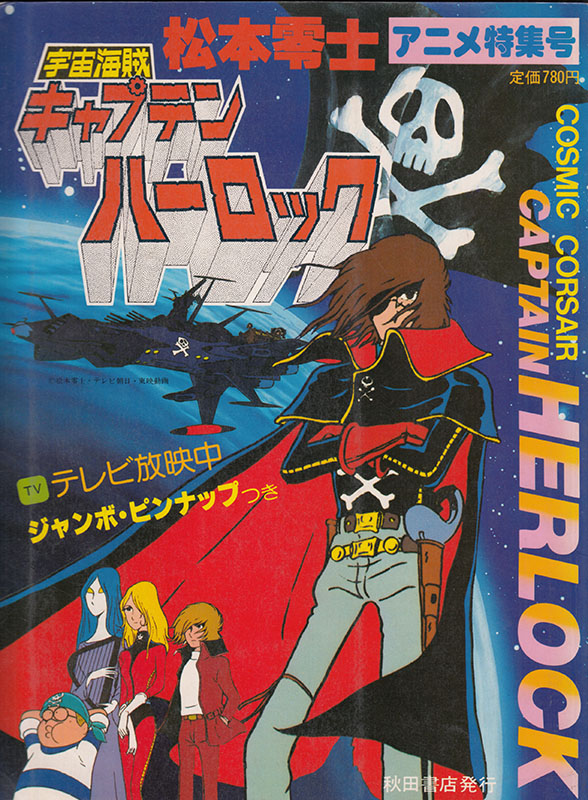
Japanese audiences were experiencing Leiji Matsumoto overload in 1978. Danguard Ace was still on the air, the Yamato was battling the Comet Empire in theaters and on TV, and March would see the first episode of one of Matsumoto's most iconic series, Space Pirate Captain Harlock. Harlock and his forty fellow space pirates defy the evil plant women of the Mazone, who return to Earth after millions of years to lay claim to their ancient-astronaut home. As we mentioned before, this terrific TV series is currently available on streaming video and in a Discotek DVD release, and Harlock would go on to star and co-star in feature films and TV series for decades to come. 


Not enough Leiji? Enjoy his April '78 science-fiction Journey To The West pastiche SF Saiyuki Starzinger – localized here as Jim Terry's Spaceketeers - or settle in for a ride on the Galaxy Express 999. Leiji Matsumoto's wistful meditation on life, death, and everything in between as seen through the eyes of a young boy travelling to Andromeda to get an immortal machine body, Toei's Galaxy Express 999 TV series first aired in September of 1978 and ran for 113 episodes. As we discussed earlier, this series is currently streaming and soon to be available on DVD from Discotek.


Harlock wasn't the only space captain zipping around '78; Golden Age SF writer Edmond Hamilton's 1940s hero Captain Future launched in November for 52 episodes of Toei-produced interplanetary adventure. These reasonably faithful pulp adaptations were thankfully updated with 70s era mechanical design and starred the titular Captain Future, Curtis Newton, and his shipmates the android Otho, the robot Grag, Simon "The Brain" Wright, and Space Girlfriend Joan Randall as they battle the evil forces that threaten to wreck the solar system. A big hit in Japan and Europe, the series has seen home video releases in almost every format and almost every region, with the exception of (sigh) North America.

Gatchaman II

Tatsunoko's Science Ninja Team Gatchaman series first aired in '72 – the cast's giant flared jeans are a dead giveaway - for 105 episodes of science ninja vs international criminal action. One of creator Ippei Kuri's most iconic creations, Gatchaman would get a theatrical compilation film in July, just in time to get audiences ready for the October start of the sequel to Gatchaman, Gatchaman II. The missing Condor Joe (spoilers!) returns early on, and the new show wastes no time getting back to battling robot monsters and evil Galactors. 1978 would also be the year that the '72 Gatchaman series would be edited, rewritten, dubbed by an all-star cast of American voice talent including Alan "Wilbur" Young and Casey "American Top 40" Kasem, and reach syndication in America as Battle of The Planets. Packed with action, great characters, and stunning mechanical mayhem, BOTP grabbed Americans by the eyeballs and turned them into what we now call 'anime fans.' Both BOTP and Gatchaman have had several iterations of home video release in North America, and the entire mythic Gatchaman cycle of Gatchaman, Gatchaman II, and Gatchaman F is available on DVD from Sentai, right now for the bargain price of eighty dollars.

it's kid-tested


Lupin III, hands down the world's greatest second-story man, safecracker, confidence trickster, and all around thief, made the jump from Monkey Punch's manga and a few hundred TMS produced TV episodes to the big movie screen in his 1978 feature film debut, directed by Mushi Pro vet Soji Yoshikawa and released by Tokyo Movie Shinsha. Known in some circles as "Mystery Of Mamo," this very 70s film is a wild roller coaster ride around the world as Lupin battles the possibly immortal Mamo past sight gags, 2001 references, spaghetti western homages, Clark Bar comic book ads, and the kinds of sleazy, lustful TV Lupin behavior that Hayao Miyazaki would totally abandon when directing the next Lupin III film. Mamo's long-lost English dub is now available on the Discotek DVD along with four (!) other English dubs.


The title can be literally translated into English as "Here Comes Miss Modern", "Here Comes Miss High-Collar" ("haikara" a Japanese portmanteau of "high collar"), or "Fashionable Girl Passing By," but in Japan they call this series Haikara-san ga Toru. In 1977, Waki Yamato's original Shoujo Friend manga series won the first Kodansha Manga Award. The Nippon Animation adaptation of Haikara-san ga Toru began airing in March of 1978, taking us all the way back to Tokyo in 1920, where teenager tomboy Benio Hanamura is always getting in trouble and advocating for new-fangled modern ways. 

here comes miss modern tree-climber
Though opposed to arranged marriages, she's engaged to the dreamy young Army captain Shinobu. Benio tries to sabotage the engagement but finds herself falling in love in spite of herself. Can their romance survive war in Manchuria, amnesia, and the Great Kanto Earthquake? A new anime film of Haikara-san was released earlier this year and Eleven Arts licenced it for North America, so look out, here she comes!

Hiromi Oka leaps from the pages of the sports shoujo manga classic Aim For The Ace by Suzumu Yamamoto, joins her high school tennis club and finds the tennis superstar inside that only the challenge of Ochofujin and the Demon Coach can bring out. This October '78 remake of the amazing 1972 Aim For The Ace series didn't feature 1972's Osamu Dezaki direction or Akio Sugino's character designs, but that's OK, they were working on the terrific 1979 Aim For The Ace movie. None of Aim For The Ace is commercially available in English in any form. Why is this? Somebody make it happen.

New Aim For The Ace


April 1978: Tadao Nagahama and an all-star cast of anime geniuses (Masaki Tsuji, Yoshikazu Yasuhiko, Yuki Hijiri, etc.) continues his "Robot Romance" series with Fighting General Daimos. Kazuya Ryuuzaki, a young karate champ/astronaut, returns from deep space along with his sword-slinging Afro-sporting copilot Kyoushirou to find Earth under attack from space aliens fleeing the destroyed planet Baam. As befits the star of an anime show, only Kazuya can pilot the transforming truck-robot Daimos to battle the invaders. His thirst for vengeance is derailed slightly when he falls in love with the Baam princess Erika. Can their romance survive the struggle between two worlds? Animated by Sunrise under contract to Toei, this show packs a one-two punch of super robot destruction and soapy love story melodrama that totally satisfies. Daimos eventually aired in the Philippines, Italy, Poland, and even in an edited compilation video titled "Star Birds" that was released on home video and a few airings on Pat Robertson's CBN cable network.

from a Fighting General Daimos children's storybook

Robert Louis Stevenson's Treasure Island has enjoyed many cinematic adaptations, and the world of anime is no exception. There have been one, two, at least three separate Japanese cartoon versions of this seminal pirate adventure story. Unquestionably the best Japanese anime iteration – the one without talking animals, anyway - is the October '78 TMS Treasure Island series, directed by genius Osamu Dezaki. This is what he was doing instead of remaking Aim For The Ace, I guess. Treasure Island aired in France, Germany, Italy, Spain, Mexico, Columbia, Taiwan, the Arabic world, and after circumnavigating the globe, finally reached the English language audience via YouTube with TMS subtitles.

Treasure Island never looked so great

1978 started its journey with the New Years Day premiere of Perrine Story, the 1978 Nippon Animation series based on the Hector Malot novel Sans Familie. Young Perrine struggles to make her way from one end of Europe to another to find her estranged grandfather and experience the clash of class and race at the tail end of the 19th century. Nothing explains the power of Japanese animation quite like its ability to entertain regardless of viewer demographics, and it's when you are on the edge of your seat hoping Perrine and her weakening mother and their long-suffering donkey Polikare can muscle their wagon up the muddy 19th century roads through the Alps, well, that's when you realize the true power of anime. I defy anyone to fail to be moved when that donkey makes a reappearance later in the show, which sadly is unavailable commercially in English.

Perrine, Baron, and Polikare, the donkey who drank too much

Sanrio, the Hello Kitty people, spent the 1970s branching out into other media, including the shoujo manga magazine Lyrica and a series of animated films, including 1978's Ringing Bell, a 47 minute film based on a children's book about a cute little lamb named Chirin. Devastated when his mother is killed by a wolf, Chirin swears eternal vengeance, and ironically is taught to be a violent survivor by the very same momicide-committing wolf. Chirin grows to learn the world is a terrifying nightmare of unending conflict. You know, for kids! Released on American VHS by Columbia in the 1980s and recently revived on DVD by Discotek, Ringing Bell is a beautifully animated film that illustrates perfectly how even the most talented of artists can completely misjudge their audience.

don't be fooled by that Ringing Bell box art


Between April and October of 1978, viewers were treated to what many believe is the best Japanese anime series ever made, Future Boy Conan. Based on Alexander Key's 1970 dystopian YA SF novel "The Incredible Tide" – yes, he's the guy that wrote "Escape To Witch Mountain" - this Nippon Animation series was produced by the anime dream team of Yasuo Otsuka, Isao Takahata, and Hayao Miyazaki. Remember that world war we had back in July 2008, the one that saw the use of super powerful magnetic weapons more powerful than atom bombs? After the world is thrown off its axis, the survivors of a flooded Earth struggle to rebuild civilization, represented by the polar opposites of the techno-fascist Industria and the peaceful, agricultural High Harbor. We first meet our hero, the titular Conan, living a bucolic, shark-fighting life with his grandfather alone on Lonely Island. The world, or what's left of it, intrudes when the girl Lana washes up on shore, with soldiers from Industria in hot pursuit. To protect Lana, Conan leaves Lonely Island and finds both friends and enemies in a world still reeling from the great disaster. Future Boy Conan is filled with adventure, action, humor, intrigue, disaster, and redemption; it's the kind of broad-appeal anime property that's made its creators famous the world over, and of course is commercially unavailable in English.

my Conan frame-tray puzzle

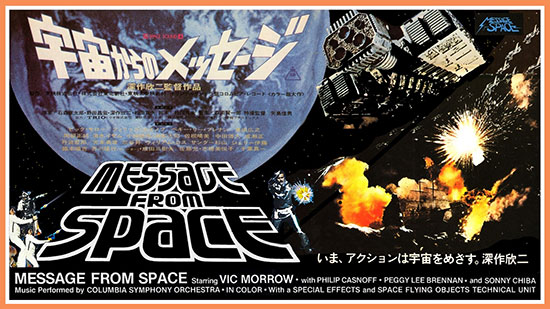
Naturally, being on the other side of the world, I had no idea these cartoons even existed. But it wasn't so terrible, back in 1978. For instance, one summer night our whole neighborhood kid gang were dropped off at Cobb Center Mall to see a movie. This was back in the day when parents felt perfectly confident in leaving their 8 and 9 and 10 year olds unsupervised at movie theaters. We all got out alive, so I guess it was OK. Anyway the movie was a rollicking sci-fi actioner titled Message From Space, and we all agreed it was pretty awesome, almost as good as, if not as good as, that other space movie with the Death Stars and the light sabers. I spent years looking for Message From Space, back when my only hope was to catch a late-night UHF TV broadcast. I'd find out it was directed by the guy who made Battle Royale, and that it starred faded Hollywood royalty and top-of-the-line Japanese movie stars, that Shotaro Ishinomori was one of the writers, that it was a sci-fi updating of the Hakkenden legend, and that there was a followup TV show starring a space ape. You can judge for yourself with the DVD from Shout Factory


So was 1978 anime's greatest year? I think I've presented a pretty solid case, and I didn't even mention Invincible Superman Daitarn 3 or that Pink Lady anime series. But to be honest, who's to say 1977 or 1979 or any other year might not be just as great? In a field that continues to produce amazing work year after year, who knows what classics lie ahead? All I know is, I'll probably be watching.

-Dave Merrill

1978 says "So long!"


Thanks for reading Let's Anime! If you enjoyed it and want to show your appreciation for what we do here as part of the Mister Kitty Dot Net world, please consider joining our Patreon!