Showing posts with label yamato. Show all posts

Sunday, July 21, 2024

Interview With A Volgar


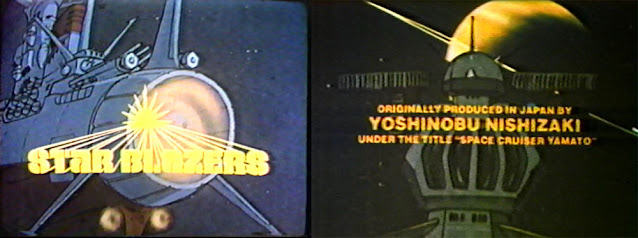
Thirty years ago the voice cast of the 1979 Star Blazers series was a mystery to American Star Blazers/Space Battleship Yamato fandom. The credits for Star Blazers listed the Japanese title and a host of Japanese creatives, but failed to mention any of the American voice talent. Without a late 70s NYC telephone directory and a lot of money for long-distance cold calls to businesses that might not even still exist, research possibilities were limited.

That changed one day at a fandom event in Atlanta. A friend of mine was not only a popular local cosplayer but also an accomplished puppeteer, and in that capacity she was involved with Atlanta's Center For Puppetry Arts. It was there that she met another puppeteer named Michael Chechopolous. In the course of  conversation she learned Mr. Chechopolous was the voice of the character "Volgar" from the TV series, Star Blazers, to which she replied, oh, I have a friend who's really into that series. The next time I saw my friend at, oh, DragonCon or the Atlanta Fantasy Fair or some such fandom gathering, she mentioned this interesting detail.

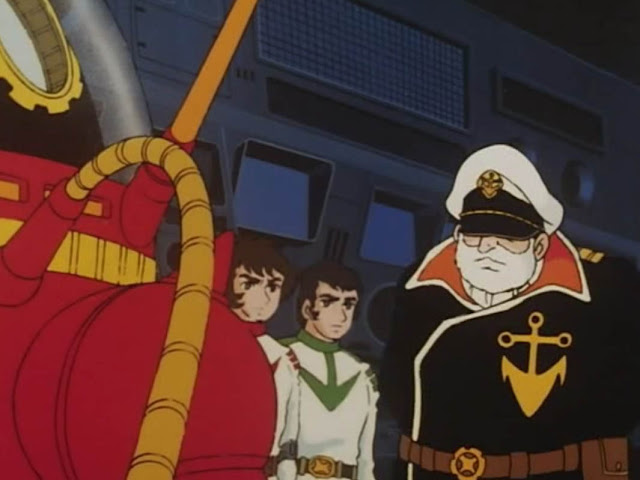
Star Blazers' Volgar is, as we all know, the Gamilon general commanding planet Balan, strategically located halfway between Earth and Iscandar. Known as 'Geru" in Japan, we first see Volgar in episode 15 as he's suddenly demoted to assisting the new base commander, General Lysis. Volgar grumbles and backstabs his way through the next story arc until episode 22 in which both he and Lysis are (spoilers) defeated by the Star Force.


I lost no time in setting up an interview with Michael Chechopolous. The interview we conducted was published in the summer 1994 issue of the print version of Let's Anime, and in an edited version in the first issue of the Star Blazers comic from Argo Press in 1995. Here today at the 21st century blog version of Let's Anime is the original, unedited, un-revised interview; at least as original as it's going to get without transcribing the audio cassette the interview was originally recorded on. Thirty years later it remains a fascinating document, revealing some of the experience of being a working actor in NYC in the late 1970s, the 1990s ineptitude and exuberance of four young anime nerds whose enthusiasm far exceeded their journalistic skills, and the patient hospitality of Chechopolous, who allowed four complete strangers into his home to talk about cartoons. So here, without further interruption, is the mostly unredacted text of our interview with Michael Chechopolous.

Michael Chechopolous is a puppeteer and television producer here in Atlanta, working with the Center For Puppetry Arts and GPTV, the local PBS station. Back in the late '70s he worked with Westchester on their production of Star Blazers, as the voice of Volgar. Our thanks to him for graciously agreeing to this interview.

This interview took place on a September night in Michael's apartment in Atlanta GA. Present in the room were Michael (MC), the author (DM), Matt Murray (MM), Christian Smith (CB), and David G. Wilson III (DW). It got pretty noisy.

MC: OK, now, what can I tell you about Star Blazers?
DM: Well, start at the beginning, I guess. How did you get contacted, who did you contact at Westchester, just what happened?
MC: I, geez, let's see. That's been how long ago?
DM: That was what, seventy-
MM: About thirteen years.
MC: '78?
MM: I saw it (Star Blazers) in 1980.
DM: Yeah, I figure around '80, '81, '82...
MC: '82... New York City.
DM: The teeming metropolis.
MC: God...
DW: There are a million naked... cities in the...
(general laughter)
MC: Yes, and this is just one story. Uh, what was I doing, oh, I must have started working for Lord & Taylor, I was lighting design for the Fifth Avenue windows and I did... we used to set up at Christmas, the animation, you know, they have animated window figures which was always a big attraction, so I was doing things, you know, as I could there in the evening or whatever, let's see, how the hell did... 

MC: Oh, that's right, it was an agent, who was a friend of mine, who was a character actor gentleman, he had told me about that, so it was like networking, he heard that this, ah, he may have done some voice-overs for them too. I even forget the man's name now. So I was always talking to him, so he gave me the contact and I called them. They were auditioning, so they had me come in for a preliminary reading, look at sides (scripts) like you do for a film reading, they give you a fresh section of the script, and they give you a while to go through it, and they explain the character.

MC: When I talked on the phone to them, they said, can you do a, sort of a Russian - Bulgarian accent...
(laughter)
MC: So I started thinking of old Bullwinkle the moose, and Natasha and Boris, and then I started thinking of, oh, Count Dracula, and so there was a combination of Boris and Count Dracula.
(laughter)
MC: So that's what I was thinking when I was trying to get this character's voice. Then I went in and they showed me the script, and he said, this is sort of a crazed military commander. So, uh, I said, all right, crazed, if they want crazy, I'll give it to 'em! So I ran over it a couple of times and I just, you know, I was just (a) wild, raving maniac, and they said good, we like it, (laughter) you're hired! 


MC: So, uh, then they had a studio space in New York, a sound booth, and it was closed off with glass, and you had microphones, and on the other side of the sound booth were monitors, they would play the tape, right, and you had the script in front of you, they gave you the script before so you could read it, but you didn't have much time, and you had to try to memorize as much as you could, but you had it there to refer to. So they play the tape, and then you try to synchronize the dialogue to the action of the character as he was moving and talking...
DM: So you got to see the picture?
MC: You see the picture, you got to see it, and then they do takes, and many times you did or they'd stop and they'd say, from this point, go on.

MC: Of course, the less you goofed up, the more they liked it, because it took less time and they were able to move on and you know, less studio time and whatever. So as an actor, you wanted to not goof up, (you wanted) to try to get it on one or two takes, and do it, you know, and then you had other actors next to you, if there were two or three in a scene, so you had somebody to read off of, but you were concentrating on the monitor out there, trying to synchronize that. It was fun, I liked it. 


MC: So of course when I saw this character, this bald-headed, big figure, I immediately could get into it, and then, you transfer, of course, the voice into the character that you saw, so it's your, your creation became something different already. So I had from puppeteering, you know, that's sort of what happens with a puppet. So I had experience, as I create a puppet as an artist, I create one thing, but when you start performing with the puppet, it becomes something else from what it is, because you're adding a life to it, and it has its own life outside of just structural, physical characterization. So just like a cartoon drawing is one thing, when you add a voice to it, the combination becomes a creation. And so, uh, it was fun. That's how we did it, and it did pretty well. I got a couple of times... I think I had about eight sessions with Volgar, right, and that was it. I've always wanted to do more, but...

DM: Did they never call you back?
MC: Uh, no. I don't know what the hell happened with that.
DM: Neither do we.
MC: It was non-union... (cross talk prevented us hearing this)
MM: We don't know what happened to any of those voice actors. We've never heard them again.
DM: What happened with that show was that, the first release they did here of Star Blazers was two television seasons, and later in Japan they came out with a third television season, but that didn't get translated and brought over here until, five years later? It's like, really recently.
MM: They couldn't find the same voice actors to do the roles, and the new ones aren't nearly as good.
MC: Huh, they should have called me.
(laughter)
DM: You know, no one can figure it out, I mean, people just don't vanish.
MC: You know, the reason was, because it was non-union...
(everyone says "Ahhhh,")
MC: So they didn't want to keep records, because I was equity SAG (Screen Actors Guild), now...
DM: So they didn't keep records?
MC: Probably not. Outside of paying you.
DM: The smoking gun!
(laughter)
MC: They probably didn't want, uh, to know, or to keep track of people, because they use a lot of union people, OK? And of course I was making like, what did I make every time I went into the studio, 150, 200 bucks, you know, so, hey, I don't care if you're union or non-union, that was good money for three or four hours in the studio just playing around! So, you know.
MM: They didn't list any voice actors in the credits for Star Blazers. None of them are listed.
MC: And that's another reason why, so I'm not... I didn't credit for that... bastards!
(laughter)
MC: So...
MM: Yeah, and all these other shows like Robotech, when they list voice actors, they don't say who played who.
DM: Well, you will (get credit) now.
MC: Yeah and not only will we know, but when we show the clip on 8 (the PBS station) and you're being interviewed, you'll say, "...and the voice actor..."
(laughter)
MC: ..."who never got credit, the poor guy, he's a struggling person, who's also assistant producer of this show, I believe...
(laughter)
CB: By a strange coincidence...
(laughter)

(Chechopolous was working at Georgia Public Television at the time, and there had been some talk of producing some sort of TV program about Japanese animation fandom and anime in general. This did not wind up happening, but the project is mentioned a few more times in the interview.)


DM: So what was it like working with the other voice actors?
MC: It was great, you know, we were all pretty good, professional people.
DM: Were they all professional actors?
MC: Yeah, I'm sure they all were. New York, you know, eight million people, and you know, everybody is an actor!
DW: Couldn't throw a stone without hitting an actor.
MC: You know, yeah! From the cabdriver to the waitress, they're all in the business. So it wasn't hard for them to find talented people in that city, who were professional and willing to work, off scale.
CB: Did they track all of you at once? I mean, did they have each person miked, and you all read parts and put it down to tape at once, or did they take each person at a time, when they were recording a session?
MC: No, no, they could, they did both. They could run two together, they could go, but usually the tempo and the flow wasn't (like) that... so that usually when the next person started, they'd have to stop, and start with him. But if it happened, they would try to go for it, and if it hit, they would let it go, OK? But if you couldn't get it, they'd stop and say, OK, you start, and they'd let the next actor shoot. But sure, when we had a dialogue going between us, we would try to take it, the dialogue, and sometimes, you know, we'd get it, it worked.

DM: So, you know, they, uh, do you remember the last episode your character was in?
MC: No.
DM: Well, you...
MC: I died?
DM: Yeah! Well, see...
(laughter)
MC: I blew up, right?
DM: General Lysis planted a bomb underneath the, the Argo, the way the Japanese (episode) had it, he had the bomb, and they sat there and blew up, 'cause he was trying to blow up the bigger ship.
DW: The bomb was still in Lysis' ship while it was attached to the side...
DM: It was suicide. But the Americans took it, I guess Westchester took it and snipped it around a little, and redid a scene where Lysis and you, like, escape and got away.
MC: Ahhh...
DM: But you never see them again. So you're still alive!
MM: They just took the same footage and ran it backwards, to show the ship fly away.
DW: Which is more effort than anyone has ever done, in a similar situation.
MC: So they kept my character alive, in the American version?
MM: In the Japanese version they just, click, poof, you're gone... beause they figure they're going to show it to kids.
DM: They usually do that when it's a kid's show in America, they have... they take Japanese shows and just snip the violence out, any...
DW: Innuendo of any kind...
MC: Death, they don't want to see you die, yeah, you can get hurt but be all right.
DW: You can't even get hurt, really.
CB: Well, occasionally.
MC: Just sort of hurt.
CB: Like a strange virus or something.
MC: Yeah, like, what's that series on now, about the polluters, the toxic, uh, thing?
CB: Toxic Avengers... (Toxic Crusaders? Captain Planet? Who knows)
MC: Yeah, like that, you never see anybody get seriously hurt.


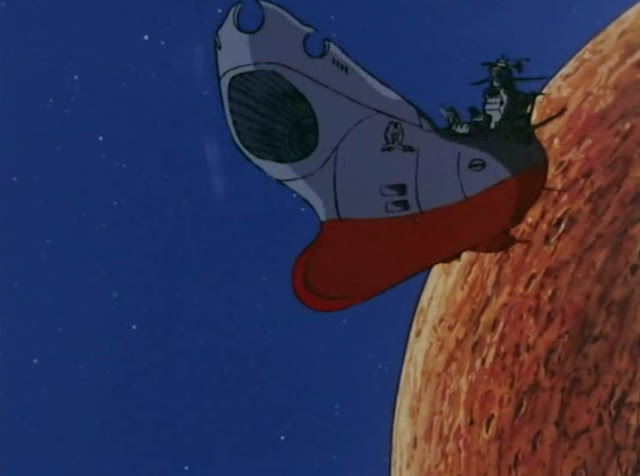
DM: Well, the Japanese... this shows... well, Star Blazers was originally Space Cruiser Yamato, and the Yamato was, you know, their super battleship during World War Two.
DW: The biggest and the best ship they ever had.
DM: The whole point behind Space Cruiser Yamato was that they revived the Yamato as a space battleship, to save Earth, and the Americans, they, you know, they said, yeah, it's the Yamato, but they called it the Argo, and it lost all the militaristic Japanese impressions, but to Japan the show is very much a political, patriotic...
MC: Ahhh.
MM: It's like Japan saving the Earth.
DW: It's as if the Enterprise (from Star Trek) was like an American, uh, spaceship.
CB: Which it pretty much is.
DW: Well, I mean if it had...
CB: The American flag painted on it...
DW: It would be that kind of thing.
MM: It's like, the planet they're trying to reach in the ship (in Star Blazers), it has one land mass on it, which looks suspiciously like Japan...
(laughter)
MM: It's very obvious.
DM: It's a very interesting show, both, you know, as far as, we like animation and it's neat, but looking at in a wider, in a sort of...
MC: How much did it play? I mean, where... I would like to know, what exposure did it get?
DM: Space Cruiser Yamato... what, in America? It's been shown all over the world.
MM: There are whole fan clubs devoted to the thing.
MC: Yeah? I could be a celebrity and I don't know it?
(laughter)
DM: There are people out there, that say, "Well, this is neat!"
MM: Mostly in Texas.
DM: They're in... well, there's these two guys! (gestures to people in room)
(laughter)
MM: There's a fan club in Texas that's named after the Earth Defense Command from Star Blazers, yeah, their primary interest is that show...
DM: Well, it used to be.
MM: Well, yeah.
MC: That would be interesting for (Channel) 8 to mention all this...
DM: There was a Star Blazers Fan Club that ran for many years in New England...
MC: Can you get connections to that?
CB: Oh yeah.
MC: So when we get on that 8 thing, and we show them, and we we talk about that, (we need to) bring as much material to support the...
DM: How many boxes?
(laughter)
MC: Well, I mean, as much...
DM: We've been into this stuff for so long...
DW: We'll have to bring a pick-up truck.
CB: We'll just come in like this (spreads arms wide)
MC: That's it! My producer will go crazy!
(laughter)
DW: It's like, how many hours can we devote to this one subject.
MM: We could show side-by-side in comparison. Here's the American version, here's the Japanese version (laughter); we have Japanese episodes too.
MC: OK, so where... it played all over America, how long did it play?
CB: About a year and a half ago, they played it weekly for a while. It was originally a daily show, they started running it on Sunday mornings only.
MM: Like, in '85 was the last time they showed it that way.
MC: You know, I should have got residuals, if it was union, I would be getting residuals, but because it was a payoff, non-union, we all got, you know...
DM: Well, you took the money then...
MC: I was a starving actor! Still am!
(laughter)
DM: But Star Blazers, or here, it was called Star Blazers, I'm not sure what it was called in Europe, it was Space Cruiser Yamato in Japan...
MC: And it played in Europe?
MM: I think it was just Space Cruiser, in Europe. (the 1977 Yamato film was released in the UK with the Space Cruiser title. The series had different titles in other European markets.)
DM: Yeah, Space Cruiser in Europe... in Japan they had three TV series and five different movies, that are all new... um, merchandise out the butt..
MM: Oh yeah.
DM: Toys, models, books...
MC: Do they have any of Volgar, do you think, (of his) character?
MM: I've seen just two figures and those were just the main characters.
DM: I don't even know if they have a Lysis.
MM: Well, unless you count IQ-9, that makes three.
DM: I think he was a main character.
DW: You've got the IQ-9, I've got, um, a...
DM: You know, the wind-up, you know the robot? I've got a little wind-up IQ-9... they've got little action figures...
MC: Yeah! Bring 'em!
(laughter)


MC: He's going to go wild.
DM: We could do a whole show on Space Cruiser Yamato.
MM: Yeah, why not?
DW: Alone!
CB: That'd be good to do.
DM: I think in Mexico it was called Space Cruiser Champion...(it was not.)
DW: I didn't know there was a Mexican series.
DM: You see, Japanese stuff is really popular all over the world. There are Japanese cartoons right now that are popular in Canada and Europe.
DW: Japanese cartoons are really, uh, growing in interest (here) too...
CB: Unfortunately it's the wrong ones...
(laughter)

(At this point the interview concluded. and we moved to another room with a TV and a VCR so that Mr. Chechopolous could enjoy his performance as Volgar for the first time in years.)

Thank you for coming with us down memory lane, and thanks to Mr. Chechopolous for inviting us into his home and giving us the details on his Star Blazers voice acting.

-Dave Merrill

Thanks for reading Let's Anime! If you enjoyed it and want to show your appreciation for what we do here as part of the Mister Kitty Dot Net world, please consider joining our Patreon!


Friday, March 31, 2023

A Time Slip Of Forty Years: 1983 In Anime Film


Let's look at the numbers. In 1982 there were 21 animated movies released in Japanese cinemas with a total running time of 1881 minutes. The next year saw slightly fewer films-  only 19 - and a concomitant shrinkage of total length down to a mere sixteen hundred sixty-five minutes. You could marathon that in less than a day! But when you look at the actual films themselves forty years ago, a different story emerges, a story of Crushers, Fantastic Trips, long-distance murder professionals, magic islands, time slips, Final Yamatos, and horrific disasters both real and imaginary. 1983 was a year of Japanese animation pulling away from its terebi manga roots and finally becoming real, slightly overstuffed roadshow capital-c Cinema in brand new ways. Let's take a look at the anime films in the order in which they were released forty years back!


Urusei Yatsura: Only You planted its tiger-striped-booted feet firmly into February 1983 and said, this is what it's gonna look like for the next few years, anime is going to be an outer space carnival of pop music, cute girls, interstellar hijinks, and frustrated romance. Based on the popular Shonen Sunday manga by Rumiko Takahashi, Urusei Yatsura, or "Those Obnoxious Aliens" as we used to call it, ostensibly is the story of Lum the invader gal and her hapless boyfriend, the dopey, skirt-chasing Ataru. Quickly overwhelmed by its equally obnoxious cast and a creative team that included Mamoru Oshii and Akemi Takada, the series became an ensemble comedy that bent the laws of time, space, propriety and gender. Only You is the first of six feature films that together with with 194 episodes of the Urusei Yatsura TV series would go a long way towards defining the 80s anime style.


One month later would be the premiere of Crusher Joe, a film directed by Yoshikazu "Yas" Yasuhiko, produced by Studio Nue and Nippon Sunrise, their first non-TV compilation film. Crusher Joe is based on the SF novels by Haruka Takachiho, who would go on to create the similarly-motifed and possibly canonically connected Dirty Pair. The far-future galactic troubleshooters known as Crushers operate throughout the galaxy, and the number one team is known as Crusher Joe after its leader Joe. His teammates the pretty princess Alfin, the cyborg Talos, engineering genius Ricky, and the 'droid Drongo uncover a conspiracy that threatens the galaxy while dodging both the murder plots of the space-pirate guild and the red tape of the United Planets. Pulpy science-fiction adventure in the classic style, Crusher Joe would get two more OVA sequels and this film would be gifted a terrible English dub that features new songs from "Bullets." Fret not, the Blu-Ray is subtitled.


The short feature Dr Slump HoYoyo! The Race Around The World premiered March 13, 1983 and the movie is just what it says on the tin. Indeed, this film is a wacky race as Akira Toriyama's zany Arale and the rest of the goofy Penguin Village gang pop the clutch and tell the world to eat their respective dusts. It's part of Dr. Slump's only American video release!


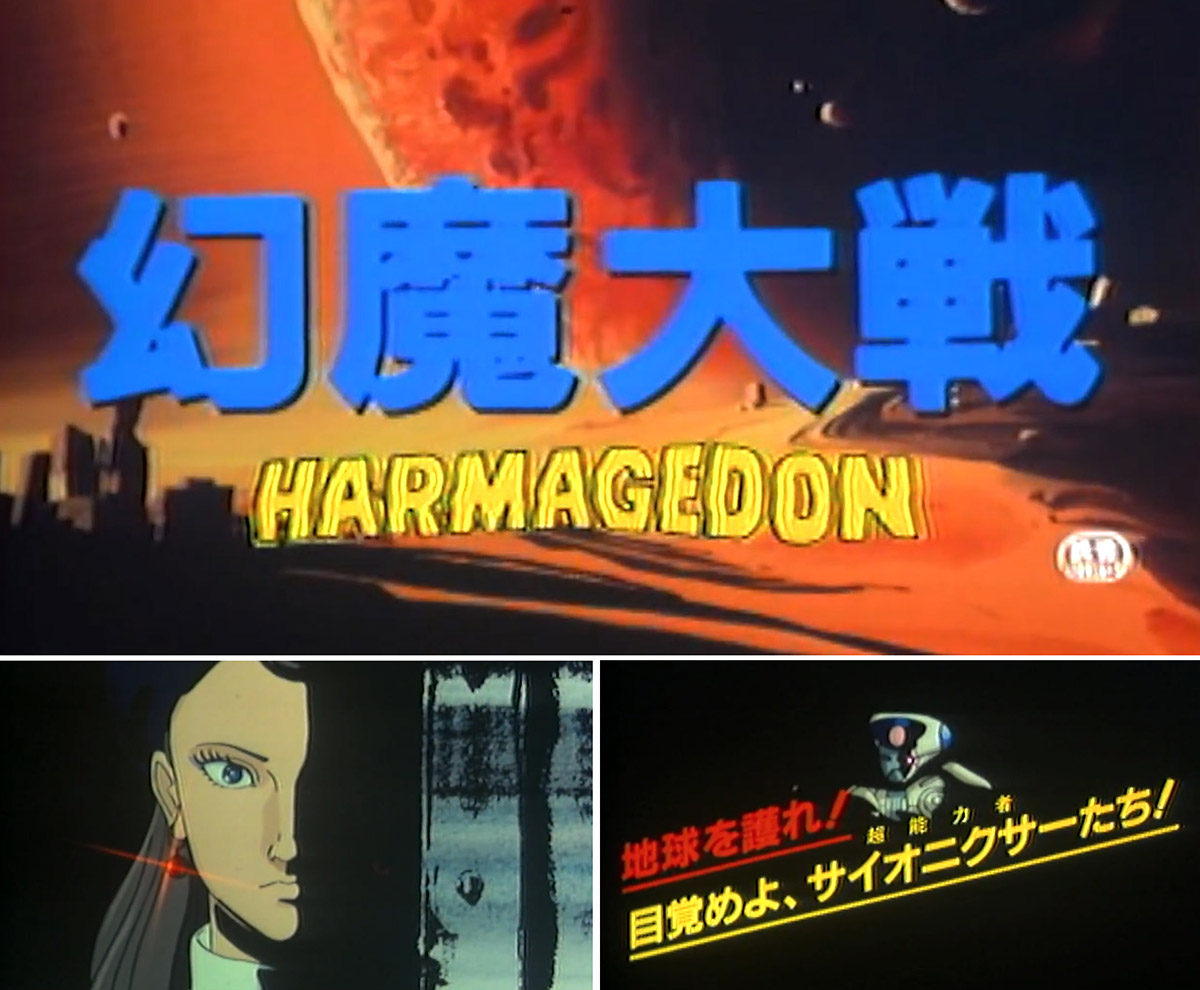
March 12 saw the release of Harmagedon, the first anime feature by publisher-turned-film-producer Haruki Kadokawa. This expensive, overstuffed epic features music from prog rock legend Keith Emerson and character designs by future prog manga legend Katsuhiro Otomo. Harmagedon, or Genma Taisen if we're going by the kanji, is based on the 1960s manga drawn by Shotaro Ishinomori and written by Kasumasu Hirai, who wrote manga classic 8-Man, pulp novel/Sonny Chiba vehicle Wolf Guy and a lengthy series of Harmagedon sequel novels. Hirai's interest in syncretic New Age religions is no surprise considering Harmagedon's script, filled with the vast darkness of Entropy fought across time and space by psychic warriors empowered by universal love consciousnesses. Harmagedon was released on VHS in the US in the 1990s, but earlier in the 80s you may have seen the laserdisk videogame it inspired, Bega's Battle.


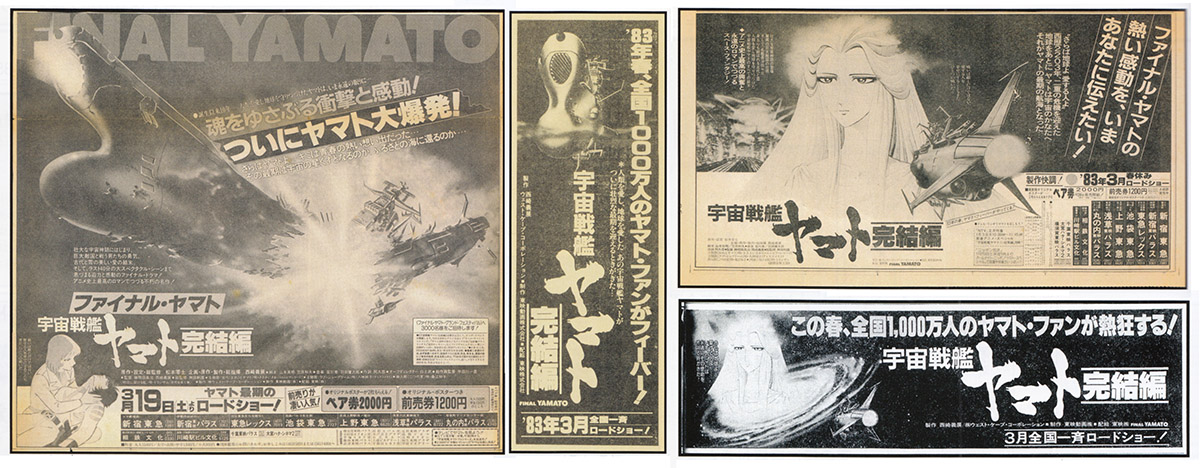
The Space Battleship Yamato faces its ultimate challenge in Uchuu Senkan Yamato Kanketsu-hen, Space Battleship Yamato the Final Chapter (or as the English language text in the promotional material likes to call it, simply Final Yamato) as the evil Denguils, outer space legions descended from Mesopotamians rescued from the Biblical flood of Noah by the actual Satan, send the water planet Aquarius to literally drown the planet Earth again. Only the Yamato - captained by a surprisingly alive Captain Okita - can save us all. This epic spectacle's extended version clocks in at 163 minutes, which includes scenes producer Yoshinobu Nishizaki added into a 70mm re-release nine months after its initial March 19 premiere. Perhaps this film's butt-demolishing length helped Yamato fans weather the full decade before they'd see another Yamato project (the ill-fated Yamato 2520).


Noel embarked on her Fantastic Trip on April 29 1983. This movie feels like a vanity project for producer and Noel's voice actor Iruka, a Japanese folk singer who since 1970 has released 26 LPs, three books, four childrens' books, 8 radio shows, and acted in a medical TV drama. Iruka is really Toshie Hosaka, and she got the Iruka nickname in high school when she saw a crowd of music students carrying their guitar cases and said "it looks like a school of dolphins (iruka in Japanese)." So this particular Fantastic Trip of Noel's is a loosely plotted string of vignettes that allow the film to express simple concepts about pollution or friendship while delivering various Iruka songs. Noel lives on an island in space with her friend Pup and a bunch of animal friends. One day after singing a song about wanting to be a country girl, she decides the sun's too hot and would like some ice cream. So Noel and Pup take off in her airplane to give the Sun some ice cream. They stop at Planet Gaudy where she convinces everyone to become nudists. 

Meet The Beatles (And Noel)

After giving the Sun ice cream, they sing a few songs with the Yellow Submarine-era Beatles on the bottom of the ocean. Then smog attacks, but they are rescued by the super whale Super Zoomer. The source of the smog is an urbanized industrial planet, and the immediate threat is stopped by Super Zoomer and then there's an extended sequence involving babies on tricycles and a song about pollution controls. The end. Noel is voiced by Iruka in the original and by Corinne Orr in the American version, which aired on cable TV and was released on home video to a confused and bewildered nation.


First he was portrayed by Ken Takakura. Then Sonny Chiba took on the role. But the definitive Golgo 13 may be the 1983 anime film directed by certified genius Osamu Dezaki. The first animation production starring Takao Saito's legendary assassin Golgo 13 was this eponymous TMS film, released May 28. Known in the West as "The Professional," Golgo 13 is jam packed with slow-motion murder, mayhem, early computer animation, and the "postcard memories" Dezaki became famous for, as Duke Togo weathers a series of increasingly bizarre attempts on his life, which, let's be honest, is itself a series of increasingly bizarre attempts to take the lives of others.


Jiron Amos saddles up his Walker Machine and rides out on the vengance trail in the July 9 release Xabungle Graffiti, a theatrical compilation of the Xabungle TV series from Nippon Sunrise that was released in a double bill with Sunrise's Dougram film. Will Jiron and the crew of the gigantic transforming land-battleship mecha Irongear defy both the traditions of their violent land and its mysterious ruling class? You'll say "yes" by the time the new MIO song starts. Available as part of Sentai's Xabungle Blu-Ray set, this Tomino series lacks the seriousness and the death toll of his other works.


On July 9, the compilation film of the Nippon Sunrise Fang Of The Sun Dougram TV series was distributed by Shochiku with the title "Document Dougram". Created by Votoms helmer Ryousuke Takahashi, the film is a condensed retelling of the struggle of guerrilla fighters battling to free the planet Deloyer from the oppressive Earth occupation forces, and is one of the few series we're discussing today that has yet to get any sort of English language release. Come on fellas, let's get it together here. Document Dougram was released along with the super deformed comedy short "Choro Q Dougram," a combination of Dougram sponsor Takara's popular deformed minature spring-powered car toy Choro Q with characters from Dougram.


Another not-available-in-America title, Maya Mineo's serio-comic gagfest manga Patalliro first appeared in Hana to Yume in 1978, switched to Bessatsu Hana to Yume in 1991 and is still going strong. Bratty boy-genius Patalliro is both king of Malynera and heir to a diamond fortune and lives to confuse and irritate everyone around him, including his dreamy bodyguard Bancoran, who attracts a variety of beautiful boy admirers. The Patalliro Toei anime series ran for 49 episodes while this film, Stardust Keikaku (Keikaku means "plan") was released on July 10 and clocks in a mere 48 minutes.


Unico In the Island Of Magic was a July 16 release. Osamu Tezuka's Unico was created for the Sanrio magazine Lyrica, a lost little unicorn propelled through worlds of magic and legend on the whims of the Wind Goddess. Here in Unico's second movie he finds himself on the Island of Magic as a succession of increasingly disturbing Madhouse-animated creations threaten him and his friends, and the enigmatic wizard Torby must decide whether to defy his master, or turn us all into lifeless dolls. Both Unico films received English dubs and home video releases, frightening entire generations of 80s kids on both sides of the Pacific.


Based on the semiautobiographical manga by Hiroshima survivor Keiji Nakazawa, Barefoot Gen / Hadashi no Gen, a July release, was directed by Mori Masaki and produced by animation powerhouse Madhouse. This film, the first of two Barefoot Gen movies, details the life of an ordinary Japanese family struggling to survive in a militarized total-war Japan and the aftermath of that war's cataclysmic conclusion. Barefoot Gen's manga was one of the first Japanese comics to be translated and published in America (by Leonard Rifas' Educomics) and the film received a 1992 American release with a subsequent dub and release by Streamline Pictures in 1995.


Prime Rose: A Time Slip Of 10000 Years was broadcast August 21 as part of Nippon TV's 24 hour "Love Saves The Earth" telethon. The demon Bazusu sends both Kujukuri City in Chiba and Dallas in Texas ten thousand years in the future and makes them battle for his amusement. Tanbara Gai of the Time Patrol fights to stop this fighting along with the barely-dressed Emiya Tachi/Prime Rose in this Tezuka Pro/Magic Bus production.


Wrapping up the year, September and December would see two Nine movies from Gisaburo Sugii and Group TAC, based on Mitsuru Adachi's popular baseball manga about Aohide High School's center fielder Katsuya and the team manager, the mysterious beauty Yuri Nakao.  Adachi would keep working that baseball angle in his next 80s series Touch, perhaps his biggest manga hit in a career that is woefully underrepresented in the West.


And that's what 1983 looked like if you spent your year in Japanese theaters watching cartoons. If you ask me to pick a favorite, well, that's a tough question. Urusei Yatsura Only You might not be as critically acclaimed as the next UY film Beautiful Dreamer, but I think Only You is a rock-solid 90 minutes that takes the Urusei Yatsura cast out of Tomobiki and into the kind of big-screen science-fiction nonsense that movies were made for.


I'm always going to have a soft spot for Harmagedon, as maligned as the film may sometimes be. It's a movie made up of some terrific, fantastically realized pieces of animated cinema, separated by long stretches of not much at all. Not to generalize, but Japanese film is, well, we might say sometimes it's deliberately paced. Discursive. Meandering. Tends to wander. That's Harmagedon in a nutshell, it's all over the map.


And as meandering as Harmagedon might be, at least it's forty minutes shorter than the long version of Final Yamato, a film that hopes you're as excited as Nishizaki is about This Being The Last Yamato Film Ever Swear To God. If you're on board with this, fine, and if you aren't, if everything isn't as epic and as majestic and as awe-inspiring as it possibly can be, well then you might think this movie's too long. And it probably is. But as the Japanese iteration of those bloated Cinemascope studio-destroying historical epics midcentury Hollywood was throwing its cash at - your Liz Taylor Cleopatras, your How The West Was Wons, your Fall Of The Roman Empires, your Lawrence Of Arabias, your Spartacuses - as one of those overbudgeted overture-preceded pray-for-intermission endurance contests, Final Yamato fits right in.


As a big fan of Saito's Golgo 13 manga it's interesting to see various G13 stories turn up in the script of the TMS Golgo 13 film, but at times the connecting threads of plot stitching them all together are overwhelmed by the sheer hallucinogenic power of Dezaki's visuals. Not that this is a bad thing, you understand. Similarly, Crusher Joe from Yas and Sunrise looks great and is filled with terrific science fiction action sequences, and those sequences pile on top of each other until the film's had what feels like one or two climaxes too many.


Pound for pound, frame for frame, perhaps 1983's most enduring animated film is Madhouse's Unico In The Island Of Magic, a movie that throws goggle-eyed witches in our faces, fills the screen with nothing but the blue of Torby's cloak, and forces Unico to flee, scared to death through an island made entirely of the petrified remains of Torby's victims. A film that feels as fresh today as it did on that hand-me-down in the kids' mid-1980s playroom, Island Of Magic holds up today against everything forty years has thrown at it, and that's not something a lot of movies - let alone people, even - can say.

-Dave Merrill


March 1983 issue of OUT

Thanks for reading Let's Anime! If you enjoyed it and want to show your appreciation for what we do here as part of the Mister Kitty Dot Net world, please consider joining our Patreon!

Saturday, February 19, 2022

Star Blazers And The Start Of A Fannish Journey

Editor's note: So back in 1999, I was on an email mailing-list of Star Blazers fans we called "The Cosmolist". Seeing as how 1999 was the 20th anniversary of Star Blazers' first appearance on American TV, it seemed to me that we ought to put together a commemorative print fanzine, a "Cosmo-zine," if you will. Was it my idea? I can't remember. Fans on the list swapped ideas for articles - recipes, funny bumper stickers, a series of Troy McClure gags, and a lengthy piece by long time anime fan Walter Amos about experiencing Star Blazers for the first time. But the zine never came together, mostly because it was 1999 and everybody had more important things to do. Print fandom was being digitally replaced by websites, primitive social media, and the Cosmolist itself. Subsequently 1999 came and went without that Cosmozine, an unfulfilled promise that’s bothered me ever since, left me feeling like one of those Fans With Plans who talk a good game but never finish what they start. Sure, I’ve piled up a lot of completed projects, but one left undone always sticks up like a nail that needs hammering down.
Well at last, that nail is finally getting the hammer. Let's Anime now presents what would have been the centerpiece of 1999’s Cosmozine - Walter's memories of Star Blazers, a piece that not only details the experience of seeing the show for the first time, but also captures the zeitgeist of Star Blazers fandom at the turn of the century, a sentence I honestly never thought I'd write. Enjoy, and thanks for waiting these, uh, twenty-three years. -Dave Merrill 


Life in the Before Time: Star Blazers and The Start of a Fannish Journey
by Walter Amos 

1979. 

Twenty years ago.(Can it really be so long?) 

Jimmy Carter was President. The Shah of Iran was deposed, and Americans were introduced to a new political force: Islamic Fundamentalism. The Soviet Union invaded Afghanistan, prompting us to boycott the 1980 Olympics. Margaret Thatcher was elected as Britain's first female Prime Minister. The first computer spreadsheet software, VisiCalc, began the process of convincing America that personal computers were more than mere toys. 

But none of that mattered to me. I was 12. What mattered to me was Star Blazers

Young fans discovering anime for the first time these days probably can't understand what it was like to be an anime fan back then, when most people (certainly my family) didn't even have VCRs, let alone laserdiscs or subtitles or all the other things that have made modern anime fandom possible. Journey back for a moment and hear one person's tale of a strange and wonderful Japanese TV show that changed the lives of a great many people. 

 Early in 1979, before Star Blazers aired for the first time (at least before I first saw it), I remember the other stuff I was into. I was always a science fiction fan, loving stuff like Star Trek (the Original Series, of course; the first Trek movie wouldn't come out for some months), as well as cartoons of all stripes. I suppose I've always had a certain predisposition toward animation in general, whether it was from Japan or not. I remember my parents finding it a little odd that I continued to watch Saturday morning cartoons well past the age at which they thought such things really "normal." 

Before Star Blazers first aired I was, oddly enough, into another Japanese import showing on weekday afternoon kidvid. A live action show. I doubt one person in fifty who reads this will remember the show Space Giants. And probably deservedly so. In retrospect the show was really pretty dorky. Space Giants was, I later learned, the U.S. adaptation of the live action Japanese TV version of a manga series titled "Ambassador Magma," created by the great "God of Manga" Dr. Osamu Tezuka. Its hero, the eponymous Magma (called "Goldar" in the US) was this giant metallic robot guy (who happened to be gold colored) who could transform into a giant golden space rocket and fly all over the place. Generally he spent most of his time flying to the places where the nefarious villain Rodak ("Goa" in Japanese) was attacking the helpless people of Earth in order to subjugate them under his iron-clad (or, well, at least foam-rubber-clad) heel. 

Now one major scene from the show involving Rodak really sticks in my mind (and is the main reason I am bringing this up at all in an article which is, after all, supposed to be about Star Blazers). In one of the early episodes we see Rodak (who is this curly-orange-haired devil sprouting little fangs and pointy ears and this ridiculous foam rubber body armor suit) briefing his faceless minions (literally! I mean all these guys were dressed in identical long black Supreme Court Justice robes and had black nylon panty hose over their faces. No, really.) on their plans to take over the Earth. While waving his arms dramatically back and forth he intones, "This is Earth, our next target. Our strategy shall be to send down giant monsters to destroy their cities. At first we shall concentrate our attacks in their Northern Hemisphere." 
 
 
Rodak: foam-rubber clad Space Giants villain

Now this is certainly a strategy destined to live in the annals of military history. Of course I don't know why he used the plural "monsters", because he only ever sent down one at a time. And usually to downtown Tokyo. I always wondered why he never saved up a few monsters and sent them to several cities at once. Or sent a bunch of them to gang up on Goldar who of course defeated the single monster he sent down every afternoon. Or maybe even sent the one somewhere else besides Tokyo. I mean, do you know how good the giant monster defenses must be in Tokyo considering they get hit with one at least once a month? I'd be willing to lay odds that Poughkeepsie, New York probably has no giant monster defenses of any kind whatsoever. 

"But what does this have to do with Star Blazers?" I hear you cry. I'm getting there. Some time later in the year Space Giants was replaced on WTAF TV Channel 29 in Philadelphia by another Japanese import. A cartoon this time. A cartoon about a really big battleship that flew out in space and had weapons like you would not believe. Now being a cartoon, in the American mindset it of course had to be for little kids, right? Well check out the basic premise of this cartoon for kids:

 Mankind is basically dead. The nefarious planet Gamilon has been dropping planet bombs on the Earth in an attempt to purge the planet of humanity so they can take over. The last remaining humans are cowering in under ground cities to escape the bombs and residual radiation, but within a year the radioactivity will seep deep enough into the surface to poison even these last redoubts so that humanity will be finished. 

Yup, comforting kiddie pablum. 

Now let's compare for a moment the basic badguy military strategies in these two shows. 

Space Giants: "We will send down monsters to destroy their cities." 

Star Blazers: "We will drop GIANT NUCLEAR BOMBS on them until everything on their planet is DEAD!" 

Can you understand why I and so many other people glommed on to this show as the greatest thing since sliced bread? This was something sui generis, totally unlike anything anyone on these shores had seen before.

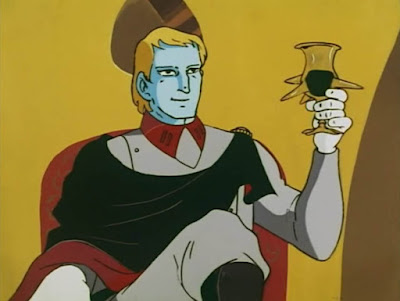
Desslok Of Gamilon: More Style Than Rodak
 

But the Star Blazers cool factor didn't end there. It had: 

 • good guys - good guys mind you - flying around in a ship that had a gun that could kill planets. 

 • bad guys who could spend their days conquering the Universe looking cool all the while, and on the weekend could still get babes.  

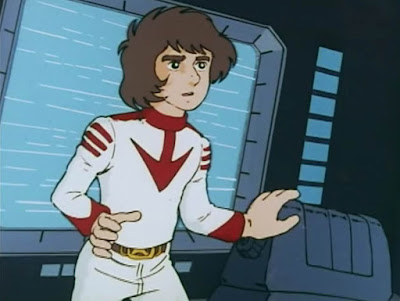
• real human drama. My favorite example of this last one: As our heroes leave Earth's solar system in an attempt to retrieve a device from a distant planet which can remove the deadly radiation created by all those nasty nuclear bombs the bad guys were dropping on us, they begin to move outside the range of possible communication with Earth. Everyone on the ship is encouraged to say a last farewell to loved ones before moving out of range. At the end, the principal male hero, Derek Wildstar, is corralled by the ship's nurse, Nova, into the radio room to make his call. When she pokes her head into the room wondering why Wildstar has been avoiding making this call all day and is just sitting there not turning on the communicator, Wildstar shouts mournfully, 

"There's no one left for me to talk to on Earth!!" 

...whoa. 

if you wish to make a call please hang up and try again


And at the end of the same episode, as the last images of their home disappear off their viewscreen, being replaced by static and the blackness of space, the ship's radio operator intones,

 "We have now moved beyond communication range. From this point on communication with Earth will be impossible." 

...whoa. 

This was heavy stuff. Certainly unlike anything I'd ever seen on TV, and I couldn't get enough of it. 

Of course, the reason it was all so cool was because, unlike every other Japanese TV show imported to the US, the people who licensed this series made a remarkable and farsighted decision. They didn't screw with it. Again, this was something totally unheard of. These things almost always had to be "improved" for the American market. Compare Star Blazers to any other Japanese import of the time and you'll see what I mean. Take a few examples: 

• Music: Save for writing English lyrics to the opening and closing themes, all the music in Star Blazers is the original music heard in Japan. One would think this should be a natural thing to do, because NOT rewriting all the music would mean less work for the importing company. But no. More often than not when people decide to import popular Japanese TV shows, rather than stick with a proven popular score into which frequently great amounts of energy and creativity are invested, for some reason producers get the bright idea to have their cousin's kid's rock band do a score since it will be popular with the kiddies. And we end up with stuff like Reba West singing "Stage Fright" in Robotech and the incessant droning thumpa-thumpa-thumpa background music in G-Force. Ugh. Fortunately Westchester Films had the intelligence to realize that a theme song that could be popular enough to be referred to as "a second Japanese national anthem" probably had something going for it. 

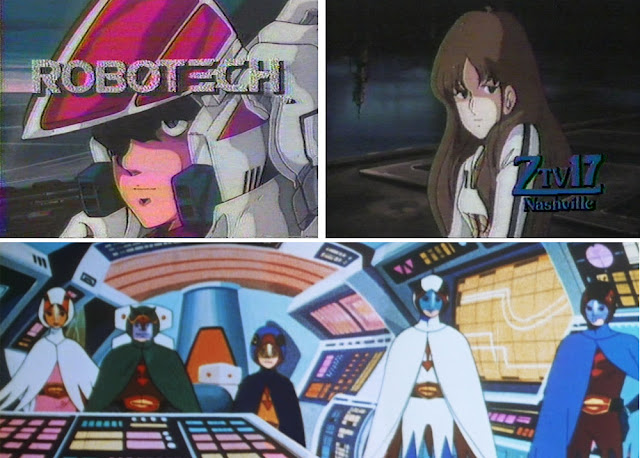
• Story: Once again the good people at Westchester Films had the bright idea that a story that could catapult a show to record-breaking popularity in Japan from out of the morass of scores of run-of-the mill TV animation shows was probably something that didn't require a lot of "tweaking". Save for some fairly minor overall edits to bring the Japanese original in compliance with U.S. kid-TV broadcasting standards (can't show the kids that too many people die during a war after all) Star Blazers' storyline is in the main untouched. Compare this again with my favorite targets of derision, Robotech and Battle of the Planets. Robotech took three totally unrelated series and created a new hackneyed plot to try and glue these disparate things together.

Robotech and Battle Of The Planets

This required making action which takes place on alien planets appear to be taking place on Earth (including editing out all the footage of the multiple moons in the night sky). Battle of the Planets took the opposite approach, deciding to make action that all took place on Earth appear to be happening on other planets. There really is just no pleasing these people. 

• Episode Sequence: Like most Japanese animated drama series, the story in Yamato was told sequentially, developing from one episode to the next. This kind of story telling allows for much more sophisticated drama and the possibility that the characters may grow and change over the course of the show. And this is exactly why it couldn't be allowed to remain in most other imported shows. After all the idea that people can grow and change is probably too sophisticated for U.S. kids, right? 


Well, with all this and more going for it, I was certainly hooked, line and sinker, on the show back then in Junior High school. Ample testament to this fact can be found throughout most of my later Junior High and High school notebooks wherein the margins were festooned with little sketches of Gamilon space destroyers and guys in Desslok-style capes. But while I knew I was hooked, what was unknown to me for a few years was just how many other people were similarly hooked. 

The discovery of that fact would have to wait a few more years, until about 1981 or 82; because that was when I attended my first convention. Well I shouldn't really call it a convention, knowing better as I do now, but at the time I thought it had to be the most amazing happening ever. In New York in the late 70s and early 80s a sort of convention / dealer's show for Sci-fi fans had cropped up called "Creation Cons". Some of you may have heard of these. Basically they would usually get a guest or two from Star Trek to give a talk, show some movies, and have a large huckster's room where eager fans could buy all sorts of related merchandise. It is really these type of shows more than anything else that get lampooned in things like William Shatner's famous "Get a Life" sketch on Saturday Night Live. It was only later that I came to understand that these things were really not true conventions: nothing that ended at 7pm with no parties or fan-run programming could really be called a convention! But I didn't know any better yet. 

Anyway, round about '81 or '82, Creation decided to hold its first show in Philadelphia. To publicize it they sent out little cards to various people who would likely be interested in this sort of thing, including subscribers of Omni magazine, which I was at the time. So here I am with a little card indicating the big Star Trek con was coming to downtown Philly. After the requisite whining and pleading with the overprotective parental units to be permitted to take the train downtown by myself, I was able to go. Now as I recall the little card advertising this thing focused mainly on Star Trek, Star Wars, and other well known Sci-Fi shows of the time. This is of course what I was mainly expecting to see. 

Imagine then my shock and surprise when entering that magical dealers' room for the first time and finding that while, sure, there was some Trek stuff and so on, easily 75% of the dealer's tables seemed to be selling Star Blazers stuff! STAR BLAZERS STUFF!! I walked up and down the aisles like a kid in a candy store. Looking over the mysterious but beautiful color art books called "Roman Albums" (the meaning of that title not being explained to me until years later) I noticed something odd. By this point I had most of Star Blazers fairly well committed to memory, but looking over these books I saw numerous scenes obviously involving the characters from my favorite show, but not in any way resembling anything I could remember. Here was a picture of the generals in the throne room of the Comet Empire wearing uniforms unlike anything I could remember from the show. In fact the Generals themselves looked different too. And there was a picture of Leader Desslok sitting on a comfy couch having a friendly chat with . . . Derek Wildstar?!?! WHAT?? I turned to the dealer and pointed out some of these scenes and asked, "Hey what's the deal here? I have this show fairly well memorized but don't remember any of these scenes here." And I remember being told: 

"Oh, those are from one of the later movies." 

"What?" 

"Oh yeah, Yamato is like, bigger than Star Wars in Japan. They had a third series of the TV show and a bunch of full length movies."

 My young brain reeled. "Movies . . . There are Star Blazers movies . . . WHY AREN'T WE GETTING THESE OVER HERE?!?!" As I pondered this important question I continued to wander around spending all of my meager saved allowance on Roman Albums and art books, gleefully freeing myself from the need to continue photographing the TV screen. Oh I forgot to mention that did I? Ah let me backtrack for a moment. One of the other several things that attracted me to Star Blazers was that its spaceship and uniform designs were the coolest things since sliced bread. I simply had to learn how to draw things like that (hence the aforementioned notebook margin decorations.) Now at the time VCRs were available but they were still kind of expensive, and quite beyond my family's usual means. Not to mention that in my parents' view, anything that would allow me to watch more TV was probably evil to begin with. So with no VCR, I had to find some way of getting images of these cool ships and uniforms on record so that I could study how to draw them. I could think of no way to do this until one day, visiting a friend's house, I noticed on the table a Polaroid Instamatic photo taken of a TV screen showing another import anime series, Tranzor Z. The screen was only a 1-inch square in the middle of the photo and everything around it was black, but you could see what was on it! Inspired I began copiously wasting my father's Instamatic film attempting to preserve this remarkable show that I knew I would probably never see again. But now having found out that there were such things as Roman Albums, with wonderful full color and line art drawings of all the ships and characters in all kinds of perspectives all right there, the need for my father's camera disappeared. Hurrah! 


Even as I was blowing my allowance buying these books, I noticed also that there were books with characters in them that looked very much like those in Star Blazers but were in fact totally unrelated. Shows with names like Captain Harlock and Galaxy Express 999. I began to learn that all these were the product of the creative genius of one man, Leiji Matsumoto. At the time I had no idea what these shows were about since there was no way I knew of to see them here in the USA, but I filed them away for future investigation. 

However I soon learned that I was wrong on that "no way to see them" point because, continuing to wander around the con, I noticed flyers around for a group of fans with an odd name called the "Cartoon/Fantasy Organization". Here were a bunch of people like me, who loved these weird Japanese cartoons, and who somehow could manage to get videotape copies of some of the aforementioned Captain Harlock and Galaxy Express 999, as well as the fabled Yamato movies I longed to see. And I later learned, people who thought very much like I did, people who also had stashes of Polaroid photos of TV screens and audio cassettes recorded off TV broadcasts in attempts to capture background music. Getting in touch with them and the nascent Star Blazers Fan Club, I was at least able to learn of the plot of some of these magical later Yamato shows. However the sad fact remained that my family was adamantly opposed to having one of those useless VCR machines in our home, so my ability to actually see these things for myself was stymied for a number of years, until I got to college. 


As my High School years progressed I continued to attend Creation Cons when I could (since these were the only conventions I had any means to get to.) As other new shows such as Britain's Dr. Who became popular I noticed that these Cons began to invite guests from these other shows as well. One of these was John Leeson, the man who played the voice of the Doctor's robotic dog, K-9. This set me thinking: "Why don't we try to invite the American voice actors who portrayed the characters in Star Blazers ?" Another of the features that set Star Blazers so far apart from the rest of the afternoon cartoon wasteland was that the voice acting was absolutely superb. These characters portrayed real emotions; despair, anger, joy. The strength of emotional scenes like the ones I mentioned earlier in this article could not have come across unless that actors dubbing the show took their job seriously, unlike so many other dub jobs where no matter what the nature or content of the show concerned, since it was a cartoon it was deemed to need "cartoony" voices. (Can you imagine what Star Blazers would have been if we had lines like "Hee-yuk! Guess it's time to fire that thar big ol' Wave Motion Gun, yesiree Bob!") 

Unfortunately such an appearance never took place, and I later learned that the American actors who had helped make Star Blazers a success had all sort of vanished off the face of the Earth, and the likelihood of ever finding most of them again was about as good as, oh, ever having an all anime convention where they would actually bring guests over from Japan. (Yeah right, like that was ever gonna happen!) 

Thanks to my new found contact with the Star Blazers Fan Club, I learned a year or two later that in fact the third season of Star Blazers had finally been dubbed and was available in the US! I wrote numerous letters to good old WTAF TV 29 in Philadelphia begging, pleading with them to pick up the show for broadcast, but to no avail. I later learned that, due to different licensing methods, this show was actually only ever shown in a tiny handful of cities around the country. Of course, I also later learned that not only could we fans not find the original voice actors to invite them to speak to us at a convention, but neither could the people at Westchester Films! They were forced to use a totally different voice cast and more importantly, different script writers as well, since there were a number of huge glaring continuity errors between the fondly remembered first two series and this third one. 

With the apparent failure to get Star Blazers season 3 on the air, there was little more I could do Japanese animation-wise for several years, at least until I got to college. Fortunately there I met numerous other likeminded people, people who had VCRs and cars with which we could travel to REAL conventions like Philcon in Philadelphia and Lunacon in New York. Conventions that didn't stop at 7pm. Conventions that had parties with booze! Conventions that had full-time anime screening rooms. And as a note to all you junior fans out there, these were called "Star Blazers rooms" for a number of years. It was at these cons in places like this that I finally got to see some of the other works by the amazing Mr. Matsumoto, as well as some other really mind blowing stuff like Nausicaä of the Valley of the Wind and Lupin III:Castle of Cagliostro by some guy named Hayao Miyazaki. 

With all these wonderful and shiny new things, and the Yamato franchise itself coming to an end in 1983 with the aptly named movie Final Yamato, Star Blazers gradually began to fade into the background. Anime fandom continued to grow and moved on to other things. For over a decade and half, despite the odd blip here and there, nothing much happened with Yamato and Star Blazers. So let's advance my anime time clock... 

past Saint Seiya... 

past Laputa: Castle in the Sky... 

past the invention of fan-subtitling (and all that did to broaden this fandom in which we find ourselves!)... 

past Totoro and Kiki's Delivery Service, past Wings of Honneamise, past Nadia of the Mysterious Sea, past Legend of the Galactic Heroes and Giant Robo... 

(and by the way, to those younger fans reading this, if you don't recognize any of the shows mentioned above, please CHECK THEM OUT! These things form some of the core of what made this fandom what it is today, and deserves to be recognized. There is more to anime after all than Dragonball, Sailor Moon, Ranma and Pokémon.) 

It is only within the last three or four years that some remarkable things have begun happening concerning Yamato fans once again. 

First, Japan is experiencing a wonderful resurgence in popularity of the works of Leiji Matsumoto. Several new anime productions based on his comics have been released in Japan and subsequently here, including The Cockpit and Queen Emeraldas. Viz Comics is publishing an English translation of his new Galaxy Express 999 comics (which features a cameo appearance by the Yamato itself!) and both dubs and subtitles of the Galaxy Express movies. The new Space Battleship Yamato Playstation game featuring new Matsumoto-style artwork has been a top seller in Japan for several months now and sequels are soon to be released. And perhaps best of all, a remake of the original Yamato story featuring snazzy new animation is slated for next year ("next year" meaning 2013- Dave). 

But for true old-time Star Blazers fans the biggest news has come thanks entirely to the growth of the Internet. As I mentioned earlier, it was nearly impossible to find any information about the American actors who played the voices in Star Blazers because few records were kept. The great dreams of Star Blazers fans - of locating these actors, meeting them at conventions, and maybe even creating that fannish holy grail: a dub of some of the later Yamato movies into English with the voices we knew and loved - it all seemed an unattainable fantasy. However, it was probably inevitable that with the explosive growth of the Internet, some highly motivated fans would create numerous Star Blazers web pages, and it was through one of these (specifically the superb Wave Motion Web Page) that the impossible happened. Webmaster Bud Cox received an e-mail about two years ago saying basically "Hi! I loved your web page. My brother found it on the Internet and said I should check it out, since I played Nova years ago!" 

Wowsers. Now you've gotta understand, after more than 15 years of hoping to locate any of these people with no success at all, to suddenly have "Nova" basically walk up and announce herself is like, say, being Sir Galahad and spending decades in search of the Holy Grail with no luck, and then one night to hear a knock on the door from a fellow who says, "Hi there, I'm Joseph of Arimathea. Would you mind holding this cup for me?" 

Being as excited as we were to find so much interest in her past work, Amy "Nova" Howard has been a guest at several regional anime conventions, to the delight of all who have had the chance to meet this vivacious lady. And better still, within just the past 8 months, with the help of Amy and further contact through the Wave Motion Web, we have also located Ken "Derek Wildstar" Meseroll and Tom "Mark Venture" Tweedy, both of whom will be making their first appearances in fandom at the upcoming Project A-Kon 10 convention. This amazing and totally unbelievable development, coupled with the resurgence of Leiji Matsumoto mentioned above and just in time for the 20th anniversary of Star Blazers, will make 1999 the most exciting time for Yamato fans since, well, since those glorious days in the early 80s when anime was new and its American fandom didn't even exist. And considering how far we have all come since those days in the "Before Time", I think that means some really amazing things are yet to come. 

I can't wait.


Thanks to Walter Amos for this article, and my apologies for the delay in publication. See you in 2029, Star Blazers fans!


Thanks for reading Let's Anime! If you enjoyed it and want to show your appreciation for what we do here as part of the Mister Kitty Dot Net world, please consider joining our Patreon!