Monday, October 13, 2008

COSPLAY THAT TIME FORGOT

Cosplay... in the before time.
(warning: this column contains blurry, low-res images. Please do not adjust your eyes.)

Before "cosplay" was a household word, before cosplay.com and the culture of tribes dressed as anime characters wandering from one hotel ballroom to another, like slightly-more-liable-to-have- bathed-recently Deadheads, had permeated every aspect of anime fandom, in the dark mists of prehistory, even then cosplay still existed. Only recently has documentary evidence come to light, enabling us to finally visualize these anime costumer pioneers.

Cosplay, or masquerade, or costuming, or dressing up like your favorite SF/F characters, or whatever you want to call it, is a new thing only on geological time scales. Back in 1939 at the first Worldcon, fan pioneer extraordinaire Forrest J. Ackerman was sporting cosplay (or as he called it, "futuristicostume") designed and sewn by Myrtle R. "Morojo" Douglas.  But this is an anime blog and we're here to look at anime costuming, aren't we?

The March 1987 issue of ANIMAGE gave the Japanese audience a glimpse of what their American counterparts were doing with fabric and foam core. Yes, Virginia-san, there are American anime fans! And they cosplay, too, as was seen in a photo spread helpfully titled "That's American Costume Play!" The Jigen and the Raideen are unidentified, but the modified Gatchaman outfit was created and modeled by Pat Munson-Siter , whose work in the field of pre-1990 anime fandom has rarely been matched.

March 1987 Animage photos; my scans

This was not the first ANIMAGE to highlight the champions of foreign otaku (even though the word "otaku" was still in the infancy of its usage) and it would not be the last. Three years later Project A-kon came into being - perhaps the first American anime convention, depending on who you ask and what time of day you ask them - and ANIMAGE was there, in spirit if not in flesh, with yet another look at those crazy Americans and their fandom for cartoons in languages they can't understand.


As captured on film by Jack Thielpape, the Dirty Pair pose provocatively as the looming spectre of Captain Harlock ensures a complete absence of any funny business, pal. In the late 80s-early 1990s there were several sets of Dirty Pairs costuming throughout the fandom convention world - one or two in California, a few on the East Coast, and the pair pictured here, who hailed from Georgia and who were actually real-life sisters. Their dedication to the Lovely Angels led them to create several sets of costumes based on the differing suits seen in the TV series, the film, and the OVA releases - even the silver suits from the Takachiho novel (and the Crusher Joe film).
Security camera footage of the Lovely Angels escorting a suspect to their space ship.

As A-Kon flourished, the culture of costuming permeated fandom, and even in late-night after-parties the cosplay spirit can be seen.


The latest in Arcadia-crewmember off-duty loungewear is sported by "S.H." as he digs through a pile of cassette tapes. Yes, cassette tapes, the year is 1992 and Project A-Kon is reeling through the teething pains of its third, crucial year. Meanwhile a Vampire Princess Miyu wonders who these people are and why they're in her hotel room, preventing her from sleeping. As these images were culled from private videotape, identities of our models have been concealed to protect the innocent.

Three years later in Atlanta the first Anime Weekend Atlanta would sport anime costumers from a wide variety of genres and shows. Though we were a few years away from full-blown Sailor Moon Fandom Explosion, the show's effects were being felt even then, as sets of Sailor Scouts competed for the attention of the male anime fan demographic, which had yet to be joined by legions of squealing yaoi anime fangirls. Here we see the first ever Sailor Moon costumer to take the stage at the AWA costume contest, as well as a friendly Sailor Mercury; the two would later entertain the crowd with an improvised Radio City Music Hall style kickline.


A wide variety of cosplay would be seen at the first AWA. Cyborg 003 and 001, from the 60s and 70s series Cyborg 009, would make an appearance, highlighting the lingering influence old-school anime had (and has) over certain of the surviving otaku of the area. 003 is portrayed by L.H. while 001 is portrayed by a stuffed doll. Neither possess cybernetic powers.
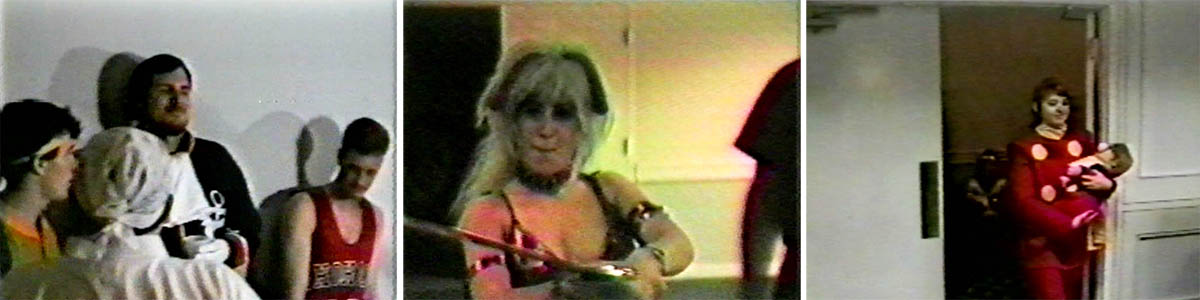


Other cosplayers would portray Yamato crewmembers, Slam Dunk B-ballers, and Ranma 1/2 characters, an example of which is the near-ubiquitous Ryoga. Ryoga was a character from Ranma 1/2 who got lost a lot, and sometimes turned into a pig. It was a great costume for regular-looking guys who wanted something colorful to dress up as, included a backpack so they could carry their stuff around, and had a ready-made comedy skit that could be rolled out at a moment's notice - run into any crowd of people and holler "I'M LOST!" Boy, that didn't get old AT ALL! Not in the slightest! It's as fresh today as it was back in 1995 when we were already thoroughly sick of Ranma 1/2 in general and that character in particular! Also seen - Princess Kahm from Outlanders, about to cut somebody's head off.

AWA would grow from a few hundred at its first show to over eleven thousand attendees at its most recent gathering (2008 numbers - 2015's attendance was 25K), but at the early conventions you could easily fit the entire costume contest and its judges and audience in a medium sized ballroom in a small-to-medium sized airport-area off-ramp hotel. Even the judges got into the act.


Lorraine "Anime Hasshin" Savage here sports a Yamato crew uniform as she sits next to future Dark Horse Manga editor Carl Horn, cosplaying as future Dark Horse Manga editor Carl Horn. Costuming at the second AWA was of an order of magnitude more impressive than the first year - most notably the Tatarek-built Patlabor Ingram, which was constructed entirely out of space-age foam-core and was mobile enough to enable the wearer to navigate fairly well. The handgun, however, was non-operational. Other, more recent cosplayers, attempting to add functional handguns to their regalia, have attracted the bemused attention of the police department. Other 1996 costumes would include Street Fighter II characters and the ever-popular Sailor Moon.


As we pass the mid 1990s, we move into a more documented world of cosplay - email mailing lists, digital cameras, and the world of the World Wide Web, which as we all know was created to facilitate the distribution of high quality images of sexy women - would all lead to anime cosplay becoming one of the dominant forces in anime fandom. Gatherings of anime fans today are a swirling mass of strangely garbed people taking photos of each other, the need of otaku to document their strange behavior an irresistible force of nature. But was it always thus? Yus, it wus. These recently unearthed images from 1983 are proof.


As we see from these images - captured in 1983 A.D. at the Baltimore Worldcon and New York's Lunacon  - anime fandom was alive, relatively fit, and could stand sunlight for minutes at a time. Representatives of Gundam's Zabi family peacefully co-exist with characters from Space Battleship Yamato and several different Captain Harlocks, while Leader Desslok battles Darth Vader and gets cozy with Endor-camo Princess Leia.  Early 1980s camcorders were also on the scene to capture the excitement of this photoshoot.


Here we see Leader Desslok working his Leader Desslok magic on all the females within reach, to the outrage of our various Harlocks, Zordars, and Yamato crew.


It may be difficult to conceive of a time when Matsumoto characters were the mainstream of anime fandom and not some kind of atavistic throwback, but pictures don't lie, even if they're low-res video captures. The influence of classic anime continues to linger in cosplay, as the recent AWA attracted Saint Seiya costumers, Yamato costumers, Harlock cosplay, and even 1984-era Macross crewmembers. Is anime costuming moving full circle, back to segregated rooftop gatherings of different Harlock iterations? I hope not,  though after a long convention season, lord knows we could all use a little sunlight and fresh air.

-Dave Merrill   

Space Battleship Yamato High School students chat in the halls before class

(images used in this article courtesy Animage, Jack Thielpape, R. Fenelon, K. Sewell, and promotional AWA videos produced by M. Murray.)

Thanks for reading Let's Anime! If you enjoyed it and want to show your appreciation for what we do here as part of the Mister Kitty Dot Net world, please consider joining our Patreon!

Thursday, October 2, 2008

MISSING: LOCKE THE SUPERMAN!

Here in the smoky aftermath of the "anime boom" we're digging ourselves out from under piles of $1 clearance manga and unsellable VHS tape, wondering just what the hell happened. And as we survey the hits and misses, we start to wonder about some titles that, to our creaky old school eyes, are conspicuous by their absence...


CHOJIN LOCKE! The immortal teenager with immense psychic powers, an enormous shock of green hair, and a constantly-frustrated desire to just be left alone. For more than thirty years his story has unfolded in manga from more publishers than I can count and four separate animated adventures. Along with other dreamy ESPers with curious hair colorings like COSMO POLICE JUSTY and TOWARDS THE TERRA's Soldier Blue, the image of Locke decorated the bedroom walls and the fan artworks of many an anime fangirl, carving a vital niche between more manly space operas and the other, girlier side of the spectrum. Even the American otaku scene of the Reagan years was lousy with those giant-haired psychic prettyboys.


However, in the subsequent wave of manga translations of series both popular and obscure - an avalanche of imported Japanese comics destined to strain the shelving capacities of bookstores from coast to coast - our ESPer friend and his 38 volumes of manga were neglected. The LOCKE THE SUPERMAN animated film from 1984 was released here, after a fashion, and the LORD LEON and NEW WORLD COMMAND videos got American anime-boom releases, but manga? No way.


But why not? It's a no-brainer. It's a classic, reader-friendly space adventure series with appeal to Americans from both a "manga is cool" angle and a "X-Men meets Star Wars" approach. Yuki Hijiri's artwork plants one foot in the high-tech world of the future and another firmly in the delicate linework and soup-plate eyeballs of Shoujo manga. His art style is breezy, uncomplicated; yet manages to seamlessly integrate the outer-space computers, blasters, and starships aesthetic with that of beautiful youths and their rose-petal strewn melodrama, and sophisticated enough to make us believe in both. (Fun fact: Hijiri designed characters for COMBATTLER V, VOLTES V, and DAIMOS as well as drawing manga for the tokusatsu series NINJA CAPTOR.)


Even though the story of CHOJIN LOCKE spans a thousand years and the aforementioned 38 volumes - a heft that might scare your more chicken-hearted manga publishers - LOCKE's saga is conveniently spread out over dozens of separate, moderately self-contained stories set amid the backdrop of Earth's discovery of star travel and colonization of the galaxy.


Locke the Chojin (don't call him "Superman" when DC's lawyers are around) is - well, appears to be - a teenager with long green hair and a gentle manner. But in reality he's at least a thousand years old and is quite possibly the most powerful ESPer in the universe. His youthful looks hide a world-weary soul whose desire to enjoy the simple life is constantly being frustrated by the space criminals and secret organizations who attempt to conquer the galaxy and the Earth Federation who, backs to the wall, is forced to ask Locke for help. In spite of his wishes Locke is frequently forced to take an active part in events; his innate, almost childlike sense of right and wrong driving him to seek the truth and fight for justice. And tragically, even though he's the most powerful ESPer in the galaxy he can never have the one thing he wants most - a normal life.


The stories themselves are dense - packed with supporting characters who frequently take the spotlight from Locke, they jump from era to era over a thousand years of space history,leaving the reader with a colorful tapestry of mankind's journey to the stars. Events or people mentioned in one story will be expanded upon in another, and blank areas are filled in piece by piece casually, as part of a natural storytelling technique. The anime versions of Locke follow this tradition with flashbacks of Locke's time with the rebellion on Lonwarl or by inserting friends and foes into the opening credits of the OVAs.


(fan translation of the first Locke story courtesy L.G. from the "Mind's Eye" APA)
There has always been a Locke contingent of American fans who collect the manga and write fan fiction about Locke, Justy, Soldier Blue, Takeru and Marg from GOD MARS, and other angsty future psychics of manga. The 1984 feature film not only was one of the screen's earliest (and most restrained) uses of computer animation, it recieved two video releases in the States, an edited version courtesy Just For Kids (titled "Locke The Superpower") and a later uncut release from Best Film & Video. Locke's always been in the background of the Western anime fan scene, but unlike other contemporaneous titles like SPACE ADVENTURE COBRA, LOCKE's manga never made the jump. And that's the surprising part, considering the volume of Japanese comics that have been thrown at us over the past few years.


I'd like to think the success (or not - see comments) of Vertical's TOWARDS THE TERRA and Tezuka manga has proved there's interest in elaborate 70s SF shoujo action. While LOCKE perhaps isn't as philosophical as TOWARDS THE TERRA, it's at least girl-friendly, with enough spaceships and blasters to keep the guys reading. And that's my challenge to Tokyopop, to Viz, to Vertical, to CMX, to Del Rey, to whoever is still mining that manga vein - use your super psychic manga powers for good, not evil, and deliver LOCKE THE SUPERMAN to America!

-Dave Merrill

(Locke fanart by D.V. from the "Mind's Eye" APA)


Thanks for reading Let's Anime! If you enjoyed it and want to show your appreciation for what we do here as part of the Mister Kitty Dot Net world, please consider joining our Patreon!

Saturday, September 13, 2008

AWA next weekend

It's been light on the posting here at Let's Anime, because I've been busy getting ready for the 14th annual Anime Weekend Atlanta, which happens next weekend in, yes, Atlanta. There will be a wide variety of classic anime programming at the show for you to enjoy, including an entire video room devoted to classic anime (it's the Tyndall Room, look it up in your program book when you get to the show).

Highlights?

Peter Fernandez and Corinne Orr (Speed Racer, Trixie, Marine Boy, Ultraman, Thunderbirds 2086, etc) will be guests and doing panels and autographs, etc., throughout the weekend.


I'll be doing the Old School Classroom thing at 11pm on Saturday night in the Classic Anime room (Tyndall), which is a thing where I screen old clips and discuss their relative importance or lack thereof. This year I'm doing my Super Robots panel, which features clips from every super robot anime series from the 1970s (minus two).


Patrick (Otaku USA) and I will be doing a presentation on the 1978 film "Message From Space" on Saturday at 1pm.


I don't know if it counts as "classic" yet, but Walter Amos will be doing a panel on Legend Of Galactic Heroes at 11am on Saturday.


Ed Hill's Magical Girls panel at noon on Sunday focuses on the Studio Pierrot shows like Creamy Mami, Pelsia, and Magical Emi.


At 1pm on Sunday there's a panel about Rose of Versailles.


At 3 on Sunday Neil Nadelman and I are doing a two-hour thing called "Anime Time Machine" where we take a look at anime from 5, 10, 15, 20, and 25 years ago.

If you're an old-time anime veteran, you're welcome to drop by the "Veterans of Anime Fandom" panel on Friday at 5 and share your stories and reminisces with the crowd.

Thursday night AWA's trying something new; the SUPERHAPPYFUNSELL is a garage-sale style sale where individuals sell used and previously-loved anime DVDs, tapes, books, manga, cosplay items, you name it. So if you're at the show early, stop by and check it out.

See you at AWA!

Sunday, August 31, 2008

anime data file

Stay informed on the vital statistics of all your favorite anime characters with these handy cards, provided free with your purchase of certain Japanese anime magazines circa 1980.


Thanks for reading Let's Anime! If you enjoyed it and want to show your appreciation for what we do here as part of the Mister Kitty Dot Net world, please consider joining our Patreon!

Sunday, August 24, 2008

ALWAYS DARING AND COURAGEOUS

(This article has been modified to include late-breaking STAR FLEET information.)

As an 80s teenager naturally I watched way too much MTV, wading through video after video, back when music videos were three-minute dramas with special effects, insane plots, action, adventure, girls in skimpy outfits, and explosions. Nowadays rock acts are too full of themselves to make videos where they turn into post-nuclear barbarians and/or fight zombies. Or maybe they realized that the budget for such nonsense comes right out of their pockets. At any rate, you turn on MTV in the early 80s and you don't know WHAT you're gonna see. Which is how I got to see STAR FLEET!


STAR FLEET is the English version of a Japanese live-action science fiction TV series from 1980 called X-BOMBER. This of course means it's a hodgepodge of concepts and visuals lifted from STAR WARS, SPACE CRUISER YAMATO, MESSAGE FROM SPACE, super robot cartoons, and other artistic triumphs. However, X-BOMBER breaks out of the lookalike pack with one simple method - it's a puppet show. The entire cast is THUNDERBIRDS-style puppets. This is not a Gerry Anderson show, so there's no effort to painstakingly mimic real life in 1/4th scale. This IS, however, a Go Nagai show, at least a show Go Nagai worked on, and therefore is vastly superior in every way, in that it has scary deformed villains, features crazy, nonsensical plot elements, and devotes a large part of its running time to a combination giant robot destroying things with fist and ray-gun.

The story, such as it is, involves the evil Imperial Master, the giant leader of a race of space-bugs and surgically-altered freaks. Imperial Master and his Imperial Alliance are looking for something called the F-Zero-One. He's decided the Earth has it, and sends Commander Makara out in a super space battleship to blow up Pluto in a friendly gesture. The Earth Defense Force, having never heard of the F-Zero-One, is not pleased by the destruction of Pluto, and in response sends out the X-Bomber to find out what the heck is going on. The X-Bomber is an experimental space cruiser with a crew of Scientist, Hero, Fat Guy, Mean Guy, and Funny Robot, later joined by Space Princess and Hairy Alien. When danger threatens, our heroes climb into three smaller spaceships that combine to form the super robot Dai-X!


As it turns out F-Zero-One has something to do with our beautiful space princess, who turns out to be from a destroyed planet, who may or may not have awesome cosmic powers, and has a mysterious connection to mysterious outer-space clipper ship called "The Skull", which shows up to save the X-Bomber whenever things look bleak. The 24 episodes of the series are filled with mighty struggles between fleets of model space warships, space mantises, Death Balls, the brainwashing of our heroes' old mentor, planets of evil trees and space hippies, and of course the final battle between the Imperial Master, played by a guy in an Imperial Master costume, and F-Zero-One, a 12-inch puppet.


It's easy to laugh at the idea of a dramatic science-fiction puppet series, but STAR FLEET winds up being a pretty entertaining show. The puppets all have a great anime-character look, the mecha design is great, the model work is excellent, and the Go Nagai influence means that the bad guys have wonderfully demented appearances. Commander Makara, striking a blow for Feminist Evil Space Commanders, not only dares to expose part of her cybernetic brain, but sports an eyepatch that is actually a little face that talks on occasion.


Puppets argue, wear camo in space, reveal cleavage, scream, die, and never take off their helmets, even in bed. There are lots of lasers, spaceships, explosions, exploding spaceship models, and models of spaceships that explode. The Dai-X is a guy in a giant robot suit, all distressed metal and flaking, battle-worn paint, who stomps around destroying bug tanks and smashing fighters with his giant metal fists. It's a really well designed robot that makes most of the Toei sentai robots look weak. In the climax of the series, they fly the Dai-X right into Makara's space battleship and start busting the whole place up in an orgy of destruction not seen since the final episode of GRANDIZER, and if that's not entertaining children's television I don't know what is.


Two years after its Japanese premiere, X-BOMBER found itself on ITV in England with English dubbing and a new title. STAR FLEET would also air in America on the Showtime cable channel, in two compilation films, "Thalian Space Wars" and "Space Quest For F-Zero-1". For years afterwards the show existed only in reruns and an 8-volume set of American VHS tapes.


The MTV connection? Well, Brian May, the talented QUEEN guitarist, has a son, and his son watched the hell out of STAR FLEET and soon Brian was too. Brian was struck by STAR FLEET's English theme song which was penned by Paul Bliss from the MOODY BLUES. Over a weekend with nothing much else going on, May called up some pals (including VAN HALEN's Eddie Van Halen) and they recorded their own bluesy rock version of the theme song. This was in turn released on an EP, which was this half-assed 1980s cross between a 45 single and a full LP album, usually used for extended dance remixes or stuff the label didn't know what else to do with but was contractually obligated to release. But anyway, Brian May took some footage from STAR FLEET and his own floating head and made a video, and it showed up on MTV, and it blew our minds! And now here I am writing about it years later.


I'm not going to go into too much detail about the show, mostly because there's a really comprehensive site about STAR FLEET / X-BOMBER here. The show was produced in literally a big warehouse in Tokyo by Cosmo Productions, which apparently existed only to produce X-BOMBER, and it seems to have been a forgotten casualty of the SF boom of the 70s and 80s, drowned in the tide of media aimed at a science-fiction hungry world. Too anime-style for the Supermarionation fans, too puppety for the anime fans, it carved out its own genre and remains in a class all its own.


Interested in seeing the show for yourself? You no longer have to haunt YouTube or the stacks of VHS cluttering up your local thrift store, or suffer the indignity of purchasing region-free DVD sets of Star Fleet from foreigners on the other side of the planet. Discotek Media just announced that they're going to be releasing STAR FLEET on DVD here in North America! Slated for sometime late 2016 or early 2017, this set will have the English version, with other details to be announced. Check back with Discotek for more information as it occurs, and in the meantime, keep watching the skies for the evil Commander Makara and the mysterious F-Zero-One!

-Dave Merrill


Thanks for reading Let's Anime! If you enjoyed it and want to show your appreciation for what we do here as part of the Mister Kitty Dot Net world, please consider joining our Patreon!

Sunday, August 17, 2008

MAKE MINE MOMO!!

(This article originally appeared in LET'S ANIME #4, Fall 1993)

Make Mine MOMO!
Why I watch FAIRY PRINCESS MINKY MOMO
by Ed Hill

Ever since I went to my first convention and contracted that inexplicable fondness for the products of anime culture ('twas at the July 1988 Dallas Fantasy Fair, for the insatiably curious), I've met countless others with the same tastes, absorbed a lot of video, and even made the crossover into the ranks of would-be creators of the stuff. So I am not here to excoriate everything about so-called "fandom"; hell, i'd be shooting myself along with my targets. Besides, I can do that later.


Nope, what I'm here to do is take Dave up on a statement he made in the last issue, an editoral where he said he'd even run an article about the show FAIRY PRINCESS MINKY MOMO if anybody sent it in. Now, considering that I really dig this show, I figured that an article on it would be really cool, and that this was a golden chance for somebody to get one published. However, also knowing the taste and the cretinous nature of the dominant fanboy herd, it also occured to me that I was that somebody. So I sat down to write this splendid retrospective on the wonders of FAIRY PRINCESS MINKY MOMO (for convenience's sake, hereafter to be referred to as "MOMO").

However, I ran into a brick wall - there exists no translated episode guide that I know of, episodes themselves are hard to find, and few people even considered translating the stuff that made it over here. This makes it rather impossible to write up something for it as worthy as the DEVILMAN or MAZINGER Z articles that have appeared in this magazine. So, I fudge a bit - herein, I offer some of the reasons that I say "Make mine MOMO!" - and why you should, too.


I have to admit my fascination with the whole thing started as a desire to be different. I got to hanging out with a rather scurvy lot of fans not long after I was introduced to anime. And since these were the guys I got most of my stuff from, most of it reflected their tastes. This meant that they mainly had lots of GUNDAM, lots of BUBBLEGUM CRISIS, and an extensive CREAM LEMON stash. Generally their attitude (like that of most fans these days) was that anything with a recent copyright date was good, old was bad, and if it didn't have cute girls with guns in it, they had no time for it. One day, they commenced to ragging on various things they hated - amongst them were the works of Hayao Miyazaki, Reiji Matsumoto, and anything Takahashi did before RANMA 1/2, as I recall.

But the show that seemed to bug them the most was something called MINKY MOMO. They thought it was the worst of them all. Now, since I happen to be somewhat contrary in nature, I figured that since they hated it, I ought to check this show out. After all, the other stuff they despised was really very good! So eventually I found some Momo episodes on an ancient tape of some other crap that a friend had, and gave it a watch. I thought that maybe even those geeks could be right about this one show - the name certainly wasn't encouraging! But, did you know, this MOMO was surprisingly good. and thusly did I become the unapologetic fan that I am today. As for reasons why I say this, just keep reading...


First, I like the show because it's cute. Yes, cute. What's wrong with that, fanboy? There is a dread of the word 'cute' these days, and it's a damned shame. Cuteness is not bad in and of itself! It can be whimsical and fun - "cute" doesn't have to mean drippy and smarmy Care Bears or Rainbow Brite nonsense. At best it can be a reminder of happier times, of affection and good things. MOMO is cute, but not TOO cute. Besides, cute is always harder to take when it's accompanied by a moral, like in American cartoons. MOMO is not afflicted by any heavy, preachy "message." Sure, she goes about helping to fulfill dreams, but you never feel as if you learned anything from it! And some of the things she does, though minor, would be roundly condemned by parents and teachers alike in America. For example, to help a boy whose father is a jewel thief, she becomes the Red Cat and gets into a stealing contest with the guy! In a racing episode she mercilessly runs a fellow driver off the road and into a river. And there's the hilarious "Minky Rambo" scene from the opening episode of the second '91 MOMO series. Trust me, it's cute, but not wussy cute!


Secondly, the show is quite funny and sports the occasional gonzo touch as well. There are jabs at other anime shows - the Red Cat episode takes pokes at LUPIN III, the racing episode was packed with SPEED RACER gags, and there are many others. The opening idol star number of the Minky Momo film "La Ronde In My Dream" features hilarious imitations of MACROSS' Minmay, MEGAZONE 23's Eve, and others. Also in the film Peter Pan and Slim Pickens' DR STRANGELOVE character Major "King" Kong show up quite a bit! And for the final perverse touch, why not consider the infamous ending of the first MOMO series, way back in '83? For those who don't know, here's the story. She's nearly completed her mission on Earth; one more dream fulfilled and the last jewel on the Magic Crown will be in place and the Dream Land of Phenarinartha will come back to Earth and everything will be groovy. Happy ending, right?


Well, no. Momo loses her magic pendant - without its protection, she's as vulnerable as any other Japanese schoolgirl - and then she's SPOILER WARNING killed in a tragic car wreck! Her spirit then chooses to hang around Earth and wait to be reborn. Now is that a hell of a way to end a kids show, or what? No matter what you think of the rest of the series, you have to hand it to anybody with the balls to wrap it up like that, eh? How many of the current wretched crop of OVAs out today have as much grit as this supposedly sickeningly-sweet children's program? Not very many, as I see it...


Thirdly, although you can't exactly accuse the show of being overburdened by complex plot structures, I see that as a good thing! Sure, it verges on dumbness sometimes, but even when the show is dumb, it is that good, lighthearted kind of unpretentious dumbness that makes it all fun. For, above all, it's a fun show at heart. So what if there aren't any MOMO technical or resin giant robot model kits - I find the fan desire to "explain" every detail really tiresome! And besides, it being a kids' show makes it easier for the untutored gaijin to figure out what's going on without help. My personal opinion is that Momo is like your favorite toy from childhood - your affection for it may not have been entirely rational, but you loved the thing anyway, didn't you?

the many faces of Minky Momo

And before you start squawking that MINKY MOMO was meant for girls, consider this - anime itself, in every sense, was not made for ANY of us! It was made for a Japanese audience with a different culture and language and different tastes. They never even considered American anime fans into the equation at all! Whether you watch "boys" or "girls" or "adult" anime, nobody is going to think you any less strange. Do you think the Japanese will condemn you for watching one thing but approve of you watching another? Quite frankly, they don't care. Most of them have no idea anybody else from any other country watches their cartoons, and the ones that do will find it odd whether you watch MOBILE SUIT GUNDAM or MINKY MOMO.This doesn't mean that you shouldn't watch it, of course - what I'm trying to say is that since you're an outsider no matter what, why not just go ahead and reach for that forbidden fruit? Watch MINKY MOMO - you have no reputation to lose! Well, maybe your nerd friends will talk smack about you. But who cares what that gang of Priss-worshipping no-lifers thinks anyway?


(note heavy metal hand gesture - ROCK ON MINKY MOMO!)

I'll be the first to admit that I can't explain every reason why I watch MINKY MOMO. It's like beer, I guess - an acquired taste. But I hope at least I came up with a few good reasons as to why you might spend a bit of time with the show. It has heart, it's cute, and it's funny - what more do you really need? Besides, if you have a thing for pink hair, this is the show for you! So, until next time kids, remember -- "Pipuruma, Pipiruma, Purilinpa! Papareho, Papareho, Dorilinpa!!"

Ed Hill is a cartoonist residing in Arlington Texas. He's noted for his strip FAIRY PRINCESS YUKIO MISHIMA and for singing the MINKY MOMO theme song at karaoke events.

Thanks for reading Let's Anime! If you enjoyed it and want to show your appreciation for what we do here as part of the Mister Kitty Dot Org world, please consider joining our Patreon!

Sunday, August 10, 2008

animanga A.P.A.

In the latter half of the Reagan Era, fan artists and writers couldn't communicate via the Information Superhighway or "texting" each other on our "cell phones" - we had to use Stone Age tools like Xerox machines and staplers and the US Post Office. What the hell am I talking about now? Why, Amateur Press Associations, or A.P.A. for short.

(Queen Millenia art by Paul Sudlow)

The APA has been around in one form or another for a long time - our Founding Fathers used "Committees Of Correspondence" to disseminate information in the heady days of the American Revolution, and your saintly, silver-haired grandma probably sent "round-robin" letters to friends and relatives around the country swapping news and recipies and gossip about What Really Happened To Uncle Bob. The fan APA isn't too different - it's basically a self-published magazine where each member produces his own submission. Everybody sends their pages - enough copies for every member of the APA - to a central collator (or "Offical Editor"), who puts it all together and mails the collated magazine out to all the members. It is, or was, a complicated yet old-fashioned way for creative types to share their work with others, get feedback on their current projects, network with other like-minded individuals, and sometimes engage in hateful, vitriolic arguments over the most useless topics imaginable.


(cover to #1 with art by Paul Sudlow)

For Japanese anime fans in the 80s who wanted to write and draw about their favorite characters, the APA was the way to go. In 1986 a Tennessee undergrad named Paul Sudlow started one with the working title "Anime And Manga APA". This was later changed to the vastly superior "Animanga", a fairly obvious combination of the two words that has since gone on to be used by a wide variety of publications and organizations. But in the beginning it was simply an APA made up of guys (and a few gals) who liked to talk about their favorite Japanese animation.


(cover to #3 with great Rich Arnold art)

ANIMANGA would last for fourteen years, through four different collators ("Offical Editors") and 54 bi-monthly or later quarterly issues of self-published comics, fan art, fan fiction, fan speculation, arguments, political rants, travelogues, sketches, works in progress, video swaps, appropriated works, copyright violations, you name it. Members hailed from the States, Canada, Japan, and points between, and ranged in age from 17 year old punks to 40ish fan veterans, most of whom were way better artists than I was. Some members would go on to direct animated films or successful careers in comics or animation, other members would get married to each other, others would start anime conventions or magazines or drop off the face of the Earth and never be heard from again.


(Animecon 91 report illustrated by David Rains)

There were other anime-themed APAs - U.S.A. Yatsura, Hasshin APA, Sasha APA, Endless Road APA, Starsha APA, Bird Scramble (the Gatchaman APA), even APAs devoted to 'esper' themed anime like JUSTY and LOCKE. But I was in ANIMANGA from beginning to end so that's what I'm writing about.


(swell hand-colored cover by Steve Krueger)

APA contributions (or "tribs") varied widely, but a few basics were always there - you'd have a cover or a logo with some kind of cutesy title for your own personal "trib", with contact info so your pals in the APA could call or write when the mood struck them. Imagine doing that on the internet these days! Usually you'd include a segment commenting on the tribs of other members from the previous issue. If you had read their trib and enjoyed it, but didn't have anything in particular to say, you'd just write 'RAEBNC' as shorthand for "read and enjoyed but no comment." The artists among us would try to work up something interesting or unique for the issue - most of the comic artists would either run continuing stories in the APA itself, or use the APA to showcase roughs and ideas for works that were being published elsewhere.


(Andy Temple's Urusei Yatsura fan comics. I loved those things.)

The more accomplished among us would create "how-to" tutorials on lettering, inking, reproduction, and other basics of the comics world. Several fan fiction writers spent their ANIMANGA time serializing their multi-part crossover fanfic epics, and the 'big tent' nature of the fandom of the time meant that your average ANIMANGA would feature anthropomorphic furry adventures, American superhero parody comics, Dr. Who jokes, and Babylon 5 fan art alongside your Dr. Slump drawings and your version of Project A-Ko or your Dirty Pair/Urusei Yatsura crossover fan comic. And if you didn't have anything to say, but couldn't bear to let an issue go by without participating, you'd do the absolute minimum and MINAC ("minimum activity") with just one page saying "sorry, more next time".


(Paul Young draws my "Jet Jaguar" character)


In my mind APAs are part and parcel of the pre-internet days when things were a bit simpler. We didn't have high speed internet, satellite TV, or an anime convention every weekend to constantly demand our attention. The pace of fandom moved slower - many a lazy summer afternoon or rainy day would be spent re-reading APAs or working on your next trib. Fan feuds took months and months to play out in the comments section of APAs, as opposed to the 24 hour blitzkrieg half-life of today's fan fisticuffs.


(JUNKSPACE - original John Ott comics)

And there was always a little tension in the APA - the more traditional American style cartoonists felt threatened by this big-eyed Japanese stuff that was all speed lines and zipatone. The manga style artists felt they were on the cutting edge of what comics SHOULD be. And everybody hated the furries. Members would use ANIMANGA to hash out political philosophies, take jabs at disagreeable aspects of modern culture, or spread malicious fan gossip. Looking back at the APA, it's amazing how seriously we all took this little self-published magazine - pulling all-nighters, spending hundreds of dollars on printing and mailing, all for something that was only going out to 20 or 30 people, tops. I guess that's the nature of fandom - 'fan' is, after all, short for 'fanatic'. In those days there wasn't any time for fence-sitting wishy-washy maybes, it was all or nothing.


(Tim Eldred showcasing some commercial Harlock work)

These days the urge of artists and writers to share their work with the world has been satisfied by dozens of websites devoted to fan art, fan fiction, webcomics and other creative endeavours of all stripes. The societal urge is filled with Livejournals and Myspaces and Facebooks. You can shoot your own movies and share them with the world via YouTube, have your press release blog picked up by Digg or Reddit, and potentially reach millions of people with less trouble than it took us to knock out one APA trib that would be seen by twenty or thirty people, max.


(cut and paste collage cover by me)

This was all just starting to percolate into existence when ANIMANGA took its last bow with issue #54 in 2001; at the time I didn't know what would replace the APA, I just knew that the membership was dwindling and it was getting tougher and tougher to cajole members into actually getting their tribs in on time. Plus, we were all getting older and had jobs. Those of us with creative jobs were finding it harder and harder to spend our leisure time doing what we did all day to pay the rent. Anyway, what ANIMANGA accomplished then is now done in a fraction of the time with a fraction of effort, and the added benefit of not killing any trees.


(Twin Peaks travelogue vacation notes by S. M.)

At the same time, I miss the homely circle-of-friends world of the APA. Even if you'd never met any of the members in person, being part of an APA put one in a select group of people whose membership was predicated upon actual participation. We were all struggling to meet deadlines, all working to make the APA bigger and better, and being part of a group like that was kind of inspirational. I think most creative types are more likely to work harder knowing there's an audience reading their work, even if it is a small one, and even if the only response is the eternal RAEBNC.

-Dave Merrill

(all artwork used in this article is copyright the original artists)

Thanks for reading Let's Anime! If you enjoyed it and want to show your appreciation for what we do here as part of the Mister Kitty Dot Net world, please consider joining our Patreon!