Monday, November 17, 2008

anime clubs - our glorious unwashed heritage

Dateline - the middle of the 1980s! All over America groups of like-minded young people from all walks of life are gripped by one obsession - running anime clubs! We were utterly convinced, for some reason that now escapes us, that once a month a library meeting room or apartment complex community center or campus media area MUST BE filled with people watching big-eyed Japanese cartoons. Traded through the mail, bought from bootleggers, badly dubbed or fan-subtitled on the sly in some PBS station, but mostly in raw Japanese - it didn't matter. Brains overheating, we strained our intellects trying to figure out who was doing what to whom and why, but years would pass before decent translations revealed that most of the time our conjured-up plots were more satisfying than the original versions.


(flyer for C/FO Atlanta circa 1987)

However, events on the 20-inch TV screen were frequently overpowered by what was happening in the audience. You see kids, fandom as we know it today- a glossy wonderland filled with sexy cosplay gals, fueled by media empires shoveling material down as many gullets as possible, and linked together in an instantaneous high speed multimedia data "internets"- did not exist. Oh no sir. In the old days "fandom" was a leper colony of dweebs, misfits, rejects, and failures; people who had formed a deep and unhealthy relationship with fantasy and/or science fiction somewhere during their third or fourth beating courtesy that jerk in the 6th grade. Fans in the 80s were seeking shelter from the storm, looking for secret redoubts where they could commiserate with fellow rejects, dream of a better world, and argue about Kirk VS Picard.


Anime fandom was doubly cursed; being devoted to children's cartoons, it was looked down upon by Trekkies; and being devoted to JAPANESE children's cartoons, it was rejected by every red-blooded American fan who felt Walt Disney and Warner Brothers were the be-all and end-all of ink and paint. So the point of all this is, your typical anime club meeting was full of the rejects that the rejects had rejected. For some of us, being wise-ass teens who cared not a whit what a lot of beardo failures thought, being rejected by the Space Command Klingon Middle Earth Glee Club was a proud badge of honor. For others, anime fandom was just another monthly meeting of the Secret Chosen, and they sat through Be Forever Yamato just as they sat through "Amok Time" at the Trek club meetings or "Caves Of Androzani" at the Dr. Who club meeting. Hey, as long as those club dues got paid!


(Anime-X flyer circa 1991)

The problem was this. Anime clubs soon learned what SF clubs had known for years - that in addition to the fandom stuff, they also had to play combination Ward Supervisor / Mommy and Daddy for a parade of flattened-affect borderline mental cases for whom the rules of polite society were merely hypothetical. Legions of middle-aged creeps who did not bathe or launder their clothes, who did not have indoor voices, whose talents for inappropriate behavior were legendary, who could barely show up for their minimum-wage jobs and yet who never failed to miss an anime club meeting. As anime gained in popularity, the middle-aged examples began to be pushed out by their teenage and young-adult counterparts, who shared the same aversions to soap, water, and society's rules, but whose talismans weren't back issues of Starlog, but instead backpacks loaded with videogame systems.


(cartoon from C/FO Atlanta newsletter by J.B.)

I'd once thought that such people were unique to MY city's fandom, but I've since found that they exist everywhere. The following are true stories collected from anime club veterans from around the country. Names have been changed to protect the innocent, and the guilty.


("D.M.", former club officer) At (NAME OF CLUB REDACTED), we had the guy who broke the glass insert window in the door by leaning against it with his gigantic overstuffed Pikachu backpack. Because when you come to an anime club you have to bring your every worldly posession in your backpack, including your heavy 1990s era video game systems.


We had a video tape library. One guy came to a meeting, joined the club, signed in, learned he would not be first in line to borrow tapes, asked for his money back, and left.

There were folding tables in the hallway of the center where the meetings were held. Somebody stood on a table in the hallway. Broke it right in half. We had to pay for that one.


One of our members was driven to the meeting by his mom, who would bring him a home-cooked lunch...during the meeting. If the chairs in the room were not of sufficent quality for her baby boy, she'd go looking for better chairs. If she steals them from the staff lounge, so much the better!

The smell in the room, of course, was terrible. Some people simply do not bathe or wash their clothes on a regular basis. We'd see new potential members arrive, walk in the door and take in the legions of black-clad video gamers hunched in the back delivering death blows to each other, and of course the amazing smell. They would then turn right around and leave.

Eventually the meeting turned into 30 people in the back of the room watching 3 people play video games, 12 people hanging out in the hallway chatting, and 4 people actually watching anime. I severed my connection to the club when the librarian telephoned me AT WORK to complain about the club's behavior at the previous meeting - rather, their behavior AFTER THE MEETING WAS OVER and they didn't have anything better to do but hang out in the parking lot.

("D.S.", former club officer) Truth to tell, the (NAME OF CLUB REDACTED) anime club has been lucky over the years. The worst example of classic foul-smelling fandom we got was in the very first year, a fellow we dubbed "Akira Hat Guy," and after a couple months of being rebuffed every time he asked people to hook him up with bootleg Dragon Ball Z subs, he went away and never came back.


(editor's note from C/FO Atlanta newsletter circa 1987)


Most of the other whackos have been more funny than genuinely aggravating. For instance, P. used an image of Patty Hearst in the club's advertisement in the (NAME OF CONVENTION REDACTED) program book. This inspired one member to complain, saying that this sort of iconography stood in opposition to "everything America stands for."


A subsequent recruitment flyer featured Patty Hearst, Fidel Castro, and Huey P. Newton, tagged with the line "Everything America Stands For."

The kibitzers are a perennial problem, but for us they've never been TOO hard to deal with. This last semester, when the kids were hooting and making porno sound effects during Victorian Romance Emma, we just explained that no, that's not acceptable behavior in a group environment, and they seemed to get the message.

Except for one gal, who said that there was no point in watching cartoons in a communal setting if she COULDN'T keep up a running commentary -- if she wanted to watch something quietly, she'd just do that on her own. To which my reaction was, hey, why don't you go do just that.

("D.3.", former club officer and convention director) Examples: the Too-Old-To-Be-Hanging-Out-With-This-Many-Kids Guy, the "I have what you want, and I won't let you forget it" Guy, the "I am an emotional Black Hole and will suck your generosity dry" guy, the "I compensate for my social awkwardness by memorizing every detail of my favorite shows and reciting them whether it's germane to the current situation or not" guy, the "I compensate for my social awkwardness by professing a deep physical attraction to a fictional character, loudly and frequently" person...

("G.S.", former club officer and convention staffer) Don't forget about "wanna read my self-insertion fanfic guy."

("R.M.", anime retailer, former con staff and club officer) We call him "The Creepy Downloader" because he looks like he's been smoking 3 packs a day for all of his 40-50 years (no idea of his real age, but he mentions an grown-up daughter and an ex-wife)and he downloads everything. The only time he buys stuff is when it's on clearance at Best Buy and then he uses his employee discount. He's only bought 2 things from me in the almost 4 years I've been open (both Newtype USAs for the DVD), despite the amount of time he's spent in the store talking my ear off. He is known to provide either a running commentary or bragging about his collection during the meetings.

Previous offenders: A boy of immense size and girth that we refer to as "Gundam Boy". Originally "Star Trek Boy" for showing up with a TNG communicator pin, TOS insignia belt buckle and Klingon logo watch. Known for completely inappropriate comments, especially toward anything with a vagina. He's on the watch list of every convention in town and automatically has his badge punched by security at NDK so they only need one time to pitch him out. Another guy managed to drive some of the older club members out because he would smoke clove cigarettes outside and tended to blow it onto people's faces. Not good for some of those club members who got headaches just by being in the same neighborhood as a charcoal grill.


Then there was the Boopster, who also hit on anything female; before, during, and after his marriage. He started up clubs in every town he moved to for the sole purpose of getting freebies from the anime companies. He would then turn around and try and sell the freebies at meetings, telling one of my female friends "I love making money off these stupid fanboys", like it would impress her. He also demanded (and eventually got, just to shut him up) a free badge one year from (NAME OF CONVENTION REDACTED) because during the Dead Dog (party), someone joked that Boop should be the Con Bartender, which he took seriously. So he shows up at the staff room saying "I'm the Con Bartender. Where's my badge?"

("D.M.") One club meeting the TV and the VCR and the tapes were all stuck inside (NAME OF FAN REDACTED)'s car, which had been locked with the keys inside. So as we stood around waiting for the locksmith, (NAME OF FAN REDACTED) offered a temporary diversion. Since (NAME OF FAN REDACTED) was infamous for forcing his unsolicited adult-themed Inspector Gadget fan artwork on unsuspecting victims, we all were relieved when his suggestion turned out to be a dramatic reading of the first-ever fan fiction devoted to the then-new STAR TREK THE NEXT GENERATION series. However, our relief did not prevent us from leaving the room at an amazing speed.

("S.M.") Oy. I've never had a problem with (NAME OF FAN REDACTED) but I know all about the Captain Linger Brigade from my time behind artists alley tables-- you always know the people who won't buy anything, because they're the ones who stand there for half an hour telling you their fucking life story. Because that's why I sit behind that table full of books and merchandise; so I can hear some sad bastard's autobiography.

("H.S.B.", former con staff) Let's see, we had one guy who made his own anime shirts & hats using bottled paints, glitter, & iron-ons. He also would make crappy pasted together flyers for (NAME OF CON REDACTED) without asking anyone in charge of the con if he could. I think this was the guy we dubbed "Master of the Folding Cane."

("Z.C.")Here we've got a balding guy who looks to be about 40 or so. I don't know his name, but he has several distinguishing characteristics:

- May or may not still live with parents
- Suspicion of failure to bathe
- Appears to be slightly mentally challenged
- Dislikes heavy violence (to the point of shouting THAT'S VIOLENT!!! loudly whenever he sees anything over his "threshold")
- (and the punchline!) but collects a whole lot of really disturbing rape-o-rama hentai.
I honestly don't know whether I should feel sorry for him, or to stay far, far away from him.


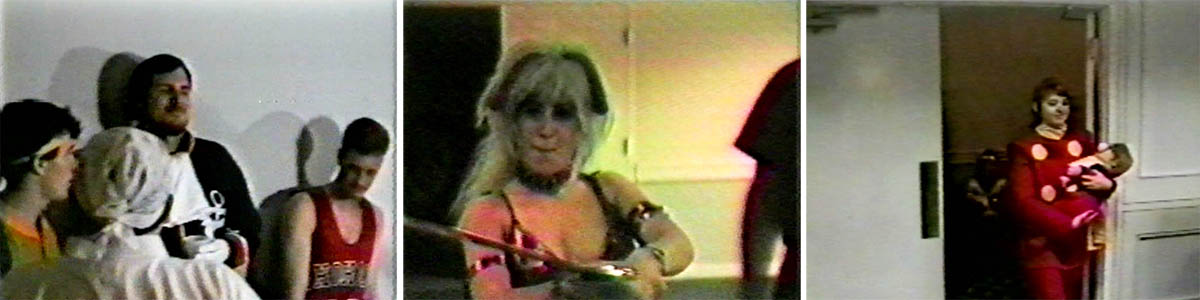
(the following video is a compilation of camcorder video recorded at Denver-area anime club meetings over the course of several years. If you want to know what anime club meetings were like in the 1980s, this video has it all. Bad hair, two TVs in parallel, and that same exact blackboard that was in the back of every single room every anime club ever had a meeting in. It's all here, people. Provided courtesy of Gimme Anime, your home for anime merchandise!!


("G.S.") You've made me recall our club's last few breaths...our club president was in place for almost the entire run of the club, so in our eyes, even after he stepped away, those of us left still treated it with the respect that it was still his. When it came to the end when the fans were just too much and we hoped to find some like ourselves who would respect it and take over we came up empty. For months I wrote in the newsletter how we were looking for people to step up and start helping out and so on. I was always met with silence.


We talked to the old prez, and told him why we were going to retire the club, and he agreed. I then went to the one guy we could count on, who was running the college club on opposing weeks and was reliable to show up, and told him what was up. He agreed to do the last few meetings for us. We also asked that he not revive our club, at least not under that name, as we believed it belonged to the guy who started it, and wanted to retire the name with its legacy intact.

So our final newsletter was published a few meetings before the end, we even had all the programs timed out that all our series would end on the same night. We compiled those last few meetings onto a tape per meeting and passed them to the aforementioned reliable guy.

Let's just say my final editorial was less than chipper, and announced the end of the club and why. We were mobbed that night with people who were upset that we'd just end the club, and they all wanted to know what they needed to do to help out....to which we really didn't have much to say as well, this club is retired, where have you all been the last few months when we asked for new blood?

Why, they were sitting in the stands watching the shows they expected us to keep bringing them without any contribution.

And this scene was replayed across the country. The availability of anime in Blockbuster and Best Buy and Wal-Mart and damn near everywhere else, combined with the sense of community engendered by the keyboard-pounding march of Wired Nation, meant that the very concept of getting together once a month to watch Japanese cartoons became an anachronism at best. When forced to deal with the constant antics of the Loser Battalion, club organizers found themselves taking a good hard look at why they were wasting their weekends showing cartoons they didn't make to people they didn't like. Most anime club officers moved on to staff anime conventions, which compress a whole year's worth of anime watching, tape trading, foul odor huffing, and window breaking into three days. This saves time, if not sanity. And who knows? The tide may again turn and anime may again become a hidden pleasure available only to those 'in the know', and perhaps we'll be back to meeting in undisclosed locations to enjoy our favorite cartoons. However, if there is a next time, we'll be a bit more... selective in our membership.


(C/FO Atlanta newsletter fan art by M.M.)

My thanks to all who participated in this project. May this facilitate the healing you so deeply desire.

-Dave Merrill

Thanks for reading Let's Anime! If you enjoyed it and want to show your appreciation for what we do here as part of the Mister Kitty Dot Net world, please consider joining our Patreon!

Saturday, November 8, 2008

GO! GO!! RAIDEEN!

It's 1976 and America - gripped by Bicentennial fever and torn between folksy peanut farmer Jimmy Carter and clumsy Washington insider Gerald Ford - is about to be transformed forever by a transforming giant robot! Or would have been, had anybody noticed.


BRAVE RAIDEEN, the pioneering Sunrise/Tohokushinsha super robot cartoon with the top-notch anime industry pedigree (Yoshiyuki Tomino, Tadao Nagahama, Yoshikazu Yasuhiko) that brought the phrase "Fade In!" to national prominence and alerted us all to the threat of satanic Fossil Beasts, not only was the first transforming super robot anime TV hero, but also was the first transforming super robot anime TV hero to make onto American broadcast television. Can we get more trivial?

Raideen with KIKU-TV subtitles


Summer of 1976 saw Japanese-language UHF television stations across America - New York, Chicago, California, Hawaii - become super robot battlegrounds as a subtitled version of BRAVE RAIDEEN burst over the airwaves. Joined by shows like CYBORG 009, CAPTAIN HARLOCK, and, um, GETTAIGER THE COMBO-CAR, these anime series would become key figures in the embryonic American anime fandom of the day. Part of BRAVE RAIDEEN's legacy were two children's books distributed by Pentacon, a Hawaii-based Japanese import outfit.


These children's books - printed in glossy full color on heavy paperboard stock - were merely English versions of similar Japanese editions (printed in Japan probably on the same presses busy cranking out indestructible children's books based on Daimos, Candy Candy, Galaxy Express, et cetera).


But even though transmission dates "fade-into" the past, the legend of Raideen continues to inspire. What's the story? Akira Hibiki, Seaside High School soccer team captain, one day listens to the voices in his head who tell him that he's actually descended from the Mu Empire civilization. Only he can psychically control Raideen, which is their ancient giant super robot hidden inside a mountain. And he's got to do it right now because the Demon Empire (who actually worship the actual Satan), led by blonde pretty-boy Prince Sharkin, is about to attack the Earth with their legions of flying monster Dorohome and evil Fossil Beasts!


Luckily for Earth, Akira's girlfriend Mari is the daughter of a prominent scientist- the best friend of Akira's absent father - who has built a gigantic scientific complex just offshore in order to use super-science and the lost technology of Mu to battle the Demon Empire. This science center is amusingly housed inside a big clam shell. Assembling a team of science fighters called "Cope Rundar" (tough guy, bespectacled smart kid, former motorcycle gang deb Asuka Rei), together with Akira and Raideen they defend the peace of Earth!


As a period piece BRAVE RAIDEEN is jam packed with 70s signifiers like giant lapels, spoon-bending Uri Geller ESP, outlandish animal-themed super vehicles, and Akira's fringed jacket. But the super robot drama of RAIDEEN is a notch or two up from the monster-of-the-week stuff coming from rival Toei- the Nagahama - Tomino combination means pathos and tragedy lurk around every corner for our heroes. The local populace comes to regret being the battleground for every Raideen/Fossil Beast battle, Akira begins to wonder if he's being taken over by Raideen, and Mari, whose panties are shown with alarming frequency, is jealous of Asuka Rei and every other female who dares to appear in the show. Combined with a stirring marching band theme and jazz-rock songs for use encouraging Raideen to fight and/or to indicate when it's time for Raideen to transform into the God-Bird and slam his pointy beak straight through the heart of yet another Fossil Beast, BRAVE RAIDEEN is nothing but entertaining.


Two lackluster remakes and about a hundred thousand different Raideen toys are evidence that inside every anime fan lurks the fierce desire to hop onto their motorcycle, take a sweet jump off a ramp, hurl yourself into the air while hollering "FADE IN!" and combine with a sentient, millennia-old super robot to defend Earth. Who says the 70s have to be over? Not me!


Well, except for the giant lapels, those can be over. RAIDEEN! USE THE "GOD GO-GUN"!!!

-Dave Merrill

Thanks for reading Let's Anime! If you enjoyed it and want to show your appreciation for what we do here as part of the Mister Kitty Dot Net world, please consider joining our Patreon!

Tuesday, October 28, 2008

LET'S BUY ANIME STUFF-- 80s STYLE!

Hey guys, the new BOOKS NIPPAN catalog showed up! It's 1984 and the only way to get Japanese animation books and magazines is through the mail, and that means catalogs!


Books Nippan was/is the American branch of Nippon Shuppan Hanbai, Japan's largest book distributor! At some point in the early 1980s, they figured that there might be a little money to be made out of re-routing a bit of the gigantic tidal wave of anime books and magazines currently submerging Japan towards the United States, where a small but devoted audience of what would one day be known as 'otaku' waited, cash in hand, for their chance to buy Roman Albums and This Is Animation books.

Earlier Books Nippan catalogs were xeroxed and had a charming punk rock cut-and-paste aesthetic that resembled the fan pages of your better anime magazines.


Even though Cat's Eye isn't about three detectives, somehow the friendly clip art and hand-lettered copy makes you want to shell out $3.30 for "black and white comic novels". This is back when the word "manga" wasn't a overused tagline and the yen-to-dollar conversion was a lot easier to calculate.

But even the friendliest of graphic design has to move with the times and soon Books Nippan's catalog got all professional-looking with screentones and set type and everything.


When you're back in 1984 be sure and pick me up some Roman Albums, okay? I will gladly shell out $7.10 for the Brygar Roman Album! Publisher Tokuma Shoten's guides to the anime world, "Roman Albums" were/are thick paperbound magazine size books jam packed with production art, story notes, character designs, color pages, posters, stickers, and other bromides, and were absolutely vital for the informational needs of anime fans circa 1984 and beyond.


Another "thank you" goes out to Books Nippan for introducing us to the world of "black and white comic volumes" based on our favorite anime! Turns out it's the other way around, that many of our favorite anime series were based on the comics. Or "manga" as we later learned to call them. All your favorites are here - Urusei Yatsura, Space Cobra, Dr. Slump, Locke The Superman, Golgo 13, and Patalliro. 24 years later, however, and I am still unsure what "Star Boy" is. I'm pretty sure they don't mean THIS "Star Boy."


The Keibunsha Daihyaka books are great little bricks of data; written for grade-schoolers, the Japanese is simple, the kanji are all ruby-equipped, and the photos are big and grainy.


I find myself hauling out my "All Animation" volume for reference a lot more than you'd think. Okay, so it's only updated through 1983, but who cares?


This is what's left of the first book I ever purchased from Books Nippan, a Keibunsha Cyborg 009 book that demonstrates how well the binding holds up after thirty years of reference usage (hint: not very well).

Probably the best part about the Books Nippan 1984 catalog is that it was, for many of us, the very first place to ever advertise Japanese Animation video tapes for sale. And I use the word "sale" very loosely, because HOLY CRAP CHECK OUT THOSE PRICES!!


Do I LOOK like I have ONE HUNDRED AND SEVENTY UNITED STATES DOLLARS to shell out for the first Space Cruiser Yamato movie? Minimum wage back then was $3 an hour. Do the math. Prices on commercial releases of anime remained high for most of the decade, leading to a thriving bootleg video market and the sad spectacle of little clubs of fans pooling their money to buy Crusher Joe or Urusei Yatsura Only You or Final Yamato at the bargain price of $202. I think these days you could fill a cargo container with anime VHS for two hundred and two dollars and hand them out on Halloween like circus peanuts. Beta - TWO cargo containers.

But that's not all Books Nippan offered - they carried a full line of fashion magazines, the charmingly censored Japanese edition of PLAYBOY, and a full page offering glossy color magazines all about your favorite British pretty-boy bands.


Decades pass and the teenage girls have abandoned Duran Duran for the manga - sorry, the "black and white comic volume" section at Barnes & Noble! And thus, the great circle of life... continues.

-Dave Merrill

Thanks for reading Let's Anime! If you enjoyed it and want to show your appreciation for what we do here as part of the Mister Kitty Dot Net world, please consider joining our Patreon!

Wednesday, October 22, 2008

paging dr. black jack

While visiting Toronto's finest comic arts establishment the Beguiling last week, I picked up Vertical's new edition of BLACK JACK, Osamu Tezuka's medical suspense manga starring the mysterious unlicensed surgeon with the two-tone hair. Published in SHONEN CHAMPION from 1973 until the mid 1980s, BLACK JACK was Tezuka at his best; moving beyond his comfort zone, away from licenseable children's robot characters and cute animals into (for him) uncharted gekiga manga territory.


Black Jack is a renegade doctor with inhuman skill, a high price tag, and scars the envy of every modern tribalist. Seemingly detached and uncaring about the rest of the world, his true feelings are betrayed by a constant struggle to end human suffering. This usually takes the form of some sort of bizarre, painful, and incredibly disfiguring make-believe disease. At least, I hope these diseases are fictional, because some of them are pretty frightening. However, Black Jack fights back with outlandish and drastic surgical procedures that no other doctor on Earth would approve, let alone attempt to perform. When he's not deep inside some poor slob's intestines (rendered in slightly-too-realistic detail by real-life doctor Tezuka), Black Jack can be found uncovering criminal plots, revealing embarrassing lies, and generally behaving like a scalpel-wielding Columbo. Several times he manages to both fulfill his Hippocratic Oath and nab evildoers at the same time, winding up with stories that read like a cross between Rex Morgan M.D. and the twist-ending E.C. crime comics of the 1950s.


Vertical's new release is not the first time Black Jack manga has appeared in English - Viz released two volumes of manga in the 90s and serialized Black Jack in their MANGA VIZION anthology - but this new Vertical edition is certainly the classiest. A direct reprint of Akita Shoten's 1987 BLACK JACK collection, Vertical's version is printed slightly larger. The Diamond Comics Exclusive Hardcover release - available only in your local comic book shop- contains an additional story, which until now has never been reprinted. Why? Because it's freaking depressing, that's why.


The book includes the first Black Jack story, "Is There A Doctor" - a class-war tale of exploitation and revenge - and rolls right along through the first appearance of the doctor's assistant Pinoko, a story about Black Jack's lost medical school girlfriend, one tale reminiscent of a sushi-themed version of the Michael Caine horror movie "The Hand", and the intriguing tale of the beautiful ice-queen lady surgeon who specializes in amputations, paging Dr. Freud. Some of the stories go a little deep into science-fictional territory; one sequence about a hospital run by a super-computer is a bit Crichton-y. But here's where Tezuka's loose, cartoony style shows its advantage. The outlandish and the mundane are both given the same big-eye treatment and the reader is left not really concerned about the reality of brain transplants or computer-doctors. Anyway, when these stories were written, limb transplants were a hope for the future, and now they're performed regularly. Who can say mix-and-match surgical hijinx aren't coming?


The one minor detail missing from the Vertical editions are the slick, ultra-realistic covers sported by the Akita Shoten volumes. I love seeing manga characters rendered in photorealistic style, every pore and (in Black Jack's case) stitch scar glistening and making us all just a little queasy. I don't think these covers would sell at all in the American market, so it's probably a wise move to have Peter Mendelsund design new jackets. So here's my treatment regimen; hie yourself down to your local comic shop and pick up BLACK JACK VOLUME ONE from Vertical. For a full dose I recommend the hardcover version. You don't need a doctor's prescription and there's no complicated follow-up medication or painful physical therapy - just some serious entertainment from the pen of one of the world's masters of comics.

-Dave Merrill  


Thanks for reading Let's Anime! If you enjoyed it and want to show your appreciation for what we do here as part of the Mister Kitty Dot Net world, please consider joining our Patreon!

Monday, October 13, 2008

COSPLAY THAT TIME FORGOT

Cosplay... in the before time.
(warning: this column contains blurry, low-res images. Please do not adjust your eyes.)

Before "cosplay" was a household word, before cosplay.com and the culture of tribes dressed as anime characters wandering from one hotel ballroom to another, like slightly-more-liable-to-have- bathed-recently Deadheads, had permeated every aspect of anime fandom, in the dark mists of prehistory, even then cosplay still existed. Only recently has documentary evidence come to light, enabling us to finally visualize these anime costumer pioneers.

Cosplay, or masquerade, or costuming, or dressing up like your favorite SF/F characters, or whatever you want to call it, is a new thing only on geological time scales. Back in 1939 at the first Worldcon, fan pioneer extraordinaire Forrest J. Ackerman was sporting cosplay (or as he called it, "futuristicostume") designed and sewn by Myrtle R. "Morojo" Douglas.  But this is an anime blog and we're here to look at anime costuming, aren't we?

The March 1987 issue of ANIMAGE gave the Japanese audience a glimpse of what their American counterparts were doing with fabric and foam core. Yes, Virginia-san, there are American anime fans! And they cosplay, too, as was seen in a photo spread helpfully titled "That's American Costume Play!" The Jigen and the Raideen are unidentified, but the modified Gatchaman outfit was created and modeled by Pat Munson-Siter , whose work in the field of pre-1990 anime fandom has rarely been matched.

March 1987 Animage photos; my scans

This was not the first ANIMAGE to highlight the champions of foreign otaku (even though the word "otaku" was still in the infancy of its usage) and it would not be the last. Three years later Project A-kon came into being - perhaps the first American anime convention, depending on who you ask and what time of day you ask them - and ANIMAGE was there, in spirit if not in flesh, with yet another look at those crazy Americans and their fandom for cartoons in languages they can't understand.


As captured on film by Jack Thielpape, the Dirty Pair pose provocatively as the looming spectre of Captain Harlock ensures a complete absence of any funny business, pal. In the late 80s-early 1990s there were several sets of Dirty Pairs costuming throughout the fandom convention world - one or two in California, a few on the East Coast, and the pair pictured here, who hailed from Georgia and who were actually real-life sisters. Their dedication to the Lovely Angels led them to create several sets of costumes based on the differing suits seen in the TV series, the film, and the OVA releases - even the silver suits from the Takachiho novel (and the Crusher Joe film).
Security camera footage of the Lovely Angels escorting a suspect to their space ship.

As A-Kon flourished, the culture of costuming permeated fandom, and even in late-night after-parties the cosplay spirit can be seen.


The latest in Arcadia-crewmember off-duty loungewear is sported by "S.H." as he digs through a pile of cassette tapes. Yes, cassette tapes, the year is 1992 and Project A-Kon is reeling through the teething pains of its third, crucial year. Meanwhile a Vampire Princess Miyu wonders who these people are and why they're in her hotel room, preventing her from sleeping. As these images were culled from private videotape, identities of our models have been concealed to protect the innocent.

Three years later in Atlanta the first Anime Weekend Atlanta would sport anime costumers from a wide variety of genres and shows. Though we were a few years away from full-blown Sailor Moon Fandom Explosion, the show's effects were being felt even then, as sets of Sailor Scouts competed for the attention of the male anime fan demographic, which had yet to be joined by legions of squealing yaoi anime fangirls. Here we see the first ever Sailor Moon costumer to take the stage at the AWA costume contest, as well as a friendly Sailor Mercury; the two would later entertain the crowd with an improvised Radio City Music Hall style kickline.


A wide variety of cosplay would be seen at the first AWA. Cyborg 003 and 001, from the 60s and 70s series Cyborg 009, would make an appearance, highlighting the lingering influence old-school anime had (and has) over certain of the surviving otaku of the area. 003 is portrayed by L.H. while 001 is portrayed by a stuffed doll. Neither possess cybernetic powers.


Other cosplayers would portray Yamato crewmembers, Slam Dunk B-ballers, and Ranma 1/2 characters, an example of which is the near-ubiquitous Ryoga. Ryoga was a character from Ranma 1/2 who got lost a lot, and sometimes turned into a pig. It was a great costume for regular-looking guys who wanted something colorful to dress up as, included a backpack so they could carry their stuff around, and had a ready-made comedy skit that could be rolled out at a moment's notice - run into any crowd of people and holler "I'M LOST!" Boy, that didn't get old AT ALL! Not in the slightest! It's as fresh today as it was back in 1995 when we were already thoroughly sick of Ranma 1/2 in general and that character in particular! Also seen - Princess Kahm from Outlanders, about to cut somebody's head off.

AWA would grow from a few hundred at its first show to over eleven thousand attendees at its most recent gathering (2008 numbers - 2015's attendance was 25K), but at the early conventions you could easily fit the entire costume contest and its judges and audience in a medium sized ballroom in a small-to-medium sized airport-area off-ramp hotel. Even the judges got into the act.


Lorraine "Anime Hasshin" Savage here sports a Yamato crew uniform as she sits next to future Dark Horse Manga editor Carl Horn, cosplaying as future Dark Horse Manga editor Carl Horn. Costuming at the second AWA was of an order of magnitude more impressive than the first year - most notably the Tatarek-built Patlabor Ingram, which was constructed entirely out of space-age foam-core and was mobile enough to enable the wearer to navigate fairly well. The handgun, however, was non-operational. Other, more recent cosplayers, attempting to add functional handguns to their regalia, have attracted the bemused attention of the police department. Other 1996 costumes would include Street Fighter II characters and the ever-popular Sailor Moon.


As we pass the mid 1990s, we move into a more documented world of cosplay - email mailing lists, digital cameras, and the world of the World Wide Web, which as we all know was created to facilitate the distribution of high quality images of sexy women - would all lead to anime cosplay becoming one of the dominant forces in anime fandom. Gatherings of anime fans today are a swirling mass of strangely garbed people taking photos of each other, the need of otaku to document their strange behavior an irresistible force of nature. But was it always thus? Yus, it wus. These recently unearthed images from 1983 are proof.


As we see from these images - captured in 1983 A.D. at the Baltimore Worldcon and New York's Lunacon  - anime fandom was alive, relatively fit, and could stand sunlight for minutes at a time. Representatives of Gundam's Zabi family peacefully co-exist with characters from Space Battleship Yamato and several different Captain Harlocks, while Leader Desslok battles Darth Vader and gets cozy with Endor-camo Princess Leia.  Early 1980s camcorders were also on the scene to capture the excitement of this photoshoot.


Here we see Leader Desslok working his Leader Desslok magic on all the females within reach, to the outrage of our various Harlocks, Zordars, and Yamato crew.


It may be difficult to conceive of a time when Matsumoto characters were the mainstream of anime fandom and not some kind of atavistic throwback, but pictures don't lie, even if they're low-res video captures. The influence of classic anime continues to linger in cosplay, as the recent AWA attracted Saint Seiya costumers, Yamato costumers, Harlock cosplay, and even 1984-era Macross crewmembers. Is anime costuming moving full circle, back to segregated rooftop gatherings of different Harlock iterations? I hope not,  though after a long convention season, lord knows we could all use a little sunlight and fresh air.

-Dave Merrill   

Space Battleship Yamato High School students chat in the halls before class

(images used in this article courtesy Animage, Jack Thielpape, R. Fenelon, K. Sewell, and promotional AWA videos produced by M. Murray.)

Thanks for reading Let's Anime! If you enjoyed it and want to show your appreciation for what we do here as part of the Mister Kitty Dot Net world, please consider joining our Patreon!

Thursday, October 2, 2008

MISSING: LOCKE THE SUPERMAN!

Here in the smoky aftermath of the "anime boom" we're digging ourselves out from under piles of $1 clearance manga and unsellable VHS tape, wondering just what the hell happened. And as we survey the hits and misses, we start to wonder about some titles that, to our creaky old school eyes, are conspicuous by their absence...


CHOJIN LOCKE! The immortal teenager with immense psychic powers, an enormous shock of green hair, and a constantly-frustrated desire to just be left alone. For more than thirty years his story has unfolded in manga from more publishers than I can count and four separate animated adventures. Along with other dreamy ESPers with curious hair colorings like COSMO POLICE JUSTY and TOWARDS THE TERRA's Soldier Blue, the image of Locke decorated the bedroom walls and the fan artworks of many an anime fangirl, carving a vital niche between more manly space operas and the other, girlier side of the spectrum. Even the American otaku scene of the Reagan years was lousy with those giant-haired psychic prettyboys.


However, in the subsequent wave of manga translations of series both popular and obscure - an avalanche of imported Japanese comics destined to strain the shelving capacities of bookstores from coast to coast - our ESPer friend and his 38 volumes of manga were neglected. The LOCKE THE SUPERMAN animated film from 1984 was released here, after a fashion, and the LORD LEON and NEW WORLD COMMAND videos got American anime-boom releases, but manga? No way.


But why not? It's a no-brainer. It's a classic, reader-friendly space adventure series with appeal to Americans from both a "manga is cool" angle and a "X-Men meets Star Wars" approach. Yuki Hijiri's artwork plants one foot in the high-tech world of the future and another firmly in the delicate linework and soup-plate eyeballs of Shoujo manga. His art style is breezy, uncomplicated; yet manages to seamlessly integrate the outer-space computers, blasters, and starships aesthetic with that of beautiful youths and their rose-petal strewn melodrama, and sophisticated enough to make us believe in both. (Fun fact: Hijiri designed characters for COMBATTLER V, VOLTES V, and DAIMOS as well as drawing manga for the tokusatsu series NINJA CAPTOR.)


Even though the story of CHOJIN LOCKE spans a thousand years and the aforementioned 38 volumes - a heft that might scare your more chicken-hearted manga publishers - LOCKE's saga is conveniently spread out over dozens of separate, moderately self-contained stories set amid the backdrop of Earth's discovery of star travel and colonization of the galaxy.


Locke the Chojin (don't call him "Superman" when DC's lawyers are around) is - well, appears to be - a teenager with long green hair and a gentle manner. But in reality he's at least a thousand years old and is quite possibly the most powerful ESPer in the universe. His youthful looks hide a world-weary soul whose desire to enjoy the simple life is constantly being frustrated by the space criminals and secret organizations who attempt to conquer the galaxy and the Earth Federation who, backs to the wall, is forced to ask Locke for help. In spite of his wishes Locke is frequently forced to take an active part in events; his innate, almost childlike sense of right and wrong driving him to seek the truth and fight for justice. And tragically, even though he's the most powerful ESPer in the galaxy he can never have the one thing he wants most - a normal life.


The stories themselves are dense - packed with supporting characters who frequently take the spotlight from Locke, they jump from era to era over a thousand years of space history,leaving the reader with a colorful tapestry of mankind's journey to the stars. Events or people mentioned in one story will be expanded upon in another, and blank areas are filled in piece by piece casually, as part of a natural storytelling technique. The anime versions of Locke follow this tradition with flashbacks of Locke's time with the rebellion on Lonwarl or by inserting friends and foes into the opening credits of the OVAs.


(fan translation of the first Locke story courtesy L.G. from the "Mind's Eye" APA)
There has always been a Locke contingent of American fans who collect the manga and write fan fiction about Locke, Justy, Soldier Blue, Takeru and Marg from GOD MARS, and other angsty future psychics of manga. The 1984 feature film not only was one of the screen's earliest (and most restrained) uses of computer animation, it recieved two video releases in the States, an edited version courtesy Just For Kids (titled "Locke The Superpower") and a later uncut release from Best Film & Video. Locke's always been in the background of the Western anime fan scene, but unlike other contemporaneous titles like SPACE ADVENTURE COBRA, LOCKE's manga never made the jump. And that's the surprising part, considering the volume of Japanese comics that have been thrown at us over the past few years.


I'd like to think the success (or not - see comments) of Vertical's TOWARDS THE TERRA and Tezuka manga has proved there's interest in elaborate 70s SF shoujo action. While LOCKE perhaps isn't as philosophical as TOWARDS THE TERRA, it's at least girl-friendly, with enough spaceships and blasters to keep the guys reading. And that's my challenge to Tokyopop, to Viz, to Vertical, to CMX, to Del Rey, to whoever is still mining that manga vein - use your super psychic manga powers for good, not evil, and deliver LOCKE THE SUPERMAN to America!

-Dave Merrill

(Locke fanart by D.V. from the "Mind's Eye" APA)


Thanks for reading Let's Anime! If you enjoyed it and want to show your appreciation for what we do here as part of the Mister Kitty Dot Net world, please consider joining our Patreon!