Saturday, April 18, 2009

What Would Jesus Watch - (cartoon edition)


SUPERBOOK EASTER!!


FLYING HOUSE SALOME DANCE!!


TILTON!!1!!


Whew... glad that's settled.

SPECIAL BONUS: WHAT BIBLE EDITION STARRING ANIME CHARACTERS WOULD JESUS READ?
The Flying House Bible, of course. Starring Corky!


And this makes Tilton happy.


Remember kids - Superbook and Flying House say JESUS IS JUST ALL RIGHT WITH THEM!


(actual dialog in this scene: "Hey it's Jesus!!"

This is of course not to be confused with the religious animation of Hikyou-Kisei Studios, including their famous show Genki no Bakagai no Eluron.

-Dave Merrill

Thanks for reading Let's Anime! If you enjoyed it and want to show your appreciation for what we do here as part of the Mister Kitty Dot Org world, please consider joining our Patreon!

Tuesday, April 7, 2009

INTO THE MACHINE!!!

Lodging deep within the brains of millions of prepubescent youths, JACK AND THE WITCH is one of those movies you see on some UHF station's afternoon movie timeslot when you're home from school with a fever or it's a rainy summer day or you're stuck at the relatives and are aimlessly turning the knobs on that giant woodgrained RCA monster - the knobs make that satisfying "klunk" as you switch from channel 2 to channel 3, and you have to fiddle with the tint once you get up into those rabbit-ear channels, and you sit there by the set inhaling ozone and faint scorched plastic until things look just right.


Twenty years later you thumb through some incomprehensible Japanese book listing every animated film ever released in Japan from 1941 until 1990 or so, and you see a picture that jogs your memory hard, like a fist, and you stand there shocked as you realize that no, you didn't DREAM that movie or IMAGINE it or HALLUCINATE it after one too many shots of Dimetapp Children's Cough Syrup - it actually exists, for once your memory isn't cheating. There actually is a Japanese animated film about little witches who fly broom-helicopters on fire missions against a spectacularly homely boy named Jack and his carload of animal friends, there really is a movie filled with spooky castles and crumbling balustrades and legions of devilish imps, featuring a giant machine that exists only to turn friendly woodland creatures into evil witches.


That's JACK AND THE WITCH, a movie seemingly produced to give children nightmares and confuse the hell out of adults. Released in 1967 by Toei Animation Company in between two rock 'em sock 'em CYBORG 009 films, JACK isn't based on a fairy tale or a popular manga or an ancient legend. It's its own thing, a bastard cross Between some whimsical Hanna Barbera TV cartoon and all the scary parts of the best Disney movies.


Directed by Japanese animation pioneer Taji Yabushita, JACK is not nearly as linear as some of his more familiar works like ALAKAZAM THE GREAT (1960) and ADVENTURES OF SINBAD (1962). However, JACK's flat character designs combined with lush, expressionistic backgrounds are proof positive of Toei's mid 60s schizoid split between wannabe Disney and wannabe UPA. Released over here by American International, this film was dubbed by Titan Productions, the outfit that handled Astro Boy, Gigantor, and many other imports. Close listeners can hear Corinne "Trixie" Orr and Billie Lou "Astro Boy" Watt voicing several different characters. Other than impacting the subconciousness of impressionable youths, this film made almost no impact on American anime fandom at large - American anime fans would obsess over early Miyazaki films and the voice talent of EIGHTH MAN, but lacking star animators or super robots, JACK AND THE WITCH spent years in obscurity, or at least a slightly higher level of obscurity than it now currently enjoys.


Our titular hero Jack is a cleft-palated young hellraiser with his own car full of animal chums. Yeah, that's it, that's all the introduction you get. As the film opens he's bombing through the house - yes, driving IN THE HOUSE - in his Model T, blissfully ignorant of things like legal driving age or roads or seat belts. Well, wouldn't you know it, after a song about how the world is a lovely place, he gets into a race with a little girl witch named Allegra who rides a chopped and channelled broomstick/helicopter. Happens all the time. Allegra offers Jack a ride on her broomstick and takes him straight to an evil castle. Don't accept rides from strangers, kids!

Turns out Allegra and her more adult witch commander-in-chief Auriana all live in the terrifying castle and their hobby is turning innocent children and woodland creatures into hideous imps of Satan. This is accomplished by means of a giant machine made up of mostly of bones. "INTO THE MACHINE!!" the imps chant as our heroes are vaccummed into its depths. "INTO THE MACHINE! INTO THE MACHINE!!" It's a rhythmic cry that scarred the memories of many a TV-watching kid. Jack escapes the harpy machine- but mouse pal Squeaker doesn't!

INTO THE MACHINE! INTO THE MACHINE!
Jack's animal posse escapes the creepy, gargoyle-carved-pillared castle with their own harpy prisoner, an amiable sort who's not averse to fun. Their impromptu dance party back at the house is interrupted by Jack's return; not to mention a fierce claw-chain attack by Allegra, which is halted by the simple expedient of whacking her on the skull with crockery until she's unconscious. Stricken by sympathy, Jack stops the animals from exacting any more violence on Allegra, but he's repaid by her knocking him down as she wakes up and escapes. Cheer up Jack, it won't be the first time a girl makes a sucker out of you. Every hesitant schoolyard crush is writ large on the animated stage here as Jack comes to grips with his strange new feelings towards this weird female creature.


Attack Of The Mushroom People
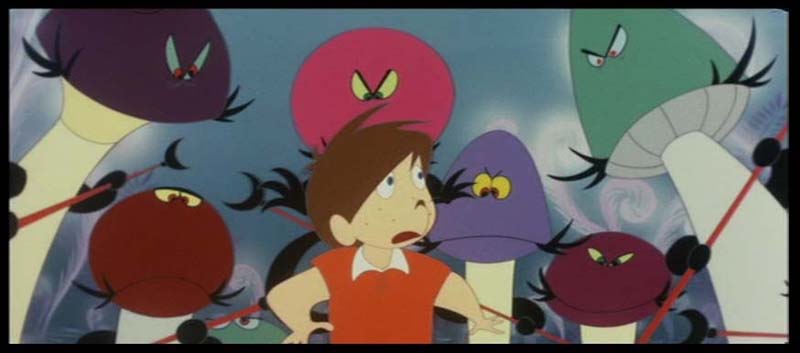
Anyway, Jack and the animals realize they've got to rescue Squeaker. Their castle home invasion is sidetracked by Allegra, who's their friend again! Sure she is! She tricks our heroes and they fall into a pit populated by giant bugs and talking Sid & Marty Krofft mushrooms. But all psychedelic experiences must eventually come to an end and soon it's time for Jack to face the harpy-transforming machine. INTO THE MACHINE JACK! Saved at the last minute by desperate anti-wind power sabotage by Barnaby the Bear, Jack must now travel to the ice caves to rescue Allegra, who was banished there for her failure! Jack has a thing for the bad girls. He frees the witch-sicle with a smash from a huge crescent wrench - but then must face the angry vengeance of Auriana, whose swinging pendant chain sends Jack and Allegra into a crazy underwater volcano dimension of swirling psychedelic colors! When Jack's captured animal pals trick Harpy Squeaker into breaking the witch-queen's crystal ball, Auriana's power takes a serious hit - Jack and Allegra pop back into the regular non-psychedelic world (or at least as regular as this film gets) and Auriana changes into a weird Oni-type goblin, inflates a giant dinosaur skeleton balloon, and sets a time bomb before she escapes!


However, as it always happens in these movies, the witch is hoist by her own petard and both the castle and the witch are destroyed in a giant explosion. All the harpies are changed back into the little boys and girls and animals they once were, and the ruined castle changes into a beautiful forest. Allegra changes from her creepy witch look into a blonde. As the film wraps, children and animal friends ride off into the sunset in Jack's car, the end credits roll over dramatically-lit shots of actual models built of the film's characters, and early 70s children all over the world have nightmares.

actual footage of children's nightmare
Did I mention that JACK AND THE WITCH is a strange film? Too bizarre for younger children, not nearly comprehensible enough for older children, and possessed of none of the pretentious artistry that allows adults to admit they enjoy cartoons, it's an odd beast that refuses to be neatly categorized. Perhaps the last gasp of Toei's struggle to produce fairy-tale Disney style animated features, its European facade is permeated throughout by hints of Asian folkways; the Oni-demon Auriana transforms into, the sasumata-carrying harpy guards, and the swirling bands of fire lifted straight from Yabushita's work on SARUTOBI SASUKE. Maybe the legacy of JACK AND THE WITCH goes beyond entertaining kids in 1967; perhaps its destiny is to put us all back in touch with that confused pre-teen trying to make sense of the mysterious ways of a world that gives us girls who are sweet one minute and scary the next; a world that gives us movies like, say, JACK AND THE WITCH.


-Dave Merrill

Thanks for reading Let's Anime! If you enjoyed it and want to show your appreciation for what we do here as part of the Mister Kitty Dot Org world, please consider joining our Patreon!

Tuesday, March 17, 2009

the aptly named noel's fantastic trip


No, I did not pay $39.95 for this.
Most of us get obsessed with Japanese cartoons as children, and it's only later that we start to realize part of what attracted us to the things is that they are, at least to Western eyes, really strange. I mean, seriously; when you're a kid you just accept the fact that people might dress up in bird costumes and fight giant mummy robots, or that a World War Two battleship would naturally make a great intergalactic weapons platform. As adults, however, you take a step back and say, "wait a minute..."


I encountered Noel's Fantastic Trip, (or Noel no Fushigi na Bouken if you prefer) as an adult, so I have no childhood confusion about its narrative coherence-- there is none. This film makes absolutely no freaking sense what-so-ever. Equal parts fairy tale, antipollution message, and multicolored hallucinogenic experience, it's a movie that defies rationality, copyright, and traditional notions of "entertainment" and "common sense".

It's about a little girl named Noel. Sure, the VHS box copy describes Noel as a boy, but Noel is addressed as "miss" in the film, and the character is introduced singing a daydream song about living life as a country girl, making it clear that whoever greenlit this video release at Columbia hadn't bothered to sit through five minutes.

Noel's Holly Hobby obsession brought to life
Anyway, Noel lives on a floating island along with a zoo's worth of friendly animals. One day while relaxing in the sun after singing a song about wanting to be a country girl, Noel decides the Sun might like some ice cream. So, Noel and her little dog pal Pup take off in their airplane to deliver ice cream to the Sun. Now you might think,a movie about a girl living on an island floating in the sky piloting an airplane to the Sun while playing Good Humor Man, that's kind of out there. Well, just wait, this is the NORMAL part.


Once out of Earth's atmosphere, Noel encounters the Space Shuttle, a 2001 style ring space station, and in some sort of fanfic writer dream scenario, is passed by the Space Cruiser Yamato, or at least a reasonable facsimile thereof.

We're off to outer space all right.
There's an extended musical number involving stars and asteroids and comets and outer space in general. Next stop is the Planet Gaudy, a glammed out place where everybody dresses as outlandishly as possible, until Noel convinces the citizens to take all their clothes off. Leaving a planet of nudists in their wake, Noel and pal reach the Sun, whose enjoyment of ice cream is only slightly marred by a bit of smog drifing in from some unknown planet.

set the controls to the heart of the sun's love of ice cream
Can Noel find the source of pollution and convince them to enact pollution controls? Diving underwater to escape the billowing clouds and belt out yet another song, Noel's subsea spotlit rock guitar solo is interrupted by the Beatles, complete with Yellow Submarine.

No, we're not kidding, that's the Beatles

After a couple of songs the journey continues, interrupted only by another song, and a smog attack. I guess the smog is tired of the incessant singing too. Who can save Noel now? Super Zoomer, of course! Super Zoomer, a whale in a Superman suit who's a student at the Superman school and can change the course of mighty rivers and bend steel in his bare hands! He answers Noel's SOS and soon his mighty super whale powers have saved the day.

the super school for super students
On the horizon they spot the smog's source, a giant city full of factories spewing out pollution. And songs, also about pollution. Apparently this city, populated by foxes and bunnies and bears, was once nice and sunny, but when the factories came and people started driving smelly cars the air got bad and people got sick all the time. Explained through song, the conflicts of the industrialized world - things we like produced in factories that destroy the land and air - seem very simple, especially when set to music and illustrated with scenes of anthropomorphic animal children playing in aqueducts and junkyards.

Super Zoomer vs Super Smog
Luckily for the cartoon world, the problems of industrial pollution can be solved by hollering for Super Zoomer to come and battle a giant talking pollution cloud. Blue skies return to the animal city after Super Zoomer uses his super lung power to blow the pollution far away, where it becomes somebody else's problem. This allegorical battle between a talking super whale and a talking smog cloud seems downright normal compared to the next sequence, which is a musical production involving legions of tricycle riding babies pedaling in aerial formation from the time of the dinosaurs to the present. 

I repeat, tricycle riding flying babies.

Nothing a choreographed platoon of babies can't solve.
This confusing sequence is in aid of a son all about how the world is better now that cars are running on "good gasoline" and how we've saved the world through "clean energy". Is there a better way to promote catalytic converters and antipollution regulation in general? And... that's the movie. Feeding the sun ice cream, meeting the Beatles, calling a giant whale to fight pollution.


At a mere 70 minutes you'd think the film would zip past, but you'd be wrong. Most of the movie is songs, tedious songs. And while the musical numbers are full of colorful, psychedelic quasi-mod graphics, only children small enough to be transfixed by any colored moving shapes will find it entertaining. Those of us older than 4 will be scratching their heads in confusion at this, seemingly a film intended for babies, immigrants, and guys on mushrooms.

Noel's Fantastic Trip was based on a children's book by Japanese folk singer Iruka, who also voiced Noel and wrote and performed all the music (her son was cast as Noel's animal friend Kisonosuke, or "Pup" in the English version). Iruka has been performing since 1970 entertaining audiences throughout Japan and the world, and in 2004 was made a Goodwill Ambassador for the International Conservation Union for Nature Conservation. 

Iruka on stage
She would combine her storytelling ability with her passion for nature in her first children's picture book, 1977's  "Noel's Blue Umbrella", starring the first appearance of her alter ego Noel. 


In America Turner Production Services got the job of localization, which means more work for Peter Fernandez and Corinne Orr, and the Grimes, Curtis, Hammond gang. As part of Columbia's mid 1980s catalog of Japanese animated films, it shares the mysterious "can't believe this is for kids" vibe of their Sanrio films Unico In The Island Of Magic and Ringing Bell, but rather than super wizardry or bleak Darwinism Noel's Fantastic Trip gives us the Beatles, super whales versus super smog, and tricycle babies in formation.

The film's not without appeal; the character designs and animation reflect the charm of its children's book origins, and there's an aggressive whimsy in Noel's transforming house/airstrip, the super-school perched on a peak on a lonely asteroid, and the Dick Bruna/Richard Scarry animaltown residents. But when half the movie is taken up with mid-tempo musical numbers about stars or country girls or clean energy, you wind up boring older children, confusing adults, and making Apple's lawyers sit up and take notice.


Perhaps the film is, after all, more mysterious than fantastic, more of a pop-culture curiosity than a must-see cinematic gem. And yet, in spite of the movie's pacing flaws and general lack of focus, we can't help but admit that when Noel's Fantastic Trip decides to give us unforgettable moments, it doesn't let copyright or coherence stand in its way, and that's an attitude you don't see from most films. Maybe Noel and Iruka are right, maybe we do all need a mysterious journey every once in a while. 

-Dave Merrill

edited and revised 2017

Thanks for reading Let's Anime! If you enjoyed it and want to show your appreciation for what we do here as part of the Mister Kitty Dot Net world, please consider joining our Patreon!

Monday, March 9, 2009

Gigantor: the eternal struggle


Judging from my referrals there is a fierce desire among the internet-enabled classic anime fans to experience again the New Adventures Of Gigantor, the 1980 Tetsujiin-28 series that was dubbed into English in the mid 1990s and broadcast on the Skiffy Channel for a brief season or two. I don't have any news on the availability of this series - though rest assured I will be alerting you all the moment something breaks - but darn it, I can't sit idly by while people want to experience Gigantor, specifically his New Adventures. So, here are some toys!!


I was lucky enough to pick up some merchandise from this show in the late 1980s when nobody cared about anything that Kenichi Sonoda didn't work on. Here's one of them - a little package of rubber stamps. If you ever wanted to mark all your possessions with the image of Jimmy Sparks and/or his super robot, this was just the thing for you.


The rubber is getting a little brittle after 29 years, and my last stamp pad dried out and gave up the ghost years ago, but darned if we can't make out some pretty good likenesses here. Also some not so good ones.


Once you've exhausted all the fun possibilities of your Gigantor Stamp Set, it's time to move on to more physical pursuits - namely, the Gigantor Top!


Diligent students of the Japanese language will no doubt be able to translate the katakana emblazoned across Tetsujin-28's mighty iron chest - it reads "Chara-Koma", "chara" being shorthand for "character", and "koma" being the Japanese word for "top", the kind you wrap a string around and spin. There, don't say you never learned anything from Let's Anime.


The top itself is metal and screen-printed with a handsome pic of Gigantor, only slightly marred by a giant pin sticking out of his upper thigh. The string has been lost in the mists of time, but rest assured it gave a mighty spin worthy of the name "Gigantor".

And please. Don't even pretend to try to claim that America knows not of Gigantor the Space-Age Robot. There once was a time when Gigantor fever gripped the nation, where young people wanted nothing more than to grab a pistol, put on a pair of shorts, and fight crime with a giant robot. As evidence I present this item from the 1960s:


No, I don't bathe with this every day. But I would if I could.

Oh, powers that be - how much longer must we wait before The New Adventures Of Gigantor appear on DVD - or at least back on basic cable? Let's get it together here guys!

In the meantime I have a desperate plea from one of my readers, who is looking for a cartoon glimpsed briefly on television in Kazakhstan. I'll let Clive tell the story:


I've been looking for a War Animation for years now without any luck.
I caught sight of some of it on TV in Kazakhstan, but I didn't see the
title or any credits, and my letters to the TV stations, Animation and
Anime experts and anyone else I thought could help have either been
unsuccessful or simply met with silence. I am really interested in
finding it, but I don't think I'm any closer to finding it than when I
started. I have a feeling it's an Anime but I have no way of proving
it until I see at least a still from it.

Here's some basic information about it:

Animation Type: 2D (drawn); Colour

Animation Style: The look of the Animation seemed similar to animated television episodes, one-off specials or direct-to-video releases. The character movements were done in limited Animation (much less than the usual 24 frames a second). The look of the Animation suggested it was made from the late 1970s to the early 1990s.

Notable Camera Movements: Two shots that occur side by side have stuttering zoom effects as opposed to the standard smooth zoom:

1) A zoom into a close up of a little boy’s concerned face.
2) A zoom into a close up of a little toy wagon rolling down the street.

Where It was Seen: an unknown local television channel from Almaty, Kazakhstan, in 1996 or '97. I was channel hopping and cam across it then. It was overdubbed in either Russian or Kazakh and I'm sure the language underneath it was English, but it wasn't lip-synched, just lip-flaps. This suggests that it was available in English at some point.

Music: There was a classical theme that was quite low and melancholy with a female classical vocal on it.


If you have any information on this mystery war animation, please get in touch with Clive via his Myspace page here!

Wednesday, February 25, 2009

the little prince and the new power revolution

It's time once again for another exciting installment of our popular high-tech feature ANIME ON CED! That's right, Capacitance Electronic Disc AKA RCA Selectavision, possibly the most useless video format ever created! Was it a temporary home for Japanese anime home video releases in North America? Yes it was, and it's our mission to seek out and document all examples of... ANIME ON CED.


The best part about buying CED discs is that invariably you find enormous piles of them in thrift stores and antique malls, and once you start thumbing through them, somebody will always come up to you and (1) ask you if you know what they are, (2) inform you that they are laser discs, and (3) ask you if you have a player for them.


All these things happened when I came across today's offering, THE LITTLE PRINCE. Based on the 1943 children's book by Antoine de Saint-Exupéry, this tale of the boy who lives on the asteroid B612 was very freely adapted by the Japanese anime studio Knack into a 39 episode series that aired in 1978 and '79.


The original novel is a popular and influential work that's influenced readers around the world with its charming, dreamlike qualities. The anime series, not so much; our little Prince spends each episode hitching comets down to Earth so that he can express amazement at all the wonderful things and help people with their problems. Broadcast on Nickelodeon in the 80s, the American version's Little Prince was voiced by Katie Leigh, who would later go on to do voice work for "Dungeons & Dragons" and "Totally Spies".


It's tough writing about this show because it's really dull. It doesn't have the crazed thievery of other Knack series like Groizer X or Astroganger, and it lacks the total sub-standard lousy of Ninja The Wonder Boy. My Nickelodeon time was spent watching "You Can't Do That On Television" and "Tomorrow People", so I have no fond memories to fall back on. You can see Knack's team trying to emulate the Nippon Animation Company's World Masterpiece Theater Miyazaki-Takahata style of vaguely Europeanish characters - and it gives Little Prince a class not normally found in Knack productions -but "Heidi" this ain't. On the other hand, the animation style is downright sophisticated for Knack, probably due to series director Yoshikazu Yasuhiko. The series pairs nicely with Nickelodeon's other Euro-style anime offerings Belle & Sebastian and Mysterious Cities Of Gold. 


The two episodes on this CED feature the Little Prince helping a mountain-climbing kid climb the Andes only to be rescued by a surrealistic balloon decorated with a giant eye, and then he visits London where he aids a chimney sweep in his star-crossed romance with a nanny - wait, I mean, with a ballet dancer. Many life lessons are learned.

This disc actually does NOT feature the scene illustrated on the back cover, which seems to be from a "very special" episode of The Little Prince, one endorsed by NAMBLA.

Unlike so many other shows, The Little Prince has been released on DVD, so you're in luck. The bargain retailer East/West also released at least two Little Prince DVDs, one of which coincidentally contains the same exact two episodes that are on CED. I guess somebody at East/West knows what Selectavision discs are, and has a player.


If you have fond memories of watching the show on Nickelodeon, then by all means I would seek this show out in whatever format currently is in vogue. If, on the other hand, your psyche was not imprinted at an early age with the story of the little asteroid guy who loves a rose and tends volcanoes, this one might make for some tough watching.


-Dave Merrill

Thanks for reading Let's Anime! If you enjoyed it and want to show your appreciation for what we do here as part of the Mister Kitty Dot Net world, please consider joining our Patreon!

Tuesday, February 17, 2009

THE TERROR OF TINY TOYS

The Japanese robot explosion of the 1980s may only properly be appreciated by the shock waves it generated on the other side of the world. The swelling pressure of thousands of suppliers creating millions of plastic toys, mounting to alarming strength, could only be relieved by using the children of America as a safety valve- children who hungered for toys from these shows and yet DID NOT EVEN KNOW THEY EXISTED. Is this evidence of the fantastically creative work of Japan's anime designers, or were they tapping into a collective unconscious of juvenile desire that knows no nationality? DO STRANGE FORCES FROM BEYOND THE STARS CONTROL OUR DESTINIES?

Well, I don't know. What I DO know, though, is that years of sifting through trays of toys at garage sales and flea markets have yielded a bounty of Japanese robot plastic that neither knows nor cares of its origins or ultimate destinations. Where did these toys come from? Carnival prizes? Party favors ordered through the mail from the Oriental Trading Company? Bubblegum machine prizes from the local Zayre's or Treasure Island or K-Mart? Let me tell you, when you see a Kroger bubblegum machine advertising GOD MARS robots in a decaying strip mall in College Park Georgia, it will turn your entire worldview upside down.

But enough of that. Allow me to show you photographic evidence of the startling penetration these "orphan" Japanese toy robots had made into American society - circa, let's say 1985.


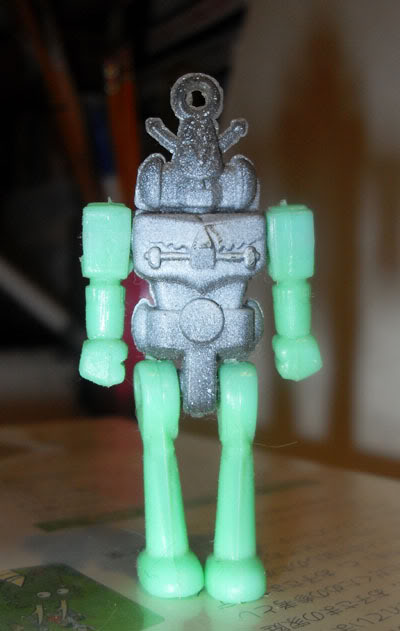
MAZINGER Z shows off his metal muscles in this tiny super-deformed style inch-high rubber figurine hastily spraypainted a neon green. Yes, the Jet Scrambler is majestically attached to his tiny green back.


Meanwhile a pink Real Robot from FANG OF THE SUN DOUGRAM raises his articulated arm in defiance. in 1984, this two-inch rubber figure was individually wrapped and sold in Spencer's Gifts in the mall with a triangular label reading "Leadworks Taiwan" affixed thereon. I could get an entire column out of the crazy anime stuff I found in Spencer's Gifts, but that's for another time.


Meanwhile, MOBILE SUIT GUNDAM is here represented by a printed cardboard target mounted on a plastic base. This was packaged with a dart gun, encouraging America's youth to regard the "White Mobile Suit" as an enemy. Influence of Zeon spies in the toy industry, I imagine.


If you ever wanted a tiny super robot to wear as a good luck charm to ward off evil, this COMBATTLER V charm fits the bill, coming complete with a little ring for threading and jointed arms and legs. Hard to believe this super robot actually weighs 550 tons, let alone could threaten us all with his super electromagnetic yo-yo.


He never made it to television as part of the VOLTRON series, but DALTANIAS here proudly stands as tall as he can, being only two inches in length. Still, his regal bearing inspires confidence.


For some reason I have a whole bunch of tiny figures from GALACTIC WHIRLWIND SASURAIGAR, the third of Kokusei Eigasha's J-9 series of early 1980s robot cartoons. Unlike Daltanius or most of these other robots, the J-9 never got within a hootin' holler of an American TV release. Not wild enough to be "super robots", way too improbable to be "real robots", shows like Sasuraigar defy categorization by anal-retentive anime fans. At any rate, our tiny inch-high Sasuraigar poses with gun in hand, molded in soft yellow plastic.


The actual mecha from the show is a lot closer to this Takatoku toy. Of course the actual mecha from the show transforms into a space-faring steam engine railway train, the better to allow it to wander freely through space fulfilling the pun in the show's name ("sasurai" means "wandering").


The cast of the show was also tastefully rendered in the medium of multicolored tiny plastic figurines. Why don't more artists express their vision thusly? From left to right we have Rock Anrock, Beat McKenzie, Birdie Show (in pink) and suitably green is I.C. Blues, the computer-genius zillionaire who built the Sasuraigar in order to win a bet. (Character names courtesy C/FO MAGAZINE VOL. 2 # 10, 1985.)


More familiar to American audiences will be this MOSPEADA figure. Is that Stick Bernard or Rook Bartley inside that Cyclone? We may never know. This little snap-together model came in one of those plastic eggs you bought for twenty five cents of your VERY OWN MONEY. The little bit of kneaded eraser at the foot there is to keep him standing up, them little toys aren't so balanced.


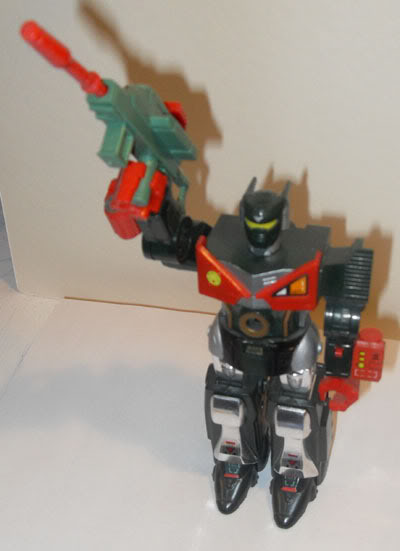
And here we have the little GOD MARS robot purchased in the Kroger bubblegum machine. Actually this was a transforming robot, if you got all six robots - Gaia, Sphinx, Uranus, Titan, Shin, and Ra - you could stick them all together to assemble God Mars, just like Takeru does in the show! However, they will NOT, repeat NOT, combine to make a bomb designed to destroy the entire Earth.


Who knows what tiny anime toy treasures lurk in the crevices of automobile upholstery, the corners of toy boxes, under sofa cushions across America? Can the history of Japanese cartoons in America be written in rubber and plastic? We here at Let's Anime say YES.

Thursday, February 5, 2009

the yamatocon excuse

I realize Let's Anime posts have been thin on the ground since Christmastime, and I do apologize. Part of why this is, is because I wrote an article for the Star Blazers fan website about Yamatocon, the 1983 Star Blazers convention in Dallas Texas. This article is now up at COSMO DNA, aka ourstarblazers.com, for you to read and enjoy!

I also wrote a short review for the upcoming OTAKU USA magazine, and that took a little time away from the dear Let's Anime. And of course every week over at Mister Kitty I provide commentary for items of questionable quality culled from our vast comic book collection. So it's not like I ain't been busy.

At any rate we should have something goofy for you here in a little while - so don't touch that dial!