Sunday, August 16, 2009

2009 is Showa 41 - listen along with CYBORG 009


Found in a MANDARAKE store in Tokyo by Tim "Starblazers.com" Eldred, this CYBORG 009 Asahi Sonorama single is, if you happen to be my brain, something that is constantly playing in the background at all hours of the day or night. I'm a big CYBORG 009 fan. I like the cartoony big-foot Shotaro Ishinomori style, I like the angsty, turned-into-fighting-cyborgs-against-our-will story, I like the bizarre monster combination enemy cyborgs they're thrown against, and most of all I like the fact that American fans of the show are thin on the ground so there isn't a lot of competition when it comes to grabbing CYBORG 009 toys or books at the anime cons (not that there's a lot of 009 stuff at anime cons these days).


As we will remember from the last time I wrote about CYBORG 009, the series is about nine people from all walks of life who are kidnaped by the evil Black Ghost and turned into cyborg soldiers with various powers and abilities. They rebel against the Black Ghost and spend three movies, three television series, dozens of manga volumes, and one Asahi Sonorama single battling for the peace of the world.


The cool thing about this disc is that it's from 1966 and uses the theme song and the basic story from the contemporaneous Toei feature- but instead of cheaping it out with production art from the film, the "book" part of this "book and record" set features all-new Ishinomori artwork. At least it's not artwork I'd seen anywhere before, and I think I'd remember seeing a lot of these illustrations somewhere in my, ahem, sizeable collection of 009 books and memorabilia.


Thanks to the miracle of my turntable and the Internet you can now listen to this Asahi Sonorama record your very own self! Side one is here and side two is here. Remember to set your computer to 33 1/3 RPM for maximum enjoyment!


So cast your mind back to 1966 and enjoy the story of Cyborg 009 and his comrades in cybernetic arms as they struggle to defend us against the Black Ghost! Feel free to sing along with the theme song if you know the words... I believe everybody can handle the first nine lyrics.


Friday, July 24, 2009

Spaced-Out Japanimation, Man

Back in the misty ages of the past - we're talking the 1990's- when the twin trip-hammer blows of POKEMON and SAILOR MOON had blasted an American pop consciousness already reeling from the art-house opus AKIRA and the cries of disbelief as entire divisions of college sophomores entertained their dateless peers with sensual, late-night screenings of LEGEND OF THE OVERFIEND and NINJA SCROLL... there came a time when the Eighth Seal was opened and THE TRUTH was revealed to America's home video marketing executives.

This TRUTH was, of course, that we'd now reached a point in Western civilization where people would buy DAMN NEAR ANYTHING that had a Japanese cartoon character on it. I'm talking skateboards. "Hook-Ups" T-shirts. Comics drawn in the "manga style" by Americans. And, of course, videos! Videos of new anime releases, videos of anime movies, and videos of anime TV shows from twenty years ago that have been through the "public domain" mill so many times that the "public" is looking desperately around for somebody to take over the copyright just to get it out of the "$1.99 Movies" bin at the Wal-Mart to make way for Dorf golfing videos and remaindered copies of "Batman Forever".

But how to sell goofily-dubbed primitive Toei super robot cartoons to the sophisticated American retailer? One word - packaging.


And that's how Parade Video (distributor of, among other things, the incredible Peter Sellers film THE WORLD OF HENRY ORIENT) came to unleash SPACED-OUT JAPANIMATION on the world! Yes, SPACED-OUT JAPANIMATION, the amazing 4-tape set that satisfies ALL your Japanimation needs,as long as your Japanimation needs include "buying a Christmas present for that nephew who will NOT SHUT UP about something called "Japanimation". How many kids asked Santa for, say, GUNDAM WING or ESCAFLOWNE videos, and instead found SPACED OUT JAPANIMATION under the tree? Many a forced grin and a stammered "Thanks, Grandpa!" would be heard on Christmas morning that year, I can tell you!


Sold through your snappier mall video outlets like the late, lamented Suncoast Video, SPACED-OUT JAPANIMATION stands as a testament both to the staying power of cheap, public domain video AND to a public's brief but intense love affair with those big-eyed Japa-heeno cartoons. Not to mention the "throw it all up there and slap a gradiated logo on it" design aesthetic of the 1990s, where minimalism and taste were abandoned in favor of FLAMES!!! and METALLIC SHEEN!!! If there isn't a van out there with this artwork airbrushed on the side, I can only ask "why not?"

Grandizer
And yet, SPACED-OUT JAPANIMATION is not without its charms. This 4-tape set devotes one tape each to the 1970s Toei series GRANDIZER, SPACEKETEERS, GAIKING, and STARVENGERS - all Jim Terry dubs from the seminal super robot TV package FORCE FIVE that entertained us all in the fall of 1980 when the world was young and we wanted nothing more than to climb into a flying saucer that jammed itself into a giant robot armed with "hydro-phasers" and "space thunder" like in GRANDIZER. Grandizer, or "UFO Robo Grendizer" as it is sometimes known, is of course the 1974 Go Nagai-created Toei anime series that picked up right where one of the MAZINGER series left off, as it stars MAZINGER's Koji Kabuto in a supporting role. Koji's well-known bad-assery is overshadowed by that of Grandizer's pilot, the even angrier and more destructive Duke Freed, whose entire planet was destroyed by aliens from Vega who have followed him to Earth to finish the job. Luckily, Duke Freed - or "Orion" as he's known in the West - has the super robot Grandizer with which to exact vengeance. 

Three pilots, three robots, no waiting: Starvengers
STARVENGERS, being a localization of the sequel to Go Nagai's GETTA ROBO, starts off confusingly as the damaged original Getta Robo is demolished and an unidentified fallen hero is mourned (GETTA's Musashi). But the series picks right up with a new super robot and enlightens us all to the possibility of 3 jet planes that combine to form three different super robots to battle the Pandemonium Empire, a horned race of devils, one of whom is apparently a Hitler cosplayer. Can't make this stuff up, kids. Well, somebody can. Just not me. 

Gaiking gets the "oriental restaurant" font for its title
GAIKING asks the anime question, what if an alien planet was destroyed by a black hole and the aliens attacked Earth which was defended by a giant robot space dragon that launched a horned super robot piloted by people dressed as baseball players? What if? What if the series was originally pitched to Toei by, yes, Go Nagai, who was to see it developed and broadcast without further input or approval or residuals, which would then sever his relationship with Toei for decades to come? And what if GAIKING managed to wring reasonably entertaining adventures starring the Space Dragon, the Gaiking robot, and his fellow dinosaur-mechas battling Zelons on Mt. St. Helens? What if, huh?

Hero, fat guy, mean guy, princess, Spaceketeers

SPACEKETEERS is the odd show out in this set, lacking the giant robots and legions of enemy mechanical brutes attacking Earth. A Leiji Matsumoto creation, under its original title SF SAIYUKI STARZINGER the series was yet another animated adaptation of the "Journey To The West" legend, dressed up with cyborg space warriors in well-armed space scooters, the impressive Cosmos Queen starship, and Princess Aurora, whose beauty entranced us all whether she was sporting her space miniskirt or her space prom dress.

Missing from the SPACED-OUT JAPANIMATION set is DANGUARD ACE, the series where Leiji Matsumoto really started working out his Velikovsky theories about tenth planets careening wildly through our solar system. But there's only room for 4 tapes in tha box; something had to go.

The benefit of a wide early 1980s home video release from Family Home Entertainment, the FORCE FIVE shows could be found in episodic and compilation-film versions in your neighborhood video rental shops. A few years later, incredibly cheap, poorly-transferred public-domain video releases of the same tapes, with new titles like "Robo-Formers" and "Zalo," began to appear in drugstores and discount shops across the land.


On first glance, SPACED OUT JAPANIMATION would appear to be just another cheap, 6-hour speed public domain copy of a copy of a copy release of our old Force Five favorites. But the surprising fact is that, even though these tapes are recorded in the penny-pinching SLP 6-hour mode, the transfers are actually pretty good. Better, in fact, than the video quality of the bootleg DVD sets that are floating around. When we consider that the FHE tapes are starting to disintegrate because of their age, SPACED OUT JAPANIMATION becomes a possible alternative to our other choice, which is the unthinkable possibility of never watching SPACEKETEERS ever again. And we can't let that happen.

SPACED OUT JAPANIMATION - exploitative bargain-basement video release? Signpost of a time when anime ruled the video stores? Or valuable part of your balanced Japanese cartoon collection? It's all these things... and more.

-Dave Merrill

(editor's note, 2017: The original Japanese Gaiking TV series has been released on DVD from Discotek Media. English-dubbed Gaiking, Spaceketeers and Danguard Ace compilation film DVD sets have been released by William Winckler. Grandizer and Starvengers remain spaced-out.)


Thanks for reading Let's Anime! If you enjoyed it and want to show your appreciation for what we do here as part of the Mister Kitty Dot Org world, please consider joining our Patreon!

Tuesday, July 7, 2009

challenge to remember the go-bots

Back in May at Anime North I sat in on the "classic anime" panel, where the topic of conversation sort of meandered amusingly, and we were rude to kids in the hall (not THE Kids In The Hall, just some actual kids in the actual hall) who were interrupting our important discussion with their tremendously annoying squeals. At one point, discussing the way Japanese toys made it over to North America in the 1980s sometimes without benefit of TV series support or any familiarity with the shows in question -a topic I've covered here before-, my befogged brain twitched and served up a tidbit of memory of a certain toy. Released as part of the "Go-Bots" line of transforming robot toys, this plaything was actually from SPACE ADVENTURE COBRA, the Buichi Terasawa manga turned into the TMS anime series all about Cobra and his Psycho-Gun and the various sexy ladies that help him on his sexy outer space adventures. Wow, I hadn't thought about that toy in a long time, not since I was in high school working part time at K-Mart and killing time wandering through the toy aisle marvelling at how K-Mart was selling Xabungle toys and Dunbine toys and who knows what else.

At any rate a couple of weeks later we were rooting through an antique mall and lo and behold, there it was, the "Go-Bot" in question. Five dollars and an inane conversation with the clerk about it being a "Transformer" later, and it was mine! Proof my brain is still the boss!


Given the name "Psycho", this space-age sports car was a proud addition to the mighty "Go-Bots" line of toys. But if the "Go-Bots" were all poorly-animated sentient robots who transformed into vehicles for the benefit of chortling, easily amused preschoolers, then why are there two human shaped people sitting in the passenger seats?


That's because this toy was originally known as the "Psychoroid", the passenger vehicle of the definitely-not-for-preschoolers Cobra, a freebooting space adventurer with a powerful laser gun built into his left arm, a sexy robot companion, and a taste for the full-figured gals that exist only in the mind of Buichi Terasawa.


Bandai licensed the toy out to Europe who took out the missile launchers, renamed it the "Future Machine", and happily passed it on to America, who were pleased to get yet another transforming robot toy to cram onto the overstuffed shelves of toy stores across the nation.


With a few clicks and turns this sporty speedster becomes an amazingly clumsy robot that barely looks as if it can stand on its own, let alone help Cobra or the "Go-Bots" battle in the far flung world of the future.


Cobra inspired an interesting line of toys, as seen here captured in photos from "My Anime" magazine.


Who wouldn't want a toy of Cobra's utilitarian spaceship "Turtle", as well as a toy Psychogun to wear on their very own arm? The schoolyard bullies will definitely respect you once you start waving that Psychogun around.

Also released as "Go-Bot" model kits were two mecha from the Tatsunoko series MOSPEADA. One was an Alpha Fighter relabeled as good "Go-Bot" leader "Leader One", and the other was a Mospeada Cyclone bike renamed as "Go-Bot" villain "Cy-Kill". You know, because he's a motorcycle, and he's evil. That's the kind of subtle understatement we've come to expect from American cartoons of the 1980s. And yes, I'm aware "Go-Bots" were based around a Japanese toy line called "Machine Robo", except for the ones that were from "Diaclone", and that some of the "Machine Robo" toys became "Go-Bots" and some became "Transformers". And I totally do not care. Toy lines that aren't based on cartoons about Psycho-Guns and/or sexy space ladies are of no interest to me.

So, farewell to the "Go-Bots"! So long suckers! Give my regards to the "Rock Lords!"

-Dave Merrill

Thanks for reading Let's Anime! If you enjoyed it and want to show your appreciation for what we do here as part of the Mister Kitty Dot Org world, please consider joining our Patreon!

Wednesday, June 24, 2009

JUST DOING THIS TO MESS WITH OUR HEADS

Wouldn't it be great if Kodansha's "Osamu Tezuka Manga Complete Works" editions were in English? Well, they kinda are.


Yes! A charmingly typewritten synopsis of his classic shojo manga PRINCESS KNIGHT! True, the rest of the comic is in Japanese, but it's a start. Is there more? Yes there is - a lot more! This Kodansha set was a 400 volume set published over a twenty year period, and as near as I can figure, they all have English-language forewords. Everything from his breakout classic New Treasure Island to, say, Ambassador Magma! 


AMBASSADOR MAGMA aka SPACE GIANTS! All right! So, how different is this from the Space Giants show we enjoyed as children?


Yeah, that's pretty different. For one thing, token Caucasian reporter "Liz" isn't even mentioned! Hey, what about KIMBA THE WHITE LION, you know, JUNGLE EMPEROR?


No, that's not Santa Claus there, it's Hige Oyaji and a grown-up Kimba - now named Leo - bravely facing the elements atop Mount Moon! A grown up Kimba?? What the heck?


Yes, the original manga goes places NBC would not dare... at least not in cartoon form. They took a big old pass on Tezuka's continuation of the Kimba storyline, and we'd have to wait until CBN Cable aired "Leo The Lion" to find out how Kimba grew up.   But enough of these popular Tezuka works - did Kodansha release Complete Works editions of his more, shall we say, obscure manga?


Yes! Yes they did. JET KING, the story of an alien boy who can change his shape at will to better defeat evil, has a spoiler right in the English synopsis, so don't read it! Also in this volume, HIKARI is the story of a boy with crazy hair and two handguns who fights gangsters. Based on a true story.

But what about ASTRO BOY? I can hear you now, where's TETSUWAN ATOMU? Okay, here's your MIGHTY ATOM already.


This volume contains the story "The Three Magicians", which was one of the first Astro Boy stories I was ever exposed to, as it is also the subject of this LP:


Those three magicians get around.

Somebody should take the hint and get to work giving this classic Tezuka manga some actual North American releases; PRINCESS KNIGHT would sell like cotton candy at the fair and who would pass up a chance to own the original stories behind SPACE GIANTS and KIMBA THE WHITE LION? Not me! In the meantime, I suppose we'll have to be content with 30 year old typewritten summaries.

(editor's note - as it turned out our pleas were heard and Princess Knight did get a manga release in English courtesy Vertical. Ambassador Magma and Jungle Emperor remain unlicensed.)

-Dave Merrill

Tuesday, June 9, 2009

ROKUSHIN GATTAI GOD MARS!!


Six enormous colorful super robots erupt from hiding to protect Takeru Myojin, a 17-year old member of the Crasher Squad who, in reality, is actually a space alien named Mars from the planet Gishin with super ESP powers sent here to destroy the Earth! Will his fellow Crasher Squad members let their suspicion and mistrust of Takeru ruin their friendship? Will Emperor Zule succeed in killing Takeru and detonating the Earth-destroying bomb hidden inside the super robot "Gaia"? Will Takeru's twin brother Marg resist Zule's mind control before he's forced to battle Mars to the death? And will Takeru/Mars realize his six super robots will combine to form the Six God Combination God Mars, the most powerful robot in the universe? The answers to all these questions may be found in ROKUSHIN GATTAI GOD MARS, the 64-episode 1981 series from Tokyo Movie Shinsha that raised the bar for colorful, well-designed super robot animation as well as heart-rending cosmic sibling melodrama.


One of TMS's few robot anime titles (the others include their 1980 remake of TETSUJIIN-28 and 1983's SUPER DIMENSION CENTURY ORGUSS), it quickly downplays the "enemy robot of the week" formula in favor of cosmic soap opera, and the melodrama and tears continue right until the end of the series. MARS, a 1976 Shonen Champion manga series by pioneer Mitsuteru Yokoyama, drew on the science fictional ESPer hero themes explored in his earlier works such as BABEL II and THE NAME IS 101, spiced with flavors of the giant robot guardian motif originated in his TETSUJIIN-28 and GIANT ROBO series.

TMS continued the evolution in GOD MARS. Where there was once one super robot guardian, GOD MARS now gives us six separate super powerful giant robots that combine into one ultra-unstoppable mechanical deity, the centerpiece of a shiny, colorful space opera that captivated audiences around the world.


The story? 17 year old Takeru Myojin is a member of the Crasher Squad, the rapid-reaction space unit of the Earth Defense Forces in the future year 1999. Troubled by strange dreams, confronted by mysterious assassins from outer space, Takeru learns his real name is Mars. As an infant, he was sent to Earth from planet Gishin as part of a secret plan by its evil Emperor Zule. Possessed of super ESP powers, Mars can summon the gigantic robot Gaia, which in addition to being your typical super strong robot, also contains a super bomb capable of destroying the entire planet Earth! The emperor's plan is thwarted, however, because Takeru rejects Zule and Gishin, instead choosing to defend his adoptive home planet alongside the Crasher Squad - Mika Hinata (girl), Akira Kiso (chubby guy), Asuka Kenji (captain), Naoto Izyuujin (the cool guy), and Namida (audience-identification kid), all led by Commander Ohtsuka (exactly the same character from TETSUJIIN-28, right down to the pot belly and moustache).


Luckily for Takeru and the Earth, his real father on Gishin secretly sent five other robots to Earth. Awaiting Takeru's summons, these five robots - Sphinx, Uranus, Titan, Shin, and Ra - slumber in locations across the globe but when Takeru commands "ROKUSHIN GATTAI!", they burst forth from their hiding places and combine into GOD MARS.


With a reputation built on anime adaptations of high-profile manga including shojo titles (ROSE OF VERSAILLES), sports drama like AIM FOR THE ACE, and the long-running adult comedy LUPIN III, TMS was known for bright, stylish animation with an international flair. ROKUSHIN GATTAI GOD MARS would be no exception. The show practically vibrates right out of the TV with the brightest, cleanest, cheeriest color palate since that time the NBC Peacock dropped acid at a wild Technicolor corporate party. The skies are impossibly blue, the trees are vibrantly green, rockets blast with clouds of flame, ray-guns scintillate and sparkle. The Six God robots aren't wasted in some tedious rainbow motif but each have their own color schemes and visual identities, and the God Mars combination is distinctive and friendly, a big clunky multicolored skyscraper of a robot that must have been a bitch for the animators. It's a series that caught American anime fans' eyes when it was nothing more than opening credits on a compilation tape; even jammed together with hundreds of other OP titles from hundreds of other similar super robot cartoons, GOD MARS stands out.

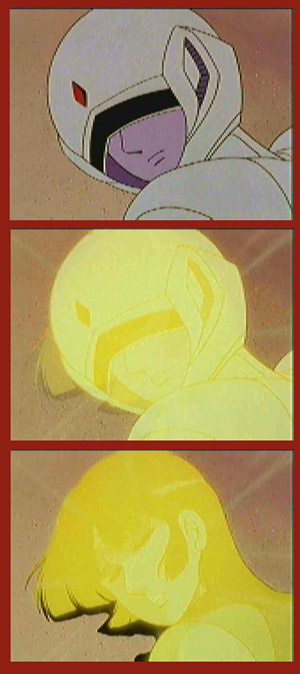
Thematically GOD MARS also excels. Abandoning the traditional 8 year old boy audience entirely, GOD MARS adopts melodramatic space opera storyline full of tragedy, loss, and heartbreak, embodied in its fan-favorite character, Takeru's shy, retiring, dreamy twin brother Marg. Held in the palace of Zule on Gishin, Marg telepathically warns his brother of impending danger until Zule brainwashes him for use as a living weapon against Takeru in a tragic battle of brothers. The first third of the series is filled with angst and more than a bit of sloppy emo brotherly emotion as both Mars and Marg agonize over the fates that have kept them from a normal sibling relationship. Meanwhile, Takeru's pals in the Crasher Squad and the EDF begin to realize that Mars is a space alien related to the other space aliens who are destroying Earth, and also, if he dies, the whole world goes boom. So there's a lot of suspicion, soul-searching, moody moping, and protective custody. Meanwhile the girl Gishin super-ESPer ace Rose swears to defeat Takeru, but eventually realizes that not only is Gishin wrong to attack Earth, but as one of the few speaking female roles in the show, it's up to her to provide some hetero non-incest romantic interest; so we're treated to a half-hearted romance between Rose and Mars. This in no way dimmed the Mars/Marg relationship, which would inspire reams of disturbing twincest fan fiction and set the template for a generation of dreamy boy-love dreams.


The show makes a brave attempt at romance between Mars and Rose, but you can tell their hearts really aren't in it, especially as a late-series plot point involves Rose being possessed by the spirit of Marg! It's a shame because Rose is one of those starts-off-evil but later-becomes-good characters with one of the few real character arcs in the show, and deserves to be more than a beard. Nobody takes the Rose/Mars hookup seriously, the nonexistent romance between Mrs Myojin and Commander Ohtsuka is more believable.

Mika is shocked, shocked I say
The 64 episodes of GOD MARS are divided up into three distinct sequences; the Gishin Chapter, the Marume chapter, and the Earth chapter. As the fight with Zule wraps, Earth finds itself smack dab in the middle of one of those fugitive space-princess sagas as Flore arrives, a refugee from a war on planet Marume, where the evil emperor Giren has conquered the planet next door. Sought by both Giren and the mysterious space pirate ship "Frontier", Flore is given asylum on Earth, and just like what happened when the United States gave asylum to the Shah of Iran, Earth is attacked by both Giren's space fleet and by the Frontier, captained by the mysterious Gasch. Luckily for all concerned Flore has super ESP powers. Takeru and the Crasher Squad travel to Marume and involve themselves in the civil war between two peoples defined by their magnetic orientations. No, seriously.


Emperor Giren and Flore battle psychically

This 'Marume Chapter' is really curious; we're treated to Gasch's space pirate ship which is equipped with sails and masts and bowsprits, one of the lead figures in the Marume war is a religious leader we can only refer to as the "Space Pope", there is an extended combat sequence where guys on skis battle tanks and airplanes, and the power level of God Mars is amplified to such an extent that Takeru can stand on the surface of a planet hundreds of light years away and call his robot protectors from Earth, who arrive within minutes to fill up air time with yet another repeat of the Six God Combination Robot Combination Sequence, two solid minutes of animation that can be used and re-used and re-re-used every episode.


Gasch and Flore battle psychically

The Marume saga wraps with peace breaking out among the twin planets and with Takeru and the Crasher Squad learning that Emperor Zule is once again threatening Earth from beyond the death dimension, or some such Kirbyesque nonsense. And thus begins the Earth Chapter. The writers realized they'd written themselves into a corner with the awesome, unbeatable power of God Mars, and so Takeru/Mars is hobbled by psychic handcuffs that drain his life force every time he yells "ROKUSHIN GATTAI!".


The ZULECUFFS!

Only the mysterious space-surfing Rose Knight can show up in the nick of time every episode to distract the villian of the week long enough for Mars to save the day! Yes, years before Tuxedo Mask was rescuing Sailor Moon, the Rose Knight was pulling the same kind of lazy-writers duty in GOD MARS. Who is the mysterious Rose Knight? I wonder if it's actually the character named Rose in disguise?


There, just spoiled the show for you.


A GOD MARS compilation film was released in 1982 and it's that movie which familiarized most American audiences with the show. And "familiarized" is probably too strong a word, as judging from the reviews the movie left most viewers confused and slightly irritated, a natural reaction to any film that shoehorns 25 episodes of action into 95 minutes and hands it to a continent of people who aren't already familiar with the concepts. GOD MARS remains a footnote of the 1980s anime boom, albeit one with staying power; GOD MARS got its own OVA remake in 1988 (featuring a girlfriend for Marg!) and a back-to-basics OVA adaptation of MARS was released by KSS in 1994. Among North American anime fans GOD MARS is mostly known these days for being the subject of some really well designed toys and dreamy boy ESPer fanfic.


Which is a pity; because GOD MARS is an entertaining show. Even if you just want to sit back in the couch and let the Crasher Squad's space attack plane zip through the impossibly blue skies to the tune of the "God Mars" theme song, the show is so colorful, so visually appealing, and so well animated (in parts) that anybody who enjoys animation will find something to like about at least part of it. Had GOD MARS been on American televison in the 1980s I predict it would have been a hit or at least a fondly remembered cult classic; Europe got a good chunk of the show and it's still fondly remembered over there. The closest North America ever got was the TMS/NBC coproduction MIGHTY ORBOTS, a five-god combination robot controlled by clean-cut non-twin Rob Simmons and his robot little sister Ohno. ORBOTS was directed by Osamu Dezaki, creating hands down the best looking American network Saturday morning cartoon ever, though hobbled by typical focus-group approved American cartoon scripting.


know the difference.

It may very well be true that there are vast chunks of GOD MARS that are tangential to the main storyline, if not outright nonsensical digressions. I mean, seriously, space popes?! But all the recycled robot combination sequences and tacked-on plot extenders can't hide the power of GOD MARS - the struggle of Takeru Myojin to move beyond his tragic past and find his place in the world. And if that place is to be the super-ESPer master of an immensely powerful six-god combination robot, then so much the better for us all.

-Dave Merrill


Farewell, Rose! Farewell, Crasher Squad! Farewell, Mars!

Thanks for reading Let's Anime! If you enjoyed it and want to show your appreciation for what we do here as part of the Mister Kitty Dot Org world, please consider joining our Patreon!

Tuesday, May 26, 2009

i am terribly sorry.

Still in crazy busy mode. Anime North went well and there was much classic anime discussioning, but I still have obligations to fulfill and miles to go before I sleep, or at least before I get a free couple of hours to write something on this blog. In the meantime you should go out and purchase the latest issue of Otaku USA magazine, featuring a big article by yours truly all about Captain Harlock and Galaxy Express 999, with extra sidebar material by Tim "Star Blazers" Eldred! Additionally there's work by the always great Darius Washington, Mike Toole, Daryl "Destroy" Surat, and others much more talented than myself. So don't let my lazy behavior keep you from wallowing in 1970s Japanese cartoons, go buy magazine! Talk at you soon!!

-Dave

Friday, May 8, 2009

the quiet time is not so quiet

Apologies for my lack of blog here for the past few weeks. I've been busy as heck on a few real-life projects that have taken my time and energy that otherwise would have been spent talking about thirty-year old Japanese cartoons, and for that I am deeply sorry. At any rate here's what's been going on instead:

This weekend is the Toronto Comics Arts Festival which I am a volunteer at. It's two days of indy cartoonist stars and legends of comic art meeting the public at the Toronto Public Library Main Branch - and it's free! So if you have a free couple of days it's well worth your time.

Two weekends later - that's right, it's Anime North, Canada's number-one Japanese animation festival! I'm on staff at that show as well. Additionally, I will be on a "Classic Anime" panel Saturday at noon, and Sunday at 1pm I will be delivering an illustrated lecture on the influence of Western literature upon Japanese animation (meaning: Captain Future, among other things). And Saturday night... well, Saturday night is special.


Anime Hell returns to Canada for one night only of cerebral-cortex-crushing video madness. Followed by TOTALLY LAME ANIME: AFTER DARK!! Don't miss it.

And then I go to a wedding and then May is over and I spend June goofing off. Er, I mean, writing for Let's Anime!! Of course. See you then!