(this article originally appeared on the website Anime Jump in 2004.)
Nostalgia used to be classified as a mental illness. The wiser heads of the Victorian age rightly determined that any personality so warped as to obsess itself with the past was one seriously in need of the finest counselling that the pre-psychoanalytical age could provide.
Knowing all this makes it all the more difficult to appreciate, much less write about, a show like ULTRAMAN. Is your love of the show truly motivated by the actual quality of the show itself? Or are you using the show as an excuse to wallow in a more innocent age, spent wearing footy pajamas, on one of America's more garish sofas, eyes glued to the Superstation Channel 17 as the weird multicolored swirl of what appeared to be latex house paint formed itself into the show's title, to the accompaniment of a discordant jangle of tortured electric guitar strings? Is ULTRAMAN your gateway drug into nostalgia addiction? Or are we, as I suspect, dealing with the effects of sleep-deprivation on young viewers combined with a unique and frequently bizarre television show?

ULTRAMAN first premiered in 1966 on TBS, the Tokyo Broadcasting System. The brainchild of producer Eiji Tsubaraya, ULTRAMAN was a sequel of sorts to a show called ULTRA Q, a monster-laden suspense show along the lines of our OUTER LIMITS. What set ULTRAMAN apart from ULTRA Q was, naturally, the eponymous Ultraman, a giant silvery spaceman visiting Earth to protect us from monsters. In a nation already dutifully trooping to the theater every year for another GODZILLA film, a television show featuring pretty much the same sort of thrill was a natural success.
 ULTRA SEVEN followed ULTRAMAN, which was in turn followed by RETURN OF ULTRAMAN, ULTRAMAN ACE, ULTRAMAN LEO, ULTRAMAN TARO, ULTRAMAN 80, and after a hiatus of nearly 20 years new ULTRA series like DYNA and TIGA have returned to Japanese (and American) television. Even though ULTRAMAN was a Tsubaraya production, I have only Peter Fernandez to thank for it; without his work dubbing the series into English, for me and most Americans it would only be a curiosity alongside FIREMAN, MIRRORMAN, ZONE FIGHTER, RED BARON, etc.
I'm not going to bore you with descriptions of Ultraman or the Science Patrol or of their guns and spaceships and uniforms and what-not. All that stuff is pure window dressing -merely the sugar coating the pill of delicious horror that the UHF antenna brought into your home. Who knew what that Saturday's episode was going to bring? A quivering, gelatinous thing, with antennae bristling from its rubbery orfices, menacing Earth simply by daring to exist? The corpse of a monkey-faced mummy, reanimated by ten million volts, vaporizing Tokyo police? Zebra-striped, fetish-masked aliens who walk through walls and collect shrunken scientists in test tubes? The tortured cry of a gigantic, mutated astronaut echoing through the forest? Or, best of all, the echoing laugh of the silver-hued, lobster-clawed Baltan, whose rotating eye-stalks foretold the doom of the human race?
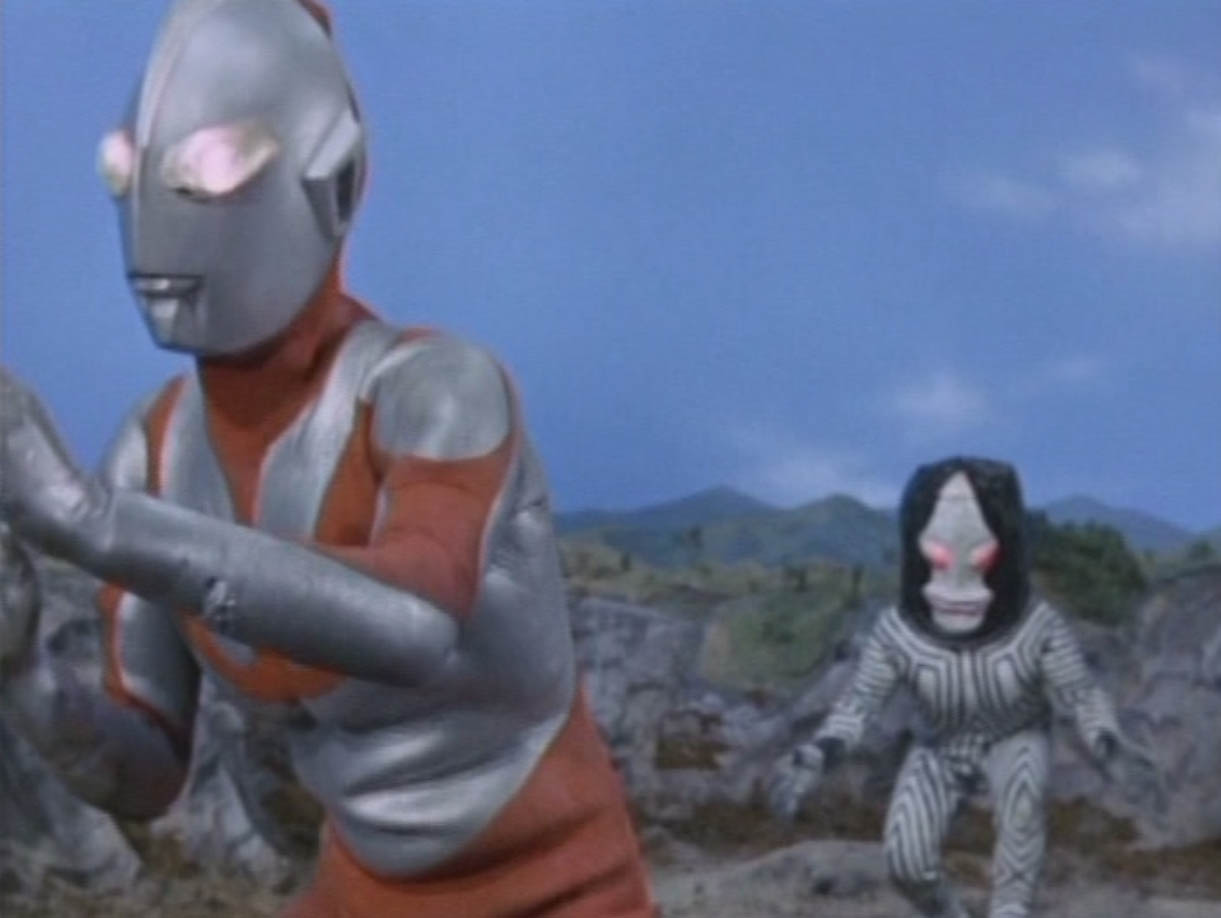
Like the British baby-boomer children who fearfully watched Dr. Who’s Daleks from behind the safety of solid middle-class British furniture, American children found that Ultraman’s monsters were not only best viewed from behind the couch, but that most could be dispatched with a quick burst of Spacium energy from Ultraman’s crossed forearms. In fact, ULTRAMAN inspired my first effort at media journalism; a one-page report delivered to my first grade class on blue-lined notebook paper (though the subtextual subtleties of the show escaped my 6-year old view). The calming presence of that giant, bulb-eyed spaceman assured us all that while monsters may howl and cardboard city blocks might be demolished, safety and order would ultimately triumph.
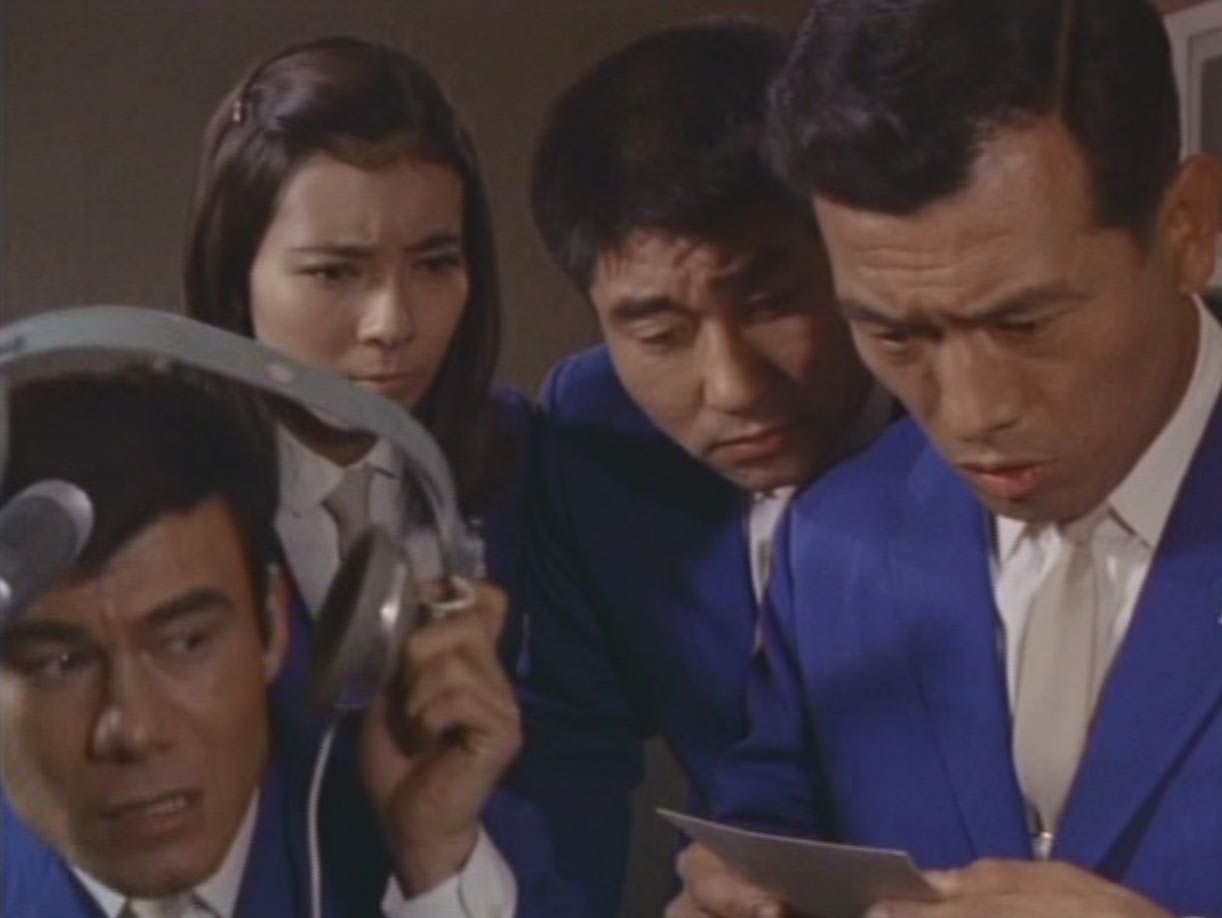
No, the fact of the matter is that ULTRAMAN is frequently dismissed as a monster-of-the-week show, a GODZILLA imitator starring Clark Kent as a giant silvery wrestling champion defending miniature office buildings. And these dismissals are entirely fair. ULTRAMAN actually is a simplistic, frequently silly show entirely too dependent upon underpaid actors in uncomfortable rubber monster suits. And yet…
And yet, I can’t forget the chill that literally tingles my spine when I recall some of the show’s more effective monsters. The bottom line of this show is – maybe it’s a show intended to frighten (and therefore entertain) children – but if that’s the show’s purpose, than it is a resounding success.

Because this is a show that scares children. The constant use of location shooting (this takes place in the real world, not some set) –the parade of incidental characters attacked, possessed, murdered, or otherwise affected by the monsters –the New Wave cinema verite camera techniques –all these add to ULTRAMAN’s fear factor. Produced by a society consumed with a love of the bizarre, ULTRAMAN could hardly expect to be anything else – bizarre is the only word for a show utterly consumed by monsters. Monsters big and small – from gigantic horned beasts that shoot fire and emit blinding flashes, to a subterranean race of what would be ordinary looking people, except they have NO EYES. Or the shiny silver alien who creates his own evil Ultraman. Or another alien who tempts a human boy to betray his planet, like Satan tempting Jesus in the wilderness.

Ultraman himself, a monster. Gigantic, unspeaking, with destructive and vaguely defined powers, looking gnarled and lumpy in the close-up shots. Sure, as the franchise continued we’d get a parade of Ultraman and Ultrawomen and Ultrakids, along with backstory about their home galaxy, et cetera, et cetera, ad nauseaum. Thank God that stuff never made it to the States, at least not while I was a kid. I prefer the original- unencumbered by dogma, paint peeling from his shopworn Ultra suit, dedicated to kicking monster ass, occasionally cutting loose with a few meaningless grunts. The silly or contrived moments of his TV show being counterbalanced by the creepy, the bizarre, the monstrous.
America has produced no children’s television quite so menacingly offbeat; the closest one might come is the Sid & Marty Kroftt production LAND OF THE LOST, or the pre-hero monster comics Marvel produced in the early ‘60s. Horror in America is strictly for adults, or for kids smart enough to dodge parents or babysitters.

This nostalgia jag was sparked by a fat volume of Sun Special ULTRAMAN manga from the 60s. I wasn’t expecting too much; so much ULTRAMAN stuff is out there, and very little of it really has much to do with the show I enjoyed as a child. In fact I’d had a volume of SHONEN MAGAZINE’s Ultraman comics by Kazumine Daiji for years –simplistic Mitsuteru Yokoyama-style clean-line SF comics without any distinguishing characteristics. Well, this manga –by horror comics auteur Kazuo "Cat Eyed Boy" Umezu, fer Chrissakes - begins with a story where a crazed scientist takes a big swallow from a gasoline pump, and then his skin peels away and he turns into a Baltan. A disgusting, veiny, chitinous Baltan, who lets Ultraman rip one of his claws off, just so he can set fire to the gasoline draining from the wound and fly off, laughing.

THEN things get REALLY weird.
The stories in this volume have a passing resemblance to the television scripts, but only faintly. Umezu's draftsmanship keeps the characters cartoony and simple, except where monsters are concerned. Monsters, the true stars, are delineated with a loving and detailed hand aimed directly at the primary goal; frightening children.

The boys who read this would grow up to read even more outlandish and violent mens’ comics; the girls would have a whole sub-genre of girls’ horror comics, jam-packed with beheadings, defenestrations, and entrails, some drawn by Umezu, for their entertainment.

The question is, do Japanese kids hide behind the sofa when the Baltans appear on the screen? Do they get the same kind of horror-excitement charge that American children got? Or are they culturally so inured to the bizarre nature of their popular entertainment that such things are seen as a matter of course? If so, that’s a shame. Perhaps you have to be raised in the more restrictive atmosphere (at least as far as television is concerned) of mid-70s America to truly appreciate the creepy vibe of ULTRAMAN.

The other question is, what happened to ULTRAMAN? From genuinely disturbing to shiny and genial in one – okay, two seasons? By the time the 70s rolled around, Ultraman was safe and non-threatening; he might as well have worn glasses and worked at the Daily Planet. It’s probably yet another symptom of Nostalgia As Psychological Disturbance for one to prefer that Tsubaraya keep his show scary and threatening rather than safe and comforting; probably more advertising money with the safe angle, I should imagine.

ATTACK OF THE FIFTY-FOOT FUJI!
Perhaps you can’t return to the pre-teen days of being scared out of your wits by a laughing Baltan. Sometimes, however, nostalgia can be induced merely by a few panels of a out-of-print comic serial, and it all comes rushing back. Minus the footy pajamas, of course.

-Dave Merrill
Thanks for reading Let's Anime! If you enjoyed it and want to show your appreciation for what we do here as part of the Mister Kitty Dot Org world, please consider joining our Patreon!