Wednesday, March 6, 2013

Force To Prefecturally Earth Defend


Prefectural Earth Defense Force aka Kenritsu Chikyû Bôeigun came out of nowhere into our anime club screenings of the late 1980s. Back then it was all new and exciting; Prefectural High School Earth Defense Force, as we mislabeled it, was shown with as much fanfare or anticipation as Urusei Yatsura or Vampire Hunter D or Dirty Pair or Zeta Gundam or Macross or Madox 01 or Bubblegum Crisis; it was all new to us.


What made PEDF stand out, even to our profoundly uneducated eyes, was very simple; it’s plain crazy. The thing is funny in a very specific cartoon fashion that transcends language, culture, class, creed, race, religion or national origin.  After 20 years I’m still dropping it onto unsuspecting audiences and getting laughs; a video like that is a rare beast indeed. Sure, it's full of specific Japanese pop-culture references, the kind of references that fill most modern "comedy”.  But here it’s a bonus, not the main attraction; PEDF succeeds in spite of the Varan the Unbelievable sequence or the Rainbowman aside, goofy enough without rubbing your nose in your own otaku stink. 


note: giant robot may not actually appear in video

Chikyû Bôeigun was the original title of Toho's The Mysterians, arguably the first science fiction film highlighting Japan's flavor of mecha-infused SF - spaceships, ray guns, evil aliens, giant monsters, robots – that we’d see parlayed into legions of rubber-suit monster films and silver-suited giant-hero TV shows. Kenritsu Chikyû Bôeigun, on the other hand, is the flip side of Japan’s love of science patrols and sentai teams – a low-budget defense force financed on a small municipal budget, composed of a failed baseball team, a foreign exchange student, and a morally suspect faculty advisor.  Luckily, their adversaries are just as goofy; wanna-be world dominators perhaps equipped with super-scientific weapons and legions of faceless minions, but hamstrung by melodramatic ineptitude. 


1986’s Prefectural Earth Defense Force OVA was, like so many other OAV, based on a manga: Koichiro Yasunaga’s PEDF ran in Shonen Sunday from 1983 until 1985, with a subsequent 4-volume reprint. Yasunaga’s later work includes Kaseijin Deka (Martian Detective) and the superhero spoof Chō Kankaku Analman, which is just as unfortunate as it sounds. He has a fun, active anime-manga style that fits right in with 80s Shonen Sunday, kind of a cleaner, less raggedy version of what fellow Sunday artist Kazuhiko Shimamoto was doing in his contemporaneous Blazing Transfer Student. Both the PEDF comic and the cartoon are infused with an infectious sense of fun, the same kind of nonsensical goofball whack-a-doodlery that you get in the best Urusei Yatsura or Sasuga No Sarutobi comics, infested with nerd-culture shoutouts like chapter titles parodies of Ultra Seven episodes or naming a major character after the composer of Godzilla’s theme music. 


If you’re familiar with the OVA, you know how the manga begins. Warned by a threatening pay-phone call, the governor of an unnamed Kyushu prefecture needs a defense against the world-domination plans of the Phone Pole Team, who have decided to start small and begin their world dominating from the vicinity of the local high school. Thus:  Prefectural Earth Defense Force. Promises of a fat expense account convince high schoolers Morita, Sukekubo, and Akiko Ifukube to abandon their dreams of Koshien glory and instead become an Earth-defending justice league, overseen by math teacher Roberi.  But can their combined strength and clearance-sale uniforms withstand the onslaught of lumber dynasty scion Kisoya Chilthonian Bunzaemon Jr and his Phone Pole Team?  Phone Pole tactical commander Baradagi enlists the super ESP powers of Marker Light – whose psychic abilities are limited to vegetables – to open the assault on decency and good government. Yams fly thru the air and the war for mankind begins; an ever escalating whirlwind of unguided cyborg missiles, beach parties, flying vegetables, mohawked musclemen, faceless minions, and Party Beams. 
The Baltimore Boys bring American-style action to the prefecture

Indian exchange student and accidental 8,000 horsepower cyborg Kami Santin escapes from the university hospital and is found by faculty supervisor Roberi, who mistakes Santin for a drunken co-ed.  Santin is duly enlisted into the PEDF, in spite of his hatred of all things Japanese. Before this newcomer is even properly scoped out by our nosy heroes, Baradagi arrives with the Phone Pole Team’s top agent Scope Tsurusaki to try and talk Santin into switching teams, resulting in missile-firing, nose-punching, house-destroying hell breaking loose. 

Masked New Year and his Party Beam strike again!

Santin becomes the focus of the Phone Pole Team’s efforts but world domination is overshadowed by the day-to-day antics of the goofs on both sides. Baradagi goes undercover as a high school student named Ryuko Hara – well, okay, she actually IS a high school student named Ryuko Hara, working part-time for the Phone Pole Team – to create a scandal by seducing Roberi. The Phone Pole Team’s own cyborg-gal Yuko arrives to destroy Santin, who doesn’t want to fight but whose missiles are not always under his control. An after-hours Morita and Baradagi put aside their day-job difference for a date. Ifukube meets her ideal, the Mohawk-sporting beefcake Battle Japan, the PEDF is menaced by the Japanese-language-deficient, crossdressing Baltimore Boys, and Masked New Year blasts his Party Beam which instantly transforms any group of people into a wild New Years party.  Yuko is turned back into a normal human, albeit of a different sex, then changed back into a girl and cloned, while Santin also gets the Christine Jorgensen treatment. 

The PEDF defeats Glycogen X in hand-to-hand karaoke battle, Santin’s lumber exec sister Pamela arrives to sell Santin on the glories of the Phone Pole Team, Baradagi is forced into bicycle tofu delivery hell, and inevitably, everybody visits Los Angeles. Suddenly it’s 1985 and time for the manga to end (apart from a doujinshi sequel). The story doesn’t end there, however; Japan was in the middle of an OAV boom and what more deserving property could there be than Kenritsu Chikyû Bôeigun, I ask you? None, that’s what.


psychological profile of the Prefectural Earth Defense Force and their inner desires 

We join the (directed by animation veteran Keiji “Future Boy Conan” Hayakawa) PEDF in the middle of Morita’s earthshaking super science-fiction dream which is helpfully described in the lyrics of the rockin’ theme song by Japanese power pop trio Johnny, Louis & Char (Johnny Yoshinaga, Luis Kabe, and Japan’s national guitar hero Char). While Morita and Sukekubo snore, an angry Santin escapes from the local university hospital, our prefectural governor gets his world domination phone call, and all the pieces for Prefectural Earth Defending fall into place. With animation talent like Urusei Yatsura veterans Katsumi Aoshida and Shichiro Kobayashi it’s no surprise we’re in store for UY style bonks, booms, grunts and pows as Santin’s missiles meet Scope Tsurusaki’s Ultra Scope, milk-drinking Chilthonian plays host to the Prefectural Governor’s cute secretary, and nobody’s safe when Santin spots Roberi with Baradagi. 


Santin has a problem with going off too soon

Before you know it, Santin and Yuko are waking up with all-new aftermarket parts and Morita and Ryuko/Baradagi are walking the streets hand in hand to the wistful sounds of Johnny, Louis & Char as the credits roll.  The direct-to-video format seems perfect for titles like PEDF; the material may not stretch as successfully into a 2-hour feature or a TV season but as a 50 minute OVA you’re left entertained and sad there isn’t more.


Colonel Baradagi, Scope Tsurusaki, and friend

PEDF was released on VHS, Beta, the shortlived VHD format, and Laserdisc. As much as it made American fans laugh, it never achieved the status of fellow ’86 releases like Guyver, MD Geist, Megazone 23 part 2, or Gall Force.  However, when the North American anime boom finally hit in the mid 2000s and everything else was getting an American release, PEDF was always on the top of our wish list. Finally in 2006 ADV decided to take some of the money they were throwing at that live-action Evangelion movie (how’d that work out for you?) and spend it on releasing Prefectural Earth Defense Force as a limited edition subtitle-only DVD, sold direct through ADV’s website.  Promotional and advertising for the release was apologetic and/or nonexistent; news sites claimed it was of interest only to old-school die-hards who might have seen it fansubbed back in the day and that modern audiences would not understand all the references or the parodies, and henceforth would not enjoy it. This is of course complete nonsense; audiences completely unfamiliar with any sort of Japanese animation have been laughing themselves stupid over PEDF for years, and the practically top-secret ADV release sold out in about ten minutes. Try buying it today for less than $100. Go on, try. I’ll wait.


The cyclical nature of history is proved anew with the story of the Prefectural Earth Defense Force, a video that came out of nowhere, made us laugh, vanished, came again out of nowhere, made us laugh, and again vanished. Will it ever return? Have we seen the last of Morita, Santin, and Colonel Baradagi? The answer is on the wind, blowing past Imazuru High School, whistling forlornly through the phone poles.

-Dave Merrill

Thanks for reading Let's Anime! If you enjoyed it and want to show your appreciation for what we do here as part of the Mister Kitty Dot Org world, please consider joining our Patreon!

Saturday, January 26, 2013

how many Little Women?


In your work in the field of Japanese cartoons you may occasionally uncover examples of any one of the several versions of anime based on Little Women, the seminal American novel by Louisa May Alcott.  But wait, you ask. How can you tell all these iterations of Little Women apart?  Well, we here at LET’S ANIME have compiled a handy guide to allow you to instantly identify and categorize Little Women by year, studio, English dub version, and hairstyle. 


Yes, not only are there three separate ‘Little Women’ anime, but all three were dubbed and released in the United States to a perhaps confused but mostly indifferent audience. What’s more, these three releases all give us the same basic snippet of Little Women storyline, frustrating the needs of those required to write a book report on Little Women but can’t be bothered to read the book.  


Who are the titular Little Women, and why? Responsible eldest Meg, tomboy writer Jo, demure piano diva Beth, and girly-girl Amy survive as best they can in 1860s New England, enduring financial difficulties, repercussions of the Civil War and a challenging adolescence as they become what we know today as “teenagers” but that the Victorian period had no name for.


The ink was barely dry on Alcott’s original Little Women when the first of several Japanese translations appeared in 1906.  When Japanese animation titan Toei decided to produce a series of TV specials based on Western literature in the late 70s, Little Women got the nod along with Les Miserables, Frankenstein, Call Of The Wild, the literary fantasia Arsene Lupin Vs Sherlock Holmes, and a Dracula that adapted Marvel’s comic book rather than Bram Stoker’s novel.  


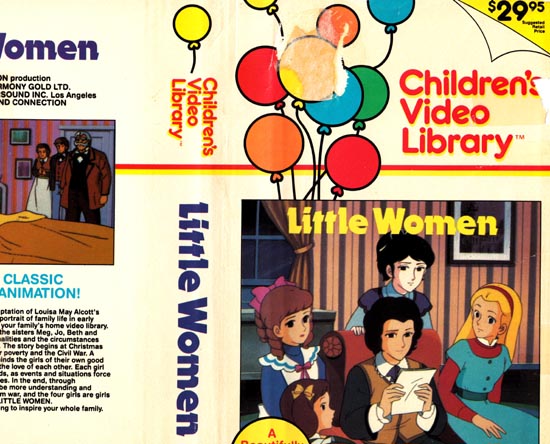
Yes, that's $29.95 for an hour long VHS tape your kids will watch once, and no, I don't miss the 80s

Toei’s Little Women, a 67-minute special on the Fuji TV network, aired May 3 1980. It starts right where the book does, a Christmas for the March girls that promises few presents and no Father. Dubbed by our Robotech pals at Intersound, this Little Women was packaged by Harmony Gold and found its way to American video stores thanks to Vestron Video’s Children’s Video Library, who also brought you Rainbow Brite, the Hugga Bunch, and the Glo Friends.  This Little Women wraps up with Jo cutting her hair to get money to buy a watch fob for a guy who buys her a comb. Well, not that last part.


Hot on the heels of the Toei telemovie was Movie International’s 1981 version, which is titled Little Women: Four Sisters Of Young Grass. I’m sure there’s a good reason they wanted to invoke lawn imagery in the title, but so far the logic escapes me. MIC farmed the animation out to Toei and there’s a distinct similarity in the two productions, especially in the character designs which sometimes show a family likeness.  Jo is almost completely different, however; sporting a new hairstyle and an adult look at odds with the story’s intent.  MIC’s series ran from April until September of ’81. With episode titles like “Christmas Eve At The March Home”, “Angels In Boots”, “Jo’s Boyfriend”,  “Beth’s Makeover”, “Jo Vs Amy”, “Meg is Caught In A Trap”, “Trouble In Raleigh”, and “Don’t Die, Beth”, you can see which story arcs the series focused on. 

Along with MIC’s Honey Honey and the Mushi Pro Tezuka series Jungle Emperor Go Leo, Little Women was dubbed by SONIC International, a since-vanished Florida production house. Like Honey Honey, Little Women made it onto a series of Sony home video tapes that may very well be lurking in the thrift stores and used bookshops near you.  If MIC’s Little Women ever made it onto CBN Cable along with Honey Honey and Leo, it got past us because we didn’t catch it.


"Angels In Boots": not the 1969 biker gang exploitation picture. (pic courtesy _D_)

It would be six long, Jo-free years before Little Women would again be animated in Japan. Nippon Animation took a ground-up approach to their 1987 World Masterpiece Theater series Little Women In Love, throwing out the Toei character designs and retooling courtesy Yoshifumi Kondo, who directed the lovely Whispers Of The Heart and would character design for Only Yesterday, Grave Of The Fireflies, and Princess Mononoke before his untimely death in 1998.  Nippon’s series is the most successful of the bunch, featuring period-accurate hairstyles, clothing, and architecture combined with good animation and scripts that stick close to Alcott’s original. The series ran 48 episodes and garnered a sequel, Little Women II: The Wrath Of Aunt March. I mean, Jo’s Boys.  Japanese audiences also got the entire series in English on specialty Japanese cable channels. Americans, however, got one measly VHS release of this series, which again features that first episode where the March gals are facing a poor Christmas. Saban provided the English dub. 


It's a Little Women Christmas with what appear to be Satan's Zombie Dolls

But is this all there is to the story of Little Women in Japanese animation?  No sir. The TBS series “World Mukashibanashi Manga” (Manga Folktales Of The World) devoted an episode to Little Women in October of 1977. 


Manga Folktales featured a variety of stories and fairy tales obscure and famous – Jack & The Beanstalk, Alibaba & The 40 Thieves, Beauty And The Beast, Why The Sea Is Salty, Gifts Of The North Wind, Cinderella, Wizard Of Oz – and in English (and Spanish) they show up in the cheap DVD bins from time to time. Did their Little Women get an English version? Is there yet another dub of yet another anime Little Women out there? How much Little Women is too much Little Women?
 
-Dave Merrill

Thanks for reading Let's Anime! If you enjoyed it and want to show your appreciation for what we do here as part of the Mister Kitty Dot Org world, please consider joining our Patreon!

Monday, December 10, 2012

ASK DOCTOR HELL

When not attempting to destroy Mazinger Z and conquer the world with his army of mechanical brutes, Doctor Hell (MD, PhD, DDS) is a syndicated advice columnist who brings his scientific and technological knowledge to the emotional and psychological problems that plague our everyday lives.

Dear Doctor Hell:
I'm 16 and in high school and lately everything I do gets me in trouble. My father disapproves of my clothes, my music, my friends, and even my boyfriend. It sure seems I can't do anything right these days. Do you have any advice?


Troubled in Tulsa


DEAR TROUBLED:
ADOLESCENCE IS A DIFFICULT TIME FOR BOTH PARENTS AND THEIR CHILDREN. MY ADVICE IS TO BUILD A GIANT SUPER-MECHANICAL ROBOT MONSTER AND USE IT TO DESTROY YOUR ENEMIES UTTERLY.


Dr. Hell;
My brother-in-law recently lost his job (again). He has used and abused the hospitality of all our other relatives, and I have a strong suspicion that he will be asking to "crash at our place" for an indefinite period. The trouble is our apartment is much too small for us, our children, our dogs, let alone a freeloading in-law. My wife wants to tell him "no way" but is finding it hard to deal with guilty feelings. What's the best way out of this situation?


Confused in Cincinnati


DEAR CONFUSED:
ECONOMIC UPS AND DOWNS ARE A FACT OF MODERN LIFE. THE ONLY REAL SOLUTION IS TO SECRETLY CONSTRUCT AN ARMY OF POWERFUL GIANT ROBOTS, PREFERABLY EQUIPPED WITH DEATH RAYS AND MISSILES, AND USE THEM TO CONQUER THE WORLD. LET ME KNOW HOW THINGS TURN OUT.


Dear Doctor Hell:
I'm seeing a guy and he seems really nice. We have been dating for three months and so far everything is perfect. My only concern is his secretive behavior. I don't know where he works, who his friends or family are, or even where he lives, exactly. My friends tell me there's something fishy about the whole affair, but my heart tells me to stand by my man. Should I confront my beau and get the truth or not?


Curious in Concord


DEAR CURIOUS:
TRUST IS AN ESSENTIAL ELEMENT OF ANY RELATIONSHIP. IF YOUR BOYFRIEND IS UNWILLING TO EXTEND THAT TRUST TO YOU, BY ALL MEANS ACTIVATE YOUR ARMY OF CYBORG SLAVES AND COMMAND THEM TO OCCUPY ALL THE STRATEGIC AREAS IN THE METROPOLITIAN AREA. WITH THE CITY PARALYZED, NOTHING CAN HALT YOUR ATTACK ON THE SCIENCE CENTER, AND SOON THE SECRET OF Z-ALLOY WILL BE YOURS.


Dear Dr. Hell:

My wife and I have been happily married for fifteen years. Lately, though, things have changed. She's been strangely distant to me, she's been spending a lot of time on internet chat rooms and on business trips. She's been receiving gifts and flowers from 'anonymous admirers' and I don't want to sound suspicious, but the many hang-up phone calls we've been receiving aren't making me feel any better. Set me straight, Dr. Hell. Am I being paranoid, or is my wife having an affair?


Disturbed in Duluth


DEAR DISTURBED:
MARITAL FIDELITY IS THE CORNERSTONE OF OUR SOCIETY AND SHOULD NOT BE QUESTIONED LIGHTLY. ONCE YOUR ARMY OF MECHANICAL MONSTER ROBOTS HAS SWEPT ALL OPPOSITION FROM THE SKIES, ALL THAT REMAINS IS TO WIPE OUT THE POCKETS OF RESISTANCE THAT WILL NATURALLY FORM AROUND MILITARY BASES, STRATEGIC LOCATIONS SUCH AS BRIDGES OR DAMS, AND OF COURSE SCIENTIFIC RESEARCH INSTITUTES. LUCKILY YOUR SUPER ROBOTS WILL OF COURSE BE EQUIPPED WITH EVERY FORM OF DESTRUCTION OUR TWISTED SCIENCE CAN FORMULATE - PARTICLE BEAMS, FLAME PROJECTORS, EXTENSIBLE BATTERING-RAM LIMBS, AND ROCKET-PROPELLED FISTS. AND DON'T FORGET, IN THE HANDS OF A SUPER-MECHANICAL MONSTER ROBOT, EVEN PRIMITIVE WEAPONS LIKE SWORDS AND CLUBS CAN BE USED TO GREAT ADVANTAGE. WITH ANY LUCK, THE SHATTERED REMNANTS OF MANKIND WILL HAVE NO CHOICE BUT TO SUBMIT TO YOUR EVERY WHIM.


Dr. Hell:
I'm currently in the process of constructing my own super-mechanical giant robot. Up until now assembly has been picture-perfect - even the robot's laser eyes and forehead drill were no problem to install. However, I'm having some serious troubles with the universal joint assembly in the third armature framework's positive feedback power supply arrangement. Can you give a novice monster-robot builder some tips?


Stuck in Stovington


DEAR STUCK:
I'M TRYING TO HELP PEOPLE WITH RELATIONSHIP AND EMOTIONAL PROBLEMS HERE, NOT ACT AS A "ASK ANDY" FOR BACKYARD MECHANICS. PLEASE DON'T WASTE MY TIME WITH QUESTIONS OF THIS NATURE.

HOWEVER, YOU NEED TO REALIZE THAT UNIVERSAL JOINT ASSEMBLIES IN THE THIRD ARMATURE ARE ESSENTIALLY POINTLESS. IN ANY TRUE GIANT-ROBOT COMBAT SITUATION THE SLIGHT INCREASE IN RANGE OF MOTION BROUGHT ABOUT BY THIS UNIVERSAL JOINT WILL BE MORE THAN COUNTERED BY YOUR OPPONENT'S POWERFUL ROCKET PUNCH OR THE SLASHING CUT OF THE SHARPENED WING OF HIS JET SCRAMBLER, OR, HEAVEN FORBID, THE IRRESTIBLE DESTRUCTION OF THE BREAST FIRE HEAT BEAM. I WOULD CONCENTRATE ON MORE POWERFUL WEAPONS SYSTEMS AND LEAVE FULL MOTION TO THOSE ROBOTS THAT AREN'T CONCERNED WITH WORLD DOMINATION. LET ME KNOW HOW IT TURNS OUT.


Dr. Hell’s column appears every week in 87 newspapers worldwide.  He is NOT a medical doctor, and yet millions have found his advice helpful.  If you have a question for Dr. Hell, feel free to contact him at:  Doctor Hell, Hell Island, Somewhere In The Ocean, or email him care of Let’s Anime via terebifunhouse@gmail.com.


Thanks for reading Let's Anime! If you enjoyed it and want to show your appreciation for what we do here as part of the Mister Kitty Dot Net world, please consider joining our Patreon!

Sunday, November 25, 2012

Urusei Yatsura: Dreaming Beautifully


This 1984 film, the second movie based on the popular URUSEI YATSURA TV series, in turn based on the popular manga series of the same name by Rumiko Takahashi, is probably the best reality-questioning feature film ever made starring wacky high school students and their jealous space alien girlfriends.  Directed by Mamoru (GHOST IN THE SHELL, PATLABOR THE MOVIE, AVALON) Oshii, BEAUTIFUL DREAMER is a brain-bending think piece far removed from typical Urusei Yatsura hijinks.

We all know about Tomobiki High School; full of colorful students and staff, home to weekly happenings of cosmic craziness.  Notorious lecher and bad-luck magnet Ataru Moroboshi is the 11th grade class-clown embarrassment, but his lowly status is overlooked by his girlfriend, the green-haired outer space princess known as Lum.  As our film opens, the student body is running itself ragged preparing for the school festival; an annual fete of crazy Toho monster-movie costumes, floats, parades, and assorted school spirit exercises.  Most students are half-dead from exhaustion and overwork and the seemingly endless preparation, and it seems if the work will never end. 


But their teacher, the fiery Mr. Onsen-Mark, has another idea – that they actually ARE reliving the same days over and over. They’re stuck in an endless cycle of early mornings and late nights and colorful bunting and papier-mache.  Onsen’s contention is they’re trapped in the famous fairy tale of Urashima Taro, the Japanese Rip Van Winkle who rode a turtle down to the undersea kingdom, hung out for a little while, and found when he returned to the surface a hundred years had passed. When the students make an effort to leave the school, they find that all the trains take them back to Tomobiki Station and all the cabs and buses do is drive in circles, and the morning reveals yet another deja-vu day of festival preparation.  It seems obnoxious rich kid Shutaro Mendo’s secret emergency Harrier VTOL Jet provides the only escape – and yet once in the air, the appalling secret of Tomobiki’s isolation becomes clear. 


Cut off from the Earth, nourished by a mysteriously replenishing mini-mart, crowded into the family home of Ataru’s long-suffering parents; this potential LORD OF THE FLIES becomes an idyllic paradise of relaxation amidst the ruins of their former home town. But the true nature of their situation soon becomes clear.  Since this is a 18 year old dub of a twenty-eight year old film that is, after all, called BEAUTIFUL DREAMER, I don’t think I’m spoiling anything by revealing that yes, this is all a dream – the dream of someone for whom the busy, bustling days of the school carnival are the happiest of all.


BEAUTIFUL DREAMER is a curiosity; its theme is one that will be revisited by Hollywood in films as disparate as GROUNDHOG DAY and THE MATRIX (not to mention DARK CITY).  Oshii was no stranger to URUSEI YATSURA; he directed scores of TV episodes and was called in to finish the first U.Y. film ONLY YOU; and he was familiar enough with the characters to use them as a vehicle to ask his own questions.  BEAUTIFUL DREAMER really captures a sense of disconnection where even something as commonplace as your own street can seem to be completely alien.  This is the point where this wacky high school SF comedy meets Philip K. Dick reaching for the light cord that isn’t there in his classic TIME OUT OF JOINT; the familiar becomes unfamiliar, and then you begin to question if ANYTHING is what it seems. 

BEAUTIFUL DREAMER is atypical, even for an anything-can-happen series like URUSEI YATSURA. It’s an ambitious film that asks questions and goes places that UY doesn’t normally go, and while I’m all for stretching boundaries and pushing envelopes, at the end of the day this is an Lum movie without any musical segments, with precious little Ataru comedy moments, and where some of the funniest characters are relegated to the background while the majority of the exposition is left to the un-funny, responsible types like Sakura. U.Y. purists may be advised to stick with ONLY YOU.   


On the other hand, it’s easy to see where Oshii and his staff would be hungry to work on a different kind of URUSEI YATSURA story.  After more than a hundred TV episodes and a feature film that to Oshii felt like an extended version of same, the urge to stretch creative muscles must have been overwhelming.  Ultimately I think this kind of reality-bending storyline is held back by the URUSEI YATSURA framework; U.Y. is a show where anything and everything can happen and usually does, and when we’re confronted on a regular basis with aliens, storybook characters come to life, robots, military hardware, mythological deities and ghosts, we can hardly be expected to give BEAUTIFUL DREAMER the awe-struck reception such a storyline asks for.  It’s a gutsy move, using an established franchise like this; the deconstructive, “what does it all mean” plot device wasn’t the cliché in 1984 that it would be twenty years later. 


Not as stylish or as deliberative as Oshii’s later works, BEAUTIFUL DREAMER clocks in at a lean 100 minutes.  Remarkably, for a film where really not that much happens, it doesn’t seem to drag.  The animation is up to Kitty Films/Studio Pierrot’s high standards, and there are several scenes where things really sparkle.  You can particularly see that Oshii’s crew really enjoyed the Harrier scenes.   Mamoru Oshii’s love of Nazi memorabilia is a curious design choice; in America swastikas are limited to the covers of 1950s mens adventure magazines and paperback thrillers about former SS officers plotting to conquer Argentina, but Oshii sees nothing strange in the students of Tomobiki High School choosing Nazi Germany as a theme for their entry in the school festival. This kind of creative thinking is why Oshii is a top film director.  Or maybe Oshii is a top film director IN SPITE OF this kind of thinking. It’s hard to tell.   The crew was clearly at home in Tomobiki High; you don’t have to be a subtextural genius to figure out that the endless sweatshop environment of the school carnival was a reflection of endless days and nights working on URUSEI YATSURA itself.

The DVD’s commentary track features an absolutely revelatory Oshii detailing the influence of real-life events upon the script for BEAUTIFUL DREAMER, his experiences on the TV animation treadmill, and his feelings towards ONLY YOU.  The commentary track – Japanese audio with English subtitles - isn’t necessary to enjoy the film, but it certainly adds another dimension to the movie.


The dubbed version of this film was produced in 1996, and sounds like it.  While most of the casting is professional and talented, none of the English talent comes close to matching the spirit or the tone of the original.  T. Roy Barnes is a good actor and has a great voice for cartoon work; unfortunately he just doesn’t sound like Onsen-Mark.  The school nurse Sakura gets the lion’s share of the dialog in the film, and Melanie Head’s line readings are stiff and repetitive, flattening lines that should be bringing the more fantastic elements to life.  Overall the dub is representative of most dubs of the 90s – competent but flat, with little of the thought and professionalism of today’s dubs or the shameless rewriting and overacting of the 60s and 70s. Nitpicks: Mendo is referred to throughout as “Shootaroo Mendow”, and while Lum’s brother Ten is admittedly at the age where gender doesn’t matter so much, it’s still glaring to see him referred to as a “her”.  The original Japanese voices are some of the best ever assembled; I’d stick with them.

Central Park’s DVD release is a good package, however; we get the original Japanese trailer and trailers for the AnimEigo release of URUSEI YATSURA  ONLY YOU as well as BEAUTIFUL DREAMER.  There’s also an art gallery of film stills and the fascinating Oshii commentary, moderated in part by Mr. CPM himself John O’Donnell.  Not to mention the fine transfer of the original film, itself a masterful example of the high point of the hand-drawn age of Japanese animation.


A departure from the URUSEI YATSURA formula, BEAUTIFUL DREAMER is both beautiful and dreamlike.  It marks the boundary between straightforward, un-ironic storytelling and the more introspective, self-referential series that would follow. As an URUSEI YATSURA film it may not follow the rules, but then again, this is UY, what rules? If you miss your old-fashioned wacky URUSEI YATSURA there’s always ONLY YOU or the TV show, produced in a world where Oshii and his staff work long days and endless nights, wondering if somehow they hadn’t done all this somewhere before.

-Dave Merrill

A previous version of this review was originally published at Anime Jump. 


Thanks for reading Let's Anime! If you enjoyed it and want to show your appreciation for what we do here as part of the Mister Kitty Dot Net world, please consider joining our Patreon!

Wednesday, October 31, 2012

Kokusai Eiga-sha Part Two: International Movies


(Where were we…let’s see.  BRYGER, yes, HONEY HONEY, all right,  ACROBUNCH, sure, NANAKO SOS... okay... BAXINGER!


1982 would see the return of the J9 in GINGA REPPU BAXINGER or “Galactic Gale Baxinger” as the toy helpfully puts it. 600 years after the climax of BRYGER, the fragile peace of the fifty-planet Solar System is being disrupted by revolutionaries who may be in league with invaders from another star. To defend the government, aristocrat Diego “Don Condor” Kondo invokes the spirit of the first J9 team and sets up the Galactic Whirlwind Baxinger, a 250-man team of outer space biker commandos ready to troubleshoot disaster wherever it may appear. Together with Shtekken Radcliffe, firearms expert Mahoroba “Billy the Shot” Shiro, melee weapon stylist Lily “the Butterfly” Mineri, and supercool samurai Samanosuke “Slugger Sama” Dodii, they pit the expanding-plasma combination super robot Baxinger against all comers.  The story of BAXINGER loosely follows Japan’s late Tokugawa era, when civil war erupted between factions who wanted to see the Emperor restored to full power and those who supported the Tokugawa government, which recruited an army of wandering samurai to defend the capital. Known as the Shinsengumi, their exploits would inspire novels, films, TV drama, manga, video games, and the occasional anime series (GINTAMA, RURONI KENSHIN). 


BAXINGER doujinshi circa 1983

The fate of the Shinsengumi looms over BAXINGER; obviously the Tokugawa shogunate no longer rules Japan, so you already know this one isn’t going to end well for our heroes. The conflicts between different factions within the Solar System become increasingly Byzantine and self-serving, the Bakufu government finds it harder to maintain any authority, and J9-II is caught in the middle. Like BRYGER they find themselves overwhelmed by events, but their honor as 28th-century samurai keeps BAXINGER’s heroes from fleeing the Solar System, instead choosing to meet their fate head-on.  Reflecting the show’s feudal roots, the costume design and general look of the show is colorful, ornate, almost Byzantine; the K. Kazuo character designs are typically classy, and we’re given a great theme song and what may be the best ED song of all time, Naomi Masuda’s “Asteroid Blues”.  The Baxinger robot itself is almost Art Nouveau in its impracticality; buy one of the Takatoku toys and then see for yourself how the chest plate prevents arm movement.  BAXINGER ran from July ’82 until March of ’83, and it would be April before the next incarnation of J9. In the meantime Kokusai Eiga filled the gap with a mission to outer space. 


Farewell, BAXINGER!

MISSION OUTER SPACE: SRUNGLE (“Akudaisakusen Srungle”) ran for a full year as a sort of combination A-TEAM and MISSION IMPOSSIBLE. The Srungle team is known as “The Gorilla Force”; they’re a gang of specialist operatives piloting what could charitably be called the least attractive super robot machines ever designed, in order to battle the evil criminal organization known helpfully as “Crime”. This all takes place in what’s called “Outer Space Zone”, a giant stretch of the cosmos that’s been given gravity and atmosphere. Humans have colonized a large city and several asteroids within the Zone, which is governed by “Galac Space”. Civilization itself hangs in the balance as the Gorilla Force – Captain Chance, Jet, Super Star, Sexy, Baby Face, and Bill Bixby as The Magician – battle the machinations of Crime. 


SRUNGLE somehow overcomes its difficulties and delivers 50 episodes of a complex plot, nutty cameos (Pac-Man, Gundam, Edvard Munch’s THE SCREAM), and increasingly unattractive robots to conclude via showdown with the Emperor Of Darkness and a giant space brain. A more detailed overview of SRUNGLE can be found at the Roketto Panchii blog , well worth a read to flesh out the SRUNGLE universe.  American audiences were treated to a “Robotech” style mashup of SRUNGLE and Ashi Pro series GOSHOGUN, dubbed and broadcast by Saban as “Macron 1”, in which characters from one show did their thing, characters from another show did their completely separate thing, and occasionally they spoke to each other via cross-dimensional television.  Merchandise-wise, SRUNGLE toys were made by Clover (who also had the Gundam license for about ten minutes) and Poplar, who specialized in cheap dime-store stuff. Both companies went out of business after attempting to merchandise SRUNGLE. 


SOOOOOOLAR WIND...

Next up at bat for MIC was the third J9 series, GINGA SHIPPU SASURAIGER. “Sasuraiger” comes from the Japanese “sasurai” or “wander”, and that’s just what the heroes of J9-III do – wander through the Solar System in their giant robot/space locomotive to fulfill the conditions of a cosmic wager. A century or so after the events of BAXINGER, disowned rich kid/computer genius Bruce Carl Bernstein – aka “IC Blues” – finds himself on the pleasure asteroid J9-Land making a gentleman’s wager with Max Girth, head of the “Bloody Syndicate”.  If Blues can travel to all fifty planets of the Solar System in one years’ time, he’ll get everything Max owns – but if he fails, all Blues gets is a bullet in the head.  Luckily Blues has an ace up his sleeve – the 23 meter tall transforming giant robot “Sasuraiger” and a crew to pilot her on this crazy gamble. Harmonica-playing gunslinger Rock “Straight-shooting” Anrock,  mechanical genius Beat “Otoboke” Mackenzie, sexy secret agent turned super thief Birdie “Kimagure” Show, and young lovers Jimmy Kenzo and Suzie Chan join IC on his wild ride around the planets, leaving Blues’ signature on prominent planetary landmarks while dodging the efforts of an increasingly desperate Bloody God.  Refereed by Joanna Carlisle, who owns the largest news syndication service in the System, the outrageous bet also catches the attention of Detective Chief Orlen, whose duty demands he track down IC Blues but whose personal feelings about the case may differ.


SASURAIGER’s light-hearted tone, evident from the first bars of the cheery theme song, sung by MOTCHIN aka groupsounds guru Ai Takano, is a real change after the sturm und drang of BAXINGER’s climax.  There is, however, excitement aplenty as Blues and company challenge Bloody God’s thugs across the System, and is that our old friend Khamen Khamen over there enjoying godhood? It just might be! Reports vary as to whether or not it was dubbed into English as “Wonder Six” and/or shown in Indonesia, but no direct English-language evidence has surfaced other than Enoki Films’ promotional material. Takatoku marketed a whole line of Sasuraiger toys including a train-to-robot transforming Sasuraiger confusingly labeled “Batrain”.  SASURAIGER would wrap up in January ’84 and MIC would start planning their next J9 series – “Ginga Ninpu Onsengar” – but subsequent events would prevent its production.


Kokusai Eiga would produce one more SF robot anime – not another J9, but a completely new show that broke with tradition both visually and thematically. CHO KOSOKU (“Super High Speed”) GALVION wasn’t anything like MIC’s previous series –less aliens, less emphasis on cosmic storylines, as far as I know, no attempted godhood – just two hard-luck ex-convicts pressed into service as drivers of a super sportscar that can turn on a dime AND turn into a fighting robot. A couple hundred years from now, sexy billionaire Midoriyama Rei realizes the best way to fight the nefarious SHADOW conspiracy is with her own secret organization called CIRCUS. She recruits Mu and Maya right out of federal prison for two reasons: they’re excellent drivers, and they’re really desperate to get their sentences reduced.  GALVION escaped the J9 space-opera style with up to date mechanical design by Koichi “Gunbuster” Ohata and character designs by manga artist Yoshihisa “Yu” Tagami, whose work we’d later see in DIGITAL TARGET GREY.  Today the look of the show is patently 80s, but it’s the first MIC show that didn’t rely on capes, swords, elaborate headgear, “expanding plasma”, or any of the other fantasy trappings of their previous SF series, and the “Lonely Chaser” OP theme sung by Riyuko Tanaka positively vibrates with mid-80s drum-machine beats and ersatz Eddie Van Halen guitar licks. 


Mu and Maya from GALVION

GALVION held promise, but its February-to-June, 22 episode run was cut short by the bankruptcy of MIC’s chief sponsor, Takatoku Toys. You’d think with the license to produce toys for a hit like MACROSS, Takatoku would have been in good financial health, but subsequent licensing decisions – among them DORVACK, ORGUSS, and the J9 series – were not popular enough to keep the company afloat. When the money ran out GALVION’s story wasn’t anywhere near finished.  Episode 22 wrapped the show up with a 35-second bit of narration and that would be the last we’d see of Mu and Maya and the Circus-1. The show has never been released on any home-video format – not VHS, not Beta, not Laserdisc, certainly not DVD. The physical whereabouts of the original film may be a mystery, so episodes taped off-air and passed from otaku to otaku may be all we ever see of GALVION. And that’s a shame. It’s a fun show with an interesting character mix and lots of noisy, transforming-robot action. 

Futari Daka pops the clutch and tells the world to eat its dust

One last MIC series remained on air after GALVION’s premature end - FUTARI DAKA or ‘Twin Hawks’. This motorcycle racing drama was based on the Shonen Sunday manga of the same name by Kaoru “Yattaman” Shintani, who earlier had provided character designs for 1980’s GOD SIGMA and would later bring us PHANTOM BURAI (script by Buronson), QUEEN 1313, and something called AREA88. Sunday’s publisher Shogakukan was a sponsor of the anime series, which may explain its survival in a post-Kokusai Eiga world. FUTARI DAKA deals with bikers Taka Tojo and Taka Sawatari, who share a first name and a bitter rivalry both on the course and off.  The OP mixed live motorcycle race footage in with its anime, was set to the catchy “Heartbreak Crossin’” by Takanori Jinnai, and though it failed to save MIC from oblivion, the show found new life on French TV five years past its cancellation date, which was June of ‘85.


the titular Twin Hawks of FUTARI DAKA

The ultimate fate of MIC – laid low by lack of a toy sponsor – serves to highlight an uncomfortable truth about Japanese cartoons. Most of these anime shows we obsess about are, let’s face it, 25-minute infomercials designed to sell toys, model kits, stationery, games and other licensed product. The product licenses keep the money flowing; without money, you don’t have your anime shows. The increasing value of the yen versus the dollar, spurred by the Plaza Accord of 1985, meant that exports from Japan got more expensive. Overseas markets were hit by sticker shock for Japanese goods and products like consumer electronics, cars, and most importantly anime TV series and toys from same.  1985 saw a contraction in the number of anime TV shows (34 in 1984, 20 in 1985), a revenue-hungry industry moved into the burgeoning home video market with direct-to-video OVAs independent from toy license financing, and the kids who grew up with super robots, science ninjas and space battleships aged out of the cartoon-watching demographic and into dating, college, and watching the bubble economy pop.

MIC’s exit from the anime production world was but one element in a larger drama; a drama that would have echoes 25 years later as another cash crisis rocked the industry. Crowded by larger studios even in the best of times, ultimately laid low by market forces beyond its control, through it all Kokusai Eiga-sha produced series that were unique and entertaining and that still have fans around the world, fulfilling their mission statement with a truly international legacy. The license for many MIC series is currently held by Enoki Films.  Hey fellas, let’s get some ACROBUNCH or HONEY HONEY DVD action going on here, I’m just saying, hint hint. 

-Dave Merrill


Thanks to Jane E. McGuire and C/FO MAGAZINE VOL. 2 NO. 10 for their assistance with the J9 portions of this article.

Thanks for reading Let's Anime! If you enjoyed it and want to show your appreciation for what we do here as part of the Mister Kitty Dot Net world, please consider joining our Patreon!