(this review of Pioneer's 2003 DVD release "Lupin The 3rd: The World's Most Wanted" originally appeared in 2003. Pioneer's no longer in business and this DVD is out of print, but I had a lot of fun writing this review and am glad to present it again.)

FROM: INSPECTOR
ZENIGATA
TO: ICPO (Interpol)
HEADQUARTERS, GENEVA
SUBJECT: LUPIN THE 3RD -THE WORLD’S MOST WANTED
Gentlemen:
I am saddened to report that once again the entertainment
industry has demonstrated its contempt for the rule of law with the release of
yet another in a long line of animated serials dealing with the notorious
criminal,
Lupin the 3rd.
This latest
DVD release
even has the audacity to poke fun at Lupin’s criminal status with its title
“The World’s Most Wanted”. I am shocked
at the lack of respect for law that Pioneer, once a highly-regarded
entertainment conglomerate, has demonstrated with this video. It was bad enough that these supposedly
comical cartoon “adventures” of that reprobate Lupin had been
transmitted across the public airwaves during the mid 1970s, but to dredge these accounts
of larcenous and immoral behavior from whatever pit of depravity they had been
confined to is almost a crime in itself.

All of Lupin’s accomplices are fully implicated in the
crimes this video depicts. The gangster
Jigen, the mercenary swordsman Goemon, and that curvaceous grifter Fujiko are
all explicitly shown engaged in violations of the criminal codes of dozens of
nations. I am, as always, deeply
embarrassed that the corrupt and malicious producers of these animated films
have seen fit to include a painfully inept caricature of myself as a character in
these shameful episodes. It is a known
fact that Lupin III has eluded capture so
far - but not for lack of effort on my part, I am proud to say. I only wish the same was true for some of our
“brethren in blue”, who seem to regard this brigand as a harmless and
entertaining thief rather than a menace to public safety and morals.


The six “escapades” contained in this
DVD
are fanciful recreations of some of Lupin’s most heinous offenses, as produced
for Japanese television by the
Tokyo Movie Shinsha animation studio. “The Revenge Of Lupin The 3
rd” features
the destruction of an entire luxury liner, prompted by a madman driven to
revenge after becoming the victim of one of Lupin’s previous schemes. In the luridly titled “Buns, Guns, And Fun In
The Sun”, Lupin and his gang demonstrate
what may be new heights of contempt for civilized society, as they not only rob
the box office of Rio’s soccer stadium and make a mockery of the Brazilian
penal system (here my opinion of the Rio police matches Lupin’s - I fear the
tropical climate and moral lassitude of the inhabitants has contributed to the
decline of this law enforcement unit) - but a priceless national landmark is
perhaps irreparably damaged by Lupin’s unthinking greed. “50 Ways To Leave Your 50-Foot Lover” is a
fanciful tale of the supposed Loch Ness Monster, reportedly tamed by Fujiko’s
singing voice. “Gold Smuggling 101” is a
primer in perfidy for anyone who wishes to embark on a life of crime. I must say it was ingenious of Lupin to
utilize a scheme straight out of the film
Goldfinger, but then again, he IS a
thief. What disturbs me the most about
this episode may be the depiction of the corruption of what was once a
respected bank manager; or perhaps it may
be the depiction of myself, which literally portrays the author as a myopic
crank from whom Lupin is able to escape without effort. I assure you, my failure to permanently
apprehend Lupin is a result of the criminal’s inhuman cunning and dexterity,
not a lapse of attention from this detective.
“Shaky Pisa” is remarkable not only for the earthquake-device that
nearly destroys Pisa, but also for expecting the viewer to believe that Lupin
the 3rd will retire from the scene while leaving millions of lire
un-stolen. In the “Cursed Case Scenario”,
the ancient sands of
Egypt
are befouled by Lupin’s perfidious footsteps.
Not even national treasures are safe from his larcenous grasp! Luckily his ill-gotten swag seems to be more
trouble than it is worth.

The animation of these criminal adventures is of the
standard seen on broadcast television in Japan
in the mid 1970s; adequate without devolving into primitivism, though bereft of
the occasional flashes of artistry seen in other “cartoons” of the period. The depiction of Lupin and his accomplices
are realistic enough, though exaggerated for supposedly comic purposes. Other than a garish series title in English,
the opening credits are as originally presented, and the end credits are
similar to the Japanese, with a rather weak instrumental replacing the original
Japanese vocals. Rendering these
photoplays into English was obviously an attempt on Pioneer’s part to corrupt
the morals of the children of the Western world, already known to be in a
precarious state.
Lupin’s English voice is remarkably similar to his
Japanese. This new Anglophone version,
however, is closest of all to the rendition heard in the
long-suppressed “Mystery of Mamo” film (though Lupin’s voice was the only point of accuracy in
that otherwise scandalously erroneous production. “Ed Scott”, indeed). Both Lupin and his crew of malcontents spout
dialog that positively reeks of the disrespectful, flippant attitude that would
lead one to a life of crime; puns,
insults, and innuendos of a leering nature abound in their speech. I am positive that the intended audience for
this low-class banter will find it quite amusing, however disturbing it may be
to those of more refined tastes.

Seemingly tireless in its mania to promote lawlessness and
crime, Pioneer has released this
DVD with
options of both English and Japanese language tracks. A detailed section of line drawings of
characters, devices, and locales acts as a veritable university education in
wrongdoing for the interested viewer.
Previews for other of Pioneer’s perhaps more law-abiding productions
fill the remainder of this digital video disc.
In conclusion, let me exhort Interpol to use every means at
its disposal to prevent this latest affront to the public dignity. How much longer will law-abiding citizens be
forced to endure the glorification of criminality? Is Lupin the 3rd the kind of
figure we want held up to our children as a figure to be emulated? Already reports are coming in about a new
Lupin comic book in America,
and the new year will see Lupin’s duplicitous face plastered across the
television screens of that already criminal-infested country. I urge you, sirs, to wait no longer. For my part, I have just received information
about Lupin’s latest target, and I must end this communication posthaste. Rest assured, gentlemen, that this time I
will DEFINITELY bring Lupin the 3rd to long-delayed justice.
Inspector Zenigata, ICPO
(transcription by correspondent Dave Merrill)
Thanks for reading Let's Anime! If you enjoyed it and want to show your appreciation for what we do here as part of the Mister Kitty Dot Net world, please consider joining our Patreon!


 As a guy roughly in the same age range and sharing a lot of
predilections as “Director”, it’s downright appalling to see him tooling along
in the car singing along to the X-Bomber theme song. Because… I do that. I too was obsessed with Ultraman as a child
and know way too much about super-robot cartoons and who directed what World
Masterpiece Theater production of which juvenile literary classic, and it is
profoundly unsettling watching my life unfold in a manga written and drawn by
complete strangers who, so far as I know, are not spying on me. Still, the parallels are ominous. “Rompers”
and “Director” were married, as my cartoonist wife and I were, in 2002 – and
while neither groom sported a Kamen Rider costume, as shown in the manga, they
DID distribute their own doujinshi to the guests (why didn’t we think of
that?). The couple faces the same
questions many of us face today; what to do with the piles of DVDs and LDs? How
best to handle the pot belly that results from the sedentary otaku
lifestyle? Where in their tiny apartment
will the Kamen Rider figures go? How should a faithful wife react when – again,
ominously paralleling my own life – she first sees her husband’s goofy amateur
films? Thankfully for my own sanity, every time Insufficient Direction hits too
close to home we come across a sequence where “Rompers” tries to convince “Director”
that changing underwear and showering every day is critical, which I assure you
is NOT an issue around HERE.
As a guy roughly in the same age range and sharing a lot of
predilections as “Director”, it’s downright appalling to see him tooling along
in the car singing along to the X-Bomber theme song. Because… I do that. I too was obsessed with Ultraman as a child
and know way too much about super-robot cartoons and who directed what World
Masterpiece Theater production of which juvenile literary classic, and it is
profoundly unsettling watching my life unfold in a manga written and drawn by
complete strangers who, so far as I know, are not spying on me. Still, the parallels are ominous. “Rompers”
and “Director” were married, as my cartoonist wife and I were, in 2002 – and
while neither groom sported a Kamen Rider costume, as shown in the manga, they
DID distribute their own doujinshi to the guests (why didn’t we think of
that?). The couple faces the same
questions many of us face today; what to do with the piles of DVDs and LDs? How
best to handle the pot belly that results from the sedentary otaku
lifestyle? Where in their tiny apartment
will the Kamen Rider figures go? How should a faithful wife react when – again,
ominously paralleling my own life – she first sees her husband’s goofy amateur
films? Thankfully for my own sanity, every time Insufficient Direction hits too
close to home we come across a sequence where “Rompers” tries to convince “Director”
that changing underwear and showering every day is critical, which I assure you
is NOT an issue around HERE. 



 Hisamatsu’s manga work would inspire another TCJ series that
premiered in April of ’67- Boken Gaboten Jima aka Adventure On The Gaboten Island.
This “Swiss Family Robinson/Robinson Crusoe” style story involves a lost island
full of strange animals and the story of five teenagers who wash up on its
shores. Tomato and Ryuga sneak onboard a
submarine at an amusement park late at night, joining Gabo, Cucumber and Igao
who were already there. Launched accidentally, the sub drifts on the ocean
until beaching on Gaboten Island,
where the five must survive as castaways. They build treehouses, make
friends with the animals, explore the hidden tunnels and caves of the island,
discover ancient relics, build irrigation canals, a waterwheel, indoor
plumbing, a little island train, meet local islanders, and hold a boxing match between a gorilla and
a baby dinosaur. As fun as all this is, they know eventually the volcano is
going to erupt, so they must find a way off Gaboten
Island! A great mambo-style theme song and interesting use of live-action footage make the opening credits fun.I’d love to see more of this series.
Hisamatsu’s manga work would inspire another TCJ series that
premiered in April of ’67- Boken Gaboten Jima aka Adventure On The Gaboten Island.
This “Swiss Family Robinson/Robinson Crusoe” style story involves a lost island
full of strange animals and the story of five teenagers who wash up on its
shores. Tomato and Ryuga sneak onboard a
submarine at an amusement park late at night, joining Gabo, Cucumber and Igao
who were already there. Launched accidentally, the sub drifts on the ocean
until beaching on Gaboten Island,
where the five must survive as castaways. They build treehouses, make
friends with the animals, explore the hidden tunnels and caves of the island,
discover ancient relics, build irrigation canals, a waterwheel, indoor
plumbing, a little island train, meet local islanders, and hold a boxing match between a gorilla and
a baby dinosaur. As fun as all this is, they know eventually the volcano is
going to erupt, so they must find a way off Gaboten
Island! A great mambo-style theme song and interesting use of live-action footage make the opening credits fun.I’d love to see more of this series. 

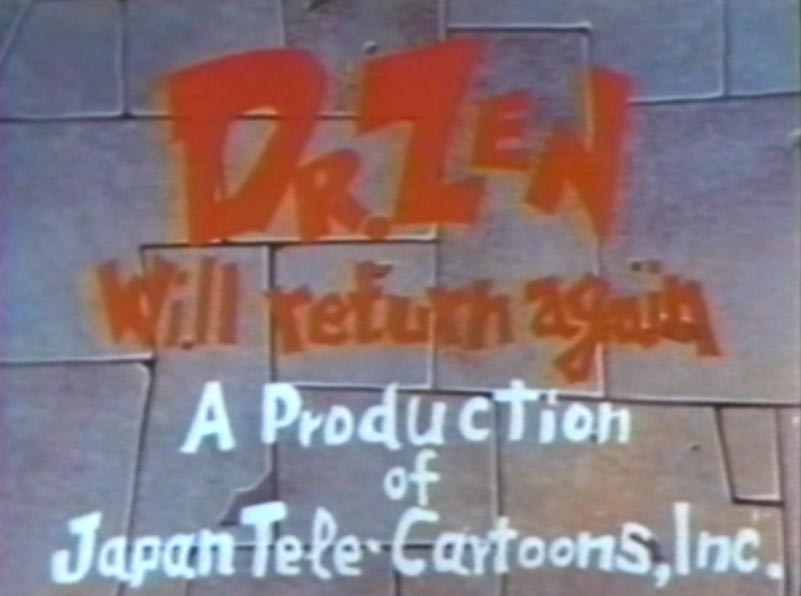
 Nihon Doga/TV Video/whatever would also produce Kaito Pride AKA Dr. Zen, a primitive series of brain-damagedly simple shorts starring the
mysterious thief Pride (or Dr. Zen) and his attempts to steal all the children’s
toys. Opposing this criminality is the boy detective Doublecheck and his pals
Gabby and Honeybee, who is a little talking bee with a woman’s face. Time to
quit drinking.
Nihon Doga/TV Video/whatever would also produce Kaito Pride AKA Dr. Zen, a primitive series of brain-damagedly simple shorts starring the
mysterious thief Pride (or Dr. Zen) and his attempts to steal all the children’s
toys. Opposing this criminality is the boy detective Doublecheck and his pals
Gabby and Honeybee, who is a little talking bee with a woman’s face. Time to
quit drinking.
 Meanwhile, back in the non “Tele-Cartoons” world of TCJ, in
the Sengoku Era/Warring States period of Japan
(16th century) – or 1968, if you like - the remnants of Sanada
Daisuke’s men were hunted by Tokugawa’s ninja led by Hattori Hanzo, and among
these survivors was the ninja Sasuke Sarutobi. Sasuke has made pop-culture
appearances for years, but in Sanpei “Ninja Bugeicho” Shirato’s 1961 Sasuke manga (based in turn on a novel by Kazuo Den), Sasuke is a young boy struggling
to survive in a ninja-infested Japan
crazy for his young ninja blood. TCJ’s 1968 Sasuke series did a decent job replicating
Shirato’s amazing brushwork and idiosyncratic character design, and delivered
the first of a very few “gekiga” anime series. Sasuke ran for 29 episodes and
would eventually find its way to American markets as a one-episode dub titled
“Kiko – Boy Ninja.”
Meanwhile, back in the non “Tele-Cartoons” world of TCJ, in
the Sengoku Era/Warring States period of Japan
(16th century) – or 1968, if you like - the remnants of Sanada
Daisuke’s men were hunted by Tokugawa’s ninja led by Hattori Hanzo, and among
these survivors was the ninja Sasuke Sarutobi. Sasuke has made pop-culture
appearances for years, but in Sanpei “Ninja Bugeicho” Shirato’s 1961 Sasuke manga (based in turn on a novel by Kazuo Den), Sasuke is a young boy struggling
to survive in a ninja-infested Japan
crazy for his young ninja blood. TCJ’s 1968 Sasuke series did a decent job replicating
Shirato’s amazing brushwork and idiosyncratic character design, and delivered
the first of a very few “gekiga” anime series. Sasuke ran for 29 episodes and
would eventually find its way to American markets as a one-episode dub titled
“Kiko – Boy Ninja.” 

 It’s around this time that TCJ underwent a transformation
into Eiken, a move that would see it through the end of the 20th
century and beyond. Spearheading this bold new direction is none other than the
cheerful housewife Sazae-San, whose TV adventures started in October of 1969
and ended… let’s see. Sazae-San is STILL ON THE AIR. That makes Sazae-San the longest-running TV cartoon of all time, anywhere. Based on
the Machiko Hasegawa comic strip which started in 1946 and took Sazae and her
family through Japan’s
occupation up into the 1970s, the success of Sazae-San made Hasegawa one of Japan’s
pre-eminent female manga-ka and allowed her to, among other things, start her own art museum. Although the strip was
controversial at first for its portrayal of Sazae as a modern, independent
woman capable of making her own decisions, the series is now seen as a light
family comedy (see also The Simpsons, which were once controversial enough to be condemned from the White House. I know, right?) enjoyed by generations of
Japanese young and old, and ignored completely by so-called “anime fans” in the
West. Get with it, people.
It’s around this time that TCJ underwent a transformation
into Eiken, a move that would see it through the end of the 20th
century and beyond. Spearheading this bold new direction is none other than the
cheerful housewife Sazae-San, whose TV adventures started in October of 1969
and ended… let’s see. Sazae-San is STILL ON THE AIR. That makes Sazae-San the longest-running TV cartoon of all time, anywhere. Based on
the Machiko Hasegawa comic strip which started in 1946 and took Sazae and her
family through Japan’s
occupation up into the 1970s, the success of Sazae-San made Hasegawa one of Japan’s
pre-eminent female manga-ka and allowed her to, among other things, start her own art museum. Although the strip was
controversial at first for its portrayal of Sazae as a modern, independent
woman capable of making her own decisions, the series is now seen as a light
family comedy (see also The Simpsons, which were once controversial enough to be condemned from the White House. I know, right?) enjoyed by generations of
Japanese young and old, and ignored completely by so-called “anime fans” in the
West. Get with it, people.


