Monday, October 8, 2018

The Rise And Fall Of the Roman Album Empire


Recently I came across a Laputa Roman Album at one of those anime con swap meets that have become all the rage as anime fans realize they have too much stuff and not enough shelves. The Roman Album was in good shape and was reasonably priced. During the purchase I remarked to the vendor, "it's not often I see Roman Albums for sale these days." The reply I received was enlightening.

"What's a Roman Album?"


And at first I'm dumbstruck by the passage of time, that here in 2018 we can be two or three iterations down the line of Western anime fandom from when Tokuma Shoten's Roman Albums weren't just ubiquitous, but absolutely crucial references that were sometimes the only primary sources we had for solid information on anime TV shows and films. And then I took a step back and flipped that question around on myself. What IS a Roman Album? How many of them were there? Why were they published and when did they go out of print? And why were they called "Roman Albums," anyway?

Roman Albums 1-4

For anime nerds of my generation they were always just there; solid, dust-jacketed bastions of anime knowledge either shelved comfortably at home or gleaming proudly in the exhibitor hall lights at local fantasy-fair dealers tables or stocked in the "Japanimation" section of our neighborhood comic shops next to Robotech Art Book I or that big Macross Perfect Memory book we regret not buying. We never gave much thought to why, exactly, there was a color illustrated guide to Minky Momo or My Youth In Arcadia, in much the same way we accepted the existence of "anime comics," Animage, Animec, and Animedia magazines and whatever a "mook" was supposed to be when it wasn't being an insult. What we did know was that these artifacts, like the cartoons themselves, were evidence of a vast ecosystem of Japanese animation interest that lay somewhere beyond the horizon, a universe of cartoons we desperately wanted to immerse ourselves in.

Roman Albums 5-7
Roman Albums 8-10

Roman Album publisher Tokuma Shoten began as the book arm of Asahi Performing Arts Publishing back in 1961. By 1978 Tokuma Shoten, already having success with the children's magazine "TV Land", realized the anime boom was in effect and jumped on that bandwagon with both feet, rolling out what would become the longest running anime magazine Animage in July of that year. Tokuma Shoten later bankrolled the anime productions Nausicaa (you might have read Miyazaki's Nausicaa manga in the back of Animage) and Legend Of The Galactic Heroes, they financed a studio you might know as Ghibli and the Streamline Pictures dub of Laputa and Castle Of Cagliostro, and they partnered with Disney to get Ghibli films into American theaters and home video outlets.

Roman Albums 11-14

"TV Land," however, would be the genesis ofロマンアルバム. The first Roman Album was a 1977 TV Land "Special Edition" all about current anime blockbuster Space Battleship Yamato. Selling 400,000 copies, the Space Battleship Yamato Roman Album not only inspired Tokuma Shoten to start publishing Animage, but to continue with a whole series of Roman Albums. Tokuma Shoten would eventually lose the "TV Land Special" cover text, replacing it with "Animage special" branding, because cross promotional marketing is where it's at.

Roman Albums 15-17
Roman Albums 18-21

Occupying a strange, liminal publishing space between books and magazines, Roman Albums carried a mix of B&W and color illustrations, scene-by-scene episode guides, color poster and sticker inserts, and the occasional flexi-disc. Interviews with the creative staff were mixed with character and mechanical designs at every stage of the process, and rest assured if the anime series featured a shower scene or a panty shot, Roman Album was there to capture it for posterity, because home video wasn't a thing yet. Theme songs would be presented as sheet music and voice talent would get biographical pieces, interviews and photo spreads. 

Roman Album 27 (Babel 2) with flexi-disc

 A healthy use of English text as design elements offered a tantalizing bit of comprehension for Western readers. Early Roman Albums carried the "magazine" aspect so far as to feature advertising on the back cover, but later editions were more book-like with dust jackets illustrated front and back. Page sizes varied but eventually standardized at the A4 size (8.27 x 11.69) with page counts that could swell to over 200 pages for some shows.

Roman Albums 22-24

Roman Albums 25-28

To our 1980s anime nerd eyes, Roman Albums were the authoritative final word on the whole world of what we then called "Japanimation," that if it wasn't in a Roman Album (or, say, a This Is Animation book or an Animec special) then it simply didn't exist. The unbelievable truth, however, is that there are vast empty spaces in the Roman Album history of anime, whole fields of anime research that Tokuma Shoten just didn't feel like talking about. There isn't a Macross Roman Album. There aren't Roman Albums for Lupin III or Gatchaman. BrygarJ9-I and Baxingar J9-II get Roman Albums while Sasuraigar J9-III is ignored. Early 80s hits like Orguss, Cobra and Cat's Eye are neglected and the absence of later 80s hits like Fist Of The North Star and Saint Seiya is downright odd. Dirty Pair? No. Crusher Joe? No. There are Roman Albums for the 1979 Gundam TV series and films but past that, Roman Album is silent. There's a Minky Momo Roman Album, but not a Creamy Mami or Magical Emi or Pastel Yumi. Heck, there isn't even one Urusei Yatsura Roman Album, one of the larger holes in the Roman Album's far from complete coverage of the field.

Roman Albums 29-32

Roman Albums 33-36

On the other hand, Tokuma Shoten did spend valuable Roman Album pages on deep cuts like Prehistoric Misbehaving Boy Kum Kum, the Tezuka telefilms Marine Express and Bander's Book, and the wonderfully named "Poems Of Baseball Madness: North Wolf South Tiger." Rights issues, personality clashes, a determination on the part of Tokuma Shoten to promote Tokuma Shoten-connected properties, who knows how these publishing decisions were made? Even with a whimsical and possibly biased publication strategy, the Roman Album library remains a vital resource. And yes, they're still publishing the occasional Roman Album, mostly covering Ghibli films, because Tokuma Shoten looks out for Tokuma Shoten, baby.

Roman Albums 37-39
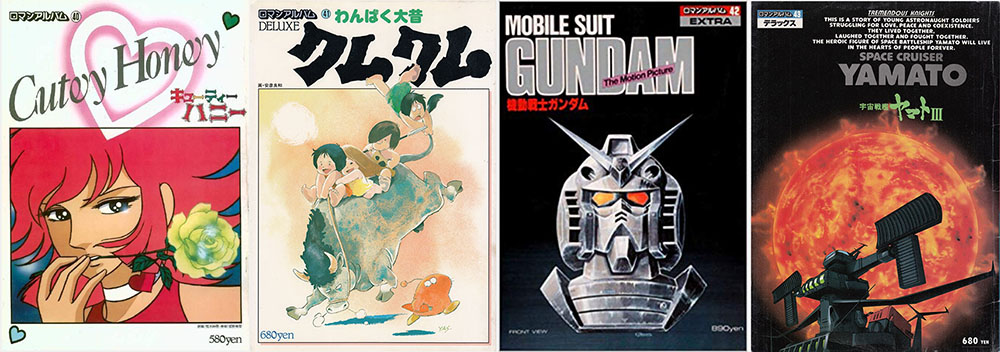
Roman Albums 40-43
And why WERE they called "Roman Albums?" Well, an album, of course, is a collection of text, musical compositions, or images, like a record album or a photo album. The "Roman" part is supposedly shorthand for "Romance Adventure", the "romance" part being used in the literary sense of "a narrative genre that includes a mysterious, adventurous, or spiritual storyline involving bravery and strong values." Tadao Nagahama's Voltes V, Daimos, and Combattler V would similarly be described as a "Robot Romance Trilogy", with only Daimos featuring "romance" in the "boy meets girl" sense. All three of these series would, of course, receive Roman Albums.

Roman Albums 44-47

Roman Albums 48-50

The growing Western interest in anime, and the 1980s comic con/comic shop distribution networks built to sell us comics, model kits, and other fannish merchandise, meant Roman Albums could and did find homes with American anime fans. And sure, you might never see a Horus, Prince Of The Sun or a Getter Robo or a Tekkaman over here, but Be Forever Yamato Roman Album number 36 was seemingly available everywhere to anime fandom circa 1986. Was there a glut of Be Forever Yamato Roman Albums in somebody's Jinbucho warehouse? Did Tokuma Shoten overestimate the Japanese public's demand for this particular symbol of the anime boom's high water mark, and pass the overstock on to a North America suddenly hungry for big-eyed Japanese cartoon characters? Did someone mistakenly add a zero to an overseas shipping invoice? Who knows. BFY RA 36 went from prized to pedestrian fairly quickly as Star Blazers became unfashionable compared to Bubblegum Crisis and other icons of the OVA age. You can still find Roman Albums from Be Forever Yamato and other anime films and TV shows cheap – in Japan. Or perhaps at the occasional anime convention swap meet... if I don't find them first!

-Dave Merrill

Roman Albums 51-54

Roman Albums 55-58

Roman Albums 1-70:
1. Space Battleship Yamato
2. Cyborg 009
3. Rainbow Soldier Robin
4. Devilman
5. Tiger Mask
6. Super Jetter
7. Astro Boy
8. Raideen
9. Mazinger Z
10. Kamui
11. Arrivederci Yamato
12. Bander's Book
13. Tomorrow's Joe
14. Voltes V

Roman Albums 59-62


15. UFO Robo Grandizer
16. Combattler V
17. Eight Man
18. Danguard Ace
19. Heidi
20. Fighting General Daimos
21. Zanbot 3
22. Treasure Island
23. Triton
24. Galaxy Express 999 film
25. Marine Express
26. Adventure Of Gamba
27. Babel II
28. Shotaro Ishinomori Works
29. Daitarn 3
30. Captain Harlock
31. Space Battleship Yamato 2
32. Getter Robo / G
33. Poems Of Baseball Madness: North Wolf South Tiger
34. Hurricane Polimar
35. Mobile Suit Gundam
36. Be Forever Yamato
37. Tekkaman

Roman Albums 63-66
38. Marco Polo
39. Cyborg 009 Legend Of Super Galaxy
40. Cutey Honey
41. Kum Kum
42. Mobile Suit Gundam I
43. Space Battleship Yamato III
44. Mobile Suit Gundam II
45. Adieu Galaxy Express
46. Future Boy Conan
47. Baldios
48. Ideon TV
49. Queen Millenia film
50. Mobile Suit Gundam III
51. A Contract Be Invoked The Ideon
52. My Youth In Arcadia
53. Yamato Perfect Manual 1
54. Yamato Perfect Manual 2
55. God Mars tv/movie
56. Final Yamato
57. Xabungle
58. Minky Momo

Roman Albums 67-70
59. Bryger/Brygar/Braiger 
60. Horus Prince Of The Sun
61. Nausicaa
62. Dunbine
63. Votoms
64. Baxingar
65. Goshogun Etranger
66. Arion
67. SPT Layzner
68. Laputa
69. Totoro
70. Kiki's Delivery Service

Roman Album 43's Special Area


Thanks for reading Let's Anime! If you enjoyed it and want to show your appreciation for what we do here as part of the Mister Kitty Dot Net world, please consider joining our Patreon!


Sunday, September 9, 2018

Anime Weekend Atlanta 2018

23 years ago our forefathers, well, okay, me and a bunch of my pals, we got together and put on a Japanese animation convention in Atlanta. It seemed like people had a good time so we figured we'd keep doing it, and so we did. In less than two weeks we'll be getting together again at the Cobb Galleria Convention Center and the Renaissance Waverly to hold Anime Weekend Atlanta 2018. 

I'm still a part of the show, and that means the last weeks of my summer are spent getting panels in order and sending lots of emails to lots of people to try and get things squared away before the show. The more prep you do, the less stressful the convention is. So what will I be up to at AWA? 


AWA's SUPERHAPPYFUNSELL continues to be a signature event for everyone looking to clean out their closets of unwanted anime stuff, and also for people looking to score deals and fill their own closets, crawlspaces, basements, attics, spare rooms, storage units, and warehouses full of anime stuff that at one point will likely become unwanted and find itself back at the SHFS. 


Friday night I'm bringing back my famous kooky clip show full of short subjects and entertaining nonsense that I like to call Anime Hell. It's a little later in the night and as always it's part of a triple-threat late-night lineup of unauthorized video funtime,  and you shouldn't miss it.


Saturday morning at 10 I'm taking a short trip through the Psychic World Of Go Nagai, at least as represented in movies and TV anime from 1970-1990. Yes, it's "The Devilman Went Down To Georgia!" 


Later Saturday, professional translator Neil Nadelman and myself will be investigating some anime that's fallen out of North American license and really deserves to be rescued! 


Then early Sunday morning I will hop into the time machine and take us all back to 1978 where we'll ask each other the eternal question - was 1978 Anime's Greatest Year? 


If you're reading this blog you probably already have strong opinions on this issue, and I welcome everyone who can get up early enough to make it to this panel. Pajamas are OK.  And that, apart, from wandering the vendor room halls, catching up with old friends, and probably eating too much BBQ, is what I'll be up to this year at AWA!  See you there! 

Sunday, July 29, 2018

cosmic corsairs and galactic railroads

A thousand years from now and forty years after the fact, Americans can finally enjoy Leiji Matsumoto's Toei Animation space-fantasies Space Pirate Captain Harlock and Galaxy Express 999.  Now you at home can join the millions enthralled by anachronistic SF tales of commuter rail between galaxies and/or the pillaging of outer space in a switchblade-equipped space battleship. Once only available through underground fansub or kiddie VHS release, now both series are available on domestic DVD and on streaming video services, with English subtitles. But can modern American audiences enjoy Japanese TV cartoons from decades past - especially cartoons that casually defy category and genre? 


Both series began in early 1977 as simultaneous manga serializations - the Captain Harlock manga, by the way, is now available in English from Seven Seas.  By 1978, in the midst of a Star Wars inspired SF boom, the Leiji-enhanced Yamato sequel Farewell To Space Battleship Yamato: Soldiers Of Love drove film audiences to romantic tears. On television Leiji's touch was evident in Office Academy's Yamato 2, and two Matsumoto-created Toei series SF Saiyuki Starzinger and Danguard Ace displayed his talent for expressive space opera. It was time for Space Pirate Captain Harlock


Decked out in eyepatch and cloak, festooned with Jolly Rogers, Captain Harlock proves clothes make the man. Or the pirate. Harlock defies the corrupt and confused Earth of 2977 A.D. at the helm of the pirate ship Arcadia, the only starship with both faster-than-light drive and delicate filigreed woodworking. When our planet's original leaseholders, the green-skinned vegetable women empire of Mazone, return to take possession in a city-destroying, Von Daniken-style ancient astronaut assault, only Harlock and his forty fellow space pirates can save us all. 

Harlock, the Arcadia, Mayu, Miimay, Tadashi, Kei Yuki, Gen. Kiruta, The President, Yattaran, The Professor, and Mary Ann
Alongside 70s anime classics like Future Boy Conan, Science Ninja Team Gatchaman II, Fighting General Daimos and Daitarn 3, Space Pirate Captain Harlock debuted in March of 1978 and ran 42 episodes Thursdays at 7 on your local TV Asahi affiliate. Staffed by anime all-stars including Chief Director Rin Taro and character designs by the great Kazuo Komatsubara, Harlock would become an instant legend. 


The series opens as the crew of the Arcadia, consisting of teenage rebel girl Kei Yuki, alcoholic Doctor Zero, mystery alien woman Miimay, Yattaran the plamodel-otaku first mate, and other assorted pirates, cats, and birds, are joined by Tadashi Daiba, a hot-headed youth determined to avenge the death of his astronomer father at the hands of the Mazone. Led by the beautiful Queen Lafresia, the Mazone attack Earth via ultra-modern starship invasion and from ancient tombs long hidden in Earth's depths. 

Yet for all its super science and pirate vengeance, the linchpin of Captain Harlock is the little girl Mayu, the orphaned daughter of the Arcadia's designer, Harlock's friend Tochiro Oyama. Harlock must honor his pledge and defend Mayu from both the conniving of Earth's security director General Kiruta and from evil plans of the Mazone, and that means defending Earth itself, not for the lazy wastrels currently infesting it, but for the future Mayu represents. 


Idiosyncratic and expressionistic, Harlock's moody style stems not only from Matsumoto's characters but from Rin Taro's bold directorial hand. Who else would stop the narrative dead to show Harlock moping in his cabin while Miimay, "the woman who gave her life to Harlock", strums her lyre and matches him drink for drink? Rin Taro's melodramatic split-screen cosmo-gun showdowns are illuminated by lightning, and the depths of outer space roil and surge like the ocean. It's a quirky show that one minute gives you the tear-jerking trials of an orphaned child and the next shows masked vigilantes racing through metropolitan streets intent on vaporizing beautiful women. 

The animation visibly struggles with some of the more elaborate outer-space scenarios, but the occasional Rin Taro or Shoken Ikuyo-directed episode comes to life with flashing bursts of movement and creativity. Is there another SF show that would interrupt a tale of interplanetary betrayal and vengeance with a shamisen solo? Matched by Seiji Yokoyama's stirring, breathless orchestral score, the series is unapologetically melodramatic. 

English-language Harlock LP
Like its namesake, Space Pirate Captain Harlock wanders freely through the universe, paying lip service to its story arc but frequently detouring to highlight the backstories of Arcadia's crew or remind us of the treachery inherent in beautiful plant-women. The series reaches a satisfying space-opera climax amidst the wreckage of a gigantic space battle as Queen Lafresia and Harlock duel hand to hand for, you guessed it, the fate of the Earth. 

Harlock and the Arcadia would vanish into space at series' end, but would return in the 1981 film Arcadia Of My Youth, which features a WWII flashback and a contradictory origin story for Harlock. This film would in turn be followed by Arcadia's television sequel, Endless Orbit SSX. Harlock and the Arcadia would also guest-star in another Leiji Matsumoto anime series now available online, the second topic of this column, Galaxy Express 999


Galaxy Express 999 shares Harlock's retro-future motifs, but fundamentally is a different viewing experience - a philosophical science-fiction fairy tale celebrating human life, shot through with surprising amount of melancholy and regret. Thousands of years from now humanity has spread throughout the galaxy, but human nature hasn't changed much. The wealthy are embracing transhumanism and switching to eternal machine bodies that never wear out, while the less fortunate live and die as second-class citizens. 


After his mother is killed by a human-hunting machine man, young Tetsuro Hoshino vows to travel on the Galaxy Express 999 and get his own immortal machine body. That's when he meets the mysterious beauty Maetel, a long-legged vision in black sable who offers Tetsuro what he wants most in the world, an unlimited pass on the 999. What is Maetel's true purpose? Will a machine body bring Tetsuro happiness? The answer lies on the 999. 


Galaxy Express 999's trip began on Fuji TV in the fall of 1978. Under the workmanlike Chief Direction of Nobutaka Nishizawa (Dragon Quest, Silver-Fang Ginga, Mazinger Z) with character setup by the versatile Shingo Araki (Devilman, Glass Mask, Mapletown, Saint Seiya, Rose Of Versailles), Galaxy Express's look is more consistent than Harlock, but at the expense of some of the earlier show's dash and sparkle. Eschewing Harlock's action-adventure milieu, 999 instead embraces its fairy tale ethos with fantastical worlds populated by the bizarre and the homely, the beautiful and the whimsical.

Tomonori "Ideon" Kogawa 999 illustration from "My Anime"

Planets are literally carved in half between technology and primitivism, there are hollow worlds where fat, globular cattle are corralled in mid-air by fat, globular cowboys, we visit a foundry planet where it rains screws and we see a manga library planet stuffed with the works of Leiji Matsumoto, and on every world the melancholy of Tetsuro's loss is referred to again and again, giving the show a unique emotional depth. 

Just as Space Battleship Yamato drew upon previously existing "flying battleship" concepts, Galaxy Express 999 can trace its genesis to Kenji Miyazawa's 1927 novel Night On The Galactic Railroad, a meditative, allegorical tale of children traveling through the stars on a steam train (itself adapted into an anime film with an all-cat cast in 1985). 999 itself is a thoughtful series that asks big questions in between scenes of Tetsuro vaporizing evil machine men with his Cosmo-Gun. As the train whistle-stops its way through the galaxy, planet by planet Tetsuro begins to see the emptiness of a never-ending mechanical life. 

112 episodes later Tetsuro and Maetel arrive at Planet Promecium, the home of the mechanized empire, the planet where eternal machine bodies are handed out to all comers no questions asked. Will Tetsuro abandon his limited life? What secret shame does Maetel hide? Did they really meet Captain Harlock in episode 83? All will be revealed as the 999 reaches its final destination! 

Of course, the 999 never really reaches the end of the line. Fresh from Harlock, Rin Taro would direct a 1979 Toei theatrical version of Galaxy Express. This lushly backgrounded and tightly animated film has remained a classic, and was followed by an equally lush  yet perhaps completely superfluous 1981 sequel, Adieu Galaxy Express 999: Andromeda Terminal


Neither series received a proper contemporaneous English-language North American release. Of coure Quebec went crazy for their own Francophone Harlock, retitled "Albator," while the United States had to make do with a mere 4 episodes of Captain Harlock whimsically dubbed for home video in the early 80s. 

Captain Harlock And The Questionable Typeface Choice

Television producer Harmony Gold's next project after their mid-80s success with Robotech was an edited-together mashup of Harlock and another Matsumoto series, 1981's Queen Millenia, syndicated on American TV with the unwieldy title Captain Harlock And The Queen Of 1000 Years. Harmony Gold would also dub two of the Galaxy Express television specials for worldwide distribution, changing Maetel's name to "Catherine" in the process. 


Both Space Pirate Captain Harlock and Galaxy Express 999 also aired on American television in the 1970s and 1980s as subtitled programs seen on various Japanese-language UHF and cable TV stations, that is until Fuji-TV noticed and pulled the plug.

 
old-school broadcast TV subtitles

Of course, here in the 21st century the availability of television programs is vastly improved, and you can look at Captain Harlock and Galaxy Express for proof. Both shows can be streamed on your PC or media device from Crunchyroll or Tubi TV, and they both received DVD releases, Harlock in a handsome 2013 set from the fine people at Discotek Media, and Galaxy Express the previous year in a not-so-handsome set from bargain-bin licencors S'More Entertainment. 

DVDs of both series for your DVD watching entertainment

Though domestically unavailable for years, the influence of both Galaxy Express and Captain Harlock as old-school figureheads was always felt in American otaku circles, from the ubiquitous Harlock cosplayers seen at anime conventions from California to Baltimore, mistakenly licensed Malibu comic book reimaginings of Harlock, Viz's 1990s release of the rebooted Galaxy Express 999 manga, and of course the inevitable Japanese remakes and re-imaginings of both series produced by an idea-hungry anime industry. Revisiting the originals, we may find the 1970s animation a little ragged, the scripts maybe a little bare-facedly melodramatic or philosophical; and yet Captain Harlock and Galaxy Express 999 may turn out to be worth waiting decades for. It's easier than ever for us in the West to enjoy these series, and I hope you all give them a chance on your device of choice. 

to be continued, somewhere in the sea of stars....

If you're curious to find out what classic anime streaming options are out there for you, I encourage you to check out the handy list provided by the Anime Nostalgia Tumblr!

-Dave Merrill

(an earlier version of this article appeared in the June 2009 issue of Otaku USA.) 

Thanks for reading Let's Anime! If you enjoyed it and want to show your appreciation for what we do here as part of the Mister Kitty Dot Net world, please consider joining our Patreon!