Sunday, July 25, 2010

F IS FOR FAKE

Okay, I guess "fake" is too strong a word. In fact I don't want to even call these "bootlegs" because honestly, they don't represent knockoffs of already established product. But there's a degree of copywrong in the provenance of these pieces that speaks volumes about the desire for Japanese anime characters, as well as the casual disregard for intellectual property that has been the hallmark of Japanese animation's impact outside Japan.


If it's the 1980s, kids are crazy for robots, even in the form of cheap, tiny coloring books meant to be handed out as door prizes or favors at birthday parties, perhaps at Showbiz Pizza. And just think, that cheap coloring book you threw away because you were 8 and had no idea of the dramatic struggle of White Base to survive the Zeon onslaught was actually pirating artwork from a famous Japanese anime series! Let's look inside.


In spite of the Gundam cover, the characters inside are from Star Musketeer Bismark. Because... they couldn't find art to trace of Char or Amuro? Somebody really liked Marianne Louvre? Who knows? All I know is now I need something to put my crayons in.


Luckily this soft vinyl-covered pencil case will do the trick! And hey, it's not going to bother with your typical RX-78 Gundam, but instead chose to decorate itself with a weird approximation of what appears to be a RMS-179/RGM-79R GM II, the Earth Federation's mass production mobile suit from Zeta Gundam. I guess my pencils feel kind of safe, sort of.


The Gundam theme continues on the back with a fairly accurate GunCannon and hey, from a completely different series produced by a completely different studio, it's a Cyclone from Tatsunoko's Genesis Climber Mospeada! Because when you're using unauthorized artwork sometimes you just have to go a little crazy.

So let's take a break from all this pen and paper stuff and play some cheap plastic hand-held pinball. Surely this inexpensive dollar store party favor type game won't feature appopriated character art!


Oh wait. That's a soccer-playing Sailor Mercury going for the gold, isn't it?


Yup, it sure is, her Mercury Healing Tiara contrasting nicely with her striped soccer jersey. I suppose there was a time in the 1990s when it was thought you could sell anything with Sailor Moon characters. On the other hand, I did actually buy this thing, so I guess their plan succeeded.

Speaking of satisfying toy play value, it's hard to beat cheap Taiwanese knockoff robots for some good robot toy "fun".


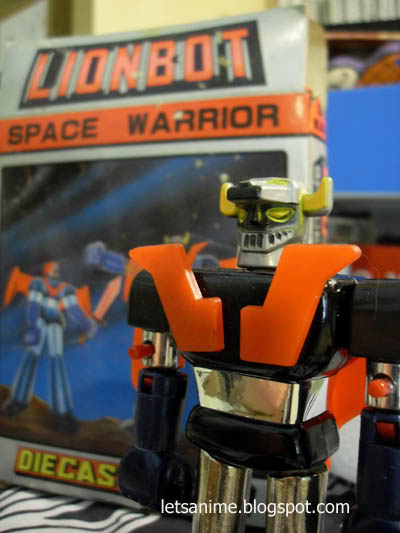
Combining the classical looks of Mazinger Z with the trendy lion motif of Voltron, the "Lionbot" stands ready to defend himself against all the copyright lawyers in the galaxy!


This box art was apparently copied right off the side of THE GREATEST AIRBRUSHED CUSTOM VAN EVER. The other robot isn't a Lionbot, but Tiger Mask captured in a rare moment cosplaying as Great Mazinger.

So just let your feelings about intellectual property and quality childrens toys retreat into the background. Unless you want Lionbot to open you up a clumsily-painted, badly-cast, frosty cold can of BEAT-DOWN!


Sunday, July 11, 2010

the golden age of scanlations


Once upon a time there were people who loved Japanese comics SO MUCH that they would, on their own recognizance, take the original Japanese comics and translate them into English! All by themselves! And then they’d distribute these translations to the world at large, unconcerned with things like “copyright” or “trademark” or “intellectual property”. Of course this whole business has generated a lot of press lately because of the amazing ability of the vast computer networks that surround us all to transmit and distribute information faster than human minds can even conceive. And to think the doomsayers and pessimists always assumed the assault on mankind would begin with killer robots and death rays!

This may astonish today's computer-enabled youth, but scanlations existed long before cheap terabyte drives and broadband connections. In fact these stone-age “scanlations” didn’t need computers at all!


This advertisement appeared in the BOOKS NIPPAN ANIMATION FAN CLUB NEWSLETTER (vol 4) from sometime in 1985. Is this the first attempt at wide distribution of a possibly unauthorized translation of Japanese manga? Could be. Translator and Gunbuster star Toren Smith was always ahead of the curve; he went on to build a career out of authorized, licensed Japanese comics through his Studio Proteus organization.


(alternate Art Frahm cover available upon request)

The prototype scanlation seen here appeared as a companion booklet to the official Shogakukan release of Urusei Yatsura volume 1. You’d simply hold the UY manga – purchased through Books Nippan, of course - in one hand and the translation booklet in the other, and through a complicated mental process not fully understood by our top scientists, the meaning of the Urusei Yatsura story will become clear to you.


One wonders just how popular this particular marketing plan was; Viz would begin publishing officially-licensed Urusei Yatsura in English in a few years. Shogakukan had already released several volumes of Urusei Yatsura in a dual-language format as an English-language teaching aid. Or as a Japanese-language teaching aid, these things swing both ways (these handsome sepia-tone tankubon were also produced for other series, including Sasuga No Sarutobi).


Rather than a strictly commercial product, these 80s UY scanlations were a more upscale form of the ‘translation packets’ being distributed by various fan organizations throughout the 80s. Anything that would fit onto photocopier glass was Xeroxed like crazy – song translations, possibly inaccurate episode guides, character sheets, articles from trade publications – if it was about anime it got distributed, copyright and original intent of the author be damned. It is with this blithe disregard for intellectual property that anime fandom first established itself upon our shores, a mark of Cain that all must bear in shame and/or glory. Of course, the way I figure it, anime fans spent 20 years producing and distributing pro bono advertising for Bandai, so it all evens out in the end.


-Dave Merrill

Thanks for reading Let's Anime! If you enjoyed it and want to show your appreciation for what we do here as part of the Mister Kitty Dot Org world, please consider joining our Patreon!

Sunday, June 20, 2010

NAUGHTY AND ANCIENT

KUM KUM THE PREHISTORIC MENACE


I’d seen stills from this show and some of Yas’ typically excellent artwork here and there for years, but I’d never thought it was anything more than some illustrations, maybe a children’s book or two. I certainly didn’t think it was a Nippon Sunrise series produced in 1975 that ran for 26 episodes, and was not only a success in most of Europe, but was dubbed into English by Paramount and became an integral part of the TV childhoods of kids in Australia and England. America, however, was bereft of KUM KUM. We had to satisfy our prehistoric desires with LAND OF THE LOST and KORG, 70,000 BC and VALLEY OF THE DINOSAURS and CAPTAIN CAVEMAN. Okay, that last one, not so much.


WANPAKU (“naughty”) OMUKASHI (“ancient”) KUM KUM is a fun little series, a prehistoric children’s adventure show that freely mixes comedy, action, myths and facts but remains firmly grounded in the day to day lives of the Mountain Folk, a tribal people just on the cusp of civilization. Kum Kum lives while mankind transitions from being hunter-gathering wanderers to becoming a agricultural, settled, animal-domesticating language-developing society. The Mountain Folk have learned to plow and plant, but still do a lot of gathering.


The Wise One has writing, but only he can read it. Occasional travelers demonstrate things like wheels, wagons, and war; but the Mountain Folk still make do with hunting and fishing. A rudimentary religion is demonstrated by Dark Eyes, the resident fortune-teller and soothsayer, who also demonstrates that this level of civilization possesses sophisticated hairpiece technology.


Our hero Kum Kum isn’t a BAD kid, just curious, mischievous, impulsive, sometimes unthinking, occasionally vindictive. Sure, those ingredients sometimes add up to “bad”, but when he crosses the line, the Wood Cave is always waiting. That’s where we find Kum Kum when the show opens, waiting out yet another stretch of hard time as a result of yet another prehistoric escapade.


Kum Kum’s world is a fun place to be a kid; plenty of forests and mountains to roam through, animals to chase, fish to catch, and friends to tease. Kum Kum’s gang – Butterfly (Chiru Chiru) , Little Rock (Aaron), and Bumbles (Mochi Mochi) run roughshod through the little Mountain Folk tribe, causing no end of headaches to Kum Kum’s dad Strongarm ((Paru-Paru), mom Flora (Malu-Malu), toddler brother Tum Tum and teenage sister Wildflower (Furu). Wildflower is smitten with the Wise One’s son Roman who lives up to his name by roaming far and wide across the unknown prehistoric landscape. Roman roams because his home life is mostly occupied by arguing with his hairy, pipe-smoking father, whose original Japanese name is “Kuropedia.” In spite of courtship attempts made by Little Rock’s enormous, slightly slow brother Jumbo (Goron) and Roman’s temptation to join the Nomad tribe and marry Rose, - not to mention opposition from both Strongarm and the Wise One - true love triumphs and Wildflower and Roman are (SPOILER!) married in the final episode.


Just a few things keep KUM KUM from being an animated, archeologically approved version of one of those natural history museum dioramas; one is the dinosaur that lives in the lake, and the other are the Cheeky-Squeakies.

Saurus is the dinosaur; this old and amiable Apatosaurus is possibly the last surviving dinosaur. He’s happy to chew his cud in the lake and occasionally act as a giant playmate for the children. Sure, we all know that dinosaurs and human beings were separated by a few million years, but here at KUM KUM scientific rigor takes a back seat to cartoon fun.


However, the Cheeky-Squeakies (“Pyonki” in Japanese) have no analog in the fossil record. These bouncy, big-eyed little mascots hop all over the countryside and give the children something to chase in idle moments. Occasionally they catch some, harness them up, and go skiing over the tall grass. We learn in a very special episode that the Cheeky-Squeakies are vastly older than man, have a language and a culture, and occasionally go to war with each other underground in ritualized combat that recalls the classic Uncle Scrooge story “The Land Beneath The Ground”, though unlike the struggle between the Terries and the Fermies, the Cheeky-Squeaky war does not cause earthquakes.

It’s pretty clear that this prehistoric land is supposed to be Japan. We’re treated to establishing shots of blossoming cherry trees, the volcanic nature of the land is remarked upon in several episodes, and we even get to see monkeys enjoying hot springs and an instance of the Japanese folk belief that fish can predict earthquakes. But the question of whether or not Kum Kum's people represent the Jomon culture will have to be answered by more knowledgeable archeologists.


The English language dub firmly presents Bumbles as a male, but I’m not convinced that Mochi Mochi isn’t a girl, a gangly, Big Ethel sort of gal. The female Japanese voice actress and the hair bow may be circumstantial evidence, but it wouldn’t be the first time a character’s gender was switched in the localization. The English voice is a hoarse goofball intonation that could go either way. And let’s face it, these are six and seven year old kids, gender is pretty much academic at this point. (editors note: recent footage screened here at the HQ proves conclusively that Bumbles is a cave-boy)

Kum Kum makes an appearance on an all-Yas character poster


KUM KUM carves its own niche between the One Million BC melodrama of Ishinomori’s ’71 Toei anime RYU THE PRIMITIVE BOY and the 1974 TMS caveman gag comedy GIATRUS THE FIRST MAN- the laughs and life lessons are parceled out in equal doses. Kum Kum’s bad behavior has consequences beyond the Wood Cave and frequently the tribe is forced to struggle for their very survival against the elements, destructive animals, or even other tribes. Parents and children fight and things don’t always wrap up neatly before the end credits. Kum Kum – and by extension the young viewing audience - are forced to come to terms with rather adult concepts like, you know, death. But the Mountain Folk’s life isn’t particulary nasty, brutish, or short – sure, there’s hard work and primitive conditions, but there are also strong family and community bonds, festivals, friends, dinosaurs, and a whole world full of wonders without any schools or homework. It’s no wonder this show was appealing to an entire generation of kids around the world, including the relatives of Argentine footballer Sergio Aguero, who thought the young future soccer star resembled Kum Kum and dubbed him a mispronounced “El Kun.”

(I now pronounce you caveman and cavewife)

KUM KUM was produced by Banjiro Uemera, who would later produce the fine Star Wars ripoff MESSAGE FROM SPACE. In his capacity as head of ITC Japan, he was responsible for 1982’s sf actioner TECHNOVOYAGER, otherwise known as THUNDERBIRDS 2086. He also produced the When Animals Attack film ROAR, starring Tippi Hedren and her animal friends (and daughter Melanie Griffith). Interestingly enough the show is an early directorial attempt by Rin “Shigeyuki Hayashi” Taro, who would go on to work for Toei and direct SPACE PIRATE CAPTAIN HARLOCK, the two GALAXY EXPRESS MOVIES, and from there to direct HARMAGEDDON, DAGGER OF KAMUI, METROPOLIS, X, DOOMED MEGALOPOLIS, PHOENIX, and other anime works. But the primary creator behind KUM KUM is obvious from even the most casual glance; the distinctive art style of Yoshikazu “Yas.” Yasuhiko. Yas.’ CV includes MOBILE SUIT GUNDAM, BRAVE RAIDEEN, DIRTY PAIR, VENUS WARS, ARION, GIANT GORG – Yasuhiko’s classy linework and graceful characters are an unmistakable hallmark of the classic era of Japanese animation. KUM KUM’s Yas. character designs are front and center; Kum Kum and his pals wouldn’t be out of place roaming the corridors of White Base as refugees from Side Whatever, and the flowing robes, bearded giants, and vital natural landscape would return in works as diverse as GORG and ARION.


What makes KUM KUM so fascinating, for me anyway, is that I’m a guy who spends way too much time thinking about Japanese cartoons (obviously). Have been this way for years. And yet here’s a show with a pretty impressive pedigree (Yas, Rin Taro) that not only had I never heard of, but that had been dubbed into English and shown around the world, to boot! It just goes to show, the more you know, the more you realize there’s yet to learn.

(no-pants cave kids)

Why did KUM KUM never make the transition to American television? One reason leaps to mind: prehistoric children don’t wear pants. So the next time you’re thinking darkly of American exceptionalism, remember that sometimes Uncle Sam is, like Kum Kum, still trapped in the dark of the Wood Cave, waiting to be set free.

(bye bye Kum Kum!)

-Dave Merrill

Thanks for reading Let's Anime! If you enjoyed it and want to show your appreciation for what we do here as part of the Mister Kitty Dot Org world, please consider joining our Patreon!

Monday, June 7, 2010

badge of honor

At Anime North a few weeks ago my wife spotted something groovy in the dealers room. No, not glomping crossdressing furry cosplayers – but something that was actually related to Japanese cartoons! Namely, a set of buttons from Albator.


 You know, Albator! The French language version of Toei’s 1978 Captain Harlock series, broadcast to the Francophone world in the late 1970s. Albator, whose name was changed from “Captain Harlock” because, as the story goes, the French localizers were afraid children would confuse the character with “Captain Haddock” from the popular Belgian comic Tintin. Because the characters are so much alike! There isn't a similar story to explain why every other character in Captain Harlock got his or her name changed, nor why all the music was thrown out in favor of vastly inferior replacements.


At any rate the buttons are pretty cool. Not just because Tadashi Daiba – sorry, “Ramis” - is clearly missing an eye, or the general sloppy fan art vibe of the artwork, but mostly for the 70s era CBC logo plastered onto the images. Albator was broadcast on the French-language CBC – sorry, “Radio-Canada Television”- starting in 1979, and along with other French-language anime hits like Goldorak, Candy Candy, and Le Roi Leo, gave the Francophone Canadian anime fan a distinct advantage over the Anglophone Canucks, who were forced to make do with Star Blazers and Force Five on Buffalo UHF stations.


You might notice that one of these characters is not like the others. Sure, Captain Future, the '78 Toei series based on the pulp series by Edmond Hamilton, was popular in Europe, where he was known as "Capitane Flam". However, how a button of Captain Future’s girlfriend “beautiful Joan Randall” wound up with some Albator badges is anybody’s guess. You know those Japanese cartoons, they all look the same. And the character's slight name change only proves the Electric Company's hypothesis that a Joan can become a “Johan” merely by adding our good friend “silent h”.

Tuesday, May 18, 2010

WHY NO REVIVAL??

It's May here at Let's Anime and that means that my important anime-blogging time is taken up with different, more urgent pursuits... namely, Anime North, Canada's number-one Japanese cartoon festival.

This year I, along with Ninjatron of AstroBoyWorld, will be hosting a Classic Anime panel on Sunday at 2pm that promises to be filled with clips of old Japanese cartoons, expounded upon at length by myself and Ninjatron. We promise to answer every question you may have about Japanese animation from the 60s, 70s and 80s, and who knows, we might not even have to make stuff up.

But before Sunday comes Friday and Saturday, and Friday night I'll be MC'ing JAPANESE ANIME HELL, the amazing two-hour collection of wonder, trash, goof, and WTF that has entertained audiences in two nations.


After HELL, you'll witness the Canadian premiere of THE OZONE COMMANDOS - the wild Corn Pone Flicks extravanganza starring nerds dressed as Japanese cartoon characters piloting their Death Blimp against a super-scientific hovering SF convention. And if you still have eyes to see and ears to hear, you'll be treated to Corn Pone Flicks' seminal 90s documentary BAD AMERICAN DUBBING.

Saturday night, interested parties may enjoy Neil Nadelman's presentation of TOTALLY LAME ANIME, where he whips up a frenzied cornucopia of terrible cartoons and inept animation for everybody to laugh at.


All these amazing events are, of course, FREE with your paid admission to Anime North, where you can also enjoy guests, videos, panels, wrestling, dealers, bands, costumers, and all the other accoutrements of the modern animation festival. It all happens May 28-30 - don't miss it!!

So basically it's an entire weekend of Japanese cartoon fun that you can't afford to miss. See you there! Your regularly scheduled Let's Anime posts will resume shortly thereafter.

Saturday, April 24, 2010

macross at the mall

Was there a better place for mid-80s teens to kill time than the mall? Sources say "no". And in the maze of shops and stores that made up the malls of the mid to late 20th century, one business attracted the teen like moths to a flame- video game arcades. When you ran out of quarters, however, where did you go to hang out? Spencer's Gifts, of course. Spencer's - since 1947 home to blacklight posters, naughty greeting cards, gag gifts, mood lighting, and a wide array of novelties, collectibles, and beer-related merchandise. But what's that lurking next to "The Fart Joke Book" and "101 Uses For A Dead Cat"? Toys from Super Dimensional Fortress Macross, that's what.


As I recall this 4-set of Macross toys was something like twelve dollars, which was a lot of money for me at the time, a time when all my cash came from hot, sweaty, backbreaking labor mowing lawns. This was my first exposure to the anime legend Macross, other than seeing ads for that Harmony Gold Macross VHS in magazines - and its MSRP was WAY beyond my budget. Robotech? Still years in the future. Your only hope for modern anime mecha action was the toys, finding their way across the Pacific and into the hobby shops and toy stores of the nation.


The toys in this Takatoku Macross 4 Part II set are a curious amalgam of 'bath toy' and 'action figure' - if they were made of slightly softer vinyl they'd be able to squeak when squeezed, but the detailing and colors are a step above your standard rubber ducky. At 5" tall they are big enough to stand against your medium-sized Shogun Warriors but dwarfed by your Jumbo Machinders, and they're sturdy enough to be hurled across the room by your rambunctious cousins. What really made this an artifact seething with universe-expanding revelations? The packaging.


If you're used to the cheap production art on any American toy of the period, the detail and craftsmanship of the Macross paintings on this box top are something special. This artwork tells us that whatever the hell Macross was, it was carefully planned by people with vision and talent, who knew of the deep desires of prepubescent boys to immerse themselves in worlds of detailed, high-tech fighting machines. Yes yes, now we know Studio Nue was responsible, but such knowledge was hidden from us in 1984. This literally was a window into another world, a world of animation not aimed at the lowest common denominator, a world where even Armored Valkyries could have cheesecake nose-art painted on their legs.


Decades later the American entertainment industry would appreciate the visual appeal of the Japanese logotypes and leave them as-is when localizing anime and anime products - but the art on this Macross toy set was unretouched for economic, not aesthetic reasons. Why create new line art when the Japanese packaging has English written all over it?


In a few years I learned what a "Tactical Pod Glaug" really was and why Minmay sounded better singing in Japanese, and I came to enjoy Macross in all its myriad forms. But in 1984, for me the "Macross Summer" was represented solely by a well-packaged set of toys found in a corner of the local mall.


-Dave Merrill

Thanks for reading Let's Anime! If you enjoyed it and want to show your appreciation for what we do here as part of the Mister Kitty Dot Net world, please consider joining our Patreon!


Thursday, April 8, 2010

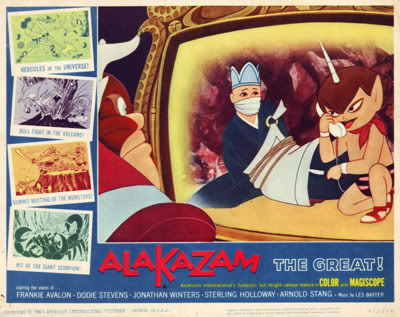
Tezuka Trash Palace Tomorrow - Alakazam!


Tomorrow night the Trash Palace will play host to a Toronto Tezuka thrill trip as the '61 color classic explodes across the big screen in glorious 16mm! And the only question is: ARE YOU GONNA BE THERE, THERE BEING THE LOCATION OF THE LOVE-IN? Doors open at 8:30, movie starts at 9:30, 9:45 is when the long-haired rock dude shows up with his current trophy girlfriend to huff disgustedly at the lack of seating. Torontonians are welcome to drop by our secret Toy Factory lair and we'll get noodles or something before we walk the 4 blocks to the secret Trash Palace location - make sure to ditch work early to pick up your tix at Eyesore! Cash only.